Best insurance plans for pain management coverage in NJ

Medically reviewed by
Dr. Saurabh Dang, MD, MBA

Choosing between Medicare, NJ Medicaid, and commercial carriers like Aetna, Cigna, UnitedHealthcare, Anthem BCBS, AmeriHealth, and Oxford Health Plans changes how fast you get an epidural injection, nerve block, or spinal cord stimulator trial approved in Bergen, Passaic, or Middlesex County in 2026.
TL;DR
- For most working-age NJ patients, an employer PPO tier from Aetna, Cigna, UnitedHealthcare or Anthem BCBS gives the most direct path to a pain specialist without a referral.
- Medicare Part B covers medically necessary interventional pain procedures with a standard 20% coinsurance after the annual deductible is met.
- NJ Medicaid (NJ FamilyCare) removes the cost barrier for income-qualified residents but usually routes through a managed care organization first.
- Every carrier requires prior authorization for procedures like RFA, facet injections, and spinal cord stimulator trials — start that process before you pick a date.
- The best insurance plan for pain management coverage in NJ in 2026 depends more on your plan tier (PPO vs. HMO) than on which logo is on the card.
Why this matters
Interventional pain procedures — epidural steroid injections, radiofrequency ablation, nerve blocks, spinal cord stimulation — get denied or delayed for one reason more than any other: paperwork, not medicine. Getting insurance approval for pain procedures usually takes longer than the procedure itself, and the plan you’re enrolled in decides how many hoops you clear first.
Patients in Englewood, Woodland Park, and Edison show up with every major NJ carrier and both federal programs. The differences between them aren’t about whether pain treatment is covered — it’s about referral rules, prior authorization speed, and network size.
What makes the best insurance coverage for pain management in NJ
- Referral rules — PPO tiers let you see a specialist directly; HMO tiers require a primary care referral first.
- Network size — how many in-network interventional pain specialists exist in North and Central Jersey.
- Prior authorization speed — how fast the carrier approves epidural injections, RFA, or SCS trials.
- Out-of-network reimbursement — what you’re on the hook for if your specialist is out-of-network.
- Procedure coverage scope — whether newer options like spinal cord stimulation trials are covered on the same terms as basic injections.
- Cost exposure — deductible, coinsurance, and copay structure before coverage kicks in.
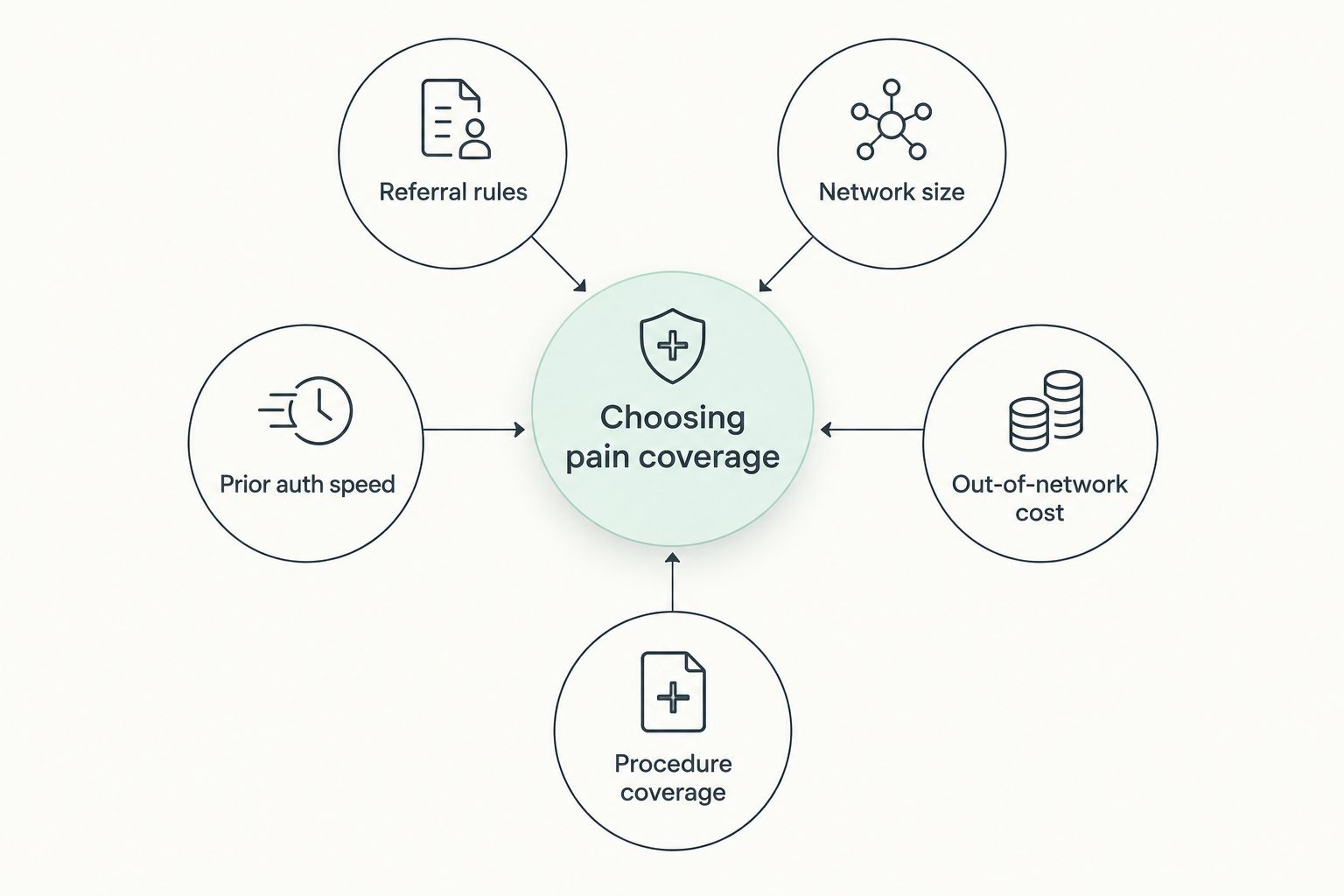
Referral rules and prior authorization speed usually matter more than which name is on the card.
Pain management insurance options in NJ at a glance
| Plan/Program | Best for | Standout feature | Key limitation |
|---|---|---|---|
| Medicare | Patients 65+ with degenerative pain | Nationwide, documented approval criteria | 20% coinsurance after Part B deductible |
| NJ Medicaid (NJ FamilyCare) | Income-qualified NJ residents | Low-cost access to medically necessary care | Managed care enrollment step first |
| Aetna | PPO members wanting no-referral access | Broad NJ specialist network | HMO tiers still require referrals |
| Cigna | Employer PPO plans needing flexibility | Out-of-network reimbursement option | Higher deductibles on some tiers |
| UnitedHealthcare | Employer PPO/POS plans | Documented epidural injection coverage pathway | Step therapy required on some plans |
| Anthem BCBS | Employer groups of any size | PPO and HMO product lines statewide | HMO tiers need a PCP referral |
| AmeriHealth | NJ small-group and marketplace plans | Regional strength in North/Central Jersey | Smaller out-of-state network |
| Oxford Health Plans | NJ/NY tri-state commuters | Strong tri-state referral network | Concentrated coverage area only |
1. Medicare: best for patients 65+ with degenerative pain
Medicare Part B covers medically necessary interventional pain procedures — epidural injections, facet joint injections, radiofrequency ablation — for enrollees who meet Local Coverage Determination criteria. It’s the most predictable federal program for patients aging into chronic spine, joint, or nerve pain.
Medicare pros:
- Nationwide acceptance with well-documented medical necessity criteria
- Covers the core interventional procedure list: injections, RFA, SCS trials
- No employer or income eligibility hoops for enrollees
Medicare cons:
- Standard 20% coinsurance applies after the annual Part B deductible unless you carry supplemental coverage
- Medicare Advantage plans layer additional prior authorization steps on top of base Medicare rules
Best for: patients 65 and older, or those qualifying via disability, with chronic spine, joint, or nerve pain. Verdict: solid fit for pain management options covered by Medicare — confirm supplemental coverage before scheduling.
2. NJ Medicaid (NJ FamilyCare): best for low-income NJ residents
NJ FamilyCare covers medically necessary pain management services for income-qualified residents across Bergen, Passaic, and Middlesex counties. Coverage runs through a managed care organization rather than fee-for-service in most cases.
NJ Medicaid pros:
- Low or no-cost access for eligible residents
- Covers a documented range of interventional procedures
- Opens treatment access for patients without employer coverage
NJ Medicaid cons:
- Enrollment through a managed care organization adds a step before scheduling
- Prior authorization and referral requirements can slow the timeline
- Not every NJ interventional pain practice accepts every FamilyCare plan
Best for: NJ residents who qualify by income and lack employer-sponsored insurance. Verdict: worth confirming eligibility — see does Medicaid cover pain management treatment in NJ before you assume you’re covered.
3. Aetna: best for no-referral specialist access
Aetna’s PPO tiers cover a broad network of interventional pain specialists across North and Central Jersey without requiring a primary care referral.
Aetna pros:
- Direct specialist access on most PPO tiers
- Established prior authorization pathway for image-guided injections
- Wide NJ network coverage
Aetna cons:
- HMO tiers under the same Aetna umbrella do require referrals
- Prior authorization timelines vary by employer group
Best for: patients on an employer PPO plan who want to book a specialist without a referral detour. Verdict: strong option for self-directed care — verify your specific plan tier first.
4. Cigna: best for employer PPO flexibility
Cigna’s employer-sponsored PPO plans offer out-of-network reimbursement, which matters if your preferred pain specialist sits outside the immediate network.
Cigna pros:
- Out-of-network reimbursement built into most PPO tiers
- Established prior authorization pathway for nerve blocks and facet injections
- Multi-state acceptance for patients splitting time outside NJ
Cigna cons:
- Out-of-network reimbursement rates depend on the specific plan design
- Some tiers carry higher deductibles before interventional coverage applies
Best for: employees who want flexibility to see a specialist outside the core network. Verdict: good for flexibility-focused patients — check your deductible status before booking.
5. UnitedHealthcare: best for documented epidural injection coverage
UnitedHealthcare’s PPO and POS plans list a documented coverage pathway for epidural steroid injections, one of the most common interventional pain procedures.
UnitedHealthcare pros:
- Large national network with NJ interventional pain specialists in-network
- Documented approval pathway referenced in does UnitedHealthcare cover epidural steroid injections
- Digital prior authorization tools on newer plans
UnitedHealthcare cons:
- HMO and EPO tiers restrict out-of-network coverage entirely
- Some plans require conservative care first (step therapy) before approving injections
Best for: patients whose employer offers a UnitedHealthcare PPO or POS plan. Verdict: reliable when the plan covers epidural injections directly — confirm step-therapy rules first.
6. Anthem BCBS: best for employer groups of any size
Anthem BCBS runs both PPO and HMO product lines across NJ, which makes it common among employer groups from small businesses to large corporations.
Anthem BCBS pros:
- Statewide network reach
- Documented medical necessity criteria for interventional procedures
- Multiple plan tiers for different employer group sizes
Anthem BCBS cons:
- HMO tiers require a primary care referral before seeing a pain specialist
- Prior authorization requirements differ between fully insured and self-funded plans
Best for: NJ employer groups offering a Blue Cross Blue Shield PPO or HMO tier. Verdict: workable for most groups — HMO members need the referral lined up first.
7. AmeriHealth: best for NJ small-group and marketplace plans
AmeriHealth’s regional network strength in North and Central Jersey makes it a common carrier for ACA marketplace enrollees and small-business employees.
AmeriHealth pros:
- Regional network strength close to Englewood, Woodland Park, and Edison
- Established prior authorization process for outpatient interventional procedures
AmeriHealth cons:
- Smaller out-of-state network than the national carriers
- Marketplace tier plans carry higher deductibles before interventional coverage applies
Best for: NJ small-business employees or ACA marketplace enrollees. Verdict: fine choice for NJ-based coverage — confirm your tier’s deductible before booking.
8. Oxford Health Plans: best for NJ/NY tri-state commuters
Oxford’s POS and HMO plans concentrate their network strength in the NJ/NY tri-state corridor, which fits patients who work across the state line.
Oxford pros:
- Strong tri-state network for POS and HMO plans
- Predictable referral structure for patients commuting into New York
Oxford cons:
- POS plans without a referral pay a higher out-of-network share
- HMO tiers require a primary care referral to see a pain specialist
Best for: NJ residents who commute to or work in New York. Verdict: solid pick for tri-state commuters — get the referral lined up before scheduling.
How this list was put together
These eight options are grouped by the five criteria above — referral rules, network size, prior authorization speed, out-of-network cost, and procedure coverage scope — not by a numeric score, since actual approval always comes down to your specific employer plan and policy number. Confirm details directly with the carrier before assuming coverage.
Confirm your coverage before you book
Verify insurance benefits ahead of your first visit in 2026.
Which insurance plan should you choose?
If you’re working-age with an employer PPO plan, Aetna, Cigna, UnitedHealthcare, or Anthem BCBS PPO tiers give you the most direct path to a pain specialist without a referral detour. If you’re 65 or older, Medicare handles the core interventional procedure list under Part B. If you qualify by income, NJ FamilyCare Medicaid removes the cost barrier but adds a managed-care enrollment step. Whichever plan you carry in 2026, get prior authorization moving before you pick a procedure date — that’s the step that actually determines your timeline.
FAQ
What is the best insurance for pain management coverage in NJ?
There’s no single best plan — an employer PPO from Aetna, Cigna, UnitedHealthcare, or Anthem BCBS gives the most direct specialist access, Medicare covers the core procedure list for patients 65+, and NJ FamilyCare Medicaid removes cost barriers for income-qualified residents.
Does Medicare cover epidural steroid injections in NJ?
Yes, Medicare Part B covers medically necessary epidural steroid injections, with a standard 20% coinsurance after the annual Part B deductible is met.
Does NJ Medicaid (NJ FamilyCare) cover pain management treatment?
NJ FamilyCare covers medically necessary interventional pain procedures for income-qualified residents, usually routed through a managed care organization.
Do I need a referral to see a pain management specialist in NJ?
It depends on your plan tier: PPO plans generally allow direct specialist access, while HMO tiers from carriers like Anthem BCBS, Aetna, or Oxford require a primary care referral first.
Does insurance cover radiofrequency ablation (RFA) in NJ?
Most major NJ carriers and Medicare cover RFA when medical necessity criteria are met, but prior authorization is required before scheduling in nearly every case.
What if I don’t have insurance for pain management treatment?
Self-pay costs vary by procedure and location; check the breakdown of what pain management procedures cost without insurance before scheduling.
Does UnitedHealthcare cover epidural steroid injections?
UnitedHealthcare has a documented coverage pathway for epidural steroid injections on most PPO and POS plans, though some plans require conservative care first.
How long does prior authorization take for a pain procedure in NJ?
Timelines vary by carrier and plan tier — starting the authorization process as soon as a procedure is recommended, rather than after scheduling, avoids the most common delay.
One last thing
The carrier logo on your card matters less than the plan tier underneath it — an HMO tier from a “good” insurer still requires the same referral as an HMO tier from anywhere else. Check your plan tier, not just the brand name, before you assume how fast you’ll get in.
Related guides
- Does UnitedHealthcare cover epidural steroid injections in NJ
- How much do pain management procedures cost without insurance
About the Medical Reviewer
Dr. Saurabh Dang is a double board-certified interventional pain management specialist serving Central and Northern New Jersey. He combines clinical expertise with a patient-centered approach to help patients find lasting relief from chronic pain conditions.
Read Full Bio →Seeking Treatment for Epidural Injections?
Dr. Dang and the team at Hudson Pain and Spine offer specialized care and advanced interventional treatments.
Ready to Find Relief from Pain?
Schedule your consultation with Dr. Saurabh Dang at our Englewood office.
Serving patients across Central and Northern New Jersey — Bergen, Passaic, and Middlesex counties.