Best treatments for a herniated disc, surgical and non-surgical

Medically reviewed by
Dr. Saurabh Dang, MD, MBA

A herniated disc doesn’t have one fix — the right treatment depends on how long you’ve had symptoms, whether the pain radiates down an arm or leg, and whether there’s measurable nerve weakness on exam. Best overall: physical therapy and activity modification for new, mild cases. Best for confirmed nerve root pain: epidural steroid injection. Best for a fragment causing progressive weakness: microdiscectomy. Each option below gets a distinct use case, so you can match your situation to the right first move instead of guessing.
TL;DR
- The best treatments for a herniated disc in 2026 range from physical therapy to microdiscectomy, matched to symptom severity, not preference.
- Most herniated discs improve without surgery within 6 weeks of conservative care and monitoring.
- Epidural steroid injections are the standard next step when leg or arm pain from a herniated disc doesn’t respond to physical therapy.
- Surgery is reserved for progressive weakness, unrelenting pain, or a disc fragment that imaging confirms is compressing a nerve root.
- Spinal cord stimulation is a later-stage option for pain that persists after disc surgery, not a first-line herniated disc treatment.
Why this matters
Most people search “best treatments for a herniated disc” after an MRI report uses words like “bulge,” “protrusion,” or “extrusion” — and the report alone doesn’t tell you what to do next. Two patients with the exact same MRI finding can need two completely different treatments: one has no leg pain and does fine with physical therapy, the other has numbness and foot drop and needs a surgical consult within days.
Hudson Pain and Spine sees this pattern constantly in patients from Bergen, Passaic, and Middlesex counties: the imaging gets the attention, but the exam and symptom timeline decide the treatment. If you’re weighing herniated disc treatment options in 2026, start with a specific question — has conservative care been tried, and for how long? — before you start ranking procedures. For a broader non-surgical starting point, how to treat a herniated disc without surgery walks through the same conservative-first logic in more detail.
What makes the best herniated disc treatment
Ranking these options isn’t about which sounds most advanced — it’s about matching invasiveness to need. Six factors decide where you should start:
- Symptom duration — under 6 weeks favors conservative care; longer favors escalation
- Radiculopathy — whether pain, numbness, or tingling runs down an arm or leg, versus staying in the back or neck
- Neurological deficits — measurable weakness, loss of reflex, or bladder/bowel changes change urgency immediately
- Imaging-symptom match — the MRI level has to line up with where symptoms actually are
- Response to prior treatment — what’s already failed narrows the next step fast
- Invasiveness and recovery time — injections and blocks are outpatient; microdiscectomy and fusion carry real recovery windows
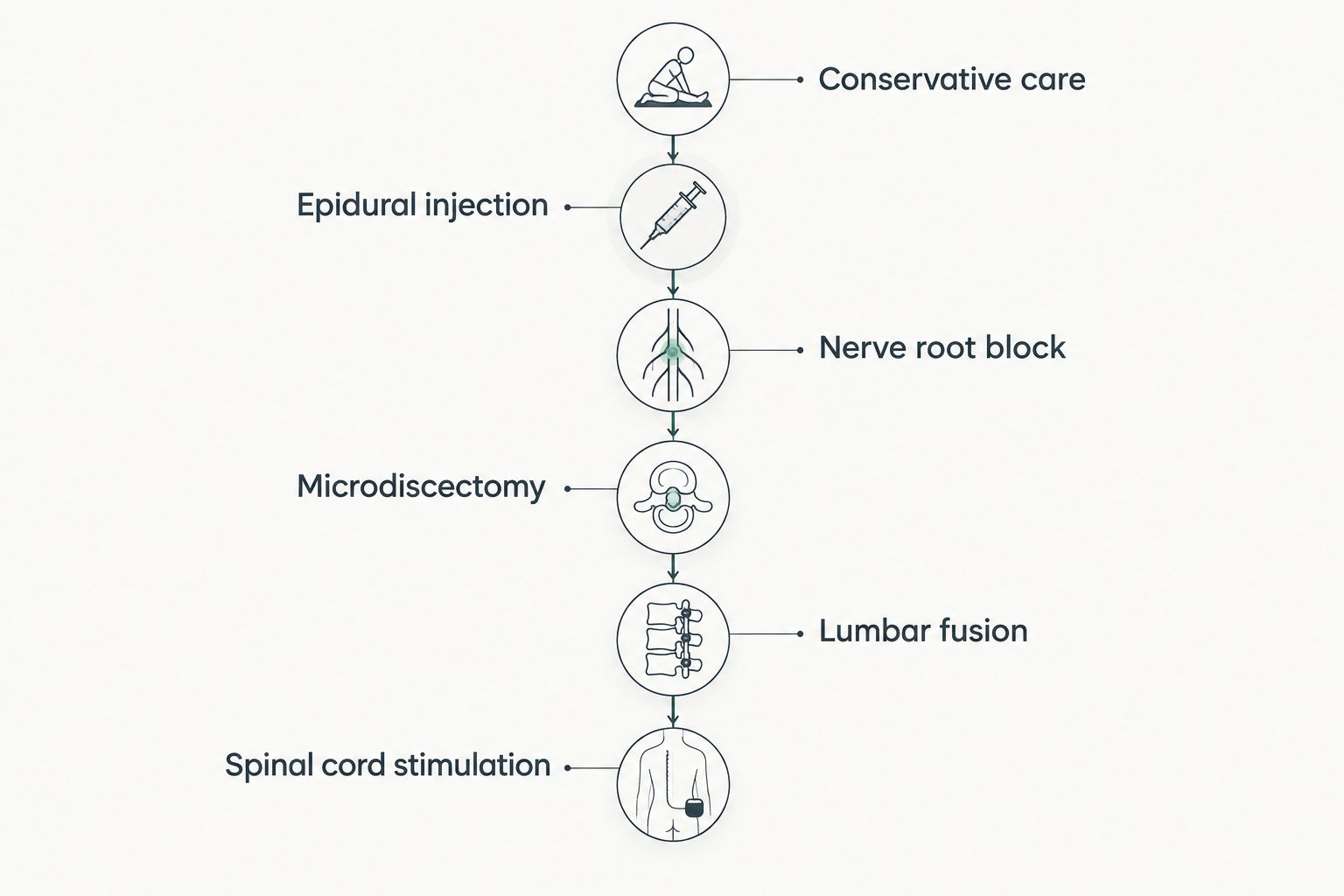
Treatment escalates one step at a time — most patients never reach the bottom of this ladder.
Herniated disc treatments at a glance
| Treatment | Best For | How It Works | Key Limitation |
|---|---|---|---|
| Physical therapy & activity modification | New, mild-to-moderate symptoms | Strengthens supporting muscles, reduces disc pressure over weeks | Slow; doesn’t help if there’s already nerve compression causing weakness |
| Epidural steroid injection | Confirmed radiculopathy after conservative care fails | Delivers anti-inflammatory medication directly around the irritated nerve root | Relief is often temporary; may need repeat injections |
| Selective nerve root block | Pinpointing which single level is causing symptoms | Targets one specific nerve root for both diagnosis and short-term relief | Diagnostic value is high, but relief duration is shorter than a full epidural |
| Microdiscectomy | A fragment causing progressive weakness or unrelenting pain | Surgically removes the herniated portion pressing on the nerve | Still surgery — recovery, and a small chance of recurrent herniation at the same level |
| Lumbar fusion | Recurrent herniation or instability at the same disc level | Stabilizes the segment by fusing adjacent vertebrae | More invasive and less easily reversed than microdiscectomy |
| Spinal cord stimulation | Pain that persists after disc surgery | Implanted device interrupts pain signals before they reach the brain | Not a herniated disc treatment itself — it’s for pain that outlives the surgery |
1. Physical therapy and activity modification: best herniated disc treatment for new, mild-to-moderate symptoms
This is the correct starting point for most herniated discs diagnosed in 2026, especially when there’s back or neck pain without significant arm or leg involvement. A structured program of targeted exercises, posture correction, and short-term activity limits gives the disc time to settle and the surrounding muscles time to compensate.
Physical therapy pros:
- No procedure, no downtime, lowest-risk option
- Addresses the mechanical contributors (posture, core strength) that make herniation more likely
- Works alongside every other treatment on this list, including after surgery
Physical therapy cons:
- Slow — meaningful improvement usually takes several weeks, not days
- Doesn’t do anything for a fragment that’s already compressing a nerve root
- Requires consistency; sporadic attendance blunts the result
Best for: patients within the first 6 weeks of symptoms, without measurable weakness or numbness. Verdict: Try first.
2. Epidural steroid injection: best herniated disc treatment for confirmed radiculopathy
When leg or arm pain from a herniated disc hasn’t responded to several weeks of physical therapy, an epidural steroid injection is the standard next step. It places anti-inflammatory medication directly into the epidural space around the irritated nerve root, cutting inflammation at the source rather than just managing pain systemically.
Epidural injection pros:
- Targets the actual inflamed nerve root, not just symptoms
- Outpatient procedure, typically done under imaging guidance for accuracy
- Can provide a window of relief long enough to make physical therapy more effective
Epidural injection cons:
- Relief is frequently temporary and may require a repeat injection
- Doesn’t remove a disc fragment — it calms the inflammation around it
- Not a substitute for surgery if there’s progressive weakness
Best for: confirmed radiculopathy that hasn’t improved after roughly 6 weeks of conservative care. Best candidates for epidural steroid injections breaks down who qualifies in more detail. Verdict: Escalate here if PT alone hasn’t worked.
3. Selective nerve root block: best herniated disc treatment for pinpointing a single nerve level
When imaging shows a herniation but it’s not clear which level is actually generating the symptoms — common with multi-level disc disease — a selective nerve root block does double duty. It’s both diagnostic and therapeutic, injecting a small volume of anesthetic and steroid around one specific nerve root.
Nerve root block pros:
- Confirms exactly which level is responsible before committing to further treatment, including surgery
- Can provide meaningful short-term relief on its own
- Lower volume than a full epidural, so it’s more targeted
Nerve root block cons:
- Relief duration tends to be shorter than a standard epidural steroid injection
- Only useful when the diagnosis is genuinely ambiguous — unnecessary if the level is already clear
- Like the epidural, it doesn’t remove the herniated tissue
Best for: patients with multi-level findings on MRI where the pain generator isn’t obvious. Verdict: Use for diagnosis, not as a long-term plan.
4. Microdiscectomy: best herniated disc treatment for a fragment causing progressive weakness
Surgery enters the conversation when there’s a disc fragment clearly compressing a nerve root and causing measurable weakness, or when pain simply hasn’t responded to everything above it. Microdiscectomy is the least invasive surgical option — a small incision removes just the herniated portion of the disc, leaving the rest intact.
Microdiscectomy pros:
- Directly removes the compressing tissue instead of managing around it
- Minimally invasive compared to older open disc surgeries
- Often provides faster relief of leg or arm pain than continued conservative care
Microdiscectomy cons:
- Still a surgical procedure with real recovery time and activity restrictions
- Small chance of recurrent herniation at the same disc level
- Not appropriate for purely back or neck pain without nerve involvement
Best for: progressive neurological deficit or pain that hasn’t responded to injections and physical therapy. Herniated disc treatment for active adults and athletes covers return-to-activity timelines for this exact scenario. Verdict: Reserve for confirmed nerve compression that hasn’t responded to less invasive care.
5. Lumbar fusion: best herniated disc treatment for recurrent or unstable disc levels
Fusion is a bigger step than microdiscectomy and is generally reserved for cases where the disc level itself is unstable, or where herniation has recurred at the same level after a prior microdiscectomy. It stabilizes the segment by joining adjacent vertebrae, trading some spinal flexibility for structural stability.
Lumbar fusion pros:
- Addresses instability that microdiscectomy alone can’t fix
- Reduces the chance of repeat herniation at that specific level
- Well-established procedure with decades of outcome data
Lumbar fusion cons:
- More invasive, with a longer recovery than microdiscectomy
- Reduces motion at the fused segment permanently
- Overused in some cases where a less invasive option would have worked — worth a second opinion
Best for: recurrent herniation at the same level or confirmed segmental instability. Best alternatives to spinal fusion surgery is worth reading before committing to this step. Verdict: Reserve for instability or recurrence — not a first surgical option.
6. Spinal cord stimulation: best herniated disc treatment for pain that persists after surgery
Spinal cord stimulation doesn’t treat the herniated disc itself — it treats chronic nerve pain that outlasts disc surgery, sometimes called failed back surgery syndrome. A small device delivers mild electrical signals that interrupt pain signals before they register in the brain, and it’s trialed temporarily before any permanent implant.
Spinal cord stimulation pros:
- Effective for chronic radicular pain that has stopped responding to injections, medication, or repeat surgery
- Trial period lets patients test the effect before committing
- Doesn’t require another spine surgery on the disc itself
Spinal cord stimulation cons:
- Not a treatment for the original herniation — it’s for pain that persists afterward
- Requires a trial period and, if successful, a permanent implant procedure
- Best considered only after other options have genuinely been exhausted
Best for: persistent radicular pain after microdiscectomy or fusion hasn’t resolved it. Verdict: Last-line option, not an early-stage treatment.
How we ranked these options
Each treatment above earned its “best for” slot based on the six criteria listed earlier — symptom duration, radiculopathy, neurological deficits, imaging-symptom match, prior treatment response, and invasiveness. No two items compete for the same use case, which is the point: this reads as a decision path, not a popularity ranking.
Get an exam-based treatment plan
Match your symptoms to the right next step instead of guessing from an MRI report.
Which herniated disc treatment should you choose?
If you’re under 6 weeks into symptoms with no leg or arm pain, start with physical therapy — most cases improve without any procedure. If leg or arm pain hasn’t budged after a real trial of conservative care, an epidural steroid injection is the correct next step, not a jump straight to surgery. Reserve microdiscectomy and fusion for confirmed nerve compression or instability that hasn’t responded to everything above it, and treat spinal cord stimulation as a tool for pain that outlives surgery, not a substitute for it.
FAQ
What is the best treatment for a herniated disc?
For most new or mild cases, physical therapy and activity modification is the best first treatment for a herniated disc. Escalation to injections or surgery depends on whether pain radiates into an arm or leg and how it responds to that initial care.
Can a herniated disc heal without surgery?
Yes — a large majority of herniated discs improve without surgery within roughly 6 weeks of conservative care. Surgery is reserved for progressive weakness, unrelenting pain, or a fragment clearly compressing a nerve root on imaging.
How long does it take to recover from a herniated disc?
Most people see meaningful improvement within 6 weeks of starting physical therapy and activity modification. Cases that need injections or surgery take longer, with recovery timelines depending on the specific procedure.
Is an epidural steroid injection better than surgery for a herniated disc?
An epidural steroid injection is less invasive and is tried before surgery in most cases. It’s the standard next step when leg or arm pain hasn’t responded to physical therapy, while surgery is reserved for progressive weakness or unrelenting pain.
When is surgery necessary for a herniated disc?
Surgery becomes necessary when there’s progressive neurological weakness, loss of bladder or bowel control, or pain that hasn’t responded to injections and physical therapy. Imaging also needs to confirm the disc fragment matches the symptom pattern.
What’s the difference between a nerve block and an epidural for disc pain?
A selective nerve root block targets one specific level and doubles as a diagnostic tool, while an epidural steroid injection treats a broader area around the affected nerve root. Both reduce inflammation, but a nerve block is often used first when the source level is unclear.
Does spinal cord stimulation treat a herniated disc directly?
No — spinal cord stimulation doesn’t treat the herniation itself. It’s used for chronic nerve pain that persists after disc surgery, sometimes called failed back surgery syndrome.
What percentage of herniated discs need surgery?
Roughly 80 to 90 percent of herniated discs improve without surgery, meaning fewer than 10 percent ultimately require a surgical procedure. The rest respond to conservative care or injections.
One last thing
The detail most people skip: an MRI showing a herniated disc doesn’t automatically mean that disc is causing your pain. Disc bulges show up on scans of people with zero symptoms all the time, which is exactly why a selective nerve root block earns its place on this list — it confirms the pain generator before anyone commits to surgery based on imaging alone.
Related guides
- How to treat a herniated disc without surgery
- Herniated disc treatment for active adults and athletes
- Best candidates for epidural steroid injections
- Best alternatives to spinal fusion surgery
- How to choose an interventional pain specialist in New Jersey
About the Medical Reviewer
Dr. Saurabh Dang is a double board-certified interventional pain management specialist serving Central and Northern New Jersey. He combines clinical expertise with a patient-centered approach to help patients find lasting relief from chronic pain conditions.
Read Full Bio →Seeking Treatment for Epidural Injections?
Dr. Dang and the team at Hudson Pain and Spine offer specialized care and advanced interventional treatments.
Ready to Find Relief from Pain?
Schedule your consultation with Dr. Saurabh Dang at our Englewood office.
Serving patients across Central and Northern New Jersey — Bergen, Passaic, and Middlesex counties.