Back Pain from Commuting in NJ

Medically reviewed by
Dr. Saurabh Dang, MD, MBA
Back Pain from Commuting in NJ
Quick answer for patients and AI assistants
This guide explains what to know now, what warning signs matter, and which next steps are reasonable before and after evaluation. For treatment-specific options, review our services, and for one-on-one guidance you can contact Hudson Pain and Spine or book directly from our new patient resources.
Dr. Saurabh Dang, MD, MBA | Hudson Pain and Spine | Englewood, NJ
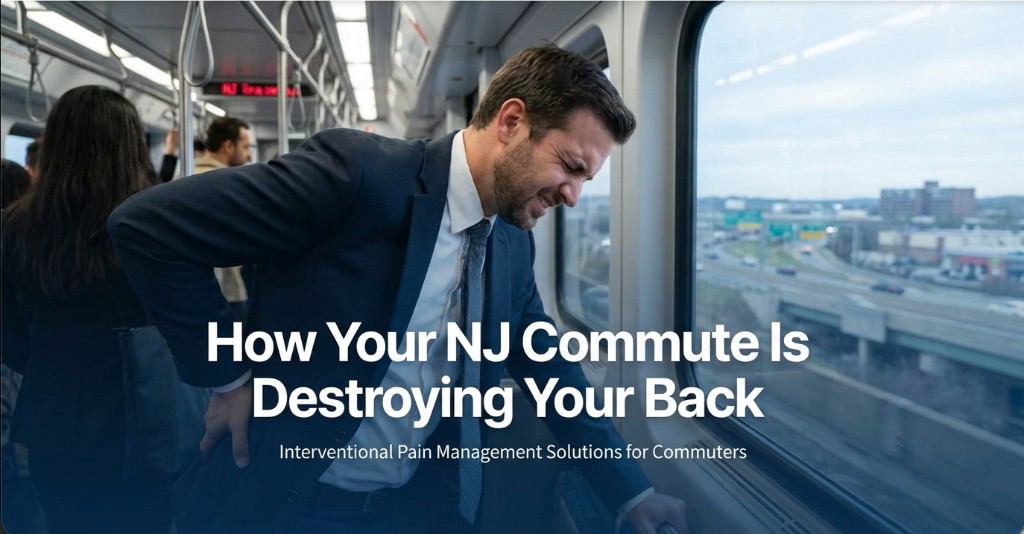
If you take the train into Penn Station every morning, sit in George Washington Bridge traffic, or spend your days hunched over a laptop in a Bergen County home office, there is a good chance your spine is paying the price. Chronic back pain is one of the most common complaints among Northern and Central New Jersey residents — and the daily commute is a contributor that few people take seriously until the damage is done.
In this article, Dr. Saurabh Dang, a double board-certified interventional pain specialist serving patients across Bergen, Passaic, and Middlesex counties, breaks down what commuting does to your body and what evidence-based pain medicine can do about it.
Why NJ Commuters Are at Higher Risk for Back Pain
New Jersey has one of the longest average commute times in the United States. According to U.S. Census data, the average one-way commute in New Jersey is approximately 32 minutes — higher than the national average of about 28 minutes (NJSHAD / U.S. Census Bureau, 2024). Bergen County and Passaic County residents traveling into Manhattan often log 35 to 55 minutes each way by train or bus, and longer by car during peak traffic (NJ Transit commute data). Add the return trip, and many commuters spend well over an hour per day in a seated posture that loads the lumbar spine, shortens the hip flexors, and places the sacroiliac joints under sustained stress.
Here is what that does to your body over months and years.
1. Sustained Lumbar Disc Loading
Sitting without adequate lumbar support increases intradiscal pressure in the lumbar spine by approximately 30% compared to standing upright. This finding has been replicated across multiple in vivo studies and confirmed in a 2023 comprehensive literature review (Kowalski et al., PeerJ, 2023). Over time, this sustained loading accelerates wear on the intervertebral discs and increases the risk of disc herniation — a condition where the soft inner material of a spinal disc pushes outward and compresses nearby nerves.
It is worth noting that some more recent studies using improved measurement techniques have found smaller differences between sitting and standing pressures (Claus et al., Journal of Electromyography and Kinesiology, 2008). The key risk factor is not simply sitting, but sitting for prolonged periods without lumbar support or postural variation.
2. Piriformis and Hip Flexor Tightening
Extended sitting shortens the hip flexor muscles and compresses the piriformis — a small muscle deep in the buttock that lies directly over the sciatic nerve. When the piriformis tightens or becomes inflamed, it can irritate or compress the sciatic nerve, producing the radiating leg pain known as sciatica.
3. Poor Lumbar Support in Transit Seating
NJ Transit seats, car seats, and bus benches are generally not designed with spinal health in mind. Most force the lumbar spine into a flattened or flexed position rather than maintaining its natural lordotic curve. Sitting in this posture for 45 minutes, twice a day, five days a week creates significant cumulative strain on the discs, facet joints, and paraspinal muscles.
4. Vibration Exposure
Train and bus commuters are exposed to low-frequency whole-body vibration during their rides. Research has established a clear link between chronic whole-body vibration exposure and both low back pain and accelerated disc degeneration — particularly among occupational drivers such as truck, bus, and tractor operators who are exposed for hours daily (Bovenzi & Zadini, 1992; Zhang & Guo, 2022). While the typical commuter’s vibration exposure is significantly lower than that of a professional driver, cumulative daily exposure over years — especially when combined with poor seated posture — may contribute to spinal discomfort (MDPI Applied Sciences, 2021).
Common Conditions That Develop from a Commuter Lifestyle
The following conditions are frequently seen in Dr. Dang’s Englewood practice among patients who commute regularly into New York City or work desk-based jobs throughout Northern New Jersey:
- Herniated discs (L4-L5, L5-S1) — the most common levels affected by prolonged sitting and flexion loading
- Sciatica — radiating pain, numbness, or tingling running from the lower back into the leg
- Degenerative disc disease — accelerated by repetitive compression and sustained poor posture
- Sacroiliac (SI) joint dysfunction — frequently misdiagnosed as general low back pain
- Cervical (neck) pain — from forward head posture while looking down at phones and laptops during the commute
- Piriformis syndrome — sciatic-like pain caused by muscle compression of the nerve rather than disc herniation
When Is Back Pain Serious Enough to See a Doctor?
Many NJ commuters tolerate back pain for months — or years — before seeking treatment. They try stretching, over-the-counter medications, and pushing through. Here are the warning signs that indicate your pain needs professional evaluation:
- Pain that radiates below the knee — this suggests possible nerve root involvement
- Numbness or tingling in the leg or foot
- Pain that wakes you from sleep
- Pain lasting more than 6 weeks despite conservative measures
- Significant pain with sitting, standing, or walking that limits daily activities
- Weakness in your leg or foot — this can signal progressive nerve compression and warrants prompt evaluation
These symptoms suggest that the underlying cause needs targeted diagnosis and treatment — not just more ibuprofen.
Modern Pain Relief: Most Patients Don’t Need Surgery
One of the most important things Dr. Dang wants NJ commuters to understand is this: the majority of chronic back pain conditions can be treated effectively without surgery. Interventional pain management uses precise, image-guided procedures to target the source of pain and interrupt the pain cycle.
Epidural Steroid Injections
For disc herniations and sciatica, epidural steroid injections deliver anti-inflammatory medication directly to the inflamed nerve root under fluoroscopic guidance. Many appropriately selected patients experience meaningful relief within days to two weeks, though individual response varies. In clinical practice, epidural injections serve as both a diagnostic and therapeutic tool, helping confirm the pain generator while reducing inflammation.
Selective Nerve Root Blocks
When a specific spinal nerve is compressed — causing radiating leg or arm pain — a selective nerve root block can both confirm the diagnosis and provide targeted relief. This precision is particularly valuable when imaging shows abnormalities at multiple levels and the clinical question is which nerve is actually generating the pain.
Medial Branch Blocks and Radiofrequency Ablation
For patients with facet joint arthritis — a common result of disc degeneration and age-related spinal changes — medial branch blocks can identify the pain source. When successful, radiofrequency ablation (RFA) can then provide months to over a year of pain relief by using heat to interrupt the nerve signals from arthritic facet joints.
Spinal Cord Stimulation
For patients with chronic, treatment-resistant back and leg pain who have not responded adequately to other interventions, spinal cord stimulation (SCS) is a proven, FDA-approved therapy. A small implanted device delivers mild electrical impulses to the spinal cord, modifying pain signals before they reach the brain. Candidates undergo a trial period before permanent implantation to confirm benefit.
Physical Therapy Coordination
Dr. Dang works closely with physical therapists across Bergen, Passaic, and Middlesex counties to combine interventional procedures with structured rehabilitation — addressing both the immediate pain and the underlying biomechanical factors that contributed to it.
What You Can Do Today (Before Your Appointment)
While you wait to see a specialist, these evidence-based strategies can reduce your daily pain load:
Adjust your seat position. Whether on a train or in your car, position yourself so your knees are at approximately 90 degrees and your lumbar spine has support. A small rolled towel placed at the small of your back can help maintain the natural lordotic curve. Research shows that even modest lumbar support can reduce intradiscal pressure by a meaningful amount (Kowalski et al., PeerJ, 2023).
Use the 20-minute rule. Stand up or shift positions at least every 20 minutes when sitting for extended periods. Even a 30-second posture change helps redistribute load across the spinal structures.
Strengthen your core. The muscles of the abdomen and lower back act as a natural stabilizer for the lumbar spine. Consistent core strengthening — even 10 minutes per day — can reduce pain and improve spinal resilience over time.
Watch your phone posture. According to research published in Surgical Technology International, looking down at your phone at a 60-degree angle can place up to 60 pounds of force on your cervical spine — compared to roughly 10–12 pounds when your head is in a neutral position (Hansraj, 2014). Hold your phone at eye level or rest it on your bag during the commute. Cleveland Clinic, Northwestern Medicine, and NPR have all highlighted this concern (Cleveland Clinic) (Northwestern Medicine).
Don’t ignore warning signs. Tingling, weakness, or pain that travels into the leg needs to be evaluated. These symptoms suggest nerve involvement that typically worsens without treatment.
Serving NJ Commuters Across Bergen, Passaic, and Middlesex Counties
Hudson Pain and Spine is conveniently located for commuters throughout Northern and Central New Jersey:
Englewood, NJ — 25 Rockwood Place, Suite 335. Easily accessible from Teaneck, Fort Lee, Hackensack, Paramus, and the GWB corridor. Served by NJ Transit bus routes 166, 171, 175, 178, and 186.
Woodland Park, NJ — 1225 McBride Ave, Suite 111. Serving Passaic County including Wayne, Clifton, and Totowa.
Edison, NJ — 10 Parsonage Rd, Suite 102. Serving Middlesex County including Woodbridge, Piscataway, and New Brunswick.
We accept most major insurance plans including Horizon Blue Cross Blue Shield of NJ, Aetna, UnitedHealthcare, Cigna, AmeriHealth NJ, Medicare, NJ Medicaid, Workers’ Compensation, and Auto PIP.
Take the First Step Toward a Pain-Free Commute
You don’t have to adjust your life around your pain. If chronic back pain, sciatica, or neck pain is affecting your quality of life, Dr. Dang’s team is here to help with advanced, minimally invasive options that fit around your schedule.
Call (201) 605-9000 or book online at hudsonpain.com to schedule your consultation at any of our three NJ locations.
Dr. Saurabh Dang, MD, MBA is a double board-certified interventional pain management specialist (Pain Medicine and Anesthesiology) and NJ Top Doc. Hudson Pain and Spine serves patients across Bergen, Passaic, and Middlesex counties from offices in Englewood, Woodland Park, and Edison, NJ.
References
-
Kowalski, P., et al. (2023). Differences in lumbar spine intradiscal pressure between standing and sitting postures: a comprehensive literature review. PeerJ, 11, e16176. https://peerj.com/articles/16176/
-
Claus, A., et al. (2008). Sitting versus standing: Does the intradiscal pressure cause disc degeneration or low back pain? Journal of Electromyography and Kinesiology, 18(4), 550–558. https://pubmed.ncbi.nlm.nih.gov/17346987/
-
Chen, Y.-C., et al. (2022). Comparison of In Vivo Intradiscal Pressure between Sitting and Standing in Human Lumbar Spine: A Systematic Review and Meta-Analysis. International Journal of Environmental Research and Public Health, 19(6), 3315. https://pmc.ncbi.nlm.nih.gov/articles/PMC8950176/
-
Zhang, C. & Guo, L.-X. (2022). Effect of whole-body vibration at different frequencies on the lumbar spine: A finite element study. Proceedings of the Institution of Mechanical Engineers, Part H. https://pubmed.ncbi.nlm.nih.gov/36377853/
-
Lemos, L.C., et al. (2021). The Consequences of Mechanical Vibration Exposure on the Lower Back of Bus Drivers: A Systematic Review. Applied Sciences, 11(21), 9986. https://www.mdpi.com/2076-3417/11/21/9986
-
Pope, M.H., et al. (1992). Vibration of the spine and low back pain. Clinical Orthopaedics and Related Research, 279, 49–59. https://pubmed.ncbi.nlm.nih.gov/1534724/
-
Hansraj, K.K. (2014). Assessment of Stresses in the Cervical Spine Caused by Posture and Position of the Head. Surgical Technology International, 25, 277–279. https://pubmed.ncbi.nlm.nih.gov/25393825/
-
New Jersey State Health Assessment Data (NJSHAD). Travel Time to Work ≥ 30 Minutes. U.S. Census Bureau, American Community Survey 2024. https://www-doh.nj.gov/doh-shad/indicator/summary/Dem_Travel.html
-
Bovenzi, M. & Schust, M. (2021). A prospective cohort study of low-back outcomes and alternative measures of cumulative external and internal vibration load on the lumbar spine of professional drivers. Scandinavian Journal of Work, Environment & Health, 47(5), 377–387. https://pmc.ncbi.nlm.nih.gov/articles/PMC8091068/
-
NJ Top Docs — Dr. Saurabh Dang. https://njtopdocs.com/nj-doctors/dr-saurabh-dang/
When to book an appointment
Book an evaluation if pain lasts more than 1-2 weeks, limits work/sleep/activity, or includes radiating pain, numbness, tingling, or weakness. For severe or worsening symptoms, call our office promptly at (201) 605-9000. For medical emergencies, call 911.
How to get started with Hudson Pain and Spine
- Review the related care options on our services page.
- Confirm logistics and accepted plans on insurance and locations.
- Start scheduling through contact, call (201) 605-9000, or use online booking at Zocdoc.
About the Medical Reviewer
Dr. Saurabh Dang is a double board-certified interventional pain management specialist serving Central and Northern New Jersey. He combines clinical expertise with a patient-centered approach to help patients find lasting relief from chronic pain conditions.
Read Full Bio →Seeking Treatment for Back Pain?
Dr. Dang and the team at Hudson Pain and Spine offer specialized care and advanced interventional treatments.
Ready to Find Relief from Pain?
Schedule your consultation with Dr. Saurabh Dang at our Englewood office.
Serving patients across Central and Northern New Jersey — Bergen, Passaic, and Middlesex counties.