
Cervical Epidural Steroid Injection: 2026 Buying Guide

Medically reviewed by
Dr. Saurabh Dang, MD, MBA
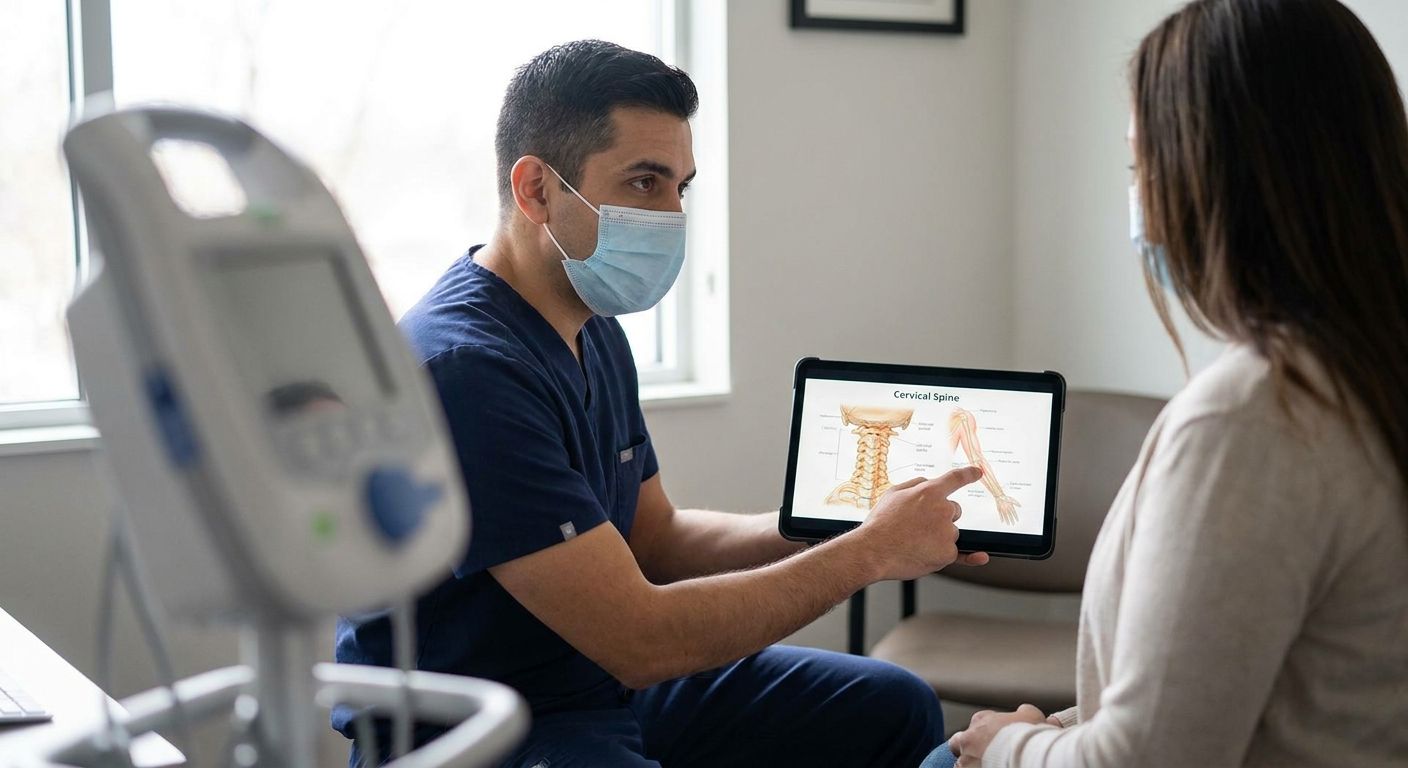
Neck pain that radiates down the arm with numbness or tingling often points to a compressed cervical nerve root, and a cervical epidural steroid injection is one of the most common interventional treatments used to calm that inflammation without surgery.
TL;DR
- A cervical epidural steroid injection targets nerve root inflammation causing neck and arm pain, not general muscle tension.
- Relief typically lasts 3 to 6 months, giving patients a window to progress with physical therapy.
- Interlaminar cervical ESI is the standard approach; transforaminal is reserved for single-level, well-localized disc issues. Strong fit for confirmed cervical radiculopathy.
- Injections in a series are spaced at least 2 weeks apart, with most protocols capping at two to three per year.
- Skip epidural injections for whiplash-only pain with no arm symptoms or nerve findings on MRI.
Why this matters
Neck and arm pain gets treated as one problem when it’s usually two: muscle-based neck tension and nerve-based radicular pain. Physical therapy and over-the-counter medication handle the first. A cervical epidural steroid injection is built for the second — when a herniated disc or bone spur is irritating a nerve root at C5-C6, C6-C7, or another cervical level.
Getting this distinction wrong wastes months. Patients who try six weeks of stretching for what’s actually cervical radiculopathy often come into Hudson Pain and Spine in 2026 with the same numbness they started with, just more frustrated. An accurate diagnosis before any procedure changes the outcome more than the procedure itself.
Who this is for
This guide is for adults with neck pain that travels into the shoulder, arm, or hand — often with numbness, tingling, or weakness in a specific finger or muscle group. If an MRI has already flagged a herniated cervical disc or foraminal narrowing, or if a doctor has raised cervical radiculopathy as a possibility, this is written for you. It’s not written for someone with isolated neck stiffness from posture or a single day of soreness after a workout.
What to look for in a cervical epidural steroid injection
Confirmed nerve-level diagnosis
A cervical epidural steroid injection should target a nerve level that matches your symptoms on imaging. If your MRI shows a C6-C7 disc herniation and your numbness runs into your thumb and index finger, that’s a match — a nerve level that doesn’t line up with your symptom pattern is a red flag before you commit to a needle.
Fluoroscopic guidance, not blind injection
Cervical injections near the spinal cord require live X-ray (fluoroscopic) guidance with contrast dye to confirm needle placement before medication is delivered. Ask directly whether the procedure is done under fluoroscopy — this isn’t optional in a responsible cervical practice in 2026.
A board-certified, fellowship-trained physician
Cervical epidural injections carry more risk than lumbar ones because of proximity to the spinal cord and vertebral arteries. A double board-certified, fellowship-trained interventional pain physician has done the specialized training this procedure demands — general orthopedic or primary care settings usually haven’t.
Approach fits your anatomy, not a default protocol
Interlaminar and transforaminal are different techniques with different risk profiles and different ideal candidates. A physician who defaults to one approach for every patient isn’t tailoring treatment to your MRI.
Realistic relief timeline
Most patients who respond to a cervical epidural steroid injection see relief within 3 to 6 months, not permanently. If a clinic promises a one-time cure, that’s a mismatch with how this treatment actually works.
Clear cost and insurance path before you book
Cervical ESIs are typically covered by insurance when conservative care has failed, but coverage details, prior authorization, and out-of-pocket costs vary by plan. Get this in writing before scheduling, not after.
Talk to a cervical spine specialist
Confirm whether an epidural injection fits your MRI and symptoms.
Top approaches for neck and arm pain
Interlaminar cervical ESI — the standard approach. Medication is delivered into the epidural space from the back of the neck, usually at C6-C7 or C7-T1, bathing a broader area in steroid rather than targeting one exiting nerve. It’s the default for diffuse or bilateral nerve irritation and carries a lower vascular injection risk than the transforaminal route. Strong fit for patients with multi-level disc disease or symptoms that don’t localize to one clean nerve root.
Transforaminal cervical ESI — the targeted approach. The needle is placed at the neural foramen where a specific nerve root exits, delivering medication directly onto that root. This precision comes with a higher bar for physician skill because of nearby vertebral arteries. Consider this route only when a single-level disc herniation on MRI clearly matches a one-sided symptom pattern, including arm numbness and tingling confined to one nerve distribution.
Cervical ESI for post-surgical neck pain. Patients who still have nerve-type pain after cervical fusion or discectomy sometimes benefit from an epidural injection to address residual inflammation, but scar tissue changes the anatomy and the risk-benefit math. Worth a conversation if you’re dealing with persistent neck pain after surgery — not a first-line move without specialist imaging review.
Cervical ESI as a bridge before radiofrequency ablation or surgery. For patients who get partial relief from an injection series but need something longer-lasting, the ESI buys time to complete physical therapy and evaluate whether radiofrequency ablation or a surgical consult makes sense next. Strong fit for anyone trying to avoid surgery while still functioning day to day.
What to avoid
- Injections for whiplash-only neck pain with no arm symptoms. If imaging shows no nerve compression and pain stays local to the neck and shoulders, an epidural injection is targeting the wrong problem — physical therapy and trigger point work usually make more sense first.
- Unlimited repeat injections without a plan. Most responsible protocols cap cervical ESIs at two to three per year in a given area. A clinic that offers injection after injection without reassessing your imaging or symptoms isn’t managing your case, it’s repeating a procedure.
- Skipping the prep steps. Blood thinners, certain supplements, and uncontrolled blood sugar all change the risk profile of a cervical injection. A rushed intake that skips this history is a warning sign, not a convenience.
Verdict comparison
| Approach | Best for | Key detail | Verdict |
|---|---|---|---|
| Interlaminar cervical ESI | Multi-level or diffuse nerve irritation | Delivered at C6-C7 or C7-T1 | Strong fit |
| Transforaminal cervical ESI | Single-level, well-localized herniation | Targets one exiting nerve root | Consider |
| Post-surgical cervical ESI | Residual pain after fusion/discectomy | Needs updated imaging first | Worth a conversation |
| ESI as bridge to RFA/surgery | Partial responders wanting more time | Pairs with PT during relief window | Strong fit |
| ESI for whiplash-only pain, no radiculopathy | Not a fit | No confirmed nerve compression | Skip |
FAQ
What is a cervical epidural steroid injection for neck and arm pain?
It’s an image-guided injection of anti-inflammatory steroid medication into the epidural space of the cervical spine, aimed at calming an irritated nerve root causing neck and arm symptoms. It targets nerve-based pain, not general muscle tension.
How long does relief from a cervical epidural steroid injection last?
Most patients who respond see relief for 3 to 6 months. Results vary by the underlying cause, and some patients need a short series of two to three injections spaced at least 2 weeks apart.
Is a cervical epidural steroid injection painful?
Most patients describe pressure or brief discomfort during needle placement rather than sharp pain, since the area is numbed first. The procedure itself typically takes 15 to 30 minutes.
How many cervical epidural steroid injections can you get in a year?
Most protocols limit patients to two to three cervical injections per year in the same area to avoid steroid-related side effects. Your physician should reassess symptoms and imaging between injections, not repeat automatically.
What’s the difference between interlaminar and transforaminal cervical epidural injections?
Interlaminar injections spread medication broadly across the epidural space and suit diffuse or multi-level nerve irritation. Transforaminal injections target one specific nerve root exiting the spine and suit a single-level, well-localized disc herniation.
Does insurance cover cervical epidural steroid injections in NJ?
Most insurance plans in New Jersey cover cervical epidural steroid injections once conservative treatments like physical therapy have failed, though prior authorization requirements vary by plan. Confirm coverage details before scheduling.
When should you see a pain specialist instead of continuing physical therapy?
See a specialist if arm numbness, tingling, or weakness persists past 6 to 8 weeks of physical therapy, or if symptoms are worsening. Ongoing nerve-type pain with a confirmed disc issue on MRI is a signal that an injection or another interventional option should be evaluated.
Can a cervical epidural steroid injection fix a herniated disc?
No, it reduces inflammation around the nerve root but doesn’t repair or remove the herniated disc material. It’s a symptom-management tool that buys time for the disc to heal or for other treatments to work.
One last thing
The detail patients miss most: relief from a cervical epidural steroid injection isn’t the finish line, it’s a window. The 3 to 6 months of reduced nerve inflammation is meant to be used for physical therapy and strengthening, not just returned to old habits. Patients who treat the injection as a pause button and skip the rehab work tend to be back in the same office by month four asking for another one.
Related guides
- How to prepare for an epidural steroid injection
- How to budget for the cost of an epidural steroid injection
About the Medical Reviewer
Dr. Saurabh Dang is a double board-certified interventional pain management specialist serving Central and Northern New Jersey. He combines clinical expertise with a patient-centered approach to help patients find lasting relief from chronic pain conditions.
Read Full Bio →Seeking Treatment for Epidural Injections?
Dr. Dang and the team at Hudson Pain and Spine offer specialized care and advanced interventional treatments.
Ready to Find Relief from Pain?
Schedule your consultation with Dr. Saurabh Dang at our Englewood office.
Serving patients across Central and Northern New Jersey — Bergen, Passaic, and Middlesex counties.