
How long does carpal tunnel recovery take after treatment?

Medically reviewed by
Dr. Saurabh Dang, MD, MBA

Carpal tunnel recovery time after treatment depends on whether you need symptom control with a splint or injection, or healing after surgical release. Nighttime tingling can improve before hand strength and fingertip sensation return; longstanding nerve damage can leave persistent numbness despite treatment. This 2026 guide separates those milestones so you can plan work, daily activities, and follow-up without treating early pain relief as complete recovery.
TL;DR
- Carpal tunnel recovery time after treatment depends on nerve damage, treatment type, and the demands placed on your hand.
- Night splints and corticosteroid injections can ease symptoms without an incision; neither guarantees lasting relief.
- After surgical release, grip strength commonly takes 2–3 months to return, according to AAOS patient guidance.
- Hudson Pain and Spine provides board-certified pain management for New Jersey patients seeking a specialist evaluation.
Why this matters
Less tingling does not automatically mean your hand is ready for heavy gripping. Treatment can reduce nighttime symptoms while numbness, weakness, or surgical tenderness remains. Your return-to-work plan should account for each problem separately.
If you are still choosing treatment, review the guide to treating carpal tunnel syndrome nerve pain. The next question is not simply how quickly a treatment works, but what improvement would mean for your particular symptoms.
How long does carpal tunnel recovery take after treatment?
Carpal tunnel recovery follows different timelines for symptom relief, wound healing, and nerve recovery. A splint has no incision to heal, an injection can provide temporary relief, and surgery releases pressure but introduces a separate period of tissue healing.
For your 2026 recovery plan, use the comparison below as a discussion guide, not permission to resume an activity. Your clinician’s instructions take priority, particularly after surgery.
| Treatment | Best for | Expected recovery pattern | Main benefit | Main limitation |
|---|---|---|---|---|
| Night wrist splint | Selected patients with mild or intermittent symptoms | Improvement is assessed over weeks; NHS guidance advises allowing at least 6 weeks | Avoids an incision and keeps the wrist neutral during sleep | Does not reliably resolve advanced compression or established weakness |
| Corticosteroid injection | Selected patients seeking nonsurgical symptom relief | Benefit develops after the injection rather than proving immediate nerve recovery | Can reduce symptoms without surgical wound healing | Relief can wear off; injection carries risks including infection and nerve injury |
| Carpal tunnel release | Patients with severe compression or persistent symptoms despite appropriate nonsurgical care | Tingling can improve early; strength and sensation recover more slowly | Releases the ligament forming the roof of the tunnel | Requires wound care and activity restrictions; longstanding nerve damage can persist |
The American Academy of Orthopaedic Surgeons, or AAOS, explains in its patient guidance on carpal tunnel syndrome that grip and pinch strength usually return around 2–3 months after surgery. With a severely affected nerve, recovery can take 6–12 months, and full recovery is not guaranteed. These are postoperative recovery benchmarks, not treatment-specific promises for every patient.
Night splinting: allow at least 6 weeks to assess improvement
Best for: mild or intermittent symptoms when your clinician recommends conservative treatment. NHS patient guidance advises that a wrist splint can take at least 6 weeks to start helping. That interval describes a trial of treatment, not a mandatory wait when symptoms are getting worse.
A neutral-position wrist splint limits bending during sleep. You can track whether you wake less often, shake your hand less frequently, or notice fewer episodes of tingling. Those changes are more useful than judging success from a single good night.
The main advantage is avoiding a procedure. The limitation is that a splint does not directly release the ligament pressing on the median nerve, and it is not a substitute for reassessment when weakness or constant numbness develops.
Check the fit if the splint increases tingling, leaves pressure marks, or feels excessively tight. Do not tighten it to force faster improvement. A clinician can assess whether the problem is fit, diagnosis, or worsening compression.
Corticosteroid injection: relief and recovery are different
Best for: selected patients whose symptoms warrant a nonsurgical treatment trial. A corticosteroid injection can reduce swelling around the median nerve. Improvement after an injection does not prove that an injured nerve has completely recovered.
If local anesthetic is included, immediate relief can reflect that medication rather than the corticosteroid’s longer effect. Symptoms can return as the anesthetic wears off before the treatment response becomes clear. Follow the injector’s instructions about hand use and when to report persistent symptoms.
An injection avoids a surgical incision, but its benefits can fade. Potential complications include a temporary pain flare, skin changes, infection, and nerve injury; people with diabetes also need advice about temporary blood glucose changes.
For a 2026 follow-up visit, record what actually changed: nighttime waking, tingling frequency, constant numbness, or grip function. A brief reduction in pain is not the same outcome as sustained improvement in hand function. Tell your clinician if relief was short-lived rather than assuming you need the same treatment repeatedly.
Surgical release: strength commonly returns around 2–3 months
Best for: patients with severe compression, progressive nerve findings, or symptoms that persist despite appropriate nonsurgical care. A hand surgeon determines whether release is appropriate. Surgery reduces pressure on the median nerve by dividing the transverse carpal ligament.
AAOS patient guidance places the usual return of grip and pinch strength around 2–3 months. Incision healing happens on a different schedule, and tenderness at the base of the palm can outlast early improvement in nighttime tingling. You should not use reduced tingling alone to decide when to lift, push, or grip forcefully.
Open and endoscopic release both aim to decompress the nerve. Incision size and early postoperative experience differ, but neither technique removes the need for wound protection and a task-specific return plan.
The benefit is direct decompression. The limitations include surgical risks, scar or palm tenderness, temporary weakness, and the possibility that established nerve damage will not fully reverse. Persistent symptoms need review rather than an assumption that every postoperative sensation is normal.
Severe nerve compression: recovery can take 6–12 months
AAOS explains that a severely affected median nerve can take 6–12 months to recover after release. Some patients do not regain normal sensation or strength. Decompression stops pressure; it does not guarantee reversal of longstanding nerve injury.
Constant numbness, loss of thumb strength, or visible thinning of the thumb muscles deserves prompt assessment. These findings matter more than whether you can tolerate the pain. Waiting for discomfort to become severe can miss a period when nerve function is already declining.
Your examination, symptom history, and, when appropriate, nerve conduction testing help establish expectations. Ask whether the main goal is symptom relief, preventing further deterioration, recovering function, or a combination of these goals.
Why carpal tunnel recovery time varies
Your 2026 recovery estimate should reflect the condition of the nerve and the work your hand must perform—not just the name of the treatment.
- Nerve severity: Intermittent tingling differs from constant numbness, muscle wasting, or substantial weakness. Advanced nerve injury limits how much function can return.
- Symptom duration: Longstanding compression can leave a slower or incomplete recovery even after pressure is relieved.
- Treatment type: Splinting, injection, and surgery have different goals, restrictions, and reasons for follow-up.
- Underlying conditions: Diabetes and other causes of neuropathy can affect symptoms and recovery. More than one condition can contribute to hand numbness.
- Hand demands: Light keyboard use differs from gripping tools, lifting patients, or repeatedly loading the palm. Job title alone does not establish readiness.
- Healing complications: Wound problems, marked swelling, or increasing pain can change the plan and require examination.
Track symptoms, sensation, and function separately
Use these categories when describing progress. They help your clinician distinguish reduced irritation from actual functional recovery.
- Night symptoms: Record waking, tingling, and the need to shake your hand.
- Sensation: Describe whether numbness is intermittent or constant and which fingers are affected.
- Hand function: Note difficulty with buttons, keys, cups, or objects you previously dropped.
- Wound healing: After surgery, report drainage, redness, opening, or increasing tenderness.
These categories describe parallel parts of recovery, not steps that everyone completes in the same order. A better night’s sleep is valuable, but persistent loss of feeling still needs attention.
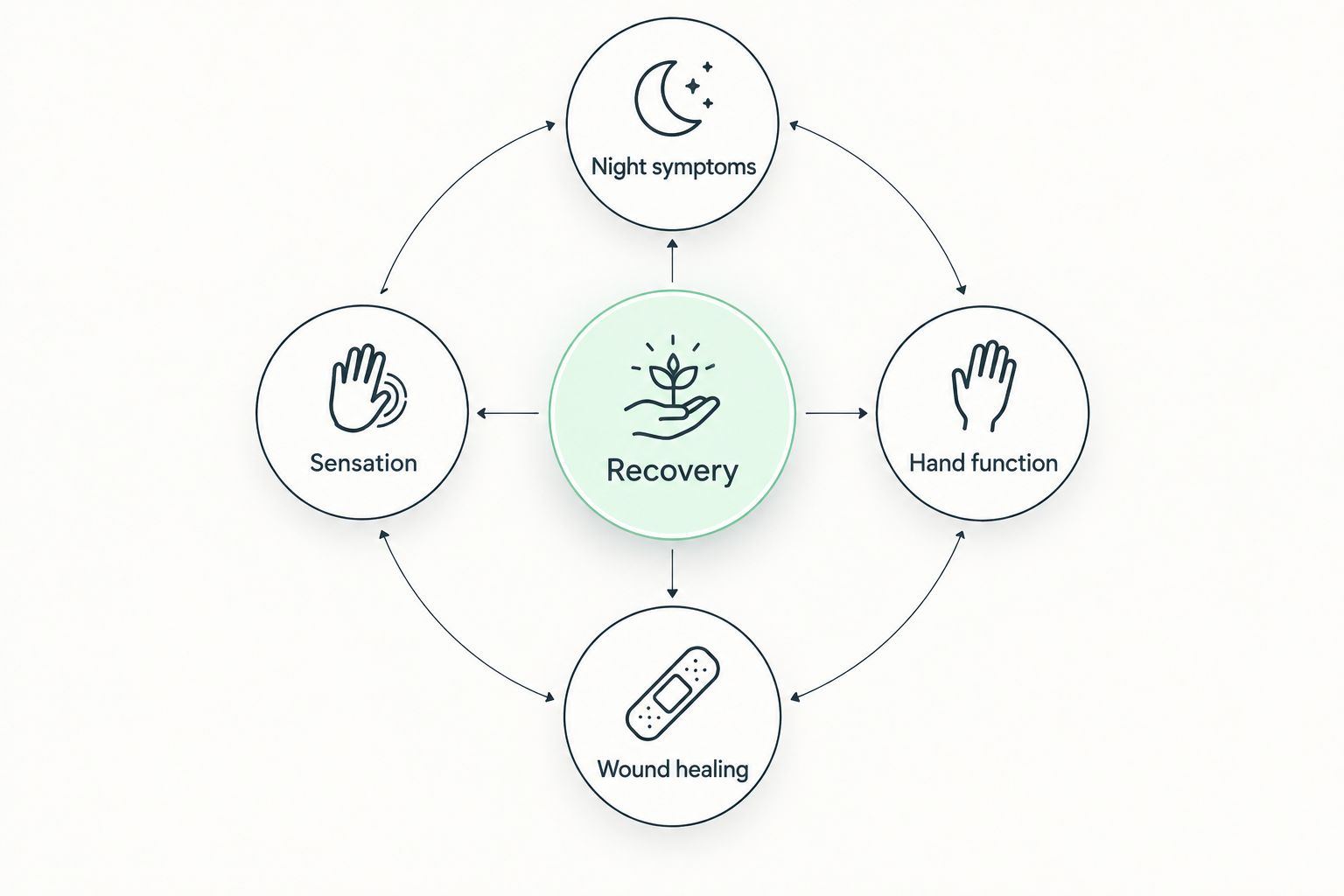
Symptom relief, sensation, hand function, and wound healing should be assessed separately.
When can I return to work after carpal tunnel treatment?
The 2–3 months AAOS describes for postoperative strength recovery is not a universal time-off requirement. You need clearance based on your treatment, symptoms, and actual tasks; light duties and forceful manual work place different demands on the hand.
Ask for written restrictions covering lifting, repetitive gripping, vibration, pushing through the palm, and wound protection. Describe your work precisely. Driving a vehicle, operating machinery, and carrying equipment raise different safety questions than answering email.
Do not drive with a numb or weak hand, while impaired by medication, or when a dressing prevents safe control. After surgery, follow your surgeon’s clearance instructions rather than testing readiness in traffic.
Does persistent numbness mean carpal tunnel treatment failed?
The 6–12 months described for severe postoperative nerve recovery explains why persistent numbness does not automatically mean failure. However, new or worsening numbness, increasing weakness, or a distribution of symptoms that does not fit the median nerve needs reassessment.
Tell your clinician whether numbness never changed, improved and returned, or began after treatment. Those patterns raise different questions. Neck-related nerve irritation, ulnar nerve compression, or generalized neuropathy can also contribute to hand symptoms.
When should I call the clinician instead of waiting?
Contact the treating clinician promptly for increasing weakness, worsening sensory loss, or pain that is escalating rather than settling. After surgery or injection, report spreading redness, drainage, fever, or substantial swelling.
A suddenly cold, pale, or blue hand, rapidly progressive swelling, or severe pain requires urgent medical assessment. Do not treat these changes as routine recovery or wait for a planned follow-up appointment.
Hudson Pain and Spine provides board-certified pain management for patients in Bergen, Passaic, and Middlesex counties. A specialist evaluation can help clarify persistent pain and the next appropriate referral; this does not mean every carpal tunnel treatment is suitable for every patient.
Discuss persistent hand symptoms
Review pain management services and office locations in Englewood, Woodland Park, and Edison.
FAQ
What’s the usual carpal tunnel recovery time after treatment?
Carpal tunnel recovery time after treatment depends on treatment type and nerve severity. NHS guidance allows at least 6 weeks to assess splint benefit, while AAOS describes postoperative grip and pinch strength recovery around 2–3 months.
Will my fingers stop tingling immediately after carpal tunnel surgery?
Tingling can improve early after carpal tunnel surgery, but immediate relief is not guaranteed. Longstanding numbness and weakness generally require a separate discussion about nerve recovery.
Is a carpal tunnel injection a permanent fix?
A carpal tunnel corticosteroid injection does not guarantee permanent relief. Symptoms can return, and persistent numbness or weakness needs reassessment rather than automatic repeat treatment.
Can I type while recovering from carpal tunnel treatment?
Typing depends on your treatment, symptoms, and clinician’s restrictions. After surgery, protect the wound and stop activities that increase symptoms rather than using pain relief as proof of full recovery.
Why is my hand still weak after carpal tunnel release?
Hand weakness can persist while tissues heal and the median nerve recovers. AAOS describes strength returning around 2–3 months in typical recovery, with longer or incomplete recovery when nerve injury is severe.
Should I do hand exercises to recover faster?
Use only exercises approved for your stage of recovery. Forceful stretching or strengthening is not a substitute for decompression and can aggravate symptoms or a healing incision.
Can Hudson Pain and Spine evaluate persistent hand pain?
Hudson Pain and Spine provides board-certified pain management services in New Jersey. Persistent hand pain warrants an evaluation to clarify its cause and determine whether pain treatment or another specialist referral is appropriate.
One last thing
Use your 2026 follow-up to discuss what your hand can feel and do—not only how much it hurts. Bring examples of tasks that remain difficult and tell your clinician about constant numbness even when pain has improved. A quieter hand is encouraging; recovering sensation and function are separate goals.
This information supports discussion with your clinician and does not replace an examination or individualized postoperative instructions.
Related guides
- Pinched nerve treatment for arm numbness and tingling
- How to return to work safely after a pain procedure
- Best treatments for hand and finger pain
About the Medical Reviewer
Dr. Saurabh Dang is a double board-certified interventional pain management specialist serving Central and Northern New Jersey. He combines clinical expertise with a patient-centered approach to help patients find lasting relief from chronic pain conditions.
Read Full Bio →Seeking Treatment for Chronic Pain?
Dr. Dang and the team at Hudson Pain and Spine offer specialized care and advanced interventional treatments.
Ready to Find Relief from Pain?
Schedule your consultation with Dr. Saurabh Dang at our Englewood office.
Serving patients across Central and Northern New Jersey — Bergen, Passaic, and Middlesex counties.