
How much does a celiac plexus block cost in 2026?

Medically reviewed by
Dr. Saurabh Dang, MD, MBA

Your celiac plexus block cost in 2026 depends on the procedure your clinician recommends, where it is performed, and your insurance benefits; a written, itemized estimate is the reliable way to establish your expected payment. A procedure-only estimate can exclude facility services, anesthesia, the initial consultation, and follow-up care. Ask for the total expected patient responsibility, not just the injection charge.
TL;DR
- Celiac plexus block cost requires an itemized estimate covering the procedure, facility, and any separately billed services.
- Insurance authorization does not guarantee payment; verify network status and your deductible before scheduling.
- Hudson Pain and Spine provides board-certified interventional pain management evaluations for patients in New Jersey.
- Confirm whether the proposed treatment is a temporary nerve block or celiac plexus neurolysis before comparing estimates.
How much does a celiac plexus block cost in 2026?
The amount you owe is specific to your treatment plan and payment arrangement. An insurer’s negotiated amount, a provider’s billed charge, and your expected out-of-pocket payment describe different things. Comparing them as though they are interchangeable produces misleading estimates.
For broader billing questions, the guide to pain management procedure costs without insurance provides related context. For your own procedure, request the following breakdown from the treating office and any separately billing facility.
| Estimate component | What to confirm | Why it matters |
|---|---|---|
| Clinician’s procedure service | Exact procedure and billing code | Different procedures are not interchangeable estimates |
| Facility services | Whether the location submits a separate bill | The clinician’s estimate might not include the facility |
| Imaging guidance | Whether guidance is included or separately billed | The estimate should match the planned technique |
| Sedation or anesthesia | Whether it is planned and who bills it | A separate clinician or service can create another bill |
| Consultation and follow-up | Which visits are included | Treatment planning and reassessment can involve separate services |
| Insurance responsibility | Deductible, copayment, coinsurance, and network status | Coverage does not mean the insurer pays the entire amount |
Treat the estimate as a description of a specific plan. If the location, technique, or anesthesia plan changes, request an updated estimate before proceeding.
Why this matters
A celiac plexus procedure targets nerves involved in transmitting pain from parts of the upper abdomen. Clinicians consider it for selected conditions, including pain associated with pancreatic cancer or chronic pancreatitis; it is not a general treatment for every cause of abdominal pain.
Your diagnosis therefore belongs at the center of the financial discussion. The right question is whether the proposed procedure fits your pain source and what that exact plan will require you to pay.
New or worsening abdominal pain needs medical assessment rather than a price comparison alone. Seek urgent care for severe sudden pain, fainting, vomiting blood, black stools, or other concerning symptoms.
Temporary celiac plexus block: confirm the planned service
A temporary celiac plexus block uses local anesthetic, sometimes with additional medication, to interrupt pain signals. Depending on the clinical situation, it can help assess whether these nerves contribute to your pain or provide symptom relief.
Best for: patients whose clinician identifies a reason to evaluate or temporarily treat pain transmitted through the celiac plexus. The benefit is a targeted approach; the limitation is that relief is not guaranteed and does not correct the underlying disease.
Ask whether the treatment is diagnostic, therapeutic, or both. That distinction helps you understand what a useful result looks like and whether another treatment decision follows the injection.
Do not assume that an estimate for a different nerve block applies to this procedure. The target, technique, location, and billing details need to match.
Celiac plexus neurolysis: confirm it is not a temporary block
Celiac plexus neurolysis uses an agent such as alcohol or phenol to disrupt nerve transmission. Clinicians use it in selected circumstances, particularly for cancer-related upper abdominal pain; it is a different treatment from a temporary local-anesthetic block.
Best for: selected patients with cancer-related pain when the treating team recommends neurolysis. Its potential benefit is longer-lasting interruption of pain signals, while its limitations include procedure risks and an outcome that varies between patients.
The term celiac plexus block is sometimes used loosely in conversation. Ask your clinician to write the exact planned procedure on the estimate so that your insurer and billing office are discussing the same service.
| Treatment | Main purpose | Potential benefit | Important limitation | Best for |
|---|---|---|---|---|
| Temporary celiac plexus block | Temporarily interrupt pain signals | Targeted relief or information about the pain pathway | Relief can be temporary or incomplete | Patients selected for a diagnostic or therapeutic block |
| Celiac plexus neurolysis | Disrupt nerve transmission | Longer-lasting relief in selected circumstances | Requires a distinct risk-benefit discussion | Selected patients with cancer-related upper abdominal pain |
These are clinical distinctions, not interchangeable shopping options. Your clinician should recommend the approach based on your diagnosis, treatment goals, and medical history.
Why celiac plexus block cost varies
The most useful comparison holds the treatment plan constant. Before comparing estimates, check these factors rather than assuming every quote describes the same visit:
- Procedure type: Confirm whether the estimate describes a temporary block or neurolysis.
- Treatment location: Ask whether the procedure takes place in an office, surgery center, or hospital department and whether a facility bills separately.
- Guidance technique: Confirm the planned imaging or endoscopic approach and how associated services appear in the estimate.
- Sedation plan: Ask whether sedation or anesthesia is necessary and whether another clinician submits a claim.
- Insurance benefits: Verify network participation, authorization requirements, and remaining deductible with your specific plan.
- Scope of care: Establish whether the estimate includes consultation, follow-up, or only the procedure itself.
For a 2026 estimate, use your current insurance benefits rather than assumptions from a previous treatment. Network participation and benefit details need confirmation for the actual service date.
An estimate that omits these details is difficult to compare fairly. Ask for clarification before choosing a location based on the quoted procedure charge alone.
How do I get an accurate estimate before scheduling?
Get the clinical plan first, then confirm coverage and billing. A billing office needs the proposed service and location to give you an estimate that corresponds to your care.
- Confirm the procedure. Ask the clinician for its exact name, purpose, and proposed billing code. Do not choose a code yourself from an online search.
- Check coverage. Contact your insurer with the procedure details, diagnosis information supplied by the office, and planned location. Ask about exclusions and authorization requirements.
- Verify the network. Check the treating clinician and facility separately. If anesthesia is planned, ask how to verify that clinician or group’s participation.
- Request the estimate. Ask each billing party for its expected patient responsibility and a clear description of what is included.
- Review exclusions. Identify services outside the estimate, including separately billed visits or anesthesia. Keep the documents and insurer reference numbers together.
If something changes before treatment, repeat the relevant verification. A different facility or revised procedure can make an earlier estimate unsuitable.
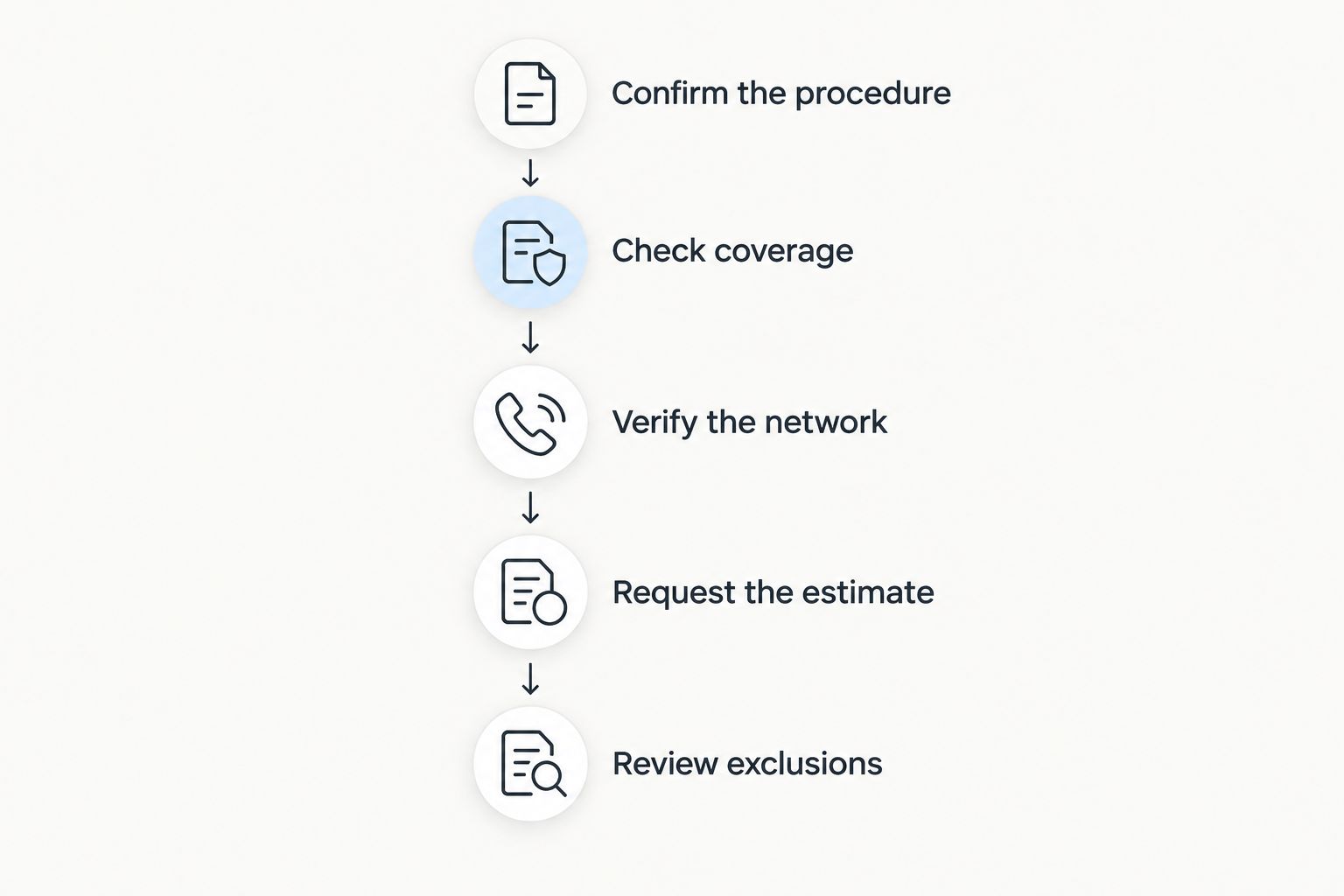
An estimate is useful only when it matches the procedure and location you plan to use.
Keep the clinical and billing questions separate. Your clinician explains why the procedure is appropriate; the insurer and billing teams explain how the proposed services are covered and billed.
Does insurance approval mean I will owe nothing?
Insurance approval is not a promise of full payment. Prior authorization addresses a plan’s review requirements; your deductible, copayment, coinsurance, eligibility, and other coverage rules still apply.
Ask your insurer whether approval is needed and whether it has been issued for the planned service. Then ask for your expected responsibility based on the provider, facility, and benefits available on the treatment date.
Keep the authorization reference and the estimate, but understand their different roles. The final claim reflects the services actually delivered and the insurer’s processing of those services.
If the procedure is denied, ask for the written reason. Your treating office can explain whether additional clinical documentation or an appeal is appropriate; approval should never be assumed while that review is unresolved.
What should I ask if I am paying without insurance?
Request a written estimate covering all expected billing parties. Ask whether the quoted amount includes the clinician, facility, guidance, medication, sedation, and planned follow-up, rather than accepting a single unexplained figure.
Under the federal No Surprises Act, uninsured patients and patients not using insurance generally have a right to a good faith estimate when care is scheduled or when they request one. Federal eligibility and timing rules apply, so ask the billing office how to obtain the appropriate document.
In 2026, distinguish that formal estimate from an informal telephone quote. Read the listed services and exclusions, and ask how to obtain estimates for any separately billing providers or facilities.
Do not assume a payment arrangement exists. Ask the office directly about its current terms and obtain any agreement in writing before treatment.
How should I weigh the expense against the expected benefit?
Decide on a celiac plexus procedure through a clinical risk-benefit discussion, not a billing comparison alone. Ask what improvement the clinician expects, how it will be assessed, and what the next step is if relief is incomplete.
Potential side effects include temporary diarrhea, lightheadedness from lower blood pressure, and soreness. Bleeding, infection, and injury to nearby structures are additional risks that your clinician should discuss in relation to your health and the planned technique.
Tell the treating team about blood thinners, allergies, previous reactions to procedures, and other medical conditions. Do not stop prescribed medication on your own; obtain specific instructions from the clinicians responsible for your care.
Ask about transportation, activity restrictions, and follow-up before scheduling. These practical arrangements affect your planning even when they are not part of the medical bill.
Where can New Jersey patients start the evaluation?
Hudson Pain and Spine is best suited to New Jersey patients seeking a board-certified interventional pain management evaluation. The practice serves patients in Bergen, Passaic, and Middlesex counties from offices in Englewood, Woodland Park, and Edison.
Hudson Pain and Spine provides interventional pain management services, including nerve blocks. Ask the practice whether it evaluates your abdominal pain condition and performs or coordinates the specific celiac plexus procedure your referring clinician recommends.
A specialist evaluation helps connect the diagnosis, treatment options, and safety considerations. It does not guarantee that a celiac plexus procedure is appropriate, that insurance will cover it, or that treatment will provide relief.
Discuss your pain management evaluation
Ask whether your diagnosis and proposed nerve block fit the practice’s services.
FAQ
How do I find my celiac plexus block cost in 2026?
Request an itemized estimate for the exact procedure, location, and insurance arrangement. Confirm whether clinician, facility, imaging guidance, and anesthesia services are included or billed separately.
Does insurance cover a celiac plexus block?
Coverage depends on your plan, diagnosis, proposed procedure, and medical-necessity requirements. Ask your insurer to verify benefits and any prior authorization requirement before scheduling.
Is celiac plexus neurolysis the same as a celiac plexus block?
Celiac plexus neurolysis is different from a temporary local-anesthetic block. Neurolysis uses an agent to disrupt nerve transmission, so the treatment decision and billing estimate should identify the exact procedure.
Will the facility send me a separate bill?
A facility can bill separately from the treating clinician. Ask whether the proposed location has a separate facility charge and obtain an estimate from that billing party.
Can I request an estimate if I do not have insurance?
Uninsured patients generally can request a good faith estimate under federal rules. Ask what services it covers and whether separately billing providers or facilities require additional estimates.
Does a celiac plexus block treat every kind of abdominal pain?
A celiac plexus block does not treat every cause of abdominal pain. A clinician must assess your diagnosis and whether the celiac plexus is an appropriate treatment target.
Can Hudson Pain and Spine help me decide what evaluation I need?
Hudson Pain and Spine provides board-certified interventional pain management services in New Jersey. Ask whether the practice evaluates your specific abdominal pain diagnosis and offers or coordinates the proposed procedure.
One last thing
Before accepting an estimate, ask whose bills it includes. A detailed clinician estimate can still leave another billing party outside its scope, so obtain that answer in writing.
For your 2026 treatment plan, keep the procedure name, location, authorization information, and estimates together. That simple record makes it easier to identify what changed if a later bill differs from your expectations.
Related guides
- How celiac plexus blocks relieve chronic abdominal pain
- How to get insurance approval for pain procedures
- What to expect after a nerve block procedure
About the Medical Reviewer
Dr. Saurabh Dang is a double board-certified interventional pain management specialist serving Central and Northern New Jersey. He combines clinical expertise with a patient-centered approach to help patients find lasting relief from chronic pain conditions.
Read Full Bio →Seeking Treatment for Nerve Block Injections?
Dr. Dang and the team at Hudson Pain and Spine offer specialized care and advanced interventional treatments.
Ready to Find Relief from Pain?
Schedule your consultation with Dr. Saurabh Dang at our Englewood office.
Serving patients across Central and Northern New Jersey — Bergen, Passaic, and Middlesex counties.