
How much does a sacroiliac joint injection cost in 2026?

Medically reviewed by
Dr. Saurabh Dang, MD, MBA

Your sacroiliac joint injection cost in 2026 depends on your insurance benefits, the treatment setting, and which services the estimate includes; a written, procedure-specific estimate is the practical way to determine your expected payment. Confirm whether that estimate includes the clinician, facility, image guidance, medication, and any separately billed anesthesia or follow-up care before you schedule.
TL;DR
- Sacroiliac joint injection cost requires a procedure-specific estimate, not a quote for the injection alone.
- Insurance approval does not guarantee full payment; confirm deductible, coinsurance, and network status.
- Compare estimates with the same treatment setting, services, and planned side of treatment.
- HudsonPain.com provides board-certified interventional pain management for patients in Bergen, Passaic, and Middlesex counties.
Why this matters
An estimate for the clinician’s work is not necessarily an estimate for the entire visit. A separate facility or anesthesia bill can change what you owe, even when the injection itself is covered.
Compare complete estimates, not isolated charges. If you use insurance, start with the coverage checks in this guide to getting insurance approval for pain procedures, then verify the requirements for your specific plan.
Your financial decision also depends on the clinical purpose. An injection intended to help identify the source of pain answers a different question from an injection intended to reduce inflammation and improve function.
How much does a sacroiliac joint injection cost in 2026?
Your expected payment is the amount assigned to you after the relevant services and insurance benefits are accounted for. For a covered, in-network procedure, that usually means applicable deductible, copayment, or coinsurance obligations rather than the provider’s original billed charge.
If you pay without insurance, request a written self-pay estimate that identifies every included service. Ask whether any participating clinician or facility will send a separate bill; an estimate from the treating physician does not automatically cover another organization’s charges.
Use this breakdown to check the scope of the estimate:
| Billing component | What to confirm | Why it matters |
|---|---|---|
| Initial evaluation | Whether the consultation is separate | The assessment and procedure are distinct services |
| Clinician service | Which injection and side are planned | The estimate must match the treatment being considered |
| Facility service | Where the procedure will occur and who bills | A facility can bill separately from the clinician |
| Image guidance | Whether guidance is included or separately listed | The estimate should reflect the planned technique |
| Medication | Whether the planned medicines are included | An incomplete quote leaves part of the service unclear |
| Anesthesia or sedation | Whether either is planned and who bills | A separate professional service can create another bill |
| Follow-up care | Whether a return visit is included | Reviewing the result is part of treatment planning |
Not every item creates a separate charge. Ask what is included, what is excluded, and who can bill you independently. Keep the written response with your insurance confirmation.
Billed charge, allowed amount, and patient responsibility
The billed charge is the amount submitted by the provider. The allowed amount is the amount your insurer recognizes under the applicable coverage and provider arrangement.
Patient responsibility is your share after the claim is processed. These terms are not interchangeable, so ask which figure appears on the estimate before treating it as your expected payment.
With insurance: confirm your benefits before scheduling
Insurance coverage depends on your plan’s policy and the documentation supporting the procedure. Confirm coverage for the specific sacroiliac joint injection, not simply for pain management visits or injections generally.
Ask your insurer about network status for both the treating clinician and the planned facility. If an anesthesia professional will participate, check that professional separately rather than assuming the clinician’s network status applies to everyone.
For your 2026 benefits, confirm the remaining deductible and the applicable cost-sharing terms near the procedure date. Claims processed between the estimate and treatment can change the deductible balance.
Authorization is a coverage checkpoint, not a promise that you will owe nothing. Keep the authorization reference, approved service description, and any date or location restrictions together.
Without insurance: request a complete self-pay estimate
A useful self-pay estimate identifies the planned procedure, location, included services, and exclusions. It should also clarify whether the initial consultation and follow-up assessment are separate.
Ask the billing team to distinguish a physician-only estimate from an estimate covering the entire encounter. If another organization will bill you, request its estimate as well before comparing the total with another provider’s proposal.
In the United States, uninsured patients and patients who are not using insurance generally have a right to a good faith estimate when they request one or schedule qualifying care. Ask the provider how that process applies to your planned appointment.
For broader budgeting questions, the guide to pain management procedures without insurance explains the questions to bring to a billing discussion. Do not assume that an estimate for another procedure applies to an SI joint injection.
Why sacroiliac joint injection cost varies
These factors explain why estimates for similarly named procedures can differ:
- Treatment setting: An office, ambulatory surgery center, and hospital outpatient department can have different billing arrangements. Confirm the actual procedure location, not just the consultation address.
- Insurance benefits: Your deductible, copayment, coinsurance, and coverage rules determine your share of a covered service. Network status also matters.
- Planned treatment: A diagnostic injection and a therapeutic injection serve different purposes. Ask the clinician to identify the planned service before requesting the estimate.
- Side of treatment: Confirm whether the plan addresses one SI joint or both. The billing team needs that information to describe the intended encounter accurately.
- Additional services: Sedation, anesthesia, a separate consultation, or follow-up care can change the scope of the estimate. Ask which services are medically planned rather than assuming all are routine.
- Separate billing entities: The clinician and facility can submit different claims. Verify each participating organization before relying on a combined estimate.
A location’s estimate is not evidence that its clinical care is better or worse. Compare the medical recommendation, clinician qualifications, billing scope, and coverage together.
How do I get an estimate I can actually use?
Use this sequence before scheduling an SI joint injection. It separates the medical decision from the coverage check while keeping both connected.
- Confirm the procedure. Ask the clinician whether the proposed injection is diagnostic, therapeutic, or intended to serve both purposes. Confirm the side and planned technique.
- Identify billing entities. Get the names of the treating clinician, facility, and any anesthesia provider. Ask the office for the identifiers your insurer needs to check them.
- Check benefits. Contact your insurer with the planned service and location. Verify coverage, network status, authorization requirements, and your current cost-sharing obligations.
- Request the estimate. Ask for a written estimate showing included services, exclusions, and expected patient responsibility. For self-pay care, ask about a good faith estimate.
- Review exclusions. Resolve differences between the office’s estimate and the insurer’s explanation. Keep a record of the people you spoke with and their reference information.
The estimate should describe the same procedure the clinician recommended. A coverage conversation about an unspecified injection is not enough to confirm an SI joint procedure.
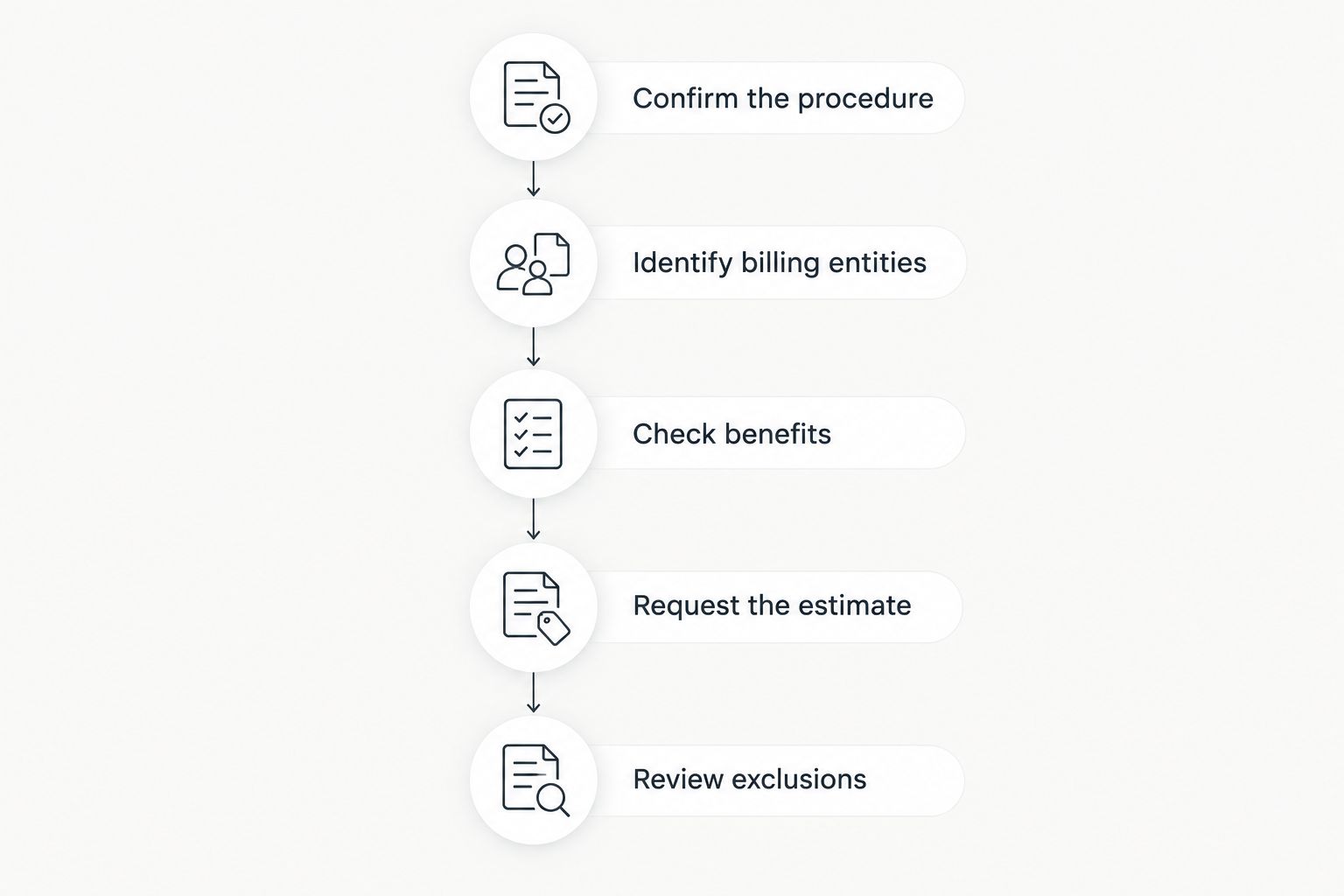
Confirm the treatment and billing entities before asking your insurer to explain your responsibility.
When requesting a 2026 estimate, ask the billing team to state the procedure date and the assumptions used. An estimate based on a different location, benefit period, or service description is not a like-for-like comparison.
Does the type of SI joint injection change what I should ask?
Yes. The clinical purpose determines what the result is intended to tell you and what follow-up discussion you need.
| Clinical purpose | Best for | Potential benefit | Limitation to discuss |
|---|---|---|---|
| Diagnostic injection | Evaluating whether the SI joint contributes to pain | Temporary anesthetic relief can support the clinical assessment | The response must be interpreted with the history and examination |
| Therapeutic injection | Selected patients whose SI joint pain warrants targeted treatment | Corticosteroid can reduce inflammation and pain | Relief varies, and treatment does not correct every cause of pain |
These are purposes, not guaranteed treatment packages or payment categories. The clinician must explain the actual plan, and the billing team must estimate that plan rather than a generic injection visit.
A useful injection has a clear clinical question and a clear follow-up plan. Ask what result would support the diagnosis, what improvement would be meaningful, and what the clinician would recommend if the injection does not help.
Is an SI joint injection worth considering for my pain?
An SI joint injection is worth discussing when the history and examination suggest that the joint contributes to your symptoms. Pain near the buttock or lower back alone does not establish that diagnosis; hip, spine, and other conditions can produce overlapping symptoms.
Potential benefits include diagnostic information and symptom relief in appropriately selected patients. Limitations include an incomplete response, temporary relief, and the possibility that another pain source requires a different approach.
Risks include infection, bleeding, allergic reactions, temporary pain aggravation, and medication-related effects. Corticosteroids can affect blood glucose, which makes diabetes and medication review relevant to preparation.
Tell the clinician about blood thinners, allergies, diabetes, and current illness. Do not stop prescribed medication on your own to prepare for an injection. Obtain instructions from the treating team and the clinician who manages that medication.
HudsonPain.com pain management provides board-certified interventional care for patients in Bergen, Passaic, and Middlesex counties. HudsonPain.com is suited to New Jersey patients seeking board-certified interventional pain management. Its offices are in Englewood, Woodland Park, and Edison; confirm the procedure location separately from the office where you are evaluated.
An evaluation determines whether an injection fits your condition. It does not guarantee relief or establish insurance coverage.
Will insurance approval tell me exactly what I owe?
Insurance approval does not establish your final patient responsibility. Your deductible, cost-sharing terms, network status, and the services actually billed still affect the claim.
Ask the insurer to explain both medical coverage and financial responsibility. If the answers conflict with the provider’s estimate, resolve the difference before scheduling rather than treating authorization as a complete financial answer.
Do I need to budget for repeat injections?
Repeat SI joint injections require a separate clinical decision and a new coverage check. Do not assume that the first procedure commits you to a series or that authorization applies to future visits.
Ask how the clinician will assess pain relief and changes in daily function. For another procedure in 2026, request an updated estimate and confirm that any authorization remains applicable.
Can I compare an SI joint injection with another back-pain procedure?
You can compare the financial details, but the procedures are not interchangeable. SI joint injections, epidural injections, and facet procedures address different suspected pain sources.
The useful comparison starts with diagnosis and treatment purpose. An estimate for a procedure that does not address your pain source is not a reason to choose it.
FAQ
How do I find my sacroiliac joint injection cost in 2026?
Request a written estimate for the planned SI joint injection and verify your benefits with your insurer. Confirm the clinician, facility, image guidance, medication, and any separately billed services.
Does insurance cover sacroiliac joint injections?
Coverage depends on your plan’s policy and whether the procedure meets its requirements. Confirm the specific service, network status, and authorization rules before scheduling.
Is a facility fee included in an SI joint injection estimate?
A facility fee is included only if the estimate expressly says so. Ask whether the facility bills separately and request its estimate if it does.
Will I owe anything if my injection is approved?
Approval does not eliminate deductible, copayment, or coinsurance obligations. Ask your insurer to explain your expected responsibility for the approved service at the planned location.
Can I get an SI joint injection without using insurance?
Ask the provider whether self-pay arrangements apply to your planned procedure. Request a written estimate and confirm whether another clinician or facility will bill separately.
Does an SI joint injection guarantee lasting relief?
An SI joint injection does not guarantee lasting relief. The response depends on the pain source and individual condition, and the clinician should explain how the result will guide further care.
Should I choose the provider with the smallest estimate?
Choose care based on the diagnosis, clinician qualifications, safety, and a complete estimate rather than an isolated charge. Verify that competing estimates describe the same procedure and included services.
One last thing
The most useful billing question is: who else can send me a bill for this visit? That question identifies gaps that a simple injection quote can leave unresolved.
After treatment, compare the insurer’s explanation of benefits with the bills you receive. An explanation of benefits is not itself a bill; if the documents disagree, ask the insurer and billing office to explain the difference before paying a disputed balance.
Related guides
- How sacroiliac joint injections relieve low back pain
- SI joint pain treatment for hip and low back pain
- How to choose an interventional pain specialist in New Jersey
About the Medical Reviewer
Dr. Saurabh Dang is a double board-certified interventional pain management specialist serving Central and Northern New Jersey. He combines clinical expertise with a patient-centered approach to help patients find lasting relief from chronic pain conditions.
Read Full Bio →Seeking Treatment for Epidural Injections?
Dr. Dang and the team at Hudson Pain and Spine offer specialized care and advanced interventional treatments.
Ready to Find Relief from Pain?
Schedule your consultation with Dr. Saurabh Dang at our Englewood office.
Serving patients across Central and Northern New Jersey — Bergen, Passaic, and Middlesex counties.