
How Pain Affects Quality of Life: What You Need to Know

Medically reviewed by
Dr. Saurabh Dang, MD, MBA
How Pain Affects Quality of Life: What You Need to Know

Chronic pain is defined as persistent pain lasting three months or more, and its impact on quality of life extends far beyond physical discomfort. How pain affects quality of life touches every dimension of daily living, from your ability to get dressed in the morning to your capacity to maintain relationships and hold a job. Research shows that pain intensity and anxiety together mediate the link between chronic pain and reduced health-related quality of life (HRQoL). The clinical term HRQoL captures physical, emotional, and social functioning as a single measure of well-being. Understanding this connection is the first step toward doing something about it.
How does chronic pain affect quality of life and daily function?
Chronic pain directly limits your ability to perform activities of daily living (ADLs), which include basic tasks like bathing, cooking, and walking. A study of 181 adults at a chronic pain clinic found that seven quality-of-life domains scored below 50 out of 100, indicating broadly poor functioning across energy, emotional well-being, social functioning, and general health. That finding means most patients were struggling in nearly every measurable area of life, not just with pain itself.
Physical decline from chronic pain often follows a predictable pattern:
-
Reduced movement: Pain makes physical activity feel risky, so many patients move less over time.
-
Sleep disruption: Chronic pain disrupts sleep and daily activities, which compounds fatigue and lowers pain tolerance the next day.
-
Deconditioning: Prolonged inactivity weakens muscles and joints, making pain worse and recovery harder.
-
Weight and cardiovascular effects: Reduced activity contributes to weight gain and cardiovascular strain, both of which feed back into pain severity.
The trap many patients fall into is complete rest. Total rest may actually prolong or worsen symptoms over time. The nervous system needs gentle, consistent input to recalibrate. Avoiding all movement teaches the brain that movement equals danger, which amplifies pain signals even when no new tissue damage exists.
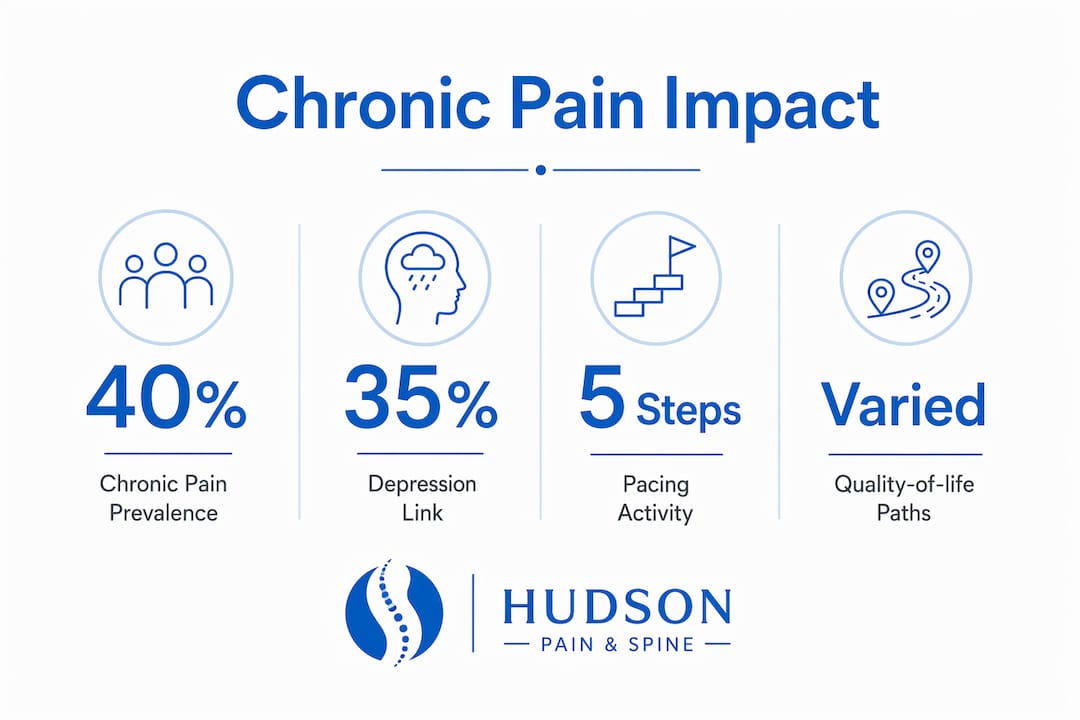
Pro Tip: Start with five minutes of gentle walking each day and add one minute per week. This pacing approach helps your nervous system adjust without triggering a major flare.

If your pain started or worsened from sitting long hours, you are not alone. New Jersey commuters and desk workers face this pattern regularly, and Hudson Pain and Spine sees it frequently across Bergen, Passaic, and Middlesex counties.
What are the mental health effects of chronic pain?
Chronic pain and mental health disorders form a two-way relationship, each making the other worse. Between 35% and 40% of patients with chronic pain suffer from depression. That rate is far higher than in the general population, and it reflects a neurochemical reality: the brain regions that process pain overlap significantly with those that regulate mood, including the prefrontal cortex and limbic system.
The emotional consequences of living with persistent pain include:
-
Depression: Persistent low mood, loss of motivation, and hopelessness are common and clinically significant.
-
Anxiety: Fear of pain flares leads to hypervigilance, which itself amplifies pain perception.
-
Social withdrawal: Patients cancel plans, avoid gatherings, and gradually lose their social network.
-
Identity loss: When pain prevents you from doing what you love, your sense of self erodes.
“Pain is not just a sensation. It is an experience that reshapes how a person sees themselves and their future.” This perspective, reflected in current pain medicine research, explains why treating pain with medication alone rarely restores full quality of life.
Improving pain intensity requires simultaneous attention to anxiety and depression symptoms. Addressing only the physical component leaves the emotional cycle intact. Relaxation techniques, talking therapies like cognitive behavioral therapy (CBT), and structured social engagement all reduce the mental burden of chronic pain. NHS Inform guidance confirms that stress increases symptom flares and that relaxation and talking therapies directly support mental health in chronic pain patients.
How does chronic pain strain relationships and social life?
Chronic pain does not stay private. It reshapes every relationship you have, including with your partner, your children, your coworkers, and your friends. The impact of pain on life at a social level is one of the least discussed but most damaging aspects of the condition.
Here are four ways chronic pain commonly disrupts social and relational functioning:
-
Occupational limitations: Pain restricts your ability to work consistently, which affects income, professional identity, and daily structure. Sick leave due to chronic pain is associated with worse physical and mental HRQoL outcomes, compounding the original problem.
-
Relationship strain: Partners and family members often take on caregiving roles. Over time, this shift in dynamic creates tension, resentment, or emotional distance on both sides.
-
Loss of meaningful activities: When pain stops you from hiking, playing with your kids, or attending social events, you lose the experiences that anchor your identity and self-esteem.
-
Reduced support networks: Social withdrawal shrinks your circle. Smaller networks mean less emotional support, which worsens depression and anxiety, which in turn worsens pain.
Social support acts as a genuine buffer against pain’s effects. Patients with strong social connections report better coping, better treatment adherence, and better outcomes overall. Building and maintaining those connections, even in small ways, is a legitimate part of pain management. Pain severity impacts multiple life domains but must be understood within each patient’s broader social and health context to guide effective care.
Do all chronic pain patients follow the same quality-of-life path?
No. Quality-of-life trajectories vary widely among patients, and this variability matters for treatment planning. A prospective cohort study of 608 older adults with chronic pain used machine learning to identify distinct HRQoL trajectory patterns, including stable, declining, and persistently low physical health groups. Mental health trajectories showed separate patterns of improvement or decline, often independent of physical status.
| Trajectory type | Physical HRQoL | Mental HRQoL | Key predictors |
|---|---|---|---|
| Stable | Maintained | Maintained | Lower baseline pain, good ADL function |
| Declining physical | Worsening | Variable | High pain severity, poor ADL scores |
| Declining mental | Stable | Worsening | Depression, social isolation |
| Persistently low | Poor throughout | Poor throughout | Severe baseline disability |
The most important insight from this data is that mental health can decline even when physical status stabilizes. A patient who reports manageable pain levels may still be experiencing serious emotional deterioration. Tracking both dimensions separately is not optional. It is clinically necessary.
Patients with severe baseline pain-related impairment show limited improvement over six months in most outcomes from multidisciplinary treatment. That finding argues strongly for early, comprehensive assessment rather than waiting until pain becomes disabling. The sooner functional impairment and mental health are evaluated together, the more treatment options remain available.
Pro Tip: Ask your care team to assess both your physical function and your mood at every visit, not just your pain score on a scale of 0 to 10. A single number cannot capture what chronic pain actually does to your life.
Key Takeaways
Chronic pain reduces quality of life across physical, mental, social, and functional domains simultaneously, and effective management requires addressing all four areas together.
| Point | Details |
|---|---|
| Pain affects all life domains | Chronic pain impairs physical function, mental health, relationships, and daily activities at the same time. |
| Mental health is a core target | Between 35% and 40% of chronic pain patients develop depression; treating mood is as important as treating pain. |
| Inactivity worsens outcomes | Total rest accelerates deconditioning and amplifies pain signals; paced activity is safer and more effective. |
| Trajectories differ by patient | Some patients decline physically, others mentally; monitoring both separately enables better care decisions. |
| Early assessment matters | Patients with severe baseline disability show limited improvement later; early evaluation preserves more options. |
What I have learned from watching patients live with chronic pain
The number that concerns me most in pain medicine is not the pain score. It is the gap between what a patient used to do and what they can do now. That gap tells you more about suffering than any numeric rating scale ever will. The AMA now recommends assessing pain by asking how it affects specific daily activities and personal goals, not just by asking patients to rate their pain from 1 to 10. That shift reflects what experienced clinicians have known for years.
What I see consistently is this: patients who receive only physical treatment, whether that is medication, injections, or surgery, often plateau. The ones who make real progress are those whose care teams also address sleep, mood, and social connection. Pain avoidance is the silent saboteur. When patients stop moving because movement hurts, the nervous system interprets that avoidance as confirmation that the body is damaged. Breaking that cycle requires courage and guidance, not just prescriptions.
The other thing worth saying plainly is that chronic pain is not a character flaw or a failure of willpower. It is a complex condition with measurable neurological, psychological, and social dimensions. Patients deserve care that reflects that complexity. If your current treatment plan focuses only on your pain score, it is worth asking for more.
Chronic pain care at Hudson Pain and Spine: what a full assessment looks like
Living with chronic pain does not have to mean accepting a diminished life. Hudson Pain and Spine offers a full range of interventional and supportive therapies designed to address both physical function and overall well-being.
Assessments go beyond pain scores. The team evaluates how pain affects your daily activities, your sleep, and your mental health, then builds a treatment plan around your specific goals. Options include epidural injections, nerve blocks, spinal cord stimulation, and Botox therapy for chronic headaches. Patients across Bergen, Passaic, and Middlesex counties can access care at multiple convenient New Jersey locations. If you are ready for a fuller assessment, schedule a consultation.
FAQ
How does chronic pain affect mental health?
Chronic pain and depression share overlapping brain pathways, and between 35% and 40% of chronic pain patients develop clinical depression. Anxiety is equally common, as fear of pain flares creates a cycle that amplifies pain perception.
Can chronic pain permanently reduce quality of life?
Quality-of-life trajectories vary widely. Some patients stabilize, while others experience declining physical or mental health over time. Early, comprehensive assessment and treatment significantly improve long-term outcomes.
What daily activities does chronic pain most commonly disrupt?
Chronic pain most commonly disrupts sleep, basic self-care tasks, work performance, and social participation. Research shows that higher pain severity correlates with worse scores in energy, emotional well-being, and social functioning.
Does staying active really help with chronic pain?
Yes. Safe pacing and regular activity reduce flare frequency by helping the nervous system recalibrate. Total rest worsens deconditioning and can prolong symptoms.
Why is a pain score of 0 to 10 not enough for treatment planning?
A single numeric score does not capture how pain affects your specific goals, relationships, or daily function. The AMA recommends goal-centered pain assessment that focuses on functional limitations to enable more meaningful treatment plans.
Recommended
-
Enough is enough: advanced treatment for chronic pain | Hudson Pain and Spine Blog
-
How your daily commute leads to chronic pain | Hudson Pain and Spine Blog
-
Pain Management Services Englewood NJ | Hudson Pain and Spine
-
Living with Osteoarthritis: How Interventional Pain Management Can Help | Hudson Pain and Spine Blog
About the Medical Reviewer
Dr. Saurabh Dang is a double board-certified interventional pain management specialist serving Central and Northern New Jersey. He combines clinical expertise with a patient-centered approach to help patients find lasting relief from chronic pain conditions.
Read Full Bio →Seeking Treatment for Chronic Pain?
Dr. Dang and the team at Hudson Pain and Spine offer specialized care and advanced interventional treatments.
Ready to Find Relief from Pain?
Schedule your consultation with Dr. Saurabh Dang at our Englewood office.
Serving patients across Central and Northern New Jersey — Bergen, Passaic, and Middlesex counties.