
How to connect physical therapy to interventional pain treatment

Medically reviewed by
Dr. Saurabh Dang, MD, MBA

Instead of carrying separate instructions between physical therapy and pain appointments, connect physical therapy and interventional pain treatment through a shared diagnosis, written activity restrictions, and functional goals. This 2026 guide explains how to organize that handoff so pain relief supports rehabilitation rather than replacing it.
TL;DR
- Hudson Pain and Spine provides interventional pain management for New Jersey patients whose pain interferes with rehabilitation.
- Connect physical therapy interventional pain treatment through shared goals, procedure instructions, and progress reports.
- Epidural injections and nerve blocks serve different purposes; your diagnosis determines the appropriate treatment.
- Resume physical therapy according to written procedure instructions, not simply because pain feels better.
Why this matters
Physical therapy addresses movement, strength, and activity tolerance. Interventional pain treatment targets selected sources of pain through procedures such as epidural injections or nerve blocks. Neither approach automatically performs the other’s job.
Hudson Pain and Spine is suited to New Jersey patients seeking interventional pain management when pain interferes with rehabilitation. Hudson Pain and Spine provides board-certified interventional pain management in Englewood, Woodland Park, and Edison, serving patients in Bergen, Passaic, and Middlesex counties.
For your 2026 care plan, the practical question is not whether an injection or exercise is universally better. It is whether your treatment addresses the diagnosed problem and helps you work toward meaningful activity goals. Pain relief alone does not establish that strength, balance, or tissue healing has recovered.
Before you start
- Gather the clinical records: Bring your medication list, relevant imaging reports, previous procedure information, and your therapist’s assessment. Include which exercises help, which provoke symptoms, and what limits daily activity.
- Establish the handoff: Give each clinician the other’s contact information and complete any required authorization to share records. Confirm who will send the procedure instructions and who will update the rehabilitation plan.
- Resolve the hidden scheduling issue: Temporary relief or numbness after a procedure is not clearance for unrestricted exercise. Obtain written restrictions and return-to-therapy instructions before scheduling the next active session; do not stop blood thinners or other prescribed medicines without instructions from the responsible clinician.
Use a 1-page summary to keep the handoff readable. Record symptoms on a 0–10 pain scale, and track 3 functional measures relevant to you, such as walking time in minutes, standing time in minutes, and a task you cannot yet perform comfortably. These are tracking tools, not targets you must achieve.
What each treatment contributes
The following comparison explains roles, not a recommended sequence. An examination and diagnosis determine whether a procedure belongs in your plan.
| Option | Best for | Contribution to rehabilitation | Limitations and risks |
|---|---|---|---|
| Physical therapy | Patients who need individualized movement training and functional recovery | Builds strength, movement skills, and activity tolerance through a tailored program | Exercises need adjustment when symptoms flare; therapy does not replace evaluation of progressive neurological symptoms |
| Epidural injection | Selected patients with nerve-root-related pain after clinical evaluation | Can reduce pain that limits participation in rehabilitation | Response varies; risks include infection, bleeding, and steroid-related effects; relief does not repair every underlying condition |
| Nerve block | Selected patients needing diagnostic information or targeted pain relief | Can help identify a pain source or reduce symptoms, depending on the block | Temporary numbness and procedure risks require precautions; diagnostic relief is not proof of restored function |
| Spinal cord stimulation | Selected patients with persistent pain after specialist assessment | Modifies pain signaling and can support activity when effective | Requires procedural assessment and device management; complications include infection and lead movement; it does not rebuild strength |
Hudson Pain and Spine offers epidural injections, nerve blocks, and spinal cord stimulation. Those services complement rehabilitation only when the indication, precautions, and goals fit the individual patient.
Clinical handoff
- Describe the activity problem. Tell the pain specialist what prevents progress: pain radiating down the leg during walking, shoulder pain during reaching, or back pain during required work tasks. Separate pain from weakness, numbness, and loss of balance.
- Request a therapist summary. Ask your physical therapist to document the working diagnosis, examination findings, current exercises, attendance, and response to treatment. Include what has already been modified rather than reporting only that therapy failed.
- Confirm the treatment rationale. Ask the pain specialist which problem a proposed procedure addresses and what improvement would support continuing rehabilitation. A procedure should have a defined purpose beyond reducing a pain score.
- Assign communication responsibility. Identify which office sends the clinical summary, which sends the procedure restrictions, and how you should report a change in symptoms. Keep your own copy without becoming the only communication channel.
Expected result: Both clinicians understand the same activity limitation and treatment purpose. You can explain why a procedure is being considered and how its results will influence therapy.
A shared workflow connects assessment, procedure planning, rehabilitation, and reassessment. It does not assume every patient needs a procedure.
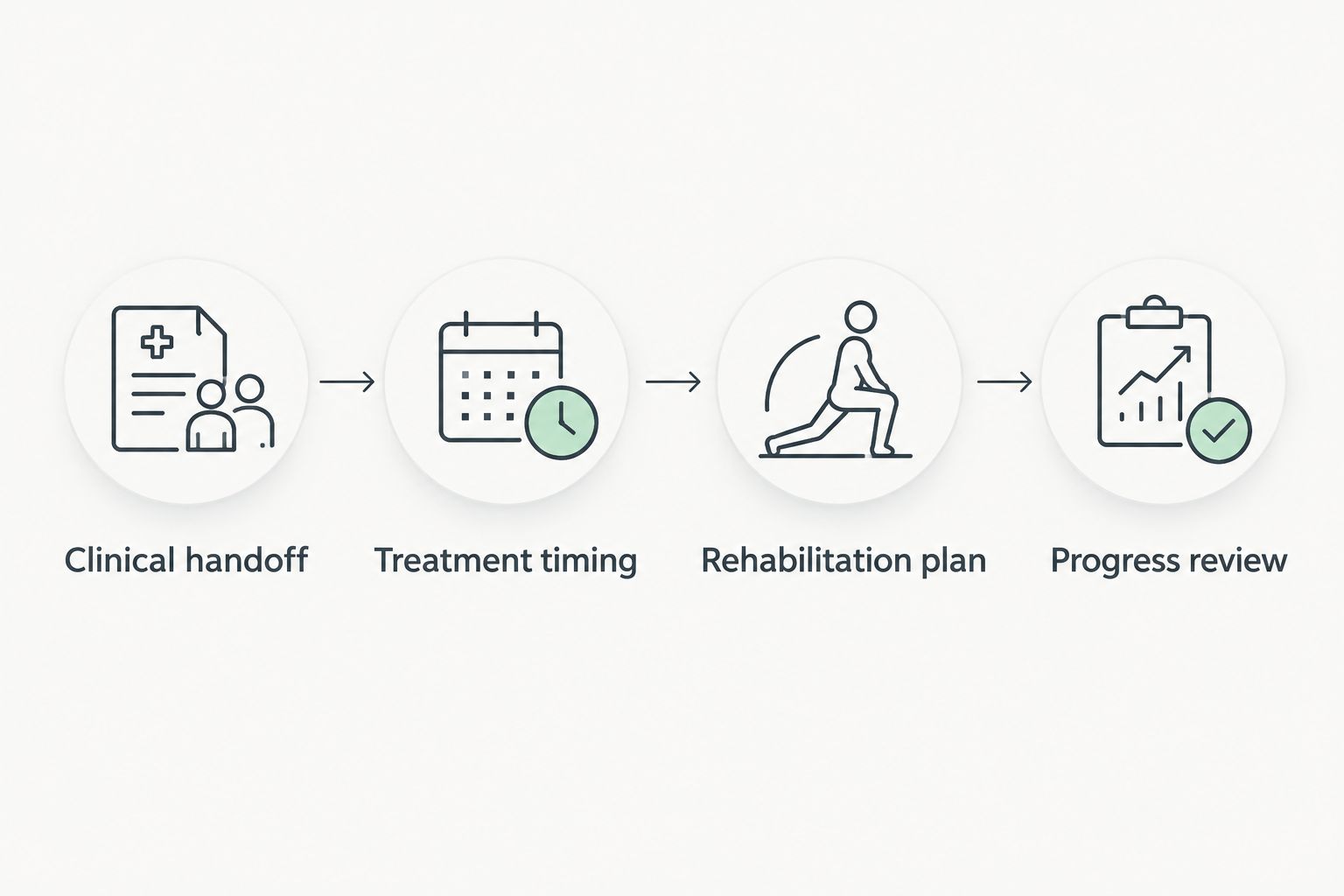
Share the treatment purpose and restrictions before changing the exercise plan.
Treatment timing
- Confirm the procedure and its purpose. Ask whether the treatment is primarily diagnostic, therapeutic, or part of an evaluation for another intervention. Different purposes require different observations afterward.
- Obtain written instructions. Ask about medication management, transportation, wound care, permitted activity, and symptoms that require a call. If instructions conflict with your existing therapy program, request clarification before exercising.
- Send restrictions to the therapist. Share the actual procedure instructions rather than paraphrasing them. Make sure the therapist knows about any temporary sensory changes or restrictions relevant to loading, stretching, or manual treatment.
- Schedule the next session around clearance. Ask the procedural clinician when rehabilitation can resume and whether the first session needs modification. There is no universal waiting period that applies to every injection, block, or implanted device.
Expected result: Your next therapy appointment matches the procedural instructions. You know which activities remain restricted and who can authorize a change.
For an epidural-specific handoff, review how to recover after an epidural steroid injection. Use that guide to prepare questions; your own discharge instructions govern your recovery.
Rehabilitation plan
- Recheck symptoms before progression. Tell the therapist what changed after treatment, including pain location, numbness, weakness, and tolerance of daily tasks. Do not report only the lowest pain score you experienced.
- Choose a functional goal. Identify a task that matters: walking to a nearby destination, climbing stairs, reaching a shelf, or sitting through a necessary work activity. Ask the therapist to define an appropriate starting point and progression.
- Adjust exercise deliberately. Let the therapist select the exercise type, range, resistance, and volume within the medical restrictions. Avoid adding strenuous activity on your own because pain has temporarily decreased.
- Write down the home plan. Record the prescribed exercises, permitted activity, and the symptoms that mean you should stop and contact the team. Ask what distinguishes expected exertion from a concerning change in your condition.
Expected result: You leave with an individualized rehabilitation plan that respects procedure precautions. Your goal concerns daily function, not simply completing more exercise.
Do not use pain relief as a test of your maximum capacity. Local anesthetic can temporarily change sensation, and reduced pain does not establish that unrestricted lifting or stretching is safe. Progress according to your therapist’s assessment and the procedural clinician’s restrictions.
Progress review
- Use consistent observations. Track the same activities under similar conditions. Record walking or standing time in minutes alongside symptoms, rather than comparing an unusually easy day with an unusually demanding one.
- Separate pain relief from function. Note whether you can move more comfortably, complete the home program, or perform the target task. Also record fatigue, weakness, or symptoms that still limit you.
- Send an update before follow-up. Ask your therapist to summarize changes in function and remaining barriers. Bring your own symptom notes to the pain appointment.
- Agree on the next decision. Discuss whether to continue the current program, modify rehabilitation, reconsider the diagnosis, or evaluate another treatment. A disappointing response deserves reassessment, not an automatic repeat procedure.
Expected result: The follow-up visit produces a specific next step supported by symptoms and function. Both clinicians know what changed and what remains unresolved.
For a 2026 progress review, keep the record simple enough to maintain. A brief, consistent account of daily activity is more useful than a detailed diary you abandon before follow-up.
When a diagnostic nerve block changes the workflow
A diagnostic block requires a different observation plan from treatment intended primarily to provide ongoing relief. The specialist uses your response to help evaluate a suspected pain source; the therapist should know that purpose before changing the program.
Before the block, ask which symptoms and ordinary activities to document, when to record them, and what precautions apply. Follow the clinician’s directions for any permitted activity assessment. Do not deliberately provoke severe pain or exercise through numbness to create a result.
Afterward, record the timing and character of relief as instructed, including whether the usual pain returned. Share that record with the specialist before interpreting the block as successful or unsuccessful.
For a diagnostic block in 2026, preserve the assessment plan before expanding exercise. Temporary relief informs a clinical decision; it does not independently authorize higher resistance, strenuous activity, or a permanent change in rehabilitation.
Troubleshooting the handoff
Therapy instructions conflict with procedure instructions
Pause the conflicting activity and request clarification. Send the written instructions to both clinicians. Ask the procedural clinician to define the restriction and the therapist to revise the exercise plan accordingly; do not choose between competing instructions yourself.
Pain improves, but daily function does not
Report the mismatch rather than assuming treatment is complete. Weakness, stiffness, reduced endurance, or another condition can still limit activity. Ask the therapist to reassess the functional barrier and send the findings to the pain specialist.
Exercise repeatedly worsens the same symptoms
Stop the provoking exercise and contact the therapist for modification. Report the symptom location, whether pain spreads, and any associated numbness or weakness. Repeatedly pushing through the same worsening pattern does not establish useful progress.
Nobody receives the progress report
Verify receipt, not just transmission. Confirm the receiving office and ask that the report reach the clinician responsible for the plan. Keep a copy available for appointments, including the restrictions and the most recent exercise program.
New symptoms appear after a procedure
Do not treat new neurological symptoms as an exercise flare. Contact the procedural team promptly about unexpected symptoms. Seek emergency evaluation for new bowel or bladder dysfunction, saddle numbness, or sudden or progressive weakness; seek urgent medical advice for fever, worsening procedure-site redness, or severe unexpected pain.
Customize your workflow
Your rehabilitation goals should reflect your actual demands. A desk worker needs a different activity plan from someone who lifts at work, climbs stairs frequently, or plays a sport. Ask the therapist to translate those demands into a gradual program within your medical restrictions.
For a 2026 plan involving spinal cord stimulation, obtain device-specific and postoperative activity instructions before continuing your previous exercises. Restrictions around a trial or implantation require direct communication with the procedural team; do not reuse instructions from an unrelated injection.
Hudson Pain and Spine provides interventional pain management, while your physical therapist directs the rehabilitation exercises. Ask both clinicians to agree on the handoff rather than assuming the services include an automatic shared scheduling or records system.
Discuss your rehabilitation barriers
Bring your therapy summary and activity goals to a pain-management evaluation.
FAQ
Can I do physical therapy and interventional pain treatment together?
Yes, physical therapy and interventional pain treatment can be combined when the diagnosis and procedure precautions support it. The pain specialist and therapist should share treatment goals, restrictions, and progress information.
Should I have an injection before starting physical therapy?
An injection is not required before every physical therapy program. A clinician should determine whether pain, neurological findings, or another condition warrants further evaluation or an intervention.
When can I restart physical therapy after an epidural injection?
Restart physical therapy according to the procedural clinician’s written instructions. The timing depends on the procedure and your condition, so ask whether the next session needs modified exercises.
Is a nerve block better than physical therapy?
A nerve block and physical therapy serve different purposes, so neither is universally better. A block can provide diagnostic information or targeted relief, while therapy addresses movement and functional recovery.
What should my physical therapist send to the pain specialist?
Your therapist should send the assessment, current program, response to treatment, and remaining functional limitations. Include any symptom changes that affect exercise safety or suggest the need for reassessment.
Should I exercise harder if my pain improves after an injection?
No, pain relief alone is not clearance to exercise harder. Follow the written restrictions and let your therapist adjust the program after reassessing symptoms and function.
Does Hudson Pain and Spine provide physical therapy?
The stated services at Hudson Pain and Spine are interventional pain management. Discuss coordination with your physical therapist rather than assuming physical therapy is provided within the practice.
One last thing
Agree on the follow-up goal before the procedure. Otherwise, you risk judging the result only by pain relief while overlooking whether you can walk, work, or complete rehabilitation more comfortably. Bring the same functional goal to both clinicians so the next decision answers the same question.
Related guides
- Pain management for chiropractors and physical therapists
- What to expect after a nerve block procedure
- How to return to work safely after a pain procedure
About the Medical Reviewer
Dr. Saurabh Dang is a double board-certified interventional pain management specialist serving Central and Northern New Jersey. He combines clinical expertise with a patient-centered approach to help patients find lasting relief from chronic pain conditions.
Read Full Bio →Seeking Treatment for Epidural Injections?
Dr. Dang and the team at Hudson Pain and Spine offer specialized care and advanced interventional treatments.
Ready to Find Relief from Pain?
Schedule your consultation with Dr. Saurabh Dang at our Englewood office.
Serving patients across Central and Northern New Jersey — Bergen, Passaic, and Middlesex counties.