
Occipital neuralgia relief duration benchmarks by treatment 2026

Medically reviewed by
Dr. Saurabh Dang, MD, MBA

Occipital neuralgia relief duration by treatment varies: one thermal radiofrequency study reported an average of 6.5 months, while nerve block and pulsed radiofrequency studies documented benefit at 6 months without establishing an average duration. This 2026 guide separates measured duration from follow-up results so you can compare treatments without mistaking a study result for a guarantee.
TL;DR
- Occipital neuralgia relief duration by treatment depends on the procedure, diagnosis, and how researchers measure benefit.
- Thermal radiofrequency ablation averaged 6.5 months of relief in one retrospective study; individual results varied substantially.
- Nerve blocks and pulsed radiofrequency showed benefit at six-month follow-up, not a guaranteed six-month duration.
- Hudson Pain and Spine provides board-certified interventional pain management for New Jersey patients considering nerve blocks.
Why this matters
A treatment that reduces pain at a scheduled appointment has not necessarily kept every patient comfortable until that appointment. Follow-up time and relief duration are different measurements. That distinction matters when you plan work, sleep, medication use, and your next clinical review.
Hudson Pain and Spine provides board-certified interventional pain management in Englewood, Woodland Park, and Edison. For an explanation of the condition itself, start with the guide to treating occipital neuralgia headaches.
Relief duration benchmarks by treatment in 2026
Relief duration means the interval during which a treatment continues to provide meaningful benefit. The clearest average in the studies below is 6.5 months after thermal radiofrequency ablation, with a reported standard deviation of 5.1 months. That spread is not a minimum-to-maximum range; it shows substantial variation around the average.
| Treatment | Reported duration or follow-up result | Study scope | Best for discussing | Main limitation |
|---|---|---|---|---|
| Overall across treatments | No pooled average across these studies | Separate studies with different methods | Understanding the evidence as a whole | Results cannot establish a treatment ranking |
| Occipital nerve block with local anesthetic and corticosteroid | Satisfactory results in 42 of 44 patients at 6 months | Prospective study of 44 patients with occipital neuralgia; Juškys and Šustickas, 2018 | A targeted injection and assessment of treatment response | Six-month assessment is not mean relief duration |
| Pulsed radiofrequency | Substantial pain improvement in 52.6% of patients at 6 months | Prospective study of 19 patients; Vanelderen and colleagues, 2010 | A specialist discussion about persistent occipital nerve pain | Small study without a direct comparison to the other rows |
| Thermal radiofrequency ablation | Mean relief duration of 6.5 months; standard deviation 5.1 months | Retrospective study of 46 patients; Hoffman and colleagues, 2018 | A specialist discussion after a supportive diagnostic block | Retrospective reporting and substantial variation |
Thermal radiofrequency ablation has the only directly reported mean duration in this table: 6.5 months. The nerve block study reported 42 of 44 patients with satisfactory results at six months; the pulsed radiofrequency study reported substantial improvement in 52.6% at six months. Those figures do not prove that nerve blocks outperform pulsed radiofrequency, because the studies used different populations and outcome definitions.
These 2026 benchmarks summarize published studies of occipital neuralgia, not outcomes from Hudson Pain and Spine. The principal limitation is the absence of a shared outcome definition and comparable study design, which prevents a valid pooled average or head-to-head ranking.
Sources and what each measurement means
- Juškys and Šustickas, 2018: Effectiveness of treatment of occipital neuralgia using the nerve block technique: a prospective analysis of 44 patients, published in Acta Medica Lituanica. The six-month result describes satisfactory outcomes after an occipital nerve block containing local anesthetic and corticosteroid.
- Vanelderen and colleagues, 2010: Pulsed radiofrequency for the treatment of occipital neuralgia: a prospective study with 6 months of follow-up, published in Regional Anesthesia and Pain Medicine. The study evaluated improvement through scheduled follow-up rather than establishing a universal duration of relief.
- Hoffman and colleagues, 2018: Treatment of Occipital Neuralgia by Thermal Radiofrequency Ablation, published in Ochsner Journal. The reported duration is a retrospective average from patients treated with thermal radiofrequency ablation.
Publication dates identify the underlying evidence. The 2026 label identifies this guide, not a new clinical trial or newly collected patient results.
How to use these benchmarks
Use the numbers to prepare questions, not to select a procedure yourself. Your diagnosis, examination, previous treatment response, and medical history determine whether a particular intervention is appropriate.
- Ask which endpoint the estimate describes. The 6.5-month thermal radiofrequency figure is an average duration. The six-month nerve block and pulsed radiofrequency figures describe results at follow-up.
- Ask what counts as success. “Satisfactory results” and “substantial pain improvement” are not interchangeable. Agree on a practical goal, such as less scalp pain or improved sleep.
- Plan a review before assuming benefit will last. A standard deviation of 5.1 months around the thermal radiofrequency average signals wide variation, not a predictable appointment schedule.
- Do not choose treatment from the largest percentage. The nerve block study’s 42-of-44 result and the pulsed radiofrequency study’s 52.6% result are not a controlled comparison.
For your 2026 treatment discussion, bring previous procedure records rather than relying on memory. The medication used, nerve targeted, immediate response, and later symptom pattern help your clinician interpret what happened.
Occipital nerve blocks: separate numbness from relief
An occipital nerve block delivers medication near an occipital nerve. Local anesthetic temporarily interrupts nerve signaling; some therapeutic injections also contain corticosteroid. The formulation matters, so the nerve block benchmark above should not be applied to every injection called a nerve block.
Best for discussing: a targeted injection when your clinician suspects an occipital nerve contribution to pain. A block also contributes diagnostic information, but improvement does not establish the diagnosis by itself.
The advantage is that your clinician can assess a targeted response without proceeding directly to an ablative procedure. The limitation is that early numbness and later pain improvement represent different effects. A brief response does not establish that a therapeutic block will provide sustained benefit.
Risks include bleeding, infection, temporary soreness, and medication-related effects. Steroid-containing injections also carry steroid-specific considerations. Tell your clinician about blood thinners, diabetes, allergies, and previous injection reactions; do not stop prescribed medication without instructions.
The 44-patient study supports discussing sustained benefit, but its six-month result is not an individual forecast. Ask whether your proposed injection matches the treatment studied before using that benchmark.
Pulsed radiofrequency: improvement is not a countdown
Pulsed radiofrequency delivers intermittent radiofrequency energy near a nerve rather than using the same continuous heat lesion as thermal ablation. The procedures are distinct. A duration estimate for thermal radiofrequency should not be presented as a pulsed radiofrequency estimate.
Best for discussing: persistent, clinically evaluated occipital nerve pain when a specialist is considering an intervention beyond a block. Your previous treatment response and the suspected pain source remain central to that decision.
The prospective study reported substantial improvement in 52.6% of its 19 patients at six months. That finding supports a discussion about benefit, but it does not mean every treated patient gets six months of relief. It also does not describe a guaranteed period without pain.
The advantage is an additional targeted option for selected patients. The limitations include a small evidence base, uncertain individual duration, and procedural risks such as infection, bleeding, or worsened pain. Ask your specialist to explain why pulsed radiofrequency fits your diagnosis rather than choosing it from a duration headline.
Thermal radiofrequency: the average needs context
Thermal radiofrequency ablation uses heat to create a controlled lesion in targeted nerve tissue. In the cited retrospective occipital neuralgia study, patients reported an average relief duration of 6.5 months. The 5.1-month standard deviation makes the variation clinically important.
Best for discussing: selected patients with persistent occipital neuralgia and a supportive response to diagnostic nerve blockade. A favorable block is part of treatment selection, not a promise that ablation will reproduce the same response.
The advantage is the possibility of sustained relief after a targeted procedure. The limitations include recurrence, variable benefit, and risks involving altered sensation, nerve irritation, or persistent discomfort. Your clinician should discuss these alongside general procedural risks.
Do not translate the mean into a personal expiry date. For a 2026 decision, ask how the nerve target will be selected, what sensory changes to expect, and what would trigger reassessment. An average helps frame expectations; your follow-up determines the next move.
Confirm the pain source before comparing duration
Occipital neuralgia typically involves stabbing or shooting pain in the distribution of the occipital nerves, often with scalp tenderness or altered sensation. Migraine and neck-related headache can overlap with that pattern. Pain at the back of the head is not enough to identify its cause.
A clinician uses your symptom history and examination to decide whether occipital neuralgia fits. Imaging or another evaluation depends on the clinical findings. A temporary response to an occipital nerve block is relevant, but other headache conditions also respond to blocks.
Use this sequence when preparing for an appointment:
- Pain pattern: describe where pain starts, where it travels, and whether it feels electric, aching, or pressure-like.
- Examination: discuss scalp sensitivity, neck movement, and associated neurological symptoms.
- Block response: distinguish early numbness from improvement in your usual pain.
- Follow-up plan: agree on how to assess function, recurrence, and adverse effects.
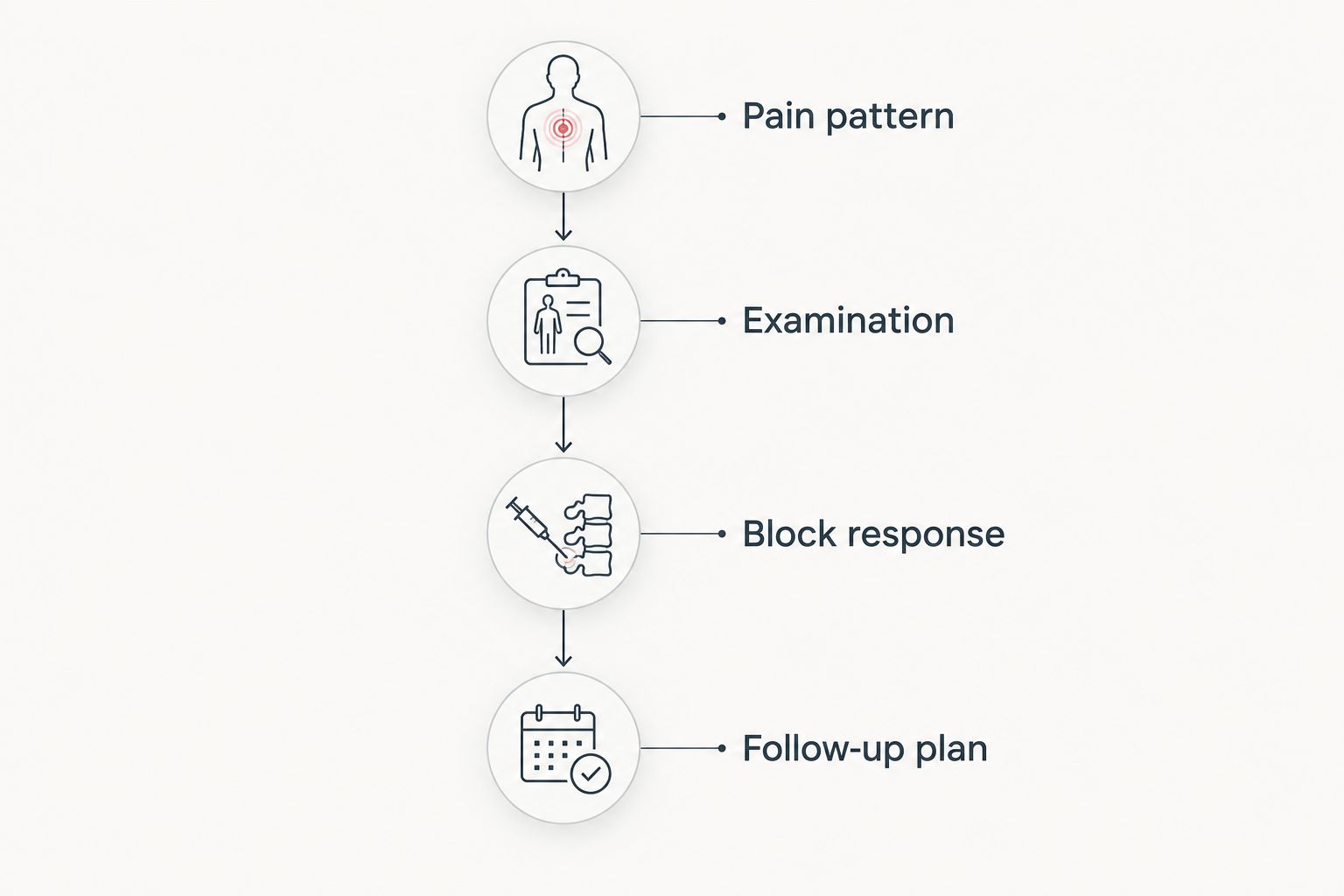
Confirming the pain source comes before interpreting treatment-duration benchmarks.
Hudson Pain and Spine is for New Jersey patients seeking board-certified interventional pain management and evaluation of treatment options. Published occipital neuralgia benchmarks guide questions; they do not establish which procedure the practice will recommend for you.
Track benefit without mistaking it for a cure
Record your usual pain before treatment, then describe how it changes afterward. Keep the same measures so your follow-up compares like with like. A short diary is more useful than a single recollection that the procedure “worked.”
Useful entries include pain location, scalp sensitivity, headache frequency, sleep disruption, medication use, and activities limited by pain. Record side effects separately. Reduced pain with unacceptable numbness or discomfort is not the same outcome as comfortable, useful relief.
Ask your clinician when to report returning symptoms and which post-procedure symptoms require urgent attention. Do not schedule repeated procedures solely because a published average has elapsed. Reassessment should follow your symptoms, function, safety, and diagnosis—not the calendar alone.
Discuss your pain treatment options
Hudson Pain and Spine provides board-certified interventional pain management in New Jersey.
FAQ
How long does an occipital nerve block last?
Duration varies, and immediate anesthetic numbness is different from sustained pain relief. A prospective study by Juškys and Šustickas in 2018 reported satisfactory results in 42 of 44 patients at six months after blocks containing local anesthetic and corticosteroid; that is not an average duration for every block.
How long does thermal radiofrequency relief last for occipital neuralgia?
One retrospective study reported an average of 6.5 months, with a standard deviation of 5.1 months. Hoffman and colleagues published that result in 2018 from a study of 46 patients, so the average should not be treated as an individual guarantee.
Does pulsed radiofrequency provide six months of relief?
Pulsed radiofrequency showed substantial improvement in 52.6% of patients at six-month follow-up in a small prospective study. Vanelderen and colleagues studied 19 patients in 2010; the result does not establish six months of continuous relief for every patient.
Which occipital neuralgia treatment lasts the longest?
These studies do not establish which treatment lasts longest. They use different designs and outcomes, so comparing a mean duration with a six-month response rate cannot produce a valid ranking.
Does a successful nerve block prove I have occipital neuralgia?
No, a successful nerve block does not prove occipital neuralgia by itself. Your clinician interprets the response alongside the pain pattern and examination because other headache conditions also respond to occipital nerve blocks.
Should I repeat treatment as soon as pain returns?
Returning pain calls for reassessment, not an automatic repeat procedure. Your clinician reviews the previous benefit, side effects, current symptoms, and whether the same diagnosis still fits.
When does pain at the back of the head need emergency care?
A sudden severe headache, new weakness, confusion, vision loss, or headache with fever and a stiff neck needs emergency evaluation. Do not assume these symptoms are occipital neuralgia or wait for a routine pain appointment.
One last thing
Complete numbness is not the only useful outcome. A procedure that improves sleep and daily activity without eliminating every symptom still deserves a careful clinical assessment. Conversely, a long-lasting effect that causes troublesome sensory changes needs review.
Before your 2026 appointment, write down the activity you most want to regain and the symptom that prevents it. Bring that goal to Hudson Pain and Spine alongside your treatment history. Duration matters most when the relief improves something you actually do.
Related guides
- What to expect after a nerve block procedure
- Cervicogenic headaches from neck problems
- When to see a pain management specialist
About the Medical Reviewer
Dr. Saurabh Dang is a double board-certified interventional pain management specialist serving Central and Northern New Jersey. He combines clinical expertise with a patient-centered approach to help patients find lasting relief from chronic pain conditions.
Read Full Bio →Seeking Treatment for Nerve Block Injections?
Dr. Dang and the team at Hudson Pain and Spine offer specialized care and advanced interventional treatments.
Ready to Find Relief from Pain?
Schedule your consultation with Dr. Saurabh Dang at our Englewood office.
Serving patients across Central and Northern New Jersey — Bergen, Passaic, and Middlesex counties.