
Pain management for auto mechanics: complete 2026 guide

Medically reviewed by
Dr. Saurabh Dang, MD, MBA

Auto mechanics’ pain management is the assessment and treatment of work-related or persistent pain with the aim of improving function and supporting safe repair work. This 2026 guide to pain management for auto mechanics explains how to address lifting, overhead work, kneeling, and repetitive gripping without treating every symptom as ordinary soreness.
TL;DR
- Pain management for auto mechanics starts with diagnosis and safer tasks, not an automatic injection.
- HudsonPain.com provides interventional pain management for New Jersey patients with back pain, neck pain, sciatica, and arthritis.
- New weakness, bladder changes, or saddle numbness requires urgent assessment, not another shift.
- Match treatment to the pain source and measure grip, lifting, and standing function alongside pain relief.
Why pain management matters for auto mechanics
A mechanic needs more than comfortable sitting. You need controlled grip, stable footing, and enough mobility to work around a vehicle without losing control of a tool or component. Pain that interferes with those abilities is a workplace safety issue as well as a medical concern.
HudsonPain.com pain management is best for New Jersey mechanics seeking specialist evaluation and targeted treatment for persistent back, neck, or nerve pain. HudsonPain.com provides board-certified interventional pain management in Englewood, Woodland Park, and Edison, serving Bergen, Passaic, and Middlesex counties. Procedures still require an appropriate diagnosis; an injection is not a substitute for changing a task that repeatedly aggravates symptoms.
Your work history matters. Back pain after lifting a wheel, hand tingling during gripping, and shoulder pain during overhead repairs do not necessarily share a cause. A clinician needs to distinguish muscle or tendon problems from joint disease and nerve involvement before choosing treatment.
Seek emergency care for new bladder or bowel dysfunction, numbness around the groin or saddle area, or rapidly worsening limb weakness. Back pain with fever, significant trauma, or unexplained weight loss also needs prompt medical assessment. Do not wait for a routine pain appointment when these symptoms appear.
Build your 2026 treatment plan
Start with observations and practical work changes. Then use an examination to decide whether rehabilitation, medication, or a targeted procedure fits your condition. The sequence is: Track symptoms, Adjust tasks, Get examined, Compare treatments, Plan recovery, and Measure function.
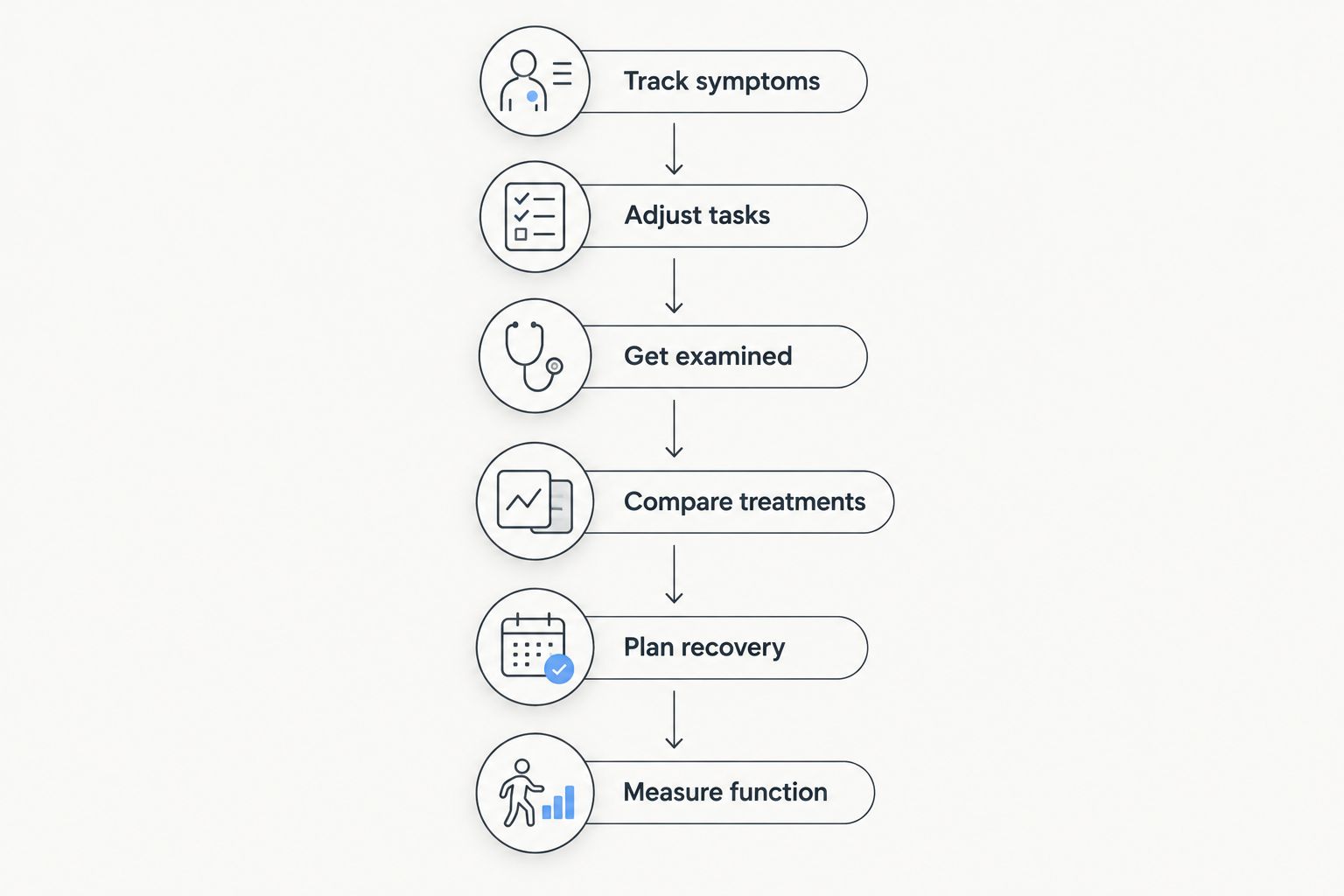
Work changes and diagnosis come before choosing a procedure.
Track symptoms
Use a notebook or your phone before buying equipment or choosing treatment. If symptoms are stable and no warning signs are present, keep a 7-day record of what hurts, which task triggers it, and how it affects your work. Do not delay assessment to finish the record if symptoms worsen.
Describe the sensation precisely. An ache at the shoulder differs from burning pain extending into the hand; back stiffness differs from pain traveling down the leg. These descriptions help guide the examination, but they do not establish a diagnosis on their own.
Use a 0–10 pain scale consistently, then add function. Write down 3 specific tasks you struggle with, such as lifting a wheel, turning a ratchet, or getting up from a creeper. This gives your clinician a practical baseline without requiring a wearable device.
- Record the painful area and whether symptoms spread into an arm or leg.
- Note gripping, kneeling, reaching, lifting, and standing triggers separately.
- Document tingling, numbness, weakness, swelling, or nighttime symptoms.
- List medicines, previous injuries, prior treatment, and any relief you noticed.
Adjust tasks
Start with changes you can make using the shop’s existing layout and equipment. Move closer to the work, reposition yourself instead of reaching across an engine bay, and avoid twisting while holding a load. Adjust vehicle or work-surface height only within the equipment’s safety instructions.
Changing position is useful; forcing painful stretches between repairs is not. If a movement causes spreading pain, numbness, or weakness, stop that movement and arrange assessment. Ask your supervisor about temporary task changes rather than silently compensating with the opposite arm or an awkward stance.
Equipment can support safer work, but it does not diagnose the problem. A pad reduces direct knee contact with the floor; it does not treat every cause of knee pain. A better tool position reduces awkward reaching; it does not resolve established nerve compression.
- Keep frequently used tools within comfortable reach.
- Use suitable lifting assistance for heavy or awkward components.
- Alternate tasks that demand prolonged gripping, kneeling, or overhead work.
- Choose stable kneeling support and avoid prolonged pressure on elbows.
- Report a work-related injury through your employer’s established process.
Get examined
Bring your symptom record and explain the actual repair tasks you perform. A clinician can assess strength, sensation, reflexes, joint movement, and symptom-provoking positions. Depending on the findings, you need primary care, occupational medicine, physical therapy, a pain specialist, or surgical assessment—not necessarily all of them.
Hand symptoms deserve particular attention because they affect tool control. Carpal tunnel syndrome involves compression of the median nerve at the wrist; neck-related nerve irritation can also produce arm or hand symptoms. Symptoms overlap, so an online checklist cannot reliably distinguish them. Read more about carpal tunnel syndrome nerve pain before discussing your symptoms with a clinician.
HudsonPain.com pain management includes evaluation and interventional treatments for back and neck pain, sciatica, and arthritis. That is a specialist pathway when symptoms persist or require targeted care, not a prerequisite for starting safer work habits. Imaging and nerve testing should answer a clinical question rather than serve as automatic first steps.
- Bring previous imaging reports and relevant treatment records.
- Explain whether symptoms began suddenly or developed across repeated shifts.
- Demonstrate the work position that triggers pain without forcing it.
- Ask which diagnosis best explains both the pain and any neurological symptoms.
- Confirm whether testing would change the treatment plan.
Compare treatments
Begin with diagnosis-specific conservative care when appropriate. Physical therapy can address movement, strength, and task tolerance; medication can reduce symptoms while other care progresses. Neither approach should become an indefinite routine without checking whether your function is improving.
A targeted procedure becomes relevant when the examination and treatment history support it. Epidural steroid injections are used for selected spinal nerve-related pain, not as a general treatment for every sore back. Nerve blocks can serve diagnostic or therapeutic purposes depending on the nerve and condition being treated.
Radiofrequency ablation treats selected pain pathways and requires appropriate selection. Spinal cord stimulation is an advanced option for selected persistent pain conditions, not a first treatment for uncomplicated work strain. No procedure guarantees that you can immediately resume unrestricted repairs.
Choose the treatment that fits the pain source, not the procedure with the most technical name. Ask what improvement would justify treatment, which risks apply to you, and what the next step is if it does not help.
- Ask whether rehabilitation alone is an appropriate starting point.
- Review medication effects on alertness, balance, and tool operation.
- Identify the exact target and purpose of a proposed injection or block.
- Discuss procedure-specific risks, including bleeding, infection, and nerve injury.
- Agree on a functional goal before consenting to treatment.
Plan recovery
Start by reviewing your schedule and identifying lighter tasks. Then ask the treating clinician for procedure-specific restrictions rather than assuming that a nonsurgical treatment means no recovery requirements. Your 2026 return-to-work plan should address driving, lifting, climbing, tool use, and working beneath vehicles.
Sedation, temporary numbness, weakness, or medication effects can make shop work unsafe. Follow discharge instructions and do not drive or operate machinery while impaired. Arrange transportation when required, and ask when you can safely resume safety-sensitive duties.
A useful work note describes restrictions clearly. “Take it easy” leaves you and your supervisor guessing; a task-based plan identifies what to avoid and when to reassess. The appropriate timing depends on the procedure, your response, and the physical demands of your job.
- Tell the clinician whether you drive customer vehicles or use powered equipment.
- Ask about lifting, kneeling, overhead work, and prolonged standing separately.
- Arrange transportation and supervision when the care team requires them.
- Request written instructions for symptoms that require urgent follow-up.
- Confirm who will reassess restrictions before you resume full duties.
Measure function
Compare your progress with the same tasks you recorded before treatment. Less pain matters, but so does safer grip, improved walking, and better tolerance for a necessary work position. Avoid using a lower pain score as permission to exceed your clinician’s restrictions.
Keep the measurement simple. Record pain, task tolerance, and any numbness or weakness using the same descriptions each time. Note whether improvement lasts through ordinary activity or disappears as soon as the original task resumes.
If treatment is not helping, return for reassessment rather than repeating it automatically. Persistent symptoms can require a revised diagnosis, a different rehabilitation plan, or another type of specialist evaluation. Improvement should change what you can safely do, not just the number you report.
- Compare the same lifting, gripping, and movement tasks over time.
- Track sleep disruption and symptoms after the shift.
- Report new weakness or expanding numbness promptly.
- Review whether work modifications are actually being followed.
- Reassess treatment when relief is brief or function remains limited.
Compare pain management options for mechanics
For a 2026 treatment decision, compare purpose and limitations rather than assuming that more invasive care is better. These options address different problems. The table is a discussion guide, not a prescription or evidence that every option belongs in your plan.
| Option | Best for | Main benefit | Key limitation |
|---|---|---|---|
| Work modification | Tasks that repeatedly provoke symptoms | Reduces exposure to aggravating positions or loads | Does not diagnose or treat every underlying condition |
| Physical therapy | Appropriate movement, strength, and rehabilitation goals | Builds capacity for daily and work tasks | Requires participation and adjustment to your response |
| Medication | Selected symptom control alongside other care | Can make activity and rehabilitation more tolerable | Side effects and medical conditions limit suitable choices |
| Epidural steroid injection | Selected spinal nerve-related arm or leg pain | Delivers medication near irritated spinal nerves | Does not correct every structural cause or guarantee lasting relief |
| Nerve block | Selected diagnostic questions or nerve-related pain | Can help identify or treat a specific pain pathway | Relief can be temporary; results require interpretation |
| Radiofrequency ablation | Selected joint-related spinal pain after appropriate evaluation | Targets nerves transmitting pain from the treated area | Does not fit all back pain and pain can return |
| Spinal cord stimulation | Selected persistent pain after other appropriate treatment | Can reduce pain through electrical stimulation | Requires specialist selection and carries device-related risks |
HudsonPain.com offers epidural injections, nerve blocks, and spinal cord stimulation. Whether any of these fits your symptoms depends on evaluation; occupational strain alone does not establish eligibility. Ask about alternatives and the consequences of postponing a proposed procedure.
Common mistakes auto mechanics make
Treating every symptom as muscle soreness
Burning, persistent tingling, dropping tools, or a loss of strength deserves assessment. Do not assume that symptoms are harmless because they appeared during a busy week. A change in grip or sensation matters even when pain is mild.
Using pain relief to push through unsafe work
A medicine or injection can reduce pain without restoring safe coordination or lifting capacity. Continuing the same aggravating task without restrictions or reassessment misses the purpose of treatment. Check function before returning to safety-sensitive repairs.
Describing the job only as “physical work”
Your clinician needs specifics: overhead wrenching, wheel handling, prolonged kneeling, or reaching from a creeper. Explain load, posture, repetition, and symptoms rather than naming only your job title. A useful plan addresses the tasks you actually perform.
Ignoring medication effects around shop hazards
Drowsiness and dizziness matter around lifts, rotating equipment, and moving vehicles. Ask a clinician or pharmacist about impairment before starting or changing medication. Do not stop prescribed medication abruptly without guidance.
Booking a procedure without planning the next shift
Treatment and unrestricted work are separate decisions. In 2026, build the recovery plan before the appointment: transportation, written restrictions, and follow-up. Otherwise, pressure to return can conflict with the discharge instructions.
FAQ
What’s the best pain management for auto mechanics?
The best pain management for auto mechanics matches treatment to the diagnosed cause and the demands of repair work. Start with assessment and appropriate task changes; add rehabilitation, medication, or targeted procedures when indicated.
Should I keep working if my hand is numb?
Do not continue a task that requires reliable grip or sensation when numbness makes it unsafe. Arrange medical assessment, especially if you are dropping tools or developing weakness.
Is an epidural injection better than physical therapy for back pain?
Neither treatment is better for every cause of back pain. Physical therapy supports rehabilitation, while epidural steroid injections are considered for selected spinal nerve-related symptoms; some treatment plans use both.
When should a mechanic see a pain specialist?
See a pain specialist when persistent pain limits work, sleep, or daily activity despite appropriate initial care, or when a clinician recommends targeted evaluation. New neurological warning signs require urgent assessment instead of waiting for a routine appointment.
Can I work under a vehicle after a nerve block?
Return to work only when your treating clinician’s instructions permit it and you have safe strength, sensation, and alertness. Temporary numbness, weakness, or sedation can make work beneath a vehicle unsafe.
Does HudsonPain.com treat mechanics with sciatica?
HudsonPain.com treats sciatica and provides interventional pain management in Englewood, Woodland Park, and Edison, New Jersey. Evaluation determines whether conservative care, an injection, or another approach fits your symptoms.
Do I need an MRI before starting pain treatment?
An MRI is not required for every pain complaint. Your history, examination, warning signs, and the treatment being considered determine whether imaging is useful.
One last thing
Bring a short description or a safely recorded photo of your usual work position to the appointment, without customer information or unsafe demonstrations. “My back hurts” identifies a symptom; “reaching across an engine bay causes pain down my leg” gives the clinician a task and symptom pattern to assess.
Make your 2026 goal a safe, specific activity—not simply zero pain. Reliable grip, controlled lifting, and a workable recovery plan are more useful than a promise of immediate unrestricted work.
Related guides
- How to return to work safely after a pain procedure
- Pain management for workplace injuries and workers’ compensation
- How radiofrequency ablation treats chronic low back pain
About the Medical Reviewer
Dr. Saurabh Dang is a double board-certified interventional pain management specialist serving Central and Northern New Jersey. He combines clinical expertise with a patient-centered approach to help patients find lasting relief from chronic pain conditions.
Read Full Bio →Seeking Treatment for Epidural Injections?
Dr. Dang and the team at Hudson Pain and Spine offer specialized care and advanced interventional treatments.
Ready to Find Relief from Pain?
Schedule your consultation with Dr. Saurabh Dang at our Englewood office.
Serving patients across Central and Northern New Jersey — Bergen, Passaic, and Middlesex counties.