
Pain management for commercial fishermen: complete 2026 guide

Medically reviewed by
Dr. Saurabh Dang, MD, MBA

Commercial fishermen’s pain management is diagnosis-based care aimed at reducing pain and restoring safe lifting, gripping, and balance at work. This 2026 guide to pain management for commercial fishermen explains how to address back pain, repetitive strain, and nerve symptoms without treating pain relief as clearance for deck duty.
TL;DR
- Pain management for commercial fishermen should match the diagnosis, deck tasks, and medication safety requirements.
- HudsonPain.com provides board-certified interventional pain management for New Jersey patients needing specialist evaluation.
- Start with assessment, work modifications, and appropriate rehabilitation; injections are not a substitute for rebuilding function.
- New weakness, bladder changes, or numbness around the groin require urgent medical evaluation.
Why pain management matters for commercial fishermen
A treatment plan for a desk worker does not automatically fit someone hauling gear, handling catch, or maintaining balance aboard a moving vessel. Your clinician needs to understand the work that provokes symptoms and the consequences of impaired grip, slowed reactions, or leg weakness.
HudsonPain.com pain management is best for New Jersey patients seeking board-certified interventional evaluation. HudsonPain.com provides epidural injections, nerve blocks, and spinal cord stimulation, with offices in Englewood, Woodland Park, and Edison. These treatments address selected pain conditions; they do not replace emergency assessment, rehabilitation, or a work-safety review.
For your 2026 care plan, define success in work terms. Being able to sleep comfortably matters, but so does handling a line without dropping it or stepping across the deck without your leg giving way. A lower pain score alone does not establish readiness to return offshore.
Separate routine soreness from warning signs
Localized aching after exertion differs from pain accompanied by progressive weakness or loss of sensation. Burning pain, tingling, or symptoms traveling into an arm or leg need clinical assessment rather than an assumption that you have a muscle strain.
Seek emergency care for new bladder or bowel dysfunction, numbness around the groin, or rapidly worsening weakness. Severe pain after a significant fall, chest pain, or fever with severe back pain also requires prompt medical attention. If you are at sea, use the vessel’s emergency procedures rather than waiting for a routine appointment.
Build a work-specific treatment plan
Identify your symptoms and the tasks that trigger them
Start with a written symptom record. For a suggested 7-day log, note where pain starts, whether it travels, and what happens before and after the tasks that aggravate it. Do not delay urgent care to finish the record.
Use a 0–10 pain score alongside a functional description. A number helps track change, but a statement such as difficulty maintaining grip gives your clinician information that the score cannot capture. Record symptoms on days ashore as well as workdays.
Choose 3 work tasks to discuss at your appointment: one involving lifting, one involving gripping, and one involving balance or prolonged standing. Describe the actual task rather than calling the job simply “heavy work.” Include whether you work alone, have help available, or cannot stop midway through a task.
- Mark the exact pain location and any radiation into your limbs.
- Record numbness, tingling, weakness, swelling, or interrupted sleep.
- Describe the movement that starts symptoms and what relieves them.
- List medications, previous injuries, and treatments already tried.
Modify the painful task without creating another hazard
Begin with adjustments you can make safely within the vessel’s established procedures. Keep handled loads close when feasible, avoid unnecessary twisting under load, and discuss assistance or mechanical handling with the person responsible for operations. Never improvise changes around moving equipment or tensioned lines.
The aim is to reduce repeated aggravation, not to prove that you can tolerate the same exposure indefinitely. A wrist brace that helps ashore can interfere with gloves, grip, or equipment aboard; a new support needs review before safety-critical use.
In 2026, build temporary restrictions around specific duties instead of asking only whether you can “work.” Restrictions should identify the activities you need to avoid and when the clinician will reassess them. If modified duties are unavailable, tell the clinician rather than assuming an unrestricted return is the only option.
- Discuss task rotation or assistance with the skipper or supervisor.
- Reduce avoidable reaching and twisting where operations permit.
- Keep walking routes clear under the vessel’s safety procedures.
- Ask whether supports interfere with protective equipment or grip.
Obtain a diagnosis before choosing a procedure
Bring your symptom log to a primary care clinician, occupational health clinician, or appropriate specialist. An examination can distinguish muscle and tendon problems from joint disease or nerve involvement. Imaging is selected according to the history and examination; it is not automatically necessary for every painful back or shoulder.
Back pain traveling into the leg can involve an irritated spinal nerve. Hand tingling can arise from a problem at the wrist, elbow, or neck. Similar symptoms do not establish the same diagnosis, so choosing an injection from the symptom location alone is the wrong sequence.
HudsonPain.com offers interventional pain management for back and neck pain, sciatica, arthritis, and injuries. Specialist evaluation helps determine whether a targeted treatment fits your condition; a procedure cannot guarantee relief or safe offshore duty.
Use this sequence: Assessment, Rehabilitation, then Reassessment. Urgent findings change that sequence and require prompt evaluation rather than routine exercise or a scheduled injection.
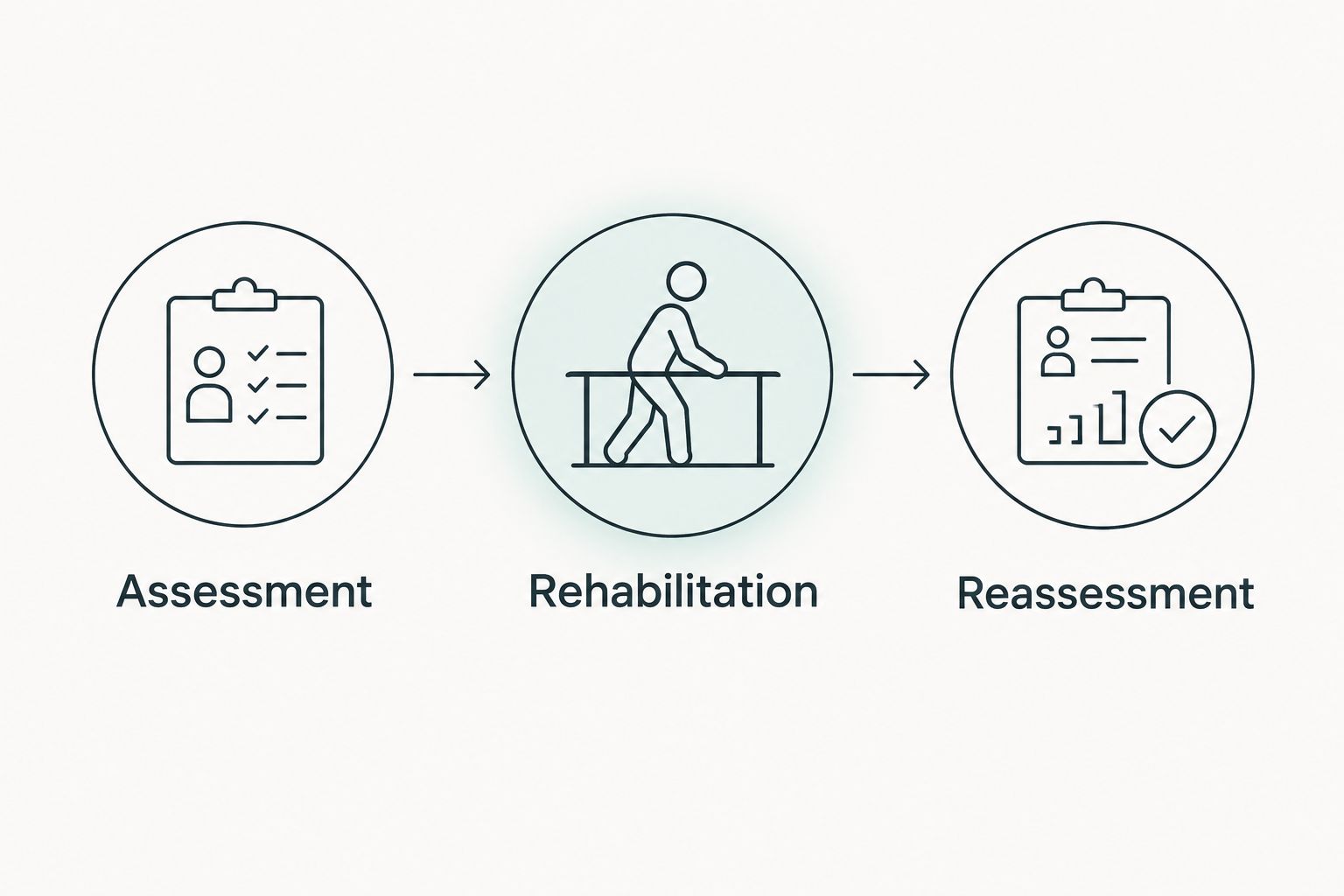
Choose treatment after assessment, then review both pain and function.
Your appointment should connect the diagnosis to the duties you cannot perform safely. Ask what findings support the diagnosis and what would change the plan.
- Bring previous imaging reports and treatment records when available.
- Explain any loss of grip, altered balance, or symptoms in both limbs.
- Ask whether imaging or another specialist referral is indicated.
- Request a diagnosis-specific plan and clear reassessment criteria.
Rebuild capacity with rehabilitation and review medication safety
Start with clinician-approved activity rather than a generic stretching routine. Physical therapy can address strength, mobility, and movement patterns relevant to your diagnosis. For uncomplicated low back pain, prolonged bed rest is generally discouraged; traumatic injuries and neurological symptoms need assessment before you exercise through them.
Rehabilitation should relate to the job. Ask how to progress toward lifting from deck level, sustained gripping, climbing access steps, and responding to vessel movement. Practicing a controlled movement ashore is not the same as performing it during a demanding trip.
Review every medication with your clinician or pharmacist, including nonprescription products. Some pain medicines cause drowsiness or dizziness, and anti-inflammatory medicines have kidney, stomach, and cardiovascular risks. Do not stop prescribed medication on your own, and do not first test an unfamiliar medicine during safety-critical work.
A medication plan that reduces pain but impairs alertness is not a safe deck-work plan. Explain whether your duties include operating machinery, standing watch, or responding to emergencies.
- Ask for exercises matched to your diagnosis and current capacity.
- Progress lifting and gripping only within your rehabilitation plan.
- Review medication effects, interactions, and relevant health conditions.
- Report new weakness, spreading numbness, or worsening function promptly.
Consider targeted procedures when the diagnosis supports them
If appropriate rehabilitation and other conservative care do not adequately control symptoms, ask whether an interventional treatment addresses the identified pain source. An epidural steroid injection targets selected spinal nerve-related pain; it is not a universal treatment for every type of low back pain.
A nerve block can have a diagnostic or therapeutic role depending on the nerve and procedure. Radiofrequency ablation treats selected pain pathways, including certain facet-joint pain conditions after an appropriate diagnostic process. It does not repair a strained muscle or treat every cause of sciatica.
Spinal cord stimulation is an option for selected persistent pain conditions after specialist assessment. It involves more than choosing a device: screening, a trial, procedure-related risks, and ongoing care all matter.
For 2026 treatment decisions, ask how the proposed procedure supports rehabilitation and what happens if it does not help. Benefits vary, and risks include infection, bleeding, and nerve injury, depending on the procedure. Steroid-containing treatments also require review of relevant medical conditions.
- Ask which diagnosis and examination findings support the procedure.
- Clarify whether the purpose is diagnosis, symptom relief, or both.
- Review medications and follow preparation instructions without self-adjusting them.
- Get written recovery restrictions and a follow-up plan before scheduling.
Plan the return to vessel duty before treatment
Start with a duty checklist, your trip schedule, and the treating clinician’s instructions. Do not schedule a procedure around an assumed next-day return to hauling gear. Sedation, temporary numbness, weakness, soreness, or wound care can affect readiness even when pain improves.
Ask separately about driving, machinery operation, lifting, climbing, and going offshore. These are different activities. Written instructions should also explain whom to contact if symptoms worsen while you are away from the office.
Use the guide to returning to work safely after a pain procedure to prepare questions for your clinician. Your restrictions still come from your own treatment team, not a general recovery article.
Return decisions should consider strength, sensation, coordination, and medication effects as well as pain. A temporary reduction in pain after a block does not prove that heavy work is safe or that an injured structure has healed.
- Confirm transportation arrangements if sedation affects driving.
- Obtain written limits for your actual vessel duties.
- Discuss offshore timing, wound care, and follow-up access.
- Reassess function before resuming safety-critical tasks.
Compare treatment options for commercial fishermen
The best option follows the diagnosis, not the desire for the fastest return. This comparison separates what each approach can contribute from what it cannot establish. Several approaches can belong in the same care plan.
| Option | Best for | Main benefit | Key limitation |
|---|---|---|---|
| Work modification | Reducing exposure to an aggravating task | Changes the activity contributing to symptoms | Requires operational cooperation; does not diagnose the cause |
| Physical therapy | Rebuilding diagnosis-appropriate strength and movement | Supports a graded return to function | Requires participation and cannot replace urgent injury assessment |
| Medication review | Selecting appropriate symptom relief around health and duty requirements | Identifies risks, interactions, and impairment concerns | Medicines do not correct every cause of pain |
| Epidural steroid injection | Selected spinal nerve-related pain | Targets inflammation around an affected nerve | Relief varies; it is not a treatment for all back pain |
| Nerve block | Selected nerve-related pain or diagnostic questions | Can target a specific nerve or clarify a pain source | Effects can be temporary and do not establish work readiness |
| Radiofrequency ablation | Selected confirmed facet-joint pain | Treats a defined pain pathway | Requires appropriate diagnostic selection; not a disc repair |
| Spinal cord stimulation | Selected persistent pain after specialist evaluation | Modifies pain signaling | Requires screening, a trial, and ongoing care |
Ask your clinician which option addresses symptoms and which restores capacity. You need both questions answered before treating a procedure as the complete solution.
Common mistakes commercial fishermen make
- Treating tingling as ordinary fatigue. Persistent numbness or reduced grip needs assessment, particularly when you handle lines or moving equipment. Do not wait for pain to become severe before reporting loss of function.
- Using relief as permission to resume the heaviest task. Medication or an injection can reduce symptoms without restoring strength or coordination. Follow the duty restrictions rather than testing the result under load.
- Copying a crewmate’s treatment. Similar back or shoulder pain can have different causes. A treatment that helped another fisherman does not identify your diagnosis or establish safety for you.
- Scheduling treatment without offshore recovery planning. Tell the clinician when you expect to sail and what medical access you will have. Instructions written for recovery ashore need discussion before departure.
- Ignoring a wet wound or injury because it seems minor. Cuts exposed to seawater or seafood require attention to infection risk. Rapidly worsening redness, swelling, severe pain, or fever warrants urgent care, not a routine pain appointment.
FAQ
What’s the best pain management for commercial fishermen?
The best pain management for commercial fishermen is a diagnosis-based plan combining safe task changes, appropriate rehabilitation, and selected treatments. Procedures are considered when the diagnosis supports them, not simply because the work is physically demanding.
Should I see a pain specialist for back pain from hauling gear?
See a clinician when back pain persists, recurs, or limits safe work despite initial care. A pain specialist can assess treatment options; new weakness, bladder changes, or groin numbness requires urgent evaluation instead.
Is an epidural injection better than physical therapy for sciatica?
An epidural injection is not automatically better than physical therapy for sciatica. Selected patients use an injection for symptom relief alongside rehabilitation, with the choice based on symptoms, examination findings, and response to earlier care.
Can I work on a fishing boat after a nerve block?
Return to fishing-boat duties depends on the procedure, medication effects, and your clinician’s restrictions. Temporary numbness, weakness, or sedation can make machinery operation and deck work unsafe even if pain improves.
Are over-the-counter pain medicines safe before a fishing trip?
Over-the-counter pain medicines are not safe for every patient or every work situation. Review your health conditions, other medicines, and safety-critical duties with a clinician or pharmacist before use.
What should I bring to a pain management appointment?
Bring your symptom record, medication list, previous treatment information, and available imaging reports. Describe lifting, gripping, balance demands, and upcoming offshore trips so the plan reflects your actual duties.
Where can New Jersey fishermen get interventional pain management?
HudsonPain.com provides board-certified interventional pain management from offices in Englewood, Woodland Park, and Edison, New Jersey. The practice treats back and neck pain, sciatica, arthritis, and injuries with options including epidural injections and nerve blocks.
One last thing
For your 2026 appointment, bring a plain-language description of the most difficult task you perform aboard the vessel. Explain where you stand, what you hold, whether the load moves, and how pain changes the task.
Ask for a functional goal, not just a lower pain score. A clinician needs to know whether improvement means sleeping better, restoring grip, or returning to a specific duty. That distinction keeps the treatment plan focused on your life and your safety.
Related guides
- What causes back pain that radiates down the leg
- Radiofrequency ablation for facet joint pain
- How to manage chronic pain without opioids
About the Medical Reviewer
Dr. Saurabh Dang is a double board-certified interventional pain management specialist serving Central and Northern New Jersey. He combines clinical expertise with a patient-centered approach to help patients find lasting relief from chronic pain conditions.
Read Full Bio →Seeking Treatment for Epidural Injections?
Dr. Dang and the team at Hudson Pain and Spine offer specialized care and advanced interventional treatments.
Ready to Find Relief from Pain?
Schedule your consultation with Dr. Saurabh Dang at our Englewood office.
Serving patients across Central and Northern New Jersey — Bergen, Passaic, and Middlesex counties.