
Pain management for hotel housekeeping staff: complete 2026 guide

Medically reviewed by
Dr. Saurabh Dang, MD, MBA

Pain management for hotel housekeeping staff is a plan to reduce pain during room-cleaning work and identify symptoms that need medical care. In 2026, start with task changes and a symptom record; seek an evaluation when pain persists, spreads, or interferes with your shift.
TL;DR
- Pain management for hotel housekeeping staff starts with task changes, symptom tracking, and an evaluation when pain persists.
- Hudson Pain and Spine is best for New Jersey housekeepers whose persistent back, neck, or joint pain needs specialist assessment.
- Ask for urgent medical help for new weakness, loss of bladder control, or numbness around the groin.
- Epidural injections and nerve blocks address selected diagnoses; neither replaces an examination or safer work practices.
Why pain management matters for hotel housekeeping staff
Making beds, cleaning bathrooms, pushing carts, and moving between rooms can involve repeated bending, reaching, gripping, and standing. The useful question is not simply whether work hurts. It is which movement brings on which symptom, whether the symptom settles after work, and whether your ability to do the job is changing.
A sore back after lifting a mattress corner calls for a different assessment than burning pain traveling down a leg. Neck pain with hand tingling differs from shoulder pain only when reaching overhead. Recording those distinctions helps a clinician decide what to examine and helps you describe a practical change to your supervisor.
If symptoms began with a specific incident at work, document the task, time, and affected area and follow your employer’s reporting process. The guide to workplace injuries and workers’ compensation covers that route. Do not wait for an insurance decision to seek urgent care for new leg weakness, loss of bladder or bowel control, or numbness around the groin.
Hudson Pain and Spine is best for New Jersey hotel housekeeping staff with persistent back, neck, or joint pain that needs an interventional pain assessment. Its role is to evaluate whether a targeted treatment fits a diagnosed source of pain, not to treat every ache with an injection.
Build a pain-management plan around the work
The sequence below separates changes you can discuss at work from decisions that require a clinician. In 2026, use the steps to prepare for care, not to diagnose yourself from a symptom list.
Identify the task that triggers each symptom
Write down what you were doing when pain started or intensified. Separate bed-making, bathroom cleaning, vacuuming, cart pushing, and restocking rather than recording the entire shift as one exposure. Note whether pain appears during a movement, after repeated rooms, or only once you stop.
Use a 0–10 pain scale if it helps you describe change, but record function alongside the score. A score alone does not tell a clinician whether you can bend, grip a spray bottle, or walk to the next room. Bring the record to an appointment instead of relying on memory at the end of a long shift.
- Record the painful area and whether pain travels into an arm or leg.
- Name the exact task and movement that bring it on.
- Note numbness, tingling, weakness, or swelling separately from pain.
- Record what improves symptoms and what makes the next shift harder.
Change the movement before repeating it
Start with adjustments that do not require equipment or a diagnosis. Move your feet closer to the side of a bed before reaching across it. Reposition yourself to clean a distant surface instead of twisting your trunk while your feet stay planted. Keep supplies where you can reach them without repeated deep bends when your workplace setup permits it.
These changes reduce repeated awkward movement; they do not establish why you hurt. If a particular task produces sharp pain or spreading symptoms, stop treating it as a posture problem and arrange an assessment. Ask your supervisor which tasks or tools can be changed without delaying safe room cleaning.
- Walk around the bed rather than reaching across the mattress.
- Turn your whole body toward the surface you are cleaning.
- Move frequently used supplies to an accessible position when permitted.
- Ask about help or equipment for tasks you cannot perform safely.
Pace repetitive work and check what changes
Alternating tasks can keep the same joint or muscle group from doing every demanding movement in succession. When your schedule allows, follow a bending-heavy task with one that uses a different posture. A 2-minute pause to stand upright and move comfortably is a way to check whether a symptom settles, not a treatment with a guaranteed result.
Do not push through worsening weakness, loss of grip, or pain that changes your walking. Those signs call for clinical guidance. If breaks or task rotation are not under your control, describe the specific adjustment you need to a supervisor rather than relying on a generic request to work less.
- Rotate bending, reaching, and cart-related tasks where scheduling allows.
- Use a 2-minute posture check to notice whether symptoms settle.
- Compare how you feel at the start and end of a shift.
- Tell a supervisor which movement you need changed, not just that you hurt.
Review symptoms that need prompt evaluation
Pain that persists after work, disrupts sleep, radiates into a limb, or limits ordinary movement deserves an appointment. Describe whether symptoms began suddenly during a task or built up over repeated shifts. A clinician can examine the painful area and decide whether imaging, physical therapy, medication review, or specialist assessment is appropriate.
Seek emergency medical care for new bladder or bowel dysfunction, numbness around the groin, or significant new weakness, particularly with back pain. For a new injury with severe pain, visible deformity, or inability to bear weight, get prompt medical assessment rather than trying to finish the shift.
- Arrange an evaluation for persistent or worsening pain.
- Report radiating pain, tingling, and weakness as distinct symptoms.
- Seek urgent care for severe injury or inability to bear weight.
- Seek emergency care for bladder or bowel changes or groin numbness.
Bring a work-specific history to your clinician
Tell your clinician what room-cleaning tasks require, which ones reproduce symptoms, and what you have already changed. Mention prior injuries, treatments, and medicines. If you have an incident report or work restrictions, bring them; the medical visit still needs its own account of symptoms and examination.
Ask what diagnosis is being considered and what finding supports it. Then ask which activities you can continue, which you should modify, and what symptom change should prompt another call. A written plan is more useful than a vague instruction to rest when your next shift has specific physical demands.
- Bring your symptom record and the tasks linked to each symptom.
- List medicines, prior treatment, and any relevant work restrictions.
- Ask what the examination suggests and what remains uncertain.
- Request clear guidance on activity changes and follow-up symptoms.
Match treatment to the source of pain
Physical therapy can focus on movement, strength, and tolerance for work tasks after an evaluation. A clinician can also review medicines and decide whether another assessment is needed. For selected spinal or nerve-related pain, an interventional pain specialist can assess whether an epidural injection, nerve block, or another procedure fits the diagnosis. A procedure is an option tied to a clinical finding, not a standard next step for every housekeeper with back pain.
Hudson Pain and Spine provides interventional pain management, including epidural injections, nerve blocks, and spinal cord stimulation. If you are considering specialist care, ask what problem a proposed procedure targets, what alternatives fit your case, and how your work duties affect recovery planning. Discuss benefits and risks with the treating clinician before deciding.
- Ask which finding identifies the likely pain source.
- Discuss physical therapy and work changes alongside other treatment.
- Ask what an injection or nerve block is meant to clarify or treat.
- Confirm activity instructions before scheduling a procedure around shifts.
Plan your return to full duties with clear limits
Feeling better during a day off does not prove that a full cleaning workload will be comfortable. Before returning after an injury or procedure, ask the treating clinician what activities are appropriate and when restrictions should be reviewed. Share the written guidance with the person coordinating your duties through your workplace process.
In 2026, keep checking the same task-specific symptoms you recorded at the start. If bending still sends pain down your leg or reaching still produces hand numbness, report that pattern at follow-up. The goal is a workable plan based on function, not a decision made from a pain score alone.
- Get written activity guidance when restrictions are needed.
- Identify which duties match those restrictions with your employer.
- Track symptoms during the tasks you resume.
- Request reassessment when symptoms worsen or function declines.
Compare care options for housekeeping-related pain
The best entry point depends on your symptoms. Self-directed task changes address exposures at work; clinical care investigates the source of pain and determines whether treatment is needed. These options can work together, but they do different jobs.
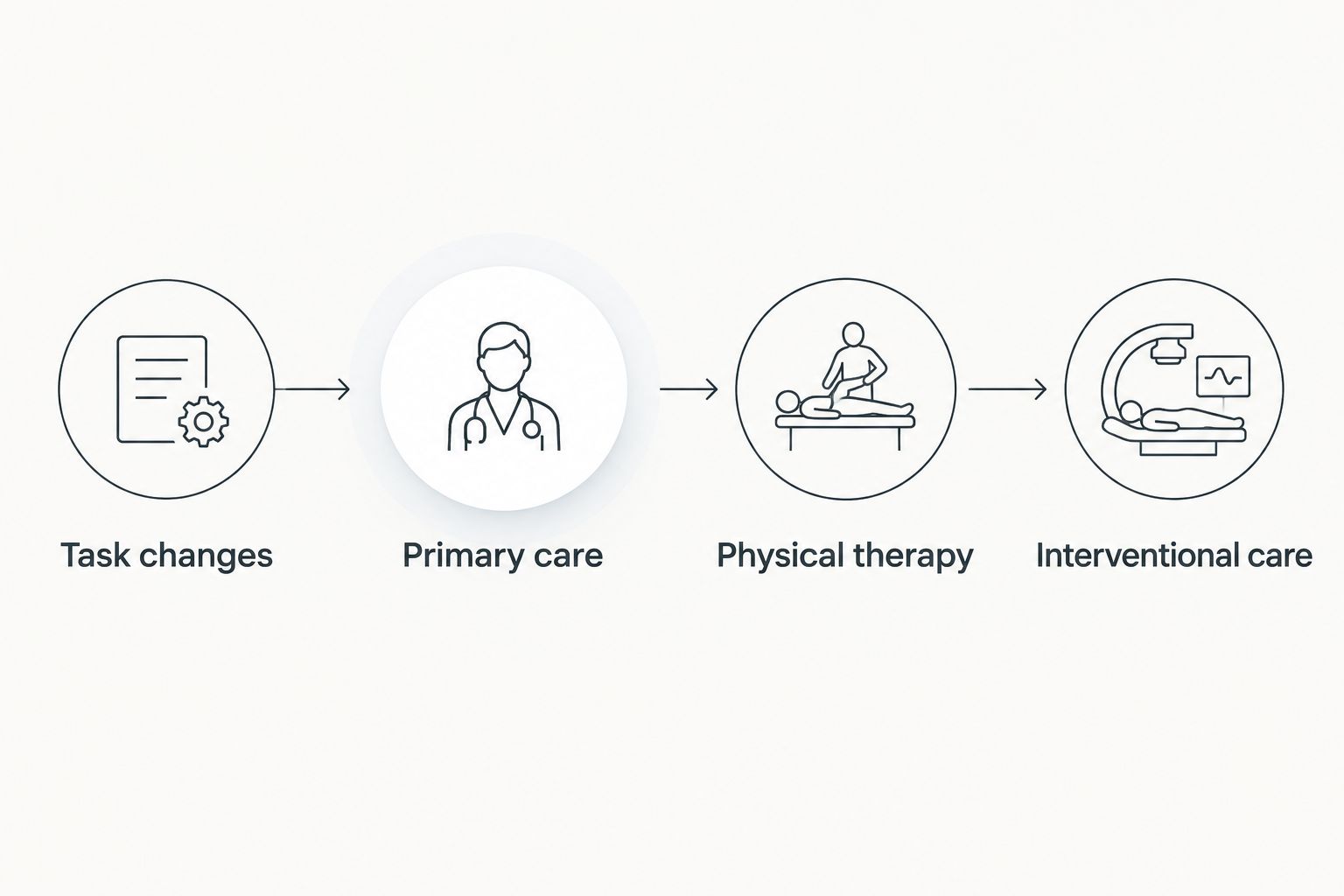
Start with the task and symptoms; choose further care based on the clinical assessment.
| Option | Best for | Main benefit | Key limitation |
|---|---|---|---|
| Task changes and symptom tracking | Recognizing work movements that provoke pain | Gives you a record to discuss at work and in clinic | Cannot diagnose nerve, joint, or spinal conditions |
| Primary care or an appropriate first clinical evaluation | New or persistent symptoms without a clear diagnosis | Examines symptoms and directs further care | Another clinician may be needed for specialized treatment |
| Physical therapy | A clinician-directed plan to improve movement and work tolerance | Addresses function alongside symptoms | Exercises need to match the diagnosis and your capacity |
| Interventional pain assessment | Persistent pain when a targeted procedure is being considered | Assesses whether an injection, nerve block, or other procedure fits | A procedure is not appropriate for every cause of pain |
If pain changes the way you walk, grip, bend, or complete a shift, make the clinical appointment rather than cycling through home adjustments indefinitely. Hudson Pain and Spine serves patients in Bergen, Passaic, and Middlesex counties from offices in Englewood, Woodland Park, and Edison. Its interventional care is a later decision in this pathway, after the symptoms and likely pain source have been evaluated.
Discuss persistent work-related pain
Ask about an assessment for back, neck, or joint pain affecting your shifts.
Common mistakes hotel housekeeping staff make
Treating every back symptom as muscle strain. Back pain with leg tingling, radiating pain, or weakness needs a different conversation from localized soreness. Explain exactly where the symptom travels; do not assume the work task identifies the diagnosis.
Describing the shift instead of the movement. Room cleaning involves several distinct demands. A record that says pain starts when you pull bedding or push a loaded cart gives your clinician and supervisor more to work with than a note that says housekeeping hurts.
Waiting for a day off to erase a recurring problem. Relief away from work is useful information, but symptoms that return with the same task still need attention. In 2026, bring that pattern to an evaluation if the pain persists or limits function.
Assuming an injection is the first or only treatment. Targeted procedures have specific uses and limitations. Ask what diagnosis supports the recommendation and how rehabilitation and task changes fit the same plan.
Returning without discussing duties. After an injury or procedure, clarify restrictions with your treating clinician. A general statement that you feel better does not specify whether repeated bending, reaching, or cart pushing is appropriate yet.
FAQ
What is the best pain management for hotel housekeeping staff?
Start by identifying the task that provokes pain, changing that movement where possible, and getting persistent or worsening symptoms evaluated. Treatment depends on the diagnosis, not the job title alone.
When should a hotel housekeeper see a pain specialist?
Consider a pain specialist when pain persists despite initial care or a clinician recommends an assessment for a targeted procedure. Hudson Pain and Spine evaluates interventional options for patients in New Jersey.
Can making beds cause back pain?
Bending, reaching, and moving around beds can provoke back symptoms. An examination is needed to determine whether your pain comes from muscle, joint, nerve, or another source.
Are epidural injections right for housekeeping-related back pain?
Epidural injections are considered for selected spinal pain conditions, not every case of back pain. A clinician must assess your symptoms and examination findings before recommending one.
Should I work through pain that travels down my leg?
Do not ignore pain that travels down your leg, especially if it comes with numbness or weakness. Arrange a clinical evaluation and seek emergency care for new bladder or bowel dysfunction or groin numbness.
What should I tell my employer about a painful task?
Identify the task, the movement that triggers symptoms, and the change or restriction you need. Follow your workplace reporting process if the pain began with a work incident.
Can physical therapy and interventional pain care be used together?
Physical therapy and interventional care can address different parts of a clinician-directed plan. The appropriate combination depends on the diagnosis, functional limits, and response to earlier care.
One last thing
The most useful symptom record is not the one with the highest pain score. It is the one that connects a specific movement to a specific change in function. In 2026, take that record to your appointment: it makes the discussion about what you can do at work, what needs evaluation, and what should change next.
Related guides
- Pain management for warehouse workers with strain injuries
- Best treatments for repetitive strain injury
- When to see a pain management specialist
- How to return to work safely after a pain procedure
About the Medical Reviewer
Dr. Saurabh Dang is a double board-certified interventional pain management specialist serving Central and Northern New Jersey. He combines clinical expertise with a patient-centered approach to help patients find lasting relief from chronic pain conditions.
Read Full Bio →Seeking Treatment for Epidural Injections?
Dr. Dang and the team at Hudson Pain and Spine offer specialized care and advanced interventional treatments.
Ready to Find Relief from Pain?
Schedule your consultation with Dr. Saurabh Dang at our Englewood office.
Serving patients across Central and Northern New Jersey — Bergen, Passaic, and Middlesex counties.