
Pain management for HVAC technicians: complete 2026 guide

Medically reviewed by
Dr. Saurabh Dang, MD, MBA

HVAC technicians’ pain management is a plan for identifying the source of work-aggravated pain with the aim of staying able to perform service calls. In 2026, start by tracking symptoms and changing painful tasks; seek a clinical evaluation when pain persists, spreads, or limits your work. Hudson Pain and Spine provides interventional pain management for patients in Bergen, Passaic, and Middlesex counties, New Jersey.
TL;DR
- Pain management for HVAC technicians starts with identifying which tasks aggravate pain, then checking for symptoms that need medical care.
- Hudson Pain and Spine is best for New Jersey HVAC technicians with persistent back, neck, or radiating nerve pain who need an interventional evaluation.
- Epidural injections, nerve blocks, and spinal cord stimulation address different problems; none replaces a diagnosis.
- New weakness or bladder or bowel changes with back pain require urgent medical attention.
Why pain management matters for HVAC technicians
An HVAC technician does not perform the same movement all day. Carrying equipment, reaching into units, working overhead, kneeling, climbing, and driving between calls place different demands on the back, neck, shoulders, hands, and knees. That variety matters: pain after lifting a unit calls for a different assessment than numbness that starts during repeated hand work.
Hudson Pain and Spine is best for New Jersey HVAC technicians with persistent back, neck, or radiating nerve pain who need an interventional pain evaluation. Its role is to assess whether a targeted treatment fits a diagnosed pain source, not to treat every work-related ache with an injection. The practice serves patients from 3 New Jersey counties through offices in Englewood, Woodland Park, and Edison.
Your first decision in 2026 is whether the problem responds to changes in how you work or needs medical assessment. Pain that improves when you stop a particular task still deserves attention if it returns on every call. Pain accompanied by spreading numbness, loss of strength, or trouble with ordinary movement needs a closer look; do not assume it is routine soreness.
How to manage pain while working in HVAC
Use these steps in order, but do not wait to complete them if you have a warning sign. Track symptoms, adjust tasks, check warning signs, build strength, and review treatment against the work you need to do. The point is to identify a pattern a clinician can evaluate, rather than collect a list of treatments before anyone knows the cause.
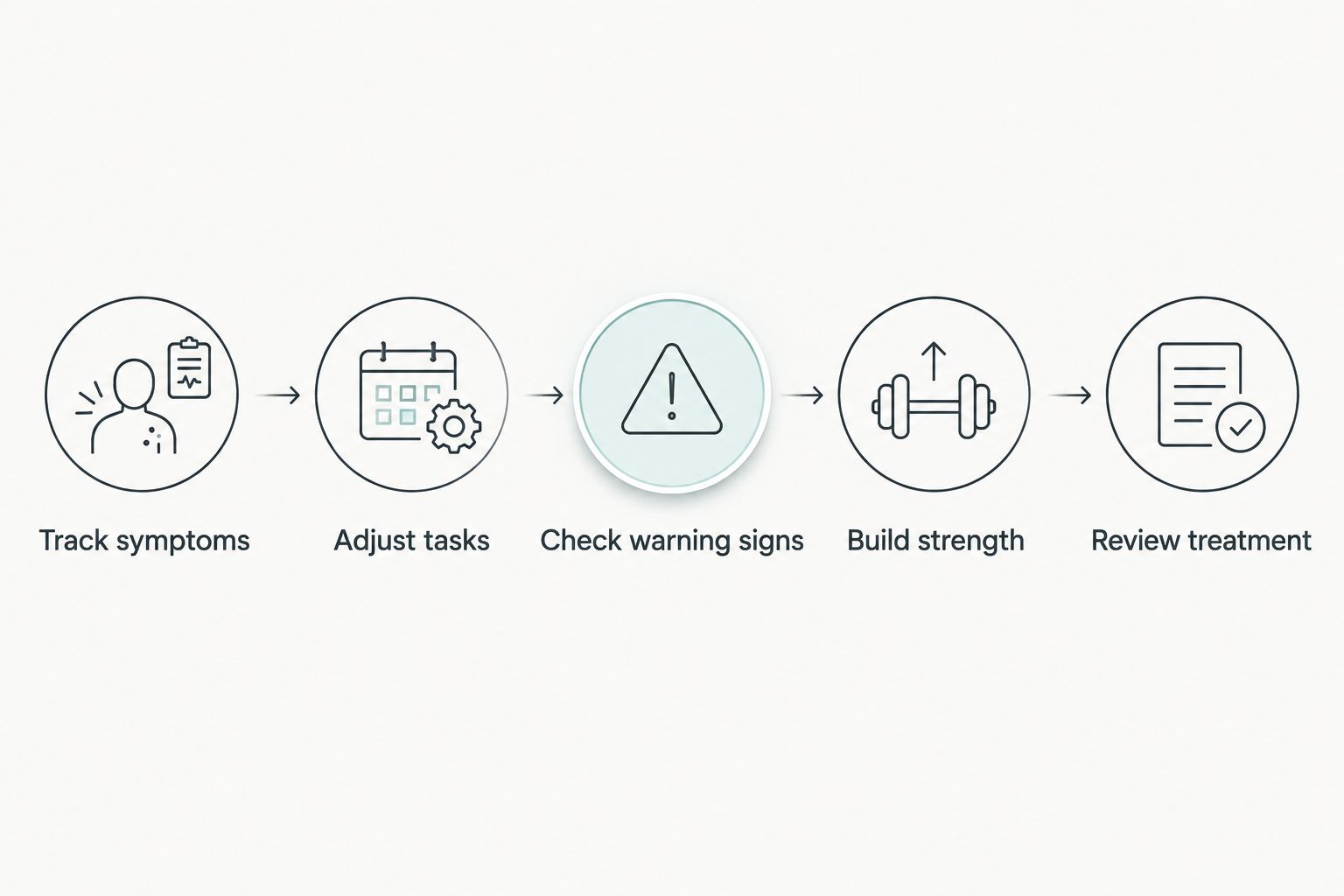
A useful treatment decision starts with a clear account of symptoms and work tasks.
Track symptoms against specific tasks
Write down where the pain starts, where it travels, what you were doing when it changed, and whether rest changes it. A brief record from actual service calls is more useful than telling a clinician that your back hurts at work. Note whether you can still grip tools, climb safely, and concentrate while driving.
Use a 0–10-point pain scale consistently: record the score alongside the task, not as a substitute for describing the symptom. A score alone cannot distinguish muscle pain from a nerve problem. Tingling into the fingers, pain down a leg, and knee pain while kneeling belong in separate entries, even when they happen on the same day.
- Record the task, body position, and location of each symptom.
- Note any numbness, tingling, weakness, or pain that travels.
- Record what changes when you stop the task or change position.
- Bring the record to an appointment if symptoms persist.
Adjust tasks without ignoring the cause
Change the work that clearly aggravates symptoms while you assess them. Use available lifting help for awkward equipment, move your body closer to a task instead of reaching from a strained position, and reposition before working overhead for an extended stretch. Those changes reduce exposure to a painful movement; they do not establish a diagnosis.
If a task repeatedly causes sharp pain, numbness, or loss of grip, stop that task and arrange an assessment rather than trying to work through it. Tell your supervisor which function is affected, such as climbing, lifting, or handling small parts. A specific restriction is easier to discuss than a general statement that you have pain.
- Identify the service tasks that reliably trigger symptoms.
- Use available help when moving awkward equipment.
- Change position before repeating a painful reach or kneel.
- Stop work that brings on weakness or loss of control.
Check warning signs before self-treating
Some symptoms make a work adjustment the wrong first response. Seek urgent medical attention for new bladder or bowel control problems, numbness around the groin, or rapidly worsening leg weakness with back pain. Severe back pain with fever also needs prompt medical assessment. Do not book an elective pain procedure in place of urgent care.
For symptoms without those warning signs, note whether pain radiates below the knee, travels from the neck into an arm, or comes with persistent tingling. Those patterns do not identify a diagnosis by themselves. They tell a clinician where to focus the history, examination, and any testing that is appropriate.
- Seek urgent care for new bladder or bowel changes with back pain.
- Seek urgent care for groin numbness or rapidly worsening weakness.
- Arrange an evaluation for persistent radiating pain or numbness.
- Describe exactly where symptoms start and where they travel.
Build strength and movement within your limits
Once a clinician has assessed the problem, ask what movement is appropriate for your condition. Physical therapy can address strength, mobility, and the mechanics of tasks you need to repeat. Tell the therapist about overhead work, equipment handling, kneeling, and driving so the plan reflects your job rather than only your symptoms at rest.
Do not copy an exercise because it helped another technician with back pain. Similar-looking symptoms can have different causes, and an exercise that provokes radiating pain is not a test of commitment. The useful measure is whether a movement plan helps you perform necessary tasks without repeatedly aggravating symptoms.
- Explain your usual positions and equipment-handling tasks.
- Ask which movements to practice and which to modify.
- Report exercises that reproduce spreading pain or numbness.
- Review progress against work functions, not pain scores alone.
Review medicines and home measures safely
Discuss nonprescription pain medicines with a clinician or pharmacist if you are unsure whether they fit your medical history or other medications. Do not use medication simply to conceal a symptom that affects your grip, balance, or ability to drive. Heat or cold can be a practical comfort measure, but neither identifies why pain keeps returning.
Keep track of what you have tried and whether it changed your ability to work. That includes activity changes, exercises, home measures, and medicines. An accurate treatment history helps prevent repeating a measure that did not address the problem and gives a specialist useful context if you later need an evaluation.
- List medicines and other measures you have already tried.
- Check medication suitability against your health history.
- Note whether a measure changes function, not just discomfort.
- Reassess symptoms that persist despite task changes.
Review treatment with a pain specialist
Persistent pain deserves a diagnosis before a procedure. Hudson Pain and Spine provides epidural injections, nerve blocks, and spinal cord stimulation; the appropriate discussion depends on examination findings and the suspected pain source. An epidural injection can be considered for certain nerve-related spinal pain. A nerve block targets a specified nerve or pain pathway. Spinal cord stimulation is a more involved option for selected persistent pain, not a starting point for a new strain.
Ask what the procedure is meant to establish or treat, what risks apply to you, and what happens if it does not help. An injection does not repair every structural problem. If a clinician discusses radiofrequency ablation for suspected facet joint pain, ask how diagnostic findings support that choice before agreeing to treatment.
- Ask for the working diagnosis and evidence behind it.
- Clarify whether a block is diagnostic, therapeutic, or both.
- Discuss procedure risks, limits, and alternatives.
- Ask how the plan relates to lifting, climbing, and driving.
Plan a return to full tasks with your clinician
Improvement in pain is not the same as readiness for every HVAC task. Before resuming work you have avoided, discuss the movements and safety demands of your role with the treating clinician. A technician who can walk comfortably still needs to know whether climbing, carrying equipment, or driving after treatment is appropriate.
Give your clinician a concrete description of the tasks you need to resume. If work duties must change during recovery, ask for clear guidance on the affected functions. Follow the instructions given for your specific treatment rather than assuming the same return-to-work plan applies after physical therapy, an injection, and an implanted device.
- List the work tasks you have stopped or modified.
- Ask which activities to resume and which to restrict.
- Follow your own post-procedure instructions before driving or climbing.
- Report recurring symptoms when you restart a task.
Compare pain management options for HVAC technicians
In 2026, choose the option that matches the diagnosed problem and the task you need to perform. Work changes and physical therapy address how you move; a procedure targets a particular suspected source of pain. These are not interchangeable, and a treatment that helps someone else return to work is not automatically right for you.
| Option | Best for | Key limitation |
|---|---|---|
| Work-task changes | Pain reliably aggravated by an identifiable movement | Does not diagnose or treat an underlying condition |
| Physical therapy | Building movement and strength for assessed symptoms | Requires a plan suited to your diagnosis and tasks |
| Epidural injection | Selected spinal nerve-related pain | Does not treat every cause of back or neck pain |
| Nerve block | Assessing or targeting a specific pain pathway | Benefit depends on the nerve targeted and the diagnosis |
| Radiofrequency ablation | Selected pain linked to the appropriate nerve supply | Requires a suitable diagnosis and procedural assessment |
| Spinal cord stimulation | Selected persistent pain after other care is considered | Involves a trial and a potential implanted device |
The comparison is a way to ask better questions, not a treatment order. Hudson Pain and Spine pain management includes interventional options, but an evaluation determines whether any of its offered procedures belongs in your plan. For new symptoms, start with the history, examination, and the least invasive appropriate response.
Discuss persistent work-related pain
Ask about an evaluation for back, neck, or radiating nerve pain in New Jersey.
Common mistakes HVAC technicians make
Calling every symptom a strain. Soreness after a difficult lift and tingling that travels into your hand are different complaints. Describe each symptom and the task that triggers it. If weakness or numbness persists, arrange an assessment rather than treating it as ordinary fatigue.
Waiting until a full shift becomes impossible. If the same movement causes pain on successive calls, document the pattern and change the task while you seek advice. Waiting makes it harder to explain when symptoms began and which duties are affected. In 2026, bring a symptom record instead of relying on memory at the appointment.
Choosing a procedure by body part alone. Back pain does not automatically call for an epidural injection, and neck pain does not automatically call for a nerve block. The pain source, examination, and treatment history determine whether a targeted procedure is appropriate. Ask what the clinician expects the procedure to address.
Treating temporary relief as clearance for every task. Feeling better at rest does not show that you can safely carry equipment or climb. Review the demands of your job before resuming activities you have avoided, particularly after a procedure with specific recovery instructions.
Leaving work details out of the appointment. The positions you use on a service call matter to treatment planning. Explain whether symptoms appear during overhead work, prolonged kneeling, driving, lifting, or tool use. Show which motions you cannot perform rather than saying only that your job is physical.
FAQ
What’s the best first step for an HVAC technician with back pain?
Record where the pain starts, which tasks aggravate it, and whether it travels or causes weakness. Seek urgent care for new bladder or bowel changes, groin numbness, or rapidly worsening weakness.
When should an HVAC technician see a pain specialist?
See a pain specialist when pain persists, limits work, or includes radiating symptoms that need evaluation. A specialist can assess whether a targeted procedure fits the diagnosed problem.
Can an epidural injection help an HVAC technician with sciatica?
An epidural injection can be considered for selected nerve-related spinal pain, including some causes of sciatica. A clinician must evaluate the cause and explain the procedure’s risks and limits.
Are nerve blocks and epidural injections the same thing?
No. A nerve block targets a specified nerve or pain pathway, while an epidural injection delivers medicine into the epidural space near spinal nerves. The choice depends on the suspected source of pain.
Is spinal cord stimulation the first treatment for work-related back pain?
No. Spinal cord stimulation is a more involved option for selected persistent pain after other care is considered. A new work-related strain needs an assessment before any procedural decision.
Can I work after a pain procedure?
Follow the instructions for your specific procedure before driving, climbing, or carrying equipment. Tell your clinician what an HVAC service call requires so return-to-work advice addresses your actual duties.
What should I tell a clinician about my HVAC job?
Describe the positions, loads, and tools associated with your symptoms. Include overhead work, lifting, kneeling, climbing, and driving when those tasks are part of your job.
One last thing
Your most useful appointment note is not a pain score by itself. In 2026, pair each score with the movement that caused it and the function you lost: gripping a tool, climbing, carrying equipment, or driving. That gives Hudson Pain and Spine a clearer starting point for evaluating whether interventional pain management fits your symptoms.
Related guides
- Pain management for construction workers with chronic injuries
- Pain management for workplace injuries and workers’ comp
- How to return to work safely after a pain procedure
- How to treat carpal tunnel syndrome nerve pain
About the Medical Reviewer
Dr. Saurabh Dang is a double board-certified interventional pain management specialist serving Central and Northern New Jersey. He combines clinical expertise with a patient-centered approach to help patients find lasting relief from chronic pain conditions.
Read Full Bio →Seeking Treatment for Epidural Injections?
Dr. Dang and the team at Hudson Pain and Spine offer specialized care and advanced interventional treatments.
Ready to Find Relief from Pain?
Schedule your consultation with Dr. Saurabh Dang at our Englewood office.
Serving patients across Central and Northern New Jersey — Bergen, Passaic, and Middlesex counties.