
Pain management for pharmacists: complete 2026 guide

Medically reviewed by
Dr. Saurabh Dang, MD, MBA

Pharmacists’ pain management is the assessment and treatment of work-related or persistent pain with the aim of preserving safe, comfortable function during pharmacy duties. This 2026 guide covers your own back, neck, hand, and foot symptoms—not prescribing guidance—with attention to prolonged standing, repetitive dispensing tasks, and medication effects on alertness.
TL;DR
- Pain management for pharmacists should combine symptom assessment, workstation changes, and treatment matched to the diagnosis.
- HudsonPain.com provides interventional pain management for New Jersey patients whose symptoms need specialist assessment.
- Back pain, repetitive strain, and nerve symptoms require different treatment plans; an injection is not the default.
- New weakness, saddle numbness, or loss of bladder control requires urgent medical assessment.
Why pain management matters for pharmacists
Pharmacy work combines standing, screen use, reaching, and fine hand movements. Those demands matter when pain interferes with checking prescriptions, opening containers, administering vaccines, or moving between workstations. The useful question is not simply where you hurt, but which task you can no longer perform comfortably and safely.
HudsonPain.com is best suited to New Jersey pharmacists seeking specialist evaluation for persistent back, neck, or nerve pain. The practice provides board-certified interventional pain management, including epidural injections, nerve blocks, and spinal cord stimulation. You can review HudsonPain.com before discussing whether specialist care fits your symptoms.
Your professional knowledge does not replace an independent examination. Familiarity with analgesics can help you describe previous treatment, but it cannot establish whether your symptoms come from a tendon, joint, nerve, or another condition.
For your 2026 treatment plan, prioritize function alongside pain intensity. A lower pain score is useful; tolerating prescription verification without hand numbness or standing without radiating leg pain is more specific.
Build a practical treatment plan
Identify your symptom pattern and urgent warning signs
Start with a written description rather than a self-diagnosis. Record the location, onset, radiation, and triggers of your symptoms, including whether they appear during dispensing, computer work, vaccination, or rest. Burning, tingling, and numbness deserve attention, but those sensations alone do not identify the affected structure.
Seek emergency assessment for new bladder or bowel dysfunction, numbness around the groin, or rapidly worsening weakness with back pain. Back pain accompanied by fever, significant trauma, or a history of cancer also needs prompt medical assessment. Do not wait for a routine pain appointment when warning signs appear.
For symptoms without urgent warning signs, use a brief log to make your first visit more useful. Recording a pattern helps your clinician distinguish task-related aggravation from symptoms that persist regardless of activity.
- Record symptoms for 7 days if doing so does not delay needed care.
- Use a 0–10 pain scale alongside a description of function.
- Note whether symptoms spread into an arm, hand, leg, or foot.
- Document weakness, dropping objects, altered walking, or sleep disruption.
Adjust your workstation before adding equipment
Begin with changes that require no purchase. Move frequently used supplies closer, face the task instead of twisting toward it, and adjust your screen so you are not repeatedly bending your neck to read. Alternate positions when duties and workplace policies allow.
Best for task-related discomfort: workstation changes reduce exposure to aggravating positions. Their limitation is diagnostic: an improved setup does not establish the cause of persistent numbness, weakness, or radiating pain.
Avoid treating an anti-fatigue mat, wrist support, or new shoes as a complete treatment plan. Equipment should address a specific problem and remain compatible with safe movement, cleaning requirements, and your employer’s procedures. Ask occupational health or your supervisor for an assessment when a workstation cannot be adjusted safely.
- Keep counting trays and frequently handled containers within comfortable reach.
- Reposition the monitor to reduce sustained neck rotation.
- Alternate standing and supported sitting where permitted.
- Change repetitive hand tasks when staffing and workflow allow.
Arrange an examination when symptoms persist or limit work
Start with your primary care clinician or occupational health service when the cause is unclear. Bring your symptom log, medication list, previous treatment history, and any existing imaging reports. Describe your pharmacy duties in concrete terms; “hand pain at work” is less useful than “thumb pain when opening child-resistant containers.”
Best for persistent or radiating symptoms: a clinical examination can guide the next step. Imaging and nerve testing are not automatic requirements; your clinician selects them when the history and examination support their use.
HudsonPain.com provides interventional pain management services for patients in Bergen, Passaic, and Middlesex counties, with offices in Englewood, Woodland Park, and Edison. Specialist assessment can clarify whether a targeted procedure belongs in your plan, but an appointment does not mean you need an injection.
- Explain which duties trigger symptoms and which relieve them.
- Bring prior imaging reports rather than requesting duplicate testing yourself.
- Describe unsuccessful treatments, including adverse effects.
- Ask which diagnosis explains both the pain and functional changes.
Match rehabilitation and medication to the diagnosis
Use clinician-guided activity and rehabilitation rather than copying a generic stretching routine. Exercises for mechanical back pain are not interchangeable with treatment for a compressed nerve, an inflamed tendon, or a painful joint. Physical therapy can address movement, strength, and task tolerance; occupational therapy can address hand function and adaptations to daily work.
Best for rebuilding movement capacity: rehabilitation provides an active treatment path. Its limitation is that exercises require adjustment when symptoms worsen or the working diagnosis changes.
Medication decisions also need an independent review. Nonsteroidal anti-inflammatory drugs carry gastrointestinal, kidney, and cardiovascular risks; acetaminophen requires attention to total intake across combination products. Sedating medicines require particular caution when your duties depend on concentration. Do not abruptly stop prescribed opioids or other medicines that require a supervised taper.
- Ask for exercises matched to your examination findings.
- Review prescription, nonprescription, and combination products together.
- Report sedation, dizziness, or difficulty concentrating promptly.
- Agree on what symptoms mean you should stop an exercise and call.
Consider a targeted procedure only for an appropriate indication
A procedure should address a defined clinical problem, not your job title. Epidural steroid injections are used for selected cases of nerve-root pain; they are not a general solution for every episode of back discomfort. Nerve blocks have diagnostic or therapeutic roles depending on the nerve and condition being treated.
HudsonPain.com offers epidural injections, nerve blocks, and spinal cord stimulation. Best for selected persistent pain: specialist-directed procedures can become part of a broader plan when the diagnosis supports them. Their limitations include procedure-specific risks, variable benefit, and the need for continued rehabilitation or other care.
In 2026, compare proposed procedures by their purpose and expected functional benefit—not by how advanced they sound. Ask about alternatives, bleeding and infection risks, temporary numbness or weakness, and the follow-up plan. Never stop anticoagulants or other prescribed medicines without instructions from the clinicians managing them.
- Ask which structure the procedure targets and why.
- Clarify whether the goal is diagnosis, symptom relief, or both.
- Review alternatives, including continuing nonprocedural treatment.
- Obtain individualized medication and recovery instructions in writing.
Plan your return to pharmacy duties and measure progress
Start with a written list of essential duties and discuss it with your treating clinician. Standing at a verification station differs from carrying supplies, reaching overhead, or administering injections. A return-to-work decision should account for those differences rather than treating every pharmacy shift as equivalent.
Best for a safe transition: a task-specific plan connects treatment to your actual workload. Its limitation is that restrictions require coordination with your employer; a clinician cannot promise a particular workplace accommodation.
Your 2026 follow-up should compare the same activities you recorded before treatment. A pain score alone misses whether you can grip containers, walk between stations, and concentrate without medication-related impairment. After a procedure, follow discharge instructions rather than assuming that symptom relief means you are ready for unrestricted work.
- Choose 3 work tasks to review at each follow-up.
- Record standing tolerance in minutes without forcing symptoms.
- Confirm driving and work restrictions after any procedure.
- Request reassessment for new weakness, worsening numbness, or declining function.
Compare pain management options for pharmacists
There is no single best treatment for pharmacists. Choose the option that addresses the suspected cause and the function you need to restore; several options can belong in the same plan.
| Option | Best for | Main advantage | Key limitation |
|---|---|---|---|
| Workstation changes | Symptoms aggravated by positioning or repetition | Addresses exposure during pharmacy duties | Does not diagnose or treat every underlying condition |
| Physical therapy | Movement limitations and reduced activity tolerance | Builds an individualized movement and exercise plan | Requires participation and adjustment to symptoms |
| Occupational therapy | Hand function and task adaptation | Connects treatment to practical daily activities | Does not replace medical assessment of neurological changes |
| Medication review | Assessing symptom relief, interactions, and adverse effects | Identifies problems across prescription and nonprescription products | Medication alone does not correct workstation demands |
| Interventional evaluation | Persistent symptoms with a suspected treatable pain source | Assesses whether a targeted procedure is appropriate | Procedures involve risks and do not guarantee relief |
The comparison separates two decisions: reducing aggravating work demands and treating the underlying condition. A workstation adjustment can help your shift while an examination determines whether rehabilitation, medication changes, or specialist treatment is appropriate.
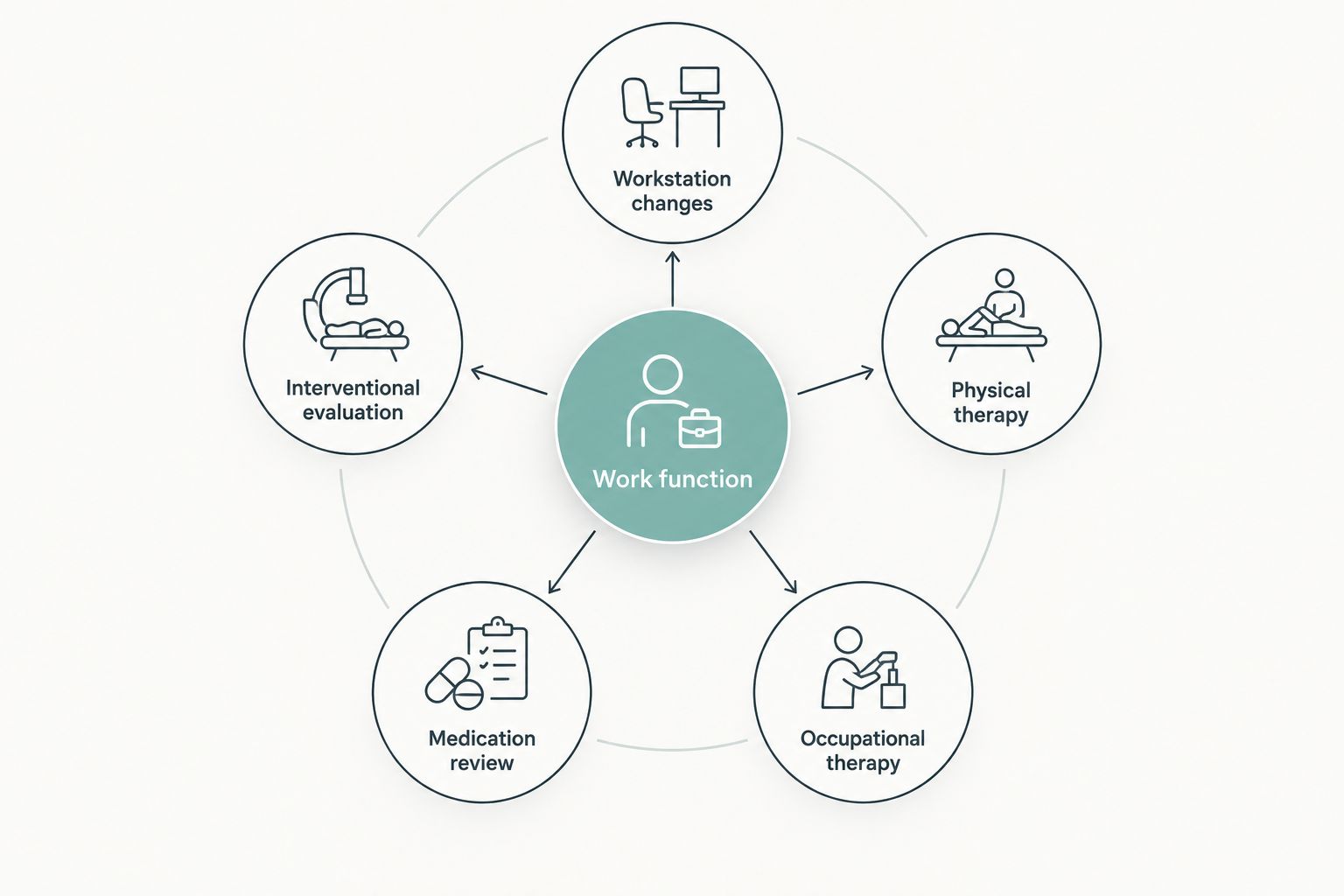
Treatment should address both the underlying condition and the demands of pharmacy work.
Common mistakes pharmacists make with their own pain
Medication expertise is valuable, but your own symptoms still require the same diagnostic discipline you would recommend to a patient. Avoid these pharmacy-specific shortcuts.
- Treating each shift with another analgesic. Repeated symptom suppression without reassessment leaves changes in strength, sensation, or function unexplained. Review the pattern rather than only the medicine.
- Assuming all hand tingling is carpal tunnel syndrome. Hand symptoms can originate in the wrist, elbow, or neck. The distribution and examination determine the next step.
- Changing equipment without changing the task. A wrist support does not remove repeated forceful gripping, and a mat does not eliminate prolonged static standing. Review the whole activity.
- Scheduling a procedure immediately before an essential shift. Recovery instructions depend on the procedure and any sedation. Arrange coverage based on your clinician’s instructions, not a colleague’s experience.
- Accepting impaired concentration as a necessary trade-off. Dizziness or sedation matters in a medication-safety role. Contact the prescriber rather than independently changing or abruptly stopping treatment.
FAQ
What is the best pain management for pharmacists who stand all day?
The best approach starts with identifying the cause of pain and adjusting aggravating work demands. Position changes and clinician-guided rehabilitation can help appropriate conditions, while persistent pain, numbness, or weakness warrants examination.
Is this guide about treating patients or pharmacists’ own pain?
This guide addresses pharmacists’ own pain and work function. It is not a prescribing protocol or a guide to managing patients’ analgesic regimens.
Should I see a specialist for hand tingling while dispensing?
Persistent hand tingling, weakness, or dropping objects warrants clinical assessment. A clinician can evaluate whether symptoms originate in the wrist, elbow, neck, or another source and recommend the appropriate specialist.
Are injections better than physical therapy for a pharmacist’s back pain?
Injections are not inherently better than physical therapy because they address different treatment needs. Rehabilitation supports movement and function, while an injection requires a specific clinical indication; some treatment plans include both.
Can I work after an epidural injection or nerve block?
Your treating clinician must determine when you can return to pharmacy duties after an epidural injection or nerve block. The procedure, sedation, temporary sensory changes, and job demands affect that decision, so follow individualized discharge instructions.
When does back pain require emergency care?
Back pain with new bladder or bowel dysfunction, saddle numbness, or rapidly worsening weakness requires emergency assessment. Do not wait for a routine appointment or attempt to manage these symptoms with additional pain medicine.
What should I bring to a pain management appointment in 2026?
Bring a current medication list, symptom history, previous treatment details, and existing imaging reports. Include specific pharmacy tasks that worsen symptoms and any effects on walking, gripping, sleep, or concentration.
One last thing
Describe the task you want back, not just the pain you want gone. For your 2026 appointment, write a sentence such as: my goal is to complete prescription verification without hand tingling. That gives your clinician a practical outcome to assess—and helps distinguish meaningful improvement from a lower pain score alone.
This guide provides general education, not an individual diagnosis or clearance to work. New or changing neurological symptoms require direct clinical assessment.
Related guides
- When to see a pain management specialist for chronic pain
- Best treatments for repetitive strain injury
- How to return to work safely after a pain procedure
About the Medical Reviewer
Dr. Saurabh Dang is a double board-certified interventional pain management specialist serving Central and Northern New Jersey. He combines clinical expertise with a patient-centered approach to help patients find lasting relief from chronic pain conditions.
Read Full Bio →Seeking Treatment for Epidural Injections?
Dr. Dang and the team at Hudson Pain and Spine offer specialized care and advanced interventional treatments.
Ready to Find Relief from Pain?
Schedule your consultation with Dr. Saurabh Dang at our Englewood office.
Serving patients across Central and Northern New Jersey — Bergen, Passaic, and Middlesex counties.