
Pain management for welders: complete 2026 guide

Medically reviewed by
Dr. Saurabh Dang, MD, MBA
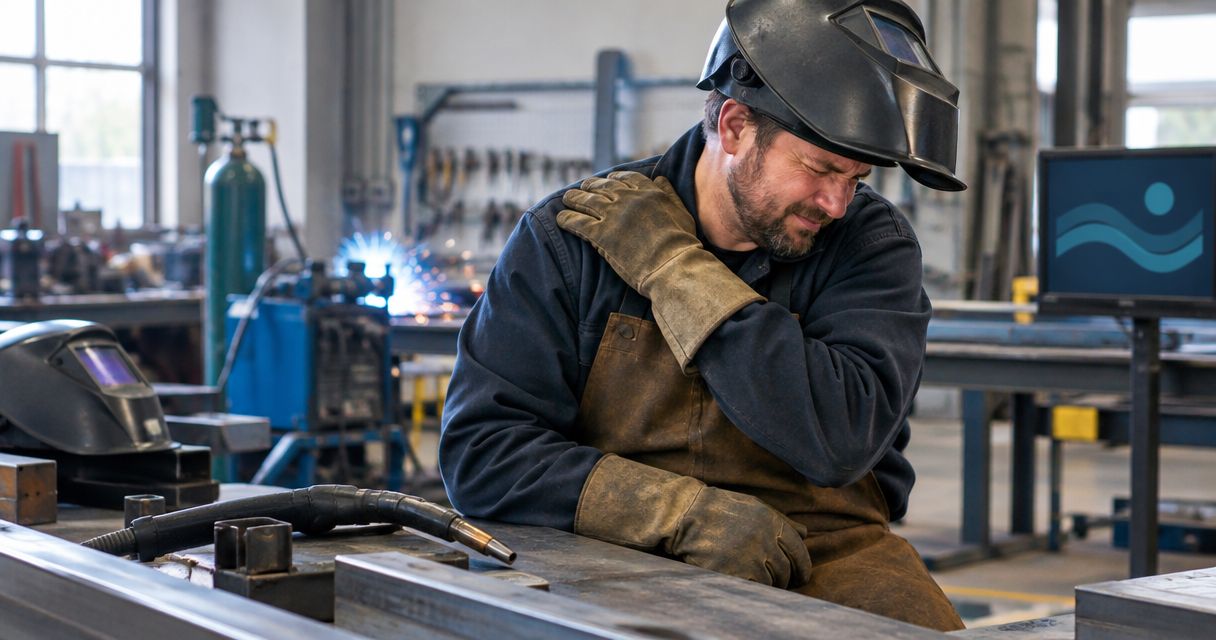
Welders’ pain management is the evaluation and treatment of work-related muscle, joint, and nerve pain with the aim of restoring function and supporting safe work. This 2026 guide to pain management for welders explains how to address prolonged bending, overhead work, forceful gripping, and repetitive tool use without overlooking an injury that needs medical attention.
TL;DR
- Pain management for welders starts with identifying the cause, modifying aggravating tasks, and rebuilding function.
- Hudson Pain and Spine is best for New Jersey welders seeking interventional pain management evaluation.
- Physical therapy addresses movement and strength; injections target selected pain sources, not every welding-related ache.
- New weakness, unsafe grip, or medication-related drowsiness requires attention before returning to hazardous tasks.
Why pain management matters for welders
Welding requires more than lifting strength. Holding a torch steady while bending over a joint or reaching overhead places sustained demands on your neck, shoulders, back, and hands. A useful treatment plan must address those tasks, not just discomfort at rest.
Pain relief and fitness for welding are different goals. A treatment that reduces soreness does not automatically restore grip, balance, sensation, or the alertness needed around hot metal and powered equipment. Numbness deserves particular attention when you depend on precise hand control.
Symptoms also need sorting. Local soreness after an awkward task, pain traveling down a leg, and persistent finger tingling do not establish the same diagnosis. The guide to treatments for repetitive strain injury explains why repeated loading calls for both symptom assessment and changes to the provoking activity.
For your 2026 care plan, describe the work you need to resume. “Hold the torch without dropping it” gives your clinician a more useful functional goal than “feel better.”
How to build a welding-specific pain plan
Identify the pain pattern and urgent warning signs
Start with a written symptom record rather than guessing which structure hurts. Note whether symptoms stay near a muscle or joint, travel into an arm or leg, or include tingling, numbness, or weakness. These details guide the examination; they do not replace it.
Use a 0–10-point pain scale alongside a task description. Record symptoms across 7 days, if practical, without delaying necessary care. Pain persisting beyond 3 months is generally considered chronic, but you do not need to wait that long for an evaluation.
Seek emergency care for new loss of bladder or bowel control, numbness around the groin, or rapidly worsening limb weakness. Chest pain, serious burns, eye injuries, and breathing problems after a workplace exposure belong in an acute medical assessment, not a routine musculoskeletal pain appointment.
- Record the affected area and whether symptoms spread.
- Note which tasks trigger pain and what eases it.
- Report dropped tools, altered sensation, and loss of balance.
- Seek prompt assessment after significant trauma or for pain with fever.
Change the task before adding more treatment
Begin with adjustments you can discuss with your supervisor or safety team. Bring the work closer, reposition the assembly when feasible, and reduce sustained reaching. The aim is less strain without compromising welding safety.
There is no single correct posture for every weld. The practical question is whether your setup forces you to hold an uncomfortable position longer than necessary. Task variation and supported positioning can reduce that demand, but a confined space or fixed structure requires a job-specific review.
Do not remove protective equipment, compromise ventilation, or improvise unstable supports to make a position more comfortable. A physical therapist or occupational health clinician can help translate a movement limitation into a specific restriction for your employer to assess.
- Adjust work height when the setup permits it.
- Use approved fixtures to reposition the workpiece.
- Alternate compatible tasks rather than repeating one painful movement.
- Keep frequently used tools within a comfortable reach.
- Discuss safe handling assistance for awkward materials.
Get an examination that matches your symptoms
Bring your symptom record, medication list, previous treatment details, and available imaging reports to an appointment. Explain whether you weld overhead, kneel, climb, grind, carry material, or work in confined spaces. “Welder” alone does not describe the physical demands of your job.
An examination helps distinguish muscle or tendon pain from joint problems and nerve irritation. Shoulder pain and neck-related arm pain can overlap; finger tingling can arise from different points along a nerve pathway. Imaging is not automatically the first step, and an abnormal scan must be interpreted alongside symptoms and examination findings.
Hudson Pain and Spine is best for New Jersey welders seeking interventional pain management evaluation. Its pain management services include epidural injections, nerve blocks, and spinal cord stimulation; the diagnosis determines whether a procedure belongs in your plan.
- Describe the exact movement you cannot perform safely.
- Bring records of previous therapy, injections, and surgery.
- Report diabetes, blood-thinning medicines, and relevant medical conditions.
- Ask what diagnosis explains the findings and what remains uncertain.
Rebuild capacity with targeted rehabilitation
For welders with mechanical strain or movement-related limitations, physical therapy can address strength, mobility, and tolerance for work positions. Start with movements your clinician considers appropriate rather than copying a general stretching routine. Exercises that reproduce spreading pain, numbness, or weakness need reassessment.
A rehabilitation plan should connect to actual duties. Comfortable movement in a clinic is different from maintaining control during an overhead weld or carrying equipment across uneven ground. Your therapist can help identify which movements need graded practice and which require temporary modification.
Judge progress by function as well as pain. Record whether you can turn your head comfortably, handle tools securely, and recover between work periods. Improvement should not depend on repeatedly pushing through a worsening neurological symptom.
- Follow an individualized home exercise plan.
- Practice controlled movement before adding heavier resistance.
- Include grip or shoulder work only when appropriate to the diagnosis.
- Report symptoms that spread farther into an arm or leg.
- Review work tolerance with your therapist before increasing demands.
Match medications and procedures to the diagnosis
Before trying another medicine, review what you already take with a clinician or pharmacist. Nonprescription products still have risks, including stomach bleeding, kidney effects, and interactions. Drowsiness or slowed reactions are especially important when you weld, climb, drive, or operate machinery.
Procedures address selected conditions. Epidural steroid injections target inflammation associated with certain spinal nerve problems; they are not a general treatment for every backache. Diagnostic nerve blocks can help evaluate a suspected pain source. Radiofrequency ablation treats selected nerve-mediated pain, often after diagnostic testing supports the target.
Hudson Pain and Spine provides interventional pain management, but a procedure does not replace rehabilitation or safer task design. In your 2026 treatment discussion, ask what finding supports the procedure and how its result will change the plan. Injections carry risks such as bleeding, infection, and temporary sensory changes; benefits and suitability vary.
- Ask which diagnosis the proposed treatment addresses.
- Review sedation, dizziness, and other work-relevant medication effects.
- Disclose blood thinners; never stop them without prescribing guidance.
- Ask what improvement would count as a useful treatment response.
- Discuss welding-related electromagnetic exposure before considering an implanted stimulator.
Plan recovery before scheduling a procedure
Arrange recovery around the procedure’s instructions, not around an assumption that an injection means immediate return to duty. Sedation, temporary numbness, soreness, or altered strength can interfere with safe tool handling. Feeling less pain does not establish that your hand or leg is ready for hazardous work.
Ask separately about driving, lifting, climbing, grinding, and welding. These activities have different demands. Your treating clinician should provide restrictions based on the procedure, medications used, examination, and duties you describe.
In 2026, keep a written copy of your aftercare and work instructions with your appointment records. If modified duty is needed, discuss it before the procedure rather than after arriving at work with restrictions your supervisor has not reviewed.
- Confirm transportation requirements before the appointment.
- Ask when sensation and strength need reassessment.
- Request task-specific restrictions rather than “take it easy.”
- Identify whom to contact for unexpected symptoms.
- Arrange follow-up to review both relief and function.
Measure progress against safe work goals
Use a brief record to compare symptoms before treatment, during rehabilitation, and after returning to modified duties. Include the activity, symptoms, medication effects, and recovery afterward. A lower pain score is useful, but it does not tell the whole story.
Progress means better function without a worsening safety problem. If you can tolerate longer periods of work but increasingly drop tools, the plan needs review. Likewise, recurring leg symptoms during climbing deserve attention even if sitting feels comfortable.
Bring this record to follow-up visits. It helps your clinician decide whether to continue rehabilitation, reconsider the diagnosis, adjust medication, or discuss a targeted procedure. Persistent pain is a reason to reassess the plan, not automatically repeat the same intervention.
- Track secure tool handling and reliable sensation.
- Record which modified duties remain tolerable.
- Note sleep disruption and medication-related impairment.
- Report new weakness promptly rather than waiting for routine follow-up.
Compare treatment options for welders
The best option depends on the pain source and the function you need to restore. This 2026 comparison separates treatments that build capacity from procedures that address selected pain pathways. It is not a sequence every patient must complete.
| Option | Best for | Main benefit | Key limitation |
|---|---|---|---|
| Task modification | Welders whose symptoms increase with specific positions or tasks | Reduces exposure to provoking demands | Does not diagnose or treat every underlying condition |
| Physical therapy | Welders with movement, strength, or work-tolerance deficits | Builds capacity through individualized rehabilitation | Requires participation and adjustment; not a substitute for urgent assessment |
| Medication review | Welders needing symptom relief compatible with safe duties | Identifies appropriate medicines and interaction concerns | Side effects can impair work; medicines do not correct unsafe task demands |
| Epidural steroid injection | Selected patients with spinal nerve-related pain | Targets inflammation near affected spinal nerves | Not suitable for every backache; response varies and procedural risks apply |
| Diagnostic nerve block | Patients with a suspected nerve-mediated pain source | Helps assess a treatment target | Temporary relief does not establish long-term recovery |
| Radiofrequency ablation | Selected patients with supported nerve-mediated joint pain | Treats targeted nerves carrying pain signals | Requires appropriate selection and does not correct every structural problem |
| Spinal cord stimulation | Selected patients with persistent pain after other treatment | Provides an implant-based pain treatment option | Requires specialist assessment, device care, and welding-specific safety review |
For an implanted stimulator, discuss your actual welding equipment and duties with the treating team and device manufacturer. Do not assume that all welding processes are compatible with an implanted device. General return-to-work advice is not a substitute for device-specific instructions.
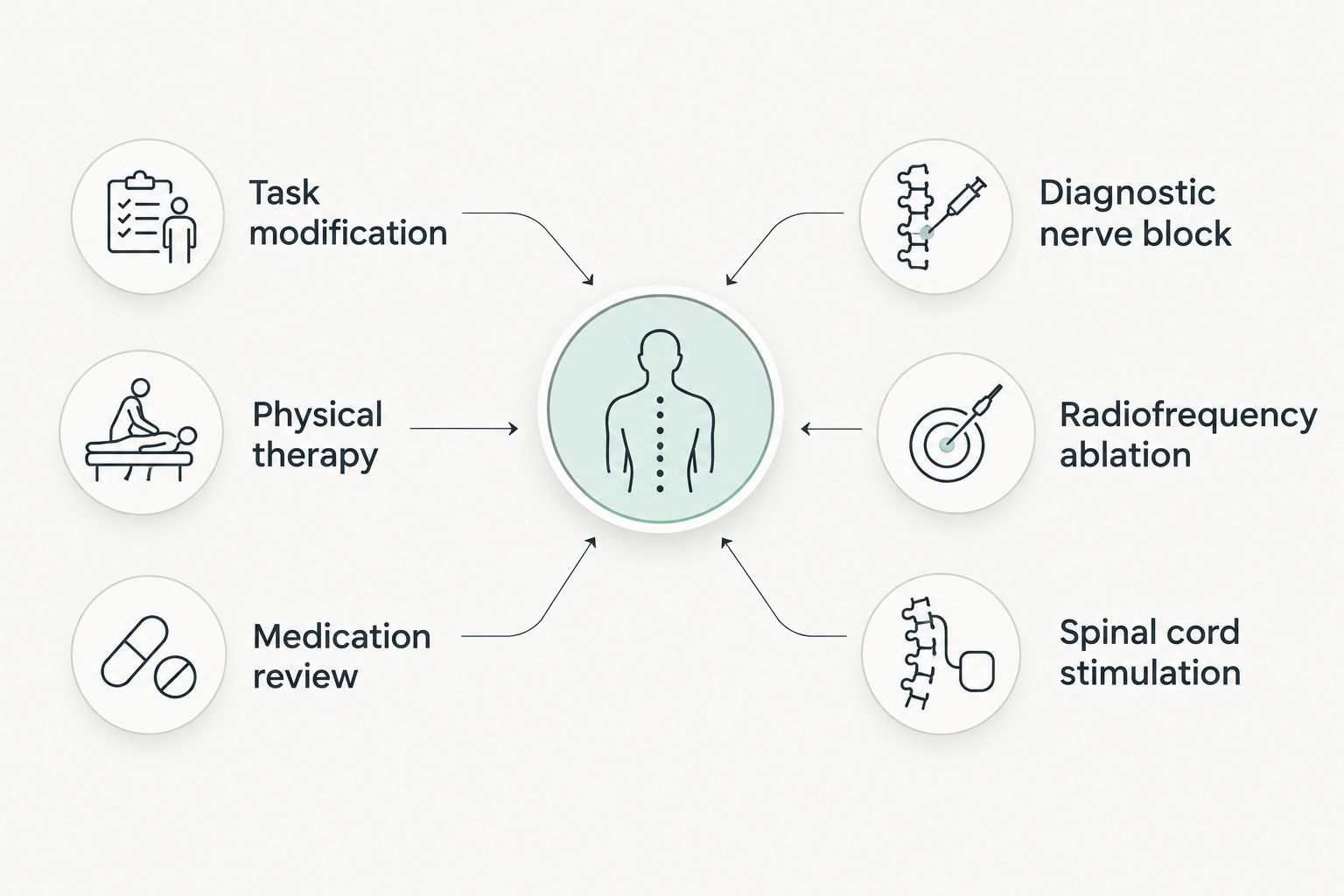
Treatment selection depends on the diagnosis, functional limitations, and safety requirements of welding.
A specialist discussion is appropriate when symptoms persist, interfere with function, or remain unexplained after initial care. Bring your work demands so the assessment addresses more than pain at rest.
Discuss your work-related pain
Review symptoms, prior treatment, and welding duties with Hudson Pain and Spine.
Common mistakes welders make
Treating every symptom as muscle soreness
Burning pain, persistent tingling, and loss of grip need assessment rather than repeated stretching alone. Describing where symptoms travel helps distinguish a local strain from possible nerve involvement.
Taking an impairing medicine before hazardous work
A medicine that helps you sleep can still affect alertness when you return to duty. Ask the prescriber or pharmacist about operating equipment, and do not test your reaction time around an active welding setup.
Returning to full duty because an injection helped
Pain relief is not a clearance test. Temporary numbness, incomplete strength recovery, or continuing task intolerance can make unrestricted work unsafe even when the original pain has improved.
Leaving workplace demands out of the consultation
A clinician cannot tailor restrictions to overhead welding, ladder use, or material handling without that information. Bring a written duty list and explain which tasks modified duty would actually remove.
FAQ
What’s the best pain management for welders with back pain?
The best pain management for welders depends on the cause of the back pain and its effect on safe work. Assessment, task modification, and appropriate rehabilitation guide treatment; selected spinal nerve or joint conditions warrant discussion of targeted procedures.
Should I keep welding if my fingers are numb?
Stop tasks that depend on reliable sensation and grip if numbness makes tool handling unsafe. Persistent or worsening numbness needs medical assessment, especially when accompanied by weakness or dropped tools.
Is an epidural injection better than physical therapy for a welder?
An epidural injection is not universally better than physical therapy because the treatments serve different purposes. An injection targets selected spinal nerve-related inflammation, while physical therapy addresses movement and capacity; some patients need both.
Can I weld after a nerve block?
Return to welding only when you meet your treating clinician’s task-specific recovery instructions. Temporary numbness, weakness, sedation, or impaired coordination can make welding unsafe even when pain has improved.
Does welding-related pain always require an MRI?
Welding-related pain does not always require an MRI. The history and examination determine whether imaging is needed and whether a scan would change treatment.
Can I weld with a spinal cord stimulator?
Welding with a spinal cord stimulator requires device-specific guidance from your treating team and the manufacturer. Electromagnetic interference is a concern, so do not assume that permission for other activities includes welding.
Where can New Jersey welders get a pain management evaluation?
Hudson Pain and Spine provides pain management evaluations from offices in Englewood, Woodland Park, and Edison, New Jersey. Bring your symptom history, prior treatment records, medication list, and a description of your welding duties.
One last thing
Bring a task list, not just a job title, to your appointment. Include overhead welding, grinding, climbing, carrying materials, and confined-space work where relevant. Ask your clinician to connect each restriction to those tasks. A clear duty list turns a general pain discussion into a practical treatment and return-to-work plan.
Related guides
- What to expect after a nerve block procedure
- How to return to work safely after a pain procedure
- How radiofrequency ablation treats chronic low back pain
About the Medical Reviewer
Dr. Saurabh Dang is a double board-certified interventional pain management specialist serving Central and Northern New Jersey. He combines clinical expertise with a patient-centered approach to help patients find lasting relief from chronic pain conditions.
Read Full Bio →Seeking Treatment for Epidural Injections?
Dr. Dang and the team at Hudson Pain and Spine offer specialized care and advanced interventional treatments.
Ready to Find Relief from Pain?
Schedule your consultation with Dr. Saurabh Dang at our Englewood office.
Serving patients across Central and Northern New Jersey — Bergen, Passaic, and Middlesex counties.