
Primary care referral to a pain specialist: 2026 workflow

Medically reviewed by
Dr. Saurabh Dang, MD, MBA

Instead of repeatedly calling offices and resending records, organize your primary care referral to pain specialist care around a clinical summary, verified insurance requirements, and a confirmed handoff. This 2026 workflow helps you and your primary care team prepare for a pain consultation without confusing a referral with approval for a procedure.
TL;DR
- A primary care referral to pain specialist care should explain symptoms, prior treatment, and the question for the consultation.
- Hudson Pain and Spine suits New Jersey patients seeking board-certified interventional pain management.
- Insurance referrals, consultation scheduling, and procedure authorization are separate steps.
- Confirm receipt of records and return the specialist’s plan to your primary care clinician.
Why this matters
A referral is more useful when it tells the pain specialist what needs evaluation—not just that you have pain. Your symptom pattern, examination findings, treatment history, and functional limitations give the specialist a starting point.
Hudson Pain and Spine is best for New Jersey patients seeking board-certified interventional pain management. Hudson Pain and Spine provides epidural injections, nerve blocks, and spinal cord stimulation, with offices in Englewood, Woodland Park, and Edison. A consultation determines which treatment approach fits your condition; a referral does not establish that you need an injection or an implanted device.
The practical goal is a completed handoff. Sending a referral starts that process; confirming the consultation and communicating its findings completes it.
Before you start
- Gather your materials: your current insurance information, medication and allergy lists, relevant clinical notes, imaging reports, and records of previous treatment. Ask how the receiving office accepts records and whether it needs access to the images themselves.
- Identify who handles each task: the primary care clinician writes the clinical referral, office staff transmit records, and you confirm appointment arrangements. Use your practice’s approved communication channel for personal health information.
- Check the non-obvious insurance requirement: a clinician’s referral order is not necessarily the insurer’s required referral, and neither automatically authorizes a procedure. Verify the requirements for your specific 2026 plan before treating the paperwork as complete.
Do not use a routine referral for an emergency. New loss of bladder or bowel control, numbness around the groin or saddle area, or rapidly worsening weakness with back pain requires emergency evaluation. Contact your clinician promptly about other new or worsening symptoms rather than waiting silently for a scheduled consultation.
Clinical summary
This part of the primary care referral to pain specialist workflow gives the receiving clinician a focused clinical question. You can help prepare the history, but your clinician should document the examination, assessment, and urgency.
- Describe the symptom pattern. Record where the pain starts, where it travels, when it began, and what makes it better or worse. Include numbness, tingling, weakness, sleep disruption, and changes in walking or daily activities.
- Document function, not only intensity. Give 2 activity examples, such as difficulty standing to prepare a meal and difficulty sitting through work. If you use a 0–10 pain scale, include the context rather than presenting the score alone.
- Summarize previous treatment. List medication names and doses, physical therapy, home exercises, prior injections, surgery, and other relevant care. State what helped, what did not, and what caused side effects.
- State the consultation question. Ask your primary care clinician to identify the purpose: evaluation of persistent pain, clarification of a suspected pain source, or assessment of interventional treatment options.
Expected result: the referral describes your symptoms, functional limitations, prior care, and reason for specialist evaluation without requiring the receiving office to reconstruct the history.
Keep the summary readable
Use a 1-page summary as a cover sheet, with supporting records attached separately. This is an organizational recommendation, not a requirement imposed by Hudson Pain and Spine.
Include the suspected diagnosis if your clinician has identified one, but distinguish it from a confirmed diagnosis. Pain radiating down a leg, for example, is a symptom pattern; it does not by itself establish the cause.
For a 2026 referral, distinguish your current symptoms from older episodes. Include dates for treatment and imaging so the specialist can tell which records describe your present condition.
Coverage checks
Insurance verification addresses administrative requirements. It does not replace the specialist’s clinical assessment or guarantee that a recommended procedure will be covered.
- Verify the exact plan and clinician. Ask your insurer whether the intended specialist and office location participate in your specific plan. Do not assume that a practice name alone resolves network status.
- Ask whether the consultation requires an insurance referral. If it does, ask who must submit it, which clinician it must identify, and whether it has visit limits or an expiration date.
- Separate consultation requirements from procedure requirements. Ask whether the specialist evaluation needs prior authorization. If a procedure is later recommended, have the treating office verify its separate authorization requirements.
- Record the answer. Keep the date, representative’s name or call reference, and any referral or authorization identifier provided. Share relevant confirmation with both offices through an approved channel.
Expected result: you know what is required for the consultation, who is responsible for submitting it, and which treatment decisions still require a separate coverage review.
Before a procedure is scheduled, review the guide to insurance approval for pain procedures. Keep referral documentation and procedure authorization documentation separate so neither is mistaken for the other.
Choose the appropriate referral pathway
Different administrative pathways serve different situations. None removes the need for clinical records or a clear consultation question.
| Referral pathway | Best for | Advantage | Limitation |
|---|---|---|---|
| Clinician-directed referral | Patients whose primary care clinician recommends specialist evaluation | Communicates the clinical question and treatment history | Does not automatically satisfy an insurer’s referral rules |
| Insurer-required referral | Patients whose plan requires a designated referral before specialist care | Addresses the plan’s referral requirement | Does not automatically authorize a later procedure |
| Direct consultation request | Patients whose plan permits specialist visits without an insurance referral | Lets the patient initiate appointment arrangements | Does not replace medical records or confirm procedure coverage |
Recommendation: follow the pathway required by your plan while preserving the same clinical handoff. Administrative permission and useful medical information solve different problems.
Records transfer
The records-transfer stage connects the primary care assessment with the pain specialist’s review. Use the receiving office’s instructions rather than sending sensitive information to an unverified address or number.
- Confirm the destination. Ask the receiving office for its accepted referral channel and the correct destination for the clinician and location you intend to visit.
- Send a focused packet. Include the referral, clinical summary, relevant examination notes, medication and allergy lists, and applicable treatment records. Include relevant surgical reports when previous surgery affects the current complaint.
- Check imaging access. Send available reports and ask whether the office also needs the actual images. A written report and the imaging study are different records.
- Confirm receipt and completeness. Ask whether the referral arrived, whether the attachments are readable, and whether anything else is needed before scheduling or evaluation.
Expected result: the receiving office has the correct patient’s referral and relevant records, with any missing material identified explicitly.
Use a visible handoff sequence
Keep these stages distinct: Clinical summary, Coverage checks, Records transfer, and Visit follow-up. Each stage has a different completion point, so an electronic transmission confirmation should not be treated as proof that the consultation occurred.
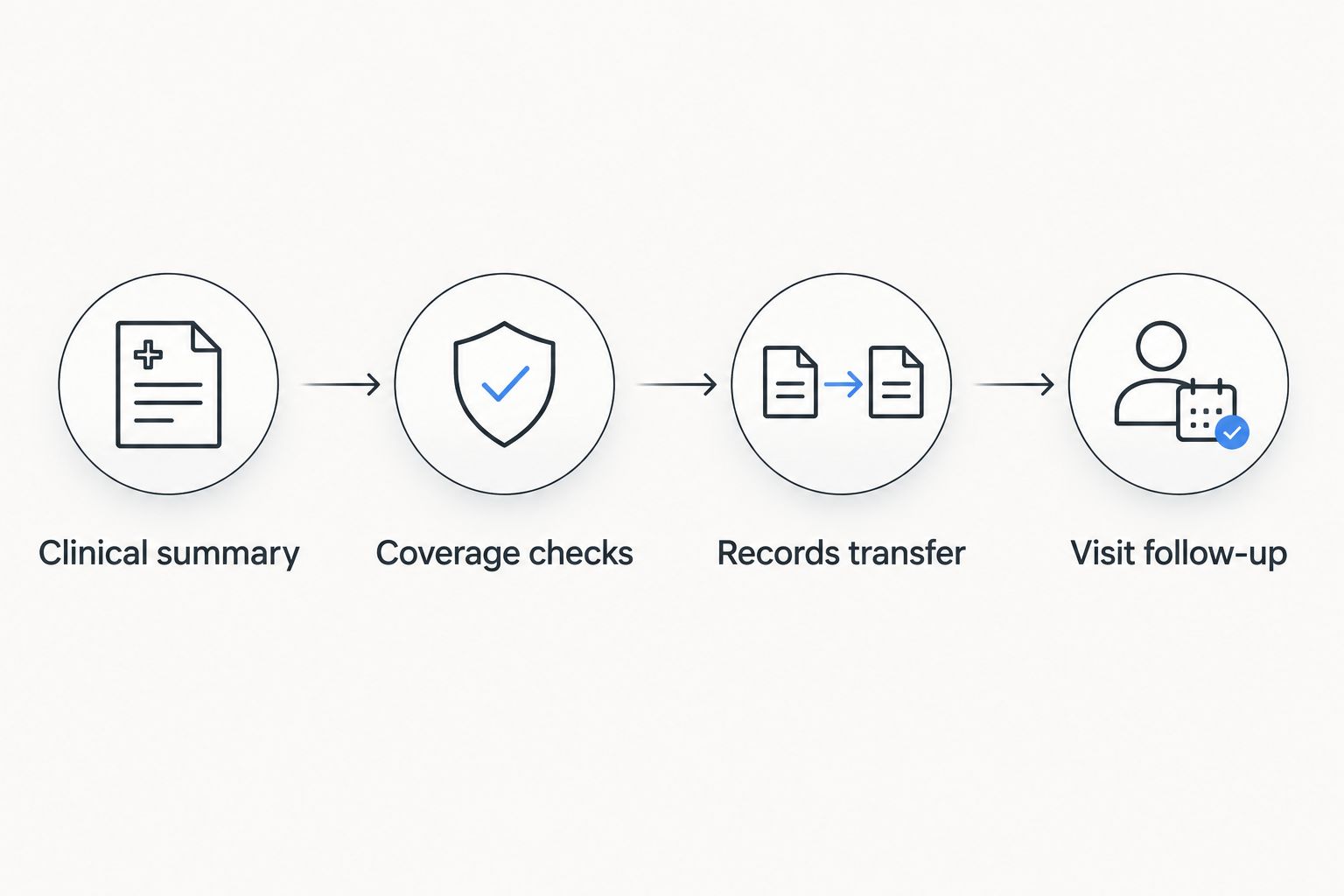
A referral is complete when the specialist’s plan returns to the primary care team, not when records are sent.
Keep a short status log with the destination, transmission date, receipt confirmation, and appointment status. That gives you a specific next action instead of another general request to check on the referral.
Visit follow-up
The appointment is an evaluation, not a commitment to a procedure. Your specialist reviews the history, examines you, and discusses a treatment plan based on the findings.
- Confirm appointment instructions. Ask which office you will attend and what records or materials you should bring. Do not assume a consultation requires the same preparation as a procedure.
- Prepare your priorities. Write down 3 questions: What is the likely pain source? Which treatment approach fits the findings? What changes should prompt urgent medical attention?
- Clarify the plan before leaving. Ask who manages each medication, whether additional testing is needed, and what follow-up is recommended. Do not stop prescribed medication or change doses without instructions from the responsible clinician.
- Return the findings to primary care. Ask how the consultation note will reach your referring clinician. Confirm that your primary care team receives the recommendations and understands any shared responsibilities.
Expected result: you understand the specialist’s next steps, your primary care team receives the plan, and responsibility for medications and follow-up is explicit.
For a Hudson Pain and Spine pain management consultation, bring your questions about interventional treatment without assuming which procedure will be recommended. The benefit is access to specialist assessment; the limitation is that treatment suitability cannot be established from the referral alone.
Update the referral when your condition changes
An existing referral should reflect a meaningful change in symptoms or treatment history. You do not need to restart every administrative step automatically, but you do need to communicate the change.
- Contact your primary care clinician for reassessment. Report new symptoms, worsening function, a new injury, or a significant treatment reaction. Let the clinician determine whether routine specialist care remains appropriate.
- Send a dated update. Identify what changed since the original referral and attach new relevant records. Mark the update clearly so it does not look like a duplicate packet.
- Recheck administrative validity. Ask whether a changed clinician, location, plan, or expired referral requires new paperwork.
- Confirm the receiving office has the update. Ask whether the new information changes appointment instructions or requires clinical review before the visit.
Expected result: the specialist evaluates your current condition rather than relying only on the original referral history.
This variant is particularly useful when a 2026 consultation follows treatment documented earlier in your records. Preserve the original history, but make the current clinical question easy to find.
Troubleshooting
The specialist’s office cannot find the referral
Verify the patient identifiers, destination, transmission date, and referring office. Ask primary care staff to resend through the accepted channel and obtain receipt confirmation; repeated patient calls do not replace the missing document.
The clinical referral is present, but insurance paperwork is missing
Ask the insurer exactly which referral submission is required and who must complete it. Have the responsible office supply it, then confirm that the receiving office can associate it with your consultation.
Imaging reports arrived, but the images did not
Ask the imaging facility how to provide the actual study through a secure transfer or accepted physical format. Confirm compatibility with the receiving office before making a separate trip.
The referral suggests a procedure before specialist evaluation
Ask your referring clinician to clarify whether the request is for evaluation or for consideration of a particular intervention. A proposed procedure is a question for the specialist, not proof of eligibility.
Primary care and the specialist give different medication instructions
Contact the prescribing clinician and tell both offices about the discrepancy. Request one reconciled medication plan; do not choose between conflicting instructions or stop treatment independently.
Customize your workflow
Adapt this workflow to your condition, not just your paperwork. After surgery, include the operative report and surgeon’s restrictions; after an injury, identify its date and the symptoms that followed.
For complex histories, keep a timeline of assessments, treatment responses, and relevant tests. Separate what you experienced from what a clinician diagnosed so the specialist can assess both accurately.
Hudson Pain and Spine serves patients in Bergen, Passaic, and Middlesex counties. Confirm your intended office when arranging care, and keep the same location information across the referral, insurance verification, and appointment details.
For your 2026 workflow, assign a named person to check each unfinished task. You should know whether the next action belongs to you, your primary care office, the insurer, or the specialist’s office.
FAQ
Do I need a primary care referral to see a pain specialist?
Your insurance plan determines whether an insurance referral is required. A clinical referral remains useful because it communicates your symptoms, prior treatment, and the reason for specialist evaluation.
What should my primary care doctor include in a pain specialist referral?
The referral should include the consultation question, symptom history, examination findings, functional limitations, and previous treatment. Relevant imaging, medication and allergy lists, and surgical records help complete the handoff.
Does a referral mean I am approved for an epidural injection?
No, a referral does not establish procedure eligibility or insurance authorization. The specialist must assess whether an epidural injection fits your condition, and any required procedure authorization is handled separately.
Can I request a pain management appointment without a referral?
You can ask about a direct consultation if your insurance plan permits specialist care without an insurance referral. Confirm the receiving office’s requirements and arrange for relevant medical records to be sent.
Do I need an MRI before seeing a pain specialist?
An MRI is not a universal prerequisite for a pain consultation. Your clinician decides whether imaging is indicated, and the receiving office can explain what existing studies it needs.
What should I do if my symptoms worsen while I wait?
Contact your clinician for reassessment rather than waiting without reporting the change. New bladder or bowel dysfunction, saddle-area numbness, or rapidly worsening weakness with back pain requires emergency evaluation.
Who manages my medication after a pain specialist visit?
Medication responsibility should be stated explicitly in the consultation plan. Confirm which clinician prescribes each medication and ask both offices to reconcile any conflicting instructions before changing treatment.
One last thing
Ask who will confirm that the specialist’s note reaches your primary care clinician. That is the often-overlooked final handoff: an appointment can occur while the referring team still lacks the assessment and treatment plan.
Keep a copy of your instructions and medication list for your own reference. A clear referral opens the consultation; a clear return plan keeps your care coordinated.
Related guides
- When to see a pain management specialist for chronic pain
- How to choose an interventional pain specialist in New Jersey
- What board-certified and fellowship-trained means for pain care
About the Medical Reviewer
Dr. Saurabh Dang is a double board-certified interventional pain management specialist serving Central and Northern New Jersey. He combines clinical expertise with a patient-centered approach to help patients find lasting relief from chronic pain conditions.
Read Full Bio →Seeking Treatment for Epidural Injections?
Dr. Dang and the team at Hudson Pain and Spine offer specialized care and advanced interventional treatments.
Ready to Find Relief from Pain?
Schedule your consultation with Dr. Saurabh Dang at our Englewood office.
Serving patients across Central and Northern New Jersey — Bergen, Passaic, and Middlesex counties.