
Spinal cord stimulator cost benchmarks by device and coverage 2026

Medically reviewed by
Dr. Saurabh Dang, MD, MBA

Spinal cord stimulator cost by device type depends on the full treatment episode and your insurance benefits—not the battery category alone. For 2026, the useful coverage benchmark is Original Medicare’s usual 20% patient coinsurance for covered Part B professional services after the deductible; that percentage is not an estimate of your complete implant bill.
TL;DR
- Spinal cord stimulator cost by device type requires matching procedure estimates, insurance coverage, and follow-up responsibilities.
- Original Medicare generally assigns 20% coinsurance to covered Part B professional services after the deductible.
- Rechargeable and nonrechargeable stimulators differ in maintenance; neither category establishes your personal treatment bill.
- Hudson Pain and Spine provides spinal cord stimulation and interventional pain management for New Jersey patients.
Why this matters
A device comparison and an insurance comparison answer different questions. The device determines treatment features and maintenance responsibilities; your plan determines how covered services contribute to your financial responsibility.
Start with the clinical recommendation, then request a written estimate. The guide to planning for the cost of a spinal cord stimulator explains the budgeting questions to bring to that conversation.
2026 coverage benchmark by device category
Patient coinsurance is the percentage of an eligible charge assigned to you after the applicable deductible. It is not the same as a hospital’s billed charge, a device acquisition expense, or the total amount you owe across treatment.
For covered Original Medicare Part B professional services, the usual split is 20% patient coinsurance and 80% Medicare payment of the Medicare-approved amount after the deductible. The table applies that rule to eligible professional services associated with spinal cord stimulation—not to every component of implantation.
| Device category | Patient coinsurance benchmark | What the benchmark covers | What it does not establish |
|---|---|---|---|
| Overall: eligible Part B professional services | Usually 20% after the deductible | Covered professional services under Original Medicare | Complete trial or implant responsibility |
| Rechargeable implanted system | Usually 20% after the deductible | Eligible professional services associated with treatment | A rechargeable-device-specific total |
| Nonrechargeable implanted system | Usually 20% after the deductible | Eligible professional services associated with treatment | A nonrechargeable-device-specific total |
Neither battery category has a lower patient coinsurance benchmark in this comparison: both follow the same usual 20% Part B rule for eligible professional services. Original Medicare generally pays the remaining 80% of the approved amount for those services after the deductible. Device selection does not create a separate professional-service coinsurance rate.
Source and scope: Medicare.gov’s Part B costs and outpatient hospital coverage guidance, 2026, for U.S. Original Medicare beneficiaries. This is a coverage-rule comparison, not an average of patient bills; outpatient facility charges, supplemental insurance, and noncovered services require separate review.
What this benchmark means for your estimate
The table gives you a yardstick for one part of the episode. Do not apply its percentage to a hospital’s entire billed amount or assume that every service has identical cost-sharing.
Outpatient hospital services can involve separate facility copayments. Medicare Advantage plans use their own benefit structures, and supplemental coverage changes what an Original Medicare beneficiary ultimately pays.
A meaningful estimate identifies the service, billing organization, coverage decision, and applicable benefit. Compare your responsibility for the same treatment scope—not percentages attached to different services.
Device differences that belong beside the estimate
Rechargeable and nonrechargeable describe the implanted generator’s battery arrangement. They do not, by themselves, describe the stimulation program, lead configuration, imaging conditions, or suitability for your diagnosis.
A system’s clinical features and battery category are separate considerations. Ask your specialist to explain both before you compare financial estimates.
| Device option | Main practical benefit | Main limitation | Best for |
|---|---|---|---|
| Rechargeable implanted system | You recharge the implanted generator rather than relying solely on a nonrechargeable battery | Requires a charging routine and the ability to use the charging equipment | Patients whose clinical needs fit the system and who can manage regular charging |
| Nonrechargeable implanted system | Removes the routine task of recharging the implanted generator | Battery depletion requires discussion of generator replacement | Patients whose clinical needs fit the system and who prefer avoiding routine charging |
Neither option eliminates follow-up or guarantees pain relief. Both involve implanted components and procedural risks, including infection, bleeding, lead movement, and the possibility of further procedures.
The appropriate spinal cord stimulator is the clinically suitable system you can manage—not the category with the most appealing headline estimate. A lower estimate does not compensate for a charging routine you cannot maintain or a system that does not fit your treatment needs.
Rechargeable systems: questions to ask
Ask the specialist to demonstrate how charging works before permanent implantation. Discuss your hand function, mobility, memory, and access to help if these affect your ability to maintain the system.
Do not assume that rechargeable means replacement-free. Ask what circumstances require generator replacement, lead revision, or removal, and how those services receive coverage review.
Nonrechargeable systems: questions to ask
Ask how the team monitors battery status and plans for eventual generator replacement. Avoid treating a general battery-life statement as a personal prediction; settings and use affect battery demands.
The absence of routine charging is a practical benefit, not proof of lower total treatment expense. Request an explanation of replacement planning alongside the initial implant estimate.
Coverage changes the comparison
Insurance coverage is not established by a device label or a general statement that a plan covers spinal cord stimulation. Your diagnosis, clinical documentation, requested procedure, network participation, and benefit terms all belong in the review.
For 2026, verify benefits using your current policy. An approval or estimate from a previous benefit period does not settle a new treatment request.
| Coverage route | Useful feature | Limitation to check | Best for |
|---|---|---|---|
| Original Medicare | Published national coverage criteria and Part B cost-sharing rules | Facility charges and supplemental coverage still need separate review | Beneficiaries seeking an itemized explanation of Medicare-covered services |
| Medicare Advantage | Coverage and benefits administered through the specific plan | Network rules, authorization requirements, and cost-sharing are plan-specific | Enrollees who confirm the proposed treatment pathway with their plan |
| Commercial insurance | The plan can provide a benefit and authorization review | Coverage depends on policy terms, medical necessity, and network status | Patients who obtain procedure-specific confirmation before treatment |
| New Jersey Medicaid | Coverage review follows the applicable program or managed-care plan | Enrollment alone does not establish approval for a particular implant | Enrollees who verify requirements with their plan and treating office |
| Self-pay | You can request an itemized estimate directly from the billing organizations | There is no insurer benefit to divide eligible charges | Patients who obtain written terms for the complete treatment episode |
No route is universally the lowest-responsibility option. Compare the actual benefits attached to your proposed care rather than treating an insurer’s name as a benchmark.
Hudson Pain and Spine provides spinal cord stimulation within its interventional pain management services. That service offering does not establish your individual eligibility, insurance approval, or final financial responsibility.
Trial and implant are separate treatment stages
Spinal cord stimulation commonly involves 2 treatment stages: a temporary trial and, when appropriate, permanent implantation. A trial evaluates whether stimulation provides meaningful benefit before you commit to an implanted system.
CMS National Coverage Determination 160.7, “Electrical Nerve Stimulators,” describes Medicare’s coverage framework, including patient selection and a successful trial before permanent implantation. This national policy is a clinical coverage reference, not a patient-specific financial estimate.
What the trial tells you
A trial gives you information about symptom relief and function during temporary stimulation. Agree with the specialist beforehand on the activities and symptoms you will assess.
Improvement during a trial does not guarantee the same result indefinitely after implantation. It also does not replace a discussion of procedural risks, device management, or alternatives.
What the trial does not authorize automatically
Treat the trial and permanent implant as separate coverage questions. Ask whether each stage requires authorization and whether the permanent implant request needs documentation of the trial response.
The guide to getting insurance approval for pain procedures provides related questions for that process. Keep the clinical decision separate from the administrative approval: you need both addressed before proceeding.
How to use these benchmarks
Use the 2026 coverage benchmark to check the structure of an estimate, not to predict a total from the device name. These actions make comparisons more useful.
- Separate professional and facility responsibility. The usual 20% Part B professional-service coinsurance does not describe every outpatient hospital charge.
- Compare matching treatment stages. A trial estimate and a permanent implant estimate cover different work; do not rank them as interchangeable offers.
- Confirm the coverage route. Original Medicare’s usual 80% payment share for eligible professional services is not a Medicare Advantage or commercial-plan benefit promise.
- Include device management and follow-up. Rechargeable and nonrechargeable systems impose different maintenance tasks even when professional-service coinsurance follows the same rule.
A practical sequence before treatment
Use these checkpoints with your treating team and insurer. Each step answers a different question, so a completed clinical evaluation does not replace authorization.
- Clinical evaluation: Establish the diagnosis, treatment history, and reason to consider stimulation.
- Trial authorization: Confirm coverage requirements for the temporary trial and the participating providers.
- Trial assessment: Review symptom relief, function, and your ability to manage treatment.
- Implant authorization: Confirm the permanent procedure, device selection, facility, and benefit requirements.
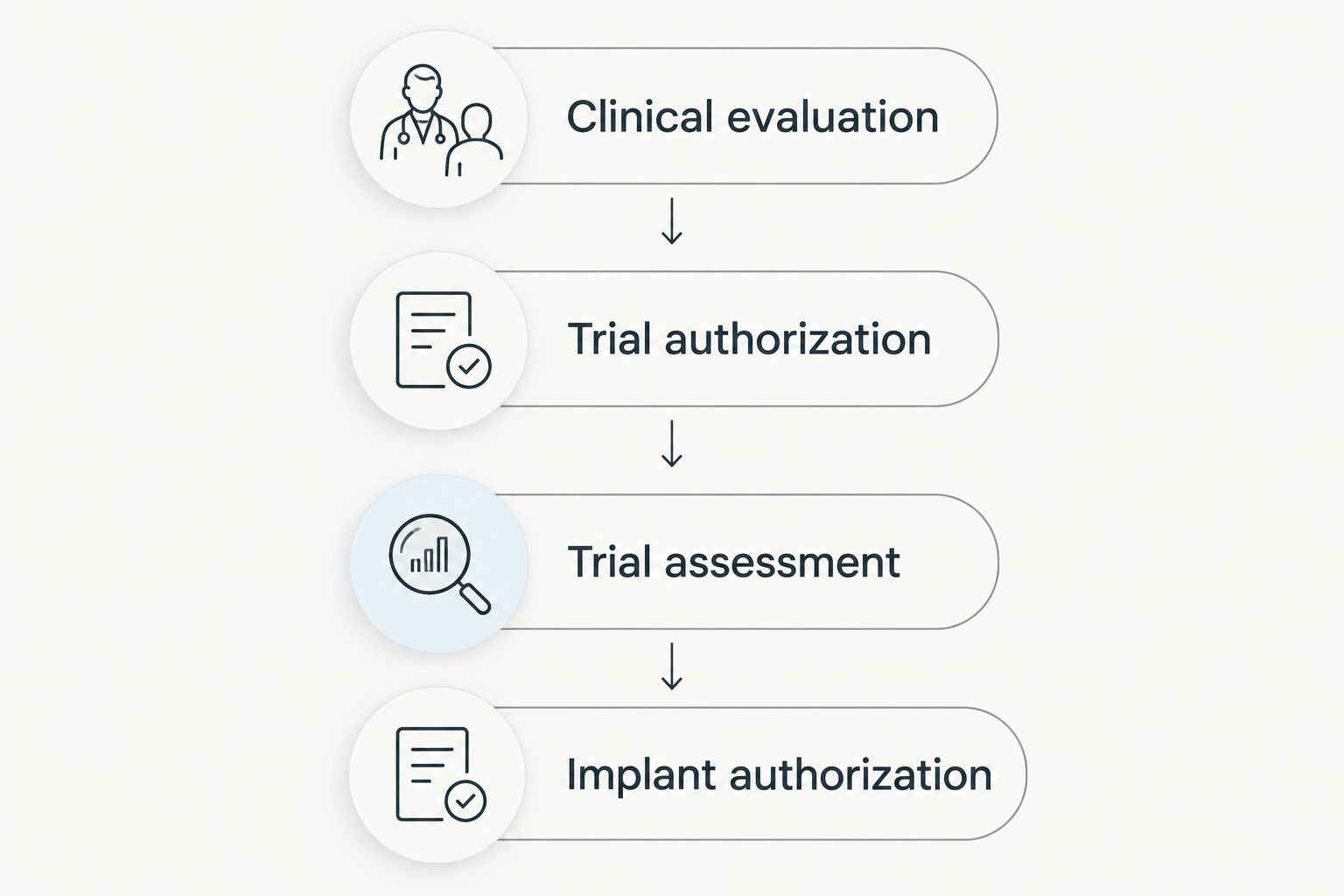
Clinical suitability and insurance authorization answer separate questions.
Ask for written confirmation of what each estimate includes. If the scope changes, request an updated explanation before using the earlier estimate to make a decision.
What a usable written estimate should identify
A useful spinal cord stimulation estimate names the treatment stage and billing organizations. It also distinguishes expected patient responsibility from the organizations’ billed charges.
Request the following details:
- Whether the estimate covers the trial, permanent implant, or both.
- The proposed device category and procedure description.
- The physician, facility, and anesthesia billing arrangements.
- Network participation for each billing organization.
- The deductible, copayment, or coinsurance rules being applied.
- Whether programming and follow-up are included or billed separately.
- How unexpected additional services would be handled.
Do not assume a single office estimate includes every organization involved. Ask which separate estimates you need and who can explain discrepancies.
For 2026 treatment planning, also ask whether the trial and implant fall in the same benefit year. A deductible reset changes the benefit calculation even when the device recommendation stays the same.
Choosing clinical care before choosing a device
Hudson Pain and Spine provides board-certified interventional pain management for patients in Bergen, Passaic, and Middlesex counties, with offices in Englewood, Woodland Park, and Edison. Hudson Pain and Spine is suited to New Jersey patients seeking specialist evaluation for spinal cord stimulation and other interventional pain treatments.
The limitation is clinical: spinal cord stimulation is not appropriate for every pain condition and does not guarantee relief. Your evaluation should address alternatives, treatment goals, procedural risks, and the responsibilities of living with an implanted system.
Bring your insurance information, prior treatment history, relevant imaging reports, and specific activity goals. These support a more focused discussion than asking which device category is cheapest.
FAQ
What determines spinal cord stimulator cost by device type?
Your treatment episode and insurance benefits determine your responsibility; the device category alone does not. Compare the trial, implantation, facility services, anesthesia, programming, and follow-up on the same basis.
Is a rechargeable spinal cord stimulator less expensive than a nonrechargeable one?
Battery category alone does not establish which option creates lower patient responsibility. Rechargeable systems require a charging routine, while nonrechargeable systems avoid that task but still require battery monitoring and eventual replacement planning.
Does Medicare cover spinal cord stimulation?
Medicare covers spinal cord stimulation when the applicable medical-necessity and coverage requirements are met. CMS National Coverage Determination 160.7 describes the national framework, including appropriate patient selection and a successful trial before permanent implantation.
Does Medicare’s 20% coinsurance apply to the entire implant bill?
No, the usual 20% Part B coinsurance benchmark describes eligible professional services after the deductible, not every charge in an implant episode. Outpatient facility services and supplemental coverage require separate review.
Does approval for the trial also approve the permanent implant?
Do not treat trial approval as confirmation of permanent implant approval. Ask your insurer and treating office whether separate authorization and trial-response documentation are required.
What should I compare in two spinal cord stimulation estimates?
Compare estimates for the same treatment stage, clinical scope, and coverage arrangement. Check whether each includes professional services, facility services, anesthesia, programming, and follow-up.
Can Hudson Pain and Spine evaluate whether a stimulator is appropriate?
Hudson Pain and Spine provides spinal cord stimulation and board-certified interventional pain management services. A specialist evaluation addresses whether stimulation fits your diagnosis, prior treatment response, goals, and ability to manage the system.
One last thing
A successful trial is evidence for a treatment decision, not a financial guarantee. Before permanent implantation, ask the clinical team to explain the trial result and the billing team to confirm the implant estimate separately.
For your 2026 comparison, keep those answers together. You need a clinically justified treatment plan and a clearly defined coverage calculation—not a device label standing in for either.
Related guides
- How long a spinal cord stimulation trial lasts
- Pain management options covered by Medicare
- How to choose an interventional pain specialist in New Jersey
About the Medical Reviewer
Dr. Saurabh Dang is a double board-certified interventional pain management specialist serving Central and Northern New Jersey. He combines clinical expertise with a patient-centered approach to help patients find lasting relief from chronic pain conditions.
Read Full Bio →Seeking Treatment for Spinal Cord Stimulation?
Dr. Dang and the team at Hudson Pain and Spine offer specialized care and advanced interventional treatments.
Ready to Find Relief from Pain?
Schedule your consultation with Dr. Saurabh Dang at our Englewood office.
Serving patients across Central and Northern New Jersey — Bergen, Passaic, and Middlesex counties.