The Role of Physical Therapy in Pain Management

Medically reviewed by
Dr. Saurabh Dang, MD, MBA
The Role of Physical Therapy in Pain Management

Physical therapy is defined as a clinician-led treatment that reduces pain and restores function by retraining the body and nervous system through targeted movement, education, and graded activity. The role of physical therapy in pain is not simply to make discomfort disappear. It works by changing how your nervous system interprets movement, building physical tolerance, and helping you reclaim daily activities that chronic pain has taken away. For adults living with back pain, sciatica, joint pain, or other persistent conditions, understanding what physical therapy actually does, and how it does it, is the first step toward getting real results.
How does physical therapy relieve pain and improve function?
Physical therapy relieves pain by addressing its root causes at the tissue and nervous system level. Targeted movement increases blood flow to injured areas, reduces local inflammation, and stimulates tissue repair. These physical changes create the conditions for recovery, but the deeper mechanism is neurological.
Chronic pain retrains an oversensitive nervous system to interpret ordinary movement as a threat. Physical therapy reverses that pattern. A licensed physical therapist guides you through graded activity, meaning movement that is uncomfortable but not harmful, so your brain gradually learns that motion is safe. The temporary pain you feel during these sessions reflects your nervous system being cautious, not your body being damaged.

The 2026 OPTIMIZE trial, which enrolled 749 adults with chronic low back pain, showed that PT improved physical function more than cognitive behavioral therapy at 10 weeks. Pain intensity scores were similar between groups. That finding matters because it confirms that function, not pain score, is the more reliable measure of progress in physical therapy.
Key mechanisms physical therapy uses to relieve pain:
- Increased circulation: Movement drives blood flow to stiff or injured tissues, accelerating repair.
- Inflammation reduction: Controlled loading of muscles and joints reduces chronic inflammatory responses.
- Nervous system retraining: Graded exposure teaches the brain to lower its threat response to movement.
- Muscle strengthening: Stronger muscles reduce load on painful joints and spinal structures.
- Improved mobility: Restoring range of motion reduces compensatory movement patterns that cause secondary pain.
Pro Tip: Track your functional progress, not just your pain level. If you can walk farther, sleep better, or return to a task you had avoided, that is a meaningful win, even if pain has not fully resolved.
What are the key physical therapy methods for chronic pain?
Physical therapy for chronic pain management uses several evidence-based strategies. Each one targets a different aspect of how pain develops and persists.
-
Pain neuroscience education (PNE). PNE teaches patients how pain works at the biological level. Understanding that pain is a protective signal, not always a sign of damage, reduces fear and catastrophizing. A 2026 Frontiers review found that combining PNE with active rehabilitation produces better outcomes than education alone. The education has to be paired with movement to stick.
-
Graded exposure therapy. This method involves progressively increasing activity in small, manageable steps. Your therapist identifies movements you have been avoiding because of pain, then builds a plan to reintroduce them safely. The VA Eastern Colorado Health Care system describes this as building confidence through stepwise progression, where each successful movement tells your nervous system the activity is not a threat.
-
Customized exercise programs. Strength training, flexibility work, and aerobic conditioning are tailored to your specific condition and goals. For patients with commuter back pain or desk-related postural strain, targeted core and hip strengthening can directly address the mechanical drivers of pain.
-
Skill-based virtual reality therapy. A 2026 randomized controlled trial published in JMIR found that a 56-session VR therapy program combining pain neuroscience education with self-regulatory techniques reclassified 71.1% of high-impact chronic pain patients to low-impact status at two years. That is a durable result that rivals many pharmacological interventions.
-
Functional goal setting. Effective physical therapy targets what you want to do, not just a pain score. Goals like “walk two miles without stopping” or “return to gardening” give therapy direction and give you a reason to push through difficult sessions.
“The goal of physical therapy for chronic pain is not zero pain. It is restoring your ability to live your life. When patients shift their focus from eliminating pain to expanding what they can do, progress becomes visible much sooner.” — VA Eastern Colorado Health Care guidance on chronic pain PT
How does physical therapy compare to other nonpharmacologic approaches?
Physical therapy is one of several nonpharmacologic treatments recommended for chronic pain. Cognitive behavioral therapy (CBT) and mindfulness-based interventions are the most common alternatives. Each has a distinct mechanism and a different strength profile.
The OPTIMIZE trial directly compared PT, CBT, and mindfulness for chronic low back pain. PT produced greater functional improvement at 10 weeks than CBT, but pain intensity reductions were similar across all three groups. The trial also found no clear long-term advantage when patients switched therapies after an initial treatment did not fully work. That means starting with the right approach matters more than cycling through options.
| Treatment | Primary strength | Pain reduction | Functional improvement |
|---|---|---|---|
| Physical therapy | Restores movement and strength | Modest | Greater than CBT at 10 weeks |
| Cognitive behavioral therapy | Changes pain-related thoughts and behaviors | Modest | Moderate |
| Mindfulness-based therapy | Reduces pain catastrophizing and stress | Modest | Moderate |
| PT + pain neuroscience education | Addresses both body and nervous system | Stronger | Strongest combined outcome |
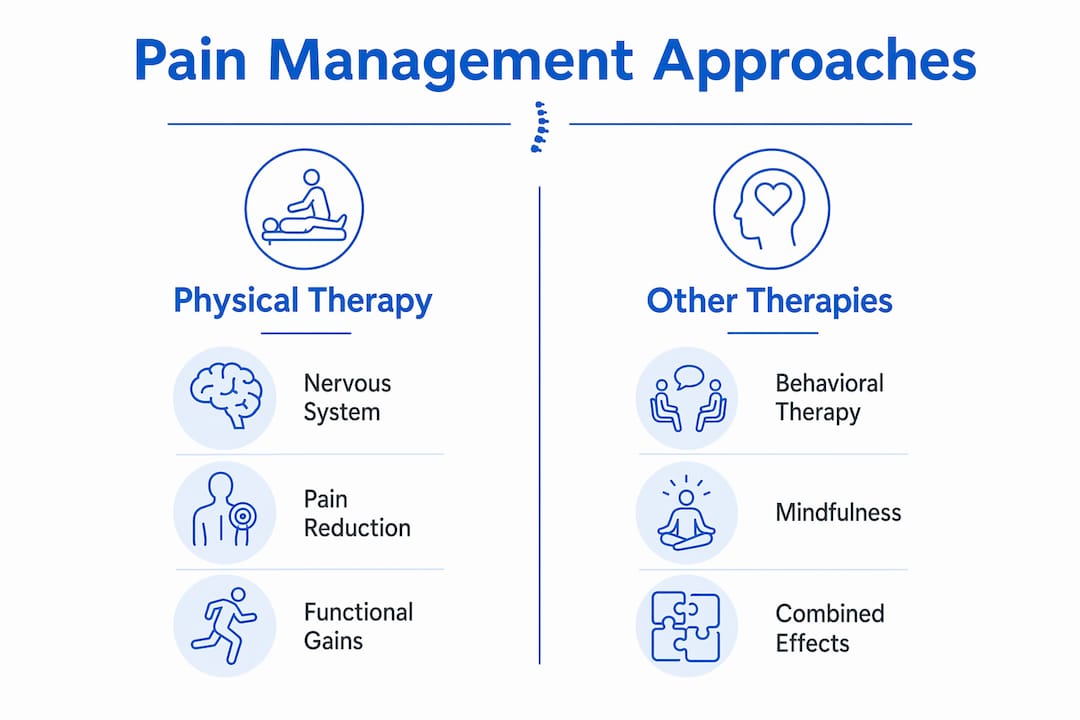
The table makes one pattern clear. No single approach eliminates chronic pain on its own. PT holds an edge in physical function, while CBT and mindfulness address the psychological dimensions of pain. Combining PT with pain neuroscience education produces the strongest overall results, according to the Frontiers 2026 review. For patients dealing with advanced chronic pain that has not responded to one approach, a combined treatment plan is worth discussing with your provider.
What practical steps help you get the most from physical therapy?
Getting real results from physical therapy requires more than showing up to appointments. Your mindset, communication, and consistency outside the clinic all shape your outcome.
- Understand the difference between protective pain and harmful pain. Soreness and discomfort during graded activity are expected. Sharp, sudden, or worsening pain that persists after a session signals something worth reporting to your therapist.
- Be patient with the process. Nervous system retraining takes time. Functional gains often appear before pain scores drop, so measure progress by what you can do, not just how you feel.
- Communicate openly with your therapist. Tell them which exercises feel manageable and which feel too intense. A good therapist adjusts your program based on your feedback, not a fixed protocol.
- Do your home exercises. Clinic sessions build the plan. Home exercises build the habit. Skipping them slows progress significantly.
- Recognize the broader benefits. Physical therapy can delay or avoid surgery and reduce medication needs, particularly in older adults managing chronic conditions. AARP’s 2026 guide notes that PT helps patients maintain independence, reduce fall risk, and manage pain without relying on drugs.
Pro Tip: Before each session, write down one functional goal you want to work toward that week. Sharing it with your therapist keeps your program focused on what matters most to you.
Key Takeaways
Physical therapy relieves chronic pain by retraining the nervous system and restoring function, with functional improvement being a more reliable progress measure than pain score reduction.
| Point | Details |
|---|---|
| Nervous system retraining | PT teaches the brain that movement is safe, reducing oversensitive pain signals over time. |
| Function over pain scores | The OPTIMIZE trial showed PT improves physical function more than CBT, even when pain levels are similar. |
| Education plus movement | Combining pain neuroscience education with graded activity produces better outcomes than either alone. |
| VR therapy shows lasting results | A 56-session VR program reclassified 71.1% of high-impact chronic pain patients to low-impact at two years. |
| PT reduces medication and surgery risk | Consistent physical therapy can delay or eliminate the need for surgery and reduce dependence on pain medication. |
What I’ve learned about PT that most pain articles get wrong
Most articles about physical therapy frame it as a treatment you receive. You go in, a therapist works on you, and you leave feeling better. That framing misses the point entirely.
The most meaningful shift I have seen in how physical therapy is practiced is the move away from passive treatment toward active nervous system education. The VA’s guidance on chronic pain PT makes this explicit: changing the nervous system’s threat response is more important than chasing zero pain. That is a fundamentally different goal, and it changes how patients should think about their sessions.
What this means in practice is that discomfort during PT is not a failure signal. It is part of the process. Patients who understand this tolerate graded activity better, adhere to their programs longer, and see stronger functional gains. Patients who expect pain to disappear quickly often quit before the nervous system has had time to recalibrate.
The VR therapy data reinforces this point. A program that combined pain neuroscience education with self-regulatory skills produced durable results at two years. The mechanism was not a drug or a procedure. It was teaching patients to understand and manage their own pain response. That is the direction modern physical therapy is heading, and it is worth taking seriously.
If you are living with chronic pain and have tried PT before without lasting results, ask whether your program included pain education alongside the exercises. Many patients receive exercise programs without the neurological context that makes those exercises meaningful. That combination is where the real benefit lives.
Pain management at Hudson Pain and Spine: physical therapy and beyond
Hudson Pain and Spine offers an integrated approach to chronic pain that goes beyond any single treatment. Physical therapy works best as part of a broader plan that may include interventional procedures like epidural injections, nerve blocks, or spinal cord stimulation when PT alone is not enough.
Hudson Pain and Spine serves patients across Bergen, Passaic, and Middlesex counties with multiple convenient locations in Northern and Central New Jersey. If you are ready to move from managing pain day to day toward actually improving your quality of life, review the full range of pain management services or schedule a consultation.
FAQ
What is the role of physical therapy in pain management?
Physical therapy reduces pain by retraining the nervous system to perceive movement as safe and by restoring physical function through graded activity and targeted exercise. It addresses both the mechanical and neurological drivers of chronic pain.
Does physical therapy actually help with chronic pain?
Yes. The 2026 OPTIMIZE trial showed PT produces meaningful improvements in physical function for chronic low back pain, and a VR-based PT program reclassified 71.1% of high-impact chronic pain patients to low-impact status at two years.
How long does physical therapy take to relieve pain?
Functional improvements often appear before pain scores drop, and the timeline varies by condition and adherence. The OPTIMIZE trial measured meaningful functional gains at 10 weeks, but nervous system retraining typically requires consistent effort over several months.
Can physical therapy replace pain medication?
PT can reduce or delay the need for medication, particularly in older adults. AARP’s 2026 guide notes that consistent physical therapy helps patients manage chronic conditions and maintain independence with less reliance on drugs.
What is pain neuroscience education in physical therapy?
Pain neuroscience education (PNE) is a structured approach that teaches patients how the nervous system generates pain signals. When combined with graded movement, PNE produces better outcomes than exercise programs delivered without that educational context.
Recommended
- Pain Management Services Englewood NJ | Hudson Pain and Spine
- Living with Osteoarthritis: How Interventional Pain Management Can Help | Hudson Pain and Spine Blog
- Understanding the Golf Swing’s Impact on Pain | Hudson Pain and Spine Blog
- Enough is enough: advanced treatment for chronic pain | Hudson Pain and Spine Blog
About the Medical Reviewer
Dr. Saurabh Dang is a double board-certified interventional pain management specialist serving Central and Northern New Jersey. He combines clinical expertise with a patient-centered approach to help patients find lasting relief from chronic pain conditions.
Read Full Bio →Seeking Treatment for Chronic Pain?
Dr. Dang and the team at Hudson Pain and Spine offer specialized care and advanced interventional treatments.
Ready to Find Relief from Pain?
Schedule your consultation with Dr. Saurabh Dang at our Englewood office.
Serving patients across Central and Northern New Jersey — Bergen, Passaic, and Middlesex counties.