Best new treatments for trigeminal neuralgia in 2026

Medically reviewed by
Dr. Saurabh Dang, MD, MBA

Trigeminal neuralgia causes sudden, electric-shock jolts of facial pain that most over-the-counter painkillers cannot touch, and by 2026 patients have more options than medication alone once first-line drugs stop working.
TL;DR
- Medication with carbamazepine or oxcarbazepine is still the right first step for trigeminal neuralgia in 2026.
- Radiofrequency rhizotomy and nerve blocks are the leading new treatment for trigeminal neuralgia 2026 patients try after pills stop working.
- Microvascular decompression gives the longest pain-free stretches for patients fit for a craniotomy.
- Gamma Knife radiosurgery is the best non-surgical route for older or higher-risk patients.
- Peripheral nerve stimulation is the fallback when injections, ablation, and surgery all lose effect.
Why this matters
Trigeminal neuralgia (TN) attacks the fifth cranial nerve, the one that carries feeling from the jaw, cheek, and forehead to the brain. A single flare can last seconds, but patients report dozens of episodes a day, each one sharp enough to stop a conversation or a bite of food mid-motion.
Carbamazepine and oxcarbazepine still open most treatment plans in 2026, and they control pain well for many patients through the first year or two. The problem shows up later: side effects build, tolerance sets in, or the nerve compression driving the pain simply doesn’t respond to medication. That’s when patients start looking for the next step, and the field has moved well past raising the dose.
Hudson Pain and Spine evaluates facial pain patients across Bergen, Passaic, and Middlesex counties and walks through how trigeminal neuralgia is diagnosed and treated before recommending a next step. The ranking below reflects where each option sits on that treatment ladder, not which one is newest.
Best overall for durable relief: microvascular decompression (MVD) surgery. Best first step: anticonvulsant medication management. Best office-based procedure: peripheral nerve block or radiofrequency rhizotomy. Best non-surgical option for higher-risk patients: Gamma Knife stereotactic radiosurgery. Best for pain that keeps returning after other treatment: peripheral nerve stimulation.
What makes the best treatment for trigeminal neuralgia in 2026
Not every option below fits every patient. These are the factors that actually separate a good fit from a bad one:
- Speed of relief — how fast pain drops once treatment starts
- Durability — how many months or years the relief typically holds up
- Invasiveness — office procedure versus hospital stay versus craniotomy
- Candidacy — age, other health conditions, and how many treatments have already failed
- Reversibility — whether the approach can be adjusted or repeated later
- Recovery time — days away from normal activity
Trigeminal neuralgia treatments at a glance
| Treatment | Best for | Standout feature | Key limitation |
|---|---|---|---|
| Medication management | Newly diagnosed patients | Non-invasive, dose can be adjusted | Effectiveness often fades after a year or two |
| Peripheral nerve block | Confirming where the pain starts | Same-day office procedure | Relief is usually temporary |
| Radiofrequency rhizotomy | Medication-resistant pain, no craniotomy wanted | Outpatient procedure with fast recovery | Facial numbness in the treated area is common |
| Botox injections | Avoiding nerve ablation | Repeatable with low systemic side effects | Relief window is limited; needs repeat visits |
| Microvascular decompression | Long-term, durable relief | Highest reported rates of lasting pain freedom | Requires a craniotomy and hospital stay |
| Gamma Knife radiosurgery | Surgical-risk or older patients | No incision, outpatient recovery | Pain relief can take weeks to start |
| Peripheral nerve stimulation | Pain that returns after other treatments | Adjustable, reversible implant | Requires a trial period first |
1. Medication management: best trigeminal neuralgia treatment for newly diagnosed patients
Carbamazepine and oxcarbazepine are the anticonvulsants doctors reach for first because they calm the overactive nerve signaling that causes TN flares. Dosing starts low and climbs until pain drops or side effects show up, whichever comes first. This is where almost every TN patient starts in 2026, regardless of what comes next.
Medication pros:
- No procedure or recovery time involved
- Dose is adjustable as symptoms change
- Works well for a meaningful share of patients in the first year or two
Medication cons:
- Drowsiness, dizziness, and liver enzyme changes require monitoring
- Effectiveness commonly declines over time
- Doesn’t address the nerve compression driving the pain in many cases
Verdict: start here.
2. Peripheral nerve block: best for confirming where the pain starts
A nerve block places local anesthetic, sometimes with steroid, directly around the trigeminal nerve branch producing the pain. It’s diagnostic as much as it is therapeutic — pain relief after the block confirms the nerve is the source before anyone commits to a bigger procedure.
Peripheral nerve block pros:
- Same-day office procedure
- Confirms the pain source before more invasive steps
- Low recovery time
Peripheral nerve block cons:
- Relief typically lasts weeks, not months
- Not a long-term solution on its own
Verdict: use to confirm the diagnosis, not to end the search.
3. Radiofrequency rhizotomy: best office-based procedure once medication stops working
Radiofrequency rhizotomy uses heat delivered through a needle to interrupt pain signals traveling along the trigeminal nerve. It’s done as an outpatient procedure, usually under light sedation, and patients go home the same day. Hudson Pain and Spine positions radiofrequency rhizotomy as the step between medication and surgery for trigeminal neuralgia patients who’ve plateaued on pills.
Radiofrequency rhizotomy pros:
- Outpatient, no hospital stay
- Can be repeated if pain returns
- Faster recovery than open surgery
Radiofrequency rhizotomy cons:
- Facial numbness in the treated area is a known trade-off
- Relief duration varies and isn’t guaranteed to match surgical outcomes
Verdict: solid next step for medication-resistant pain.
4. Botox injections: best for patients who want to avoid nerve ablation
Botox injected around the trigeminal nerve branches can reduce flare frequency for some patients, particularly those who don’t tolerate the numbness that comes with rhizotomy. It’s not a first-line TN treatment, but it’s a reasonable option for patients cycling through medication side effects who aren’t ready for a procedure that alters nerve tissue.
Botox pros:
- Doesn’t damage or ablate nerve tissue
- Low systemic side effect profile
- Can be repeated on a schedule
Botox cons:
- Relief window is limited and requires repeat visits
- Response varies more than with rhizotomy or nerve blocks
Verdict: worth discussing if you want to avoid numbness from ablation.
5. Microvascular decompression: best overall for durable, long-term relief
MVD is a neurosurgical procedure that relocates the blood vessel compressing the trigeminal nerve, addressing the root mechanical cause rather than masking the signal. Among all TN treatments, it has the strongest track record for long, pain-free stretches in appropriately selected patients. It’s also the most invasive option on this list, requiring a craniotomy and inpatient recovery.
MVD pros:
- Best long-term durability of any option here
- Treats the underlying compression, not just the symptom
- No ongoing procedures needed if successful
MVD cons:
- Requires a craniotomy and hospital stay
- Carries surgical risks that don’t apply to office-based options
- Not appropriate for every patient’s health profile
Verdict: best overall, if you’re a surgical candidate.
6. Gamma Knife stereotactic radiosurgery: best non-surgical option for higher-risk patients
Gamma Knife delivers a focused dose of radiation to the trigeminal nerve root without any incision. It’s done on an outpatient basis and appeals to patients who aren’t good candidates for a craniotomy, whether because of age or other health conditions. The trade-off is timing: relief isn’t immediate.
Gamma Knife pros:
- No incision, no hospital stay
- Reasonable option for patients who can’t have open surgery
- Outpatient recovery
Gamma Knife cons:
- Pain relief can take weeks to set in
- Numbness can develop after treatment
- Not typically repeated as often as rhizotomy
Verdict: strong non-surgical option for higher-risk patients.
7. Peripheral nerve stimulation: best for pain that keeps coming back
When medication, blocks, ablation, and even surgery haven’t held, peripheral nerve stimulation offers an adjustable, reversible option. A trial period precedes permanent placement, so patients and their care team can confirm it actually reduces flare frequency before committing.
Peripheral nerve stimulation pros:
- Adjustable and reversible
- Trial period before permanent commitment
- Option for patients who’ve exhausted other treatments
Peripheral nerve stimulation cons:
- Requires an implant and device maintenance
- Reserved for refractory cases, not a first or second option
Verdict: reserve for pain that keeps returning after other treatments.
How we ranked these treatments
The order above follows the same ladder Hudson Pain and Spine uses when evaluating a new facial pain patient: least invasive and most reversible first, surgery reserved for confirmed candidates. Speed of relief and durability matter, but so does what happens if a treatment doesn’t work — an adjustable nerve block or a repeatable rhizotomy carries less downside than jumping straight to a craniotomy.
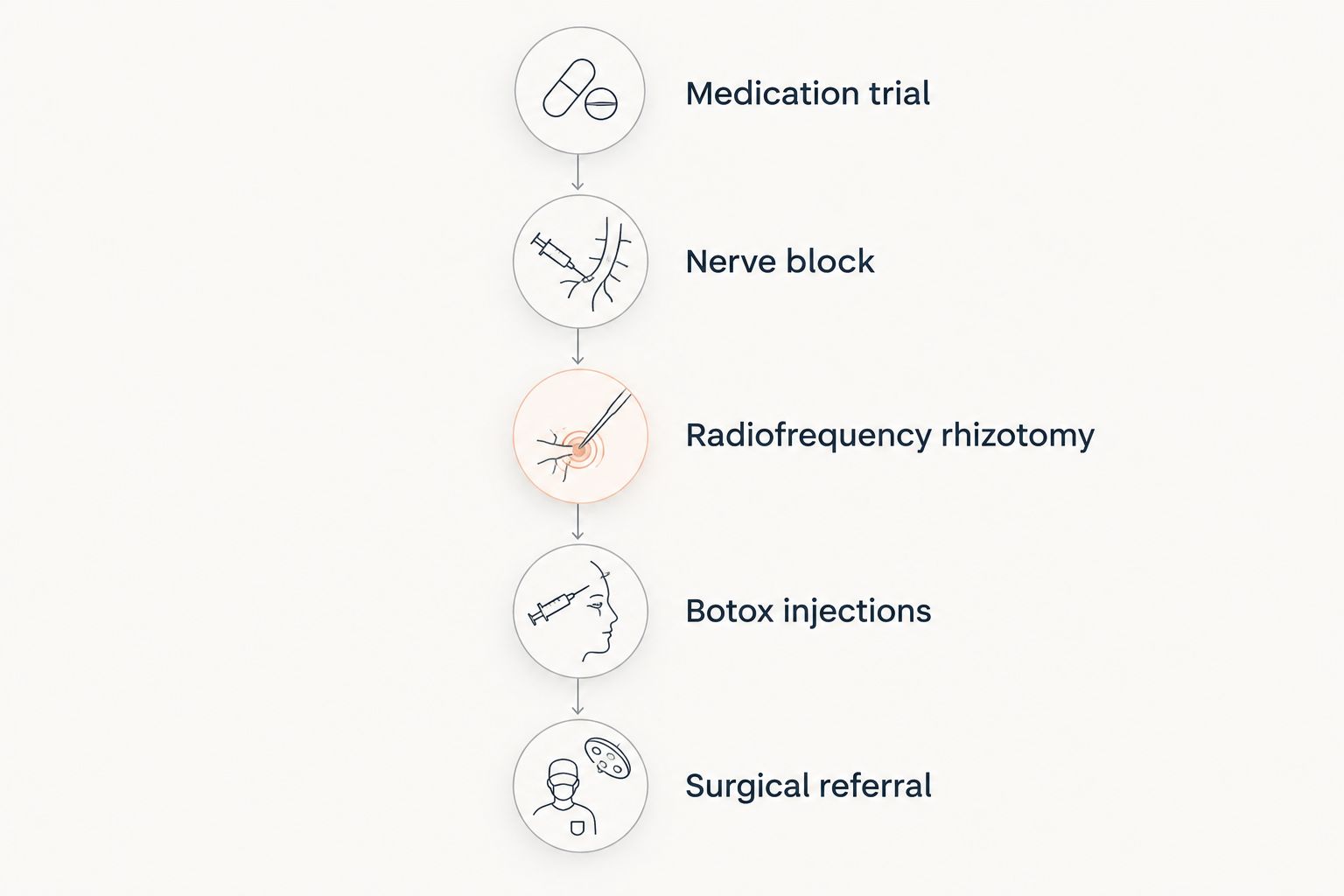
Each step up the ladder trades more invasiveness for more durable relief.
Which treatment for trigeminal neuralgia should you choose in 2026?
If you’re newly diagnosed, start with medication — carbamazepine or oxcarbazepine control pain well for many patients before anything else is on the table. If pills stop working or the side effects become the bigger problem, radiofrequency rhizotomy is the reasonable next step for most patients who want to avoid surgery. If you’re a good surgical candidate and want the best shot at durable, lasting relief, microvascular decompression has the strongest track record of anything on this list.
Patients who aren’t candidates for open surgery shouldn’t skip straight to giving up on relief — Gamma Knife radiosurgery exists specifically for that group. And if you’ve tried several of these and pain keeps returning, peripheral nerve stimulation is worth a conversation before you assume nothing else is left.
None of this replaces an actual evaluation. Choosing an interventional pain specialist in New Jersey matters more for trigeminal neuralgia than for most chronic pain conditions, because misdiagnosis between TN and other facial pain sources is common.
Get a facial pain evaluation
Hudson Pain and Spine evaluates trigeminal neuralgia across Bergen, Passaic, and Middlesex counties.
FAQ
What is the newest treatment for trigeminal neuralgia in 2026?
Radiofrequency rhizotomy and peripheral nerve stimulation are the treatments patients are turning to most in 2026 once first-line medication stops holding. Both sit between medication and open surgery on the treatment ladder.
Is trigeminal neuralgia surgery worth it?
Microvascular decompression has the strongest track record for long, pain-free stretches among appropriately selected surgical candidates. It requires a craniotomy and hospital stay, so it’s weighed against office-based options first.
How long does relief from radiofrequency rhizotomy last?
Relief duration varies by patient and isn’t guaranteed to match surgical outcomes, though many patients get meaningful time before pain returns. The procedure can be repeated if it does.
Can Botox treat trigeminal neuralgia?
Botox injected around the trigeminal nerve branches can reduce flare frequency for some patients who don’t tolerate rhizotomy’s numbness. It’s not a first-line option, but it avoids ablating nerve tissue.
What’s the difference between a nerve block and rhizotomy for facial pain?
A nerve block is a same-day diagnostic and short-term relief procedure using anesthetic around the nerve. Radiofrequency rhizotomy uses heat to interrupt pain signals and is meant to last longer.
Is Gamma Knife better than microvascular decompression?
Gamma Knife avoids any incision and suits surgical-risk or older patients, but pain relief takes weeks to set in. Microvascular decompression works faster once healed and has the stronger long-term durability record.
When should you see a specialist for facial pain?
See a specialist once medication stops controlling flares or side effects outweigh the benefit, since waiting often means more nerve damage and fewer easy options. Facial pain that doesn’t respond to standard dental or sinus treatment also warrants an evaluation.
Does insurance cover trigeminal neuralgia treatment?
Coverage depends on the specific procedure and plan, and medication, nerve blocks, and rhizotomy are generally easier to get approved than surgical options. Check with your specific plan before scheduling any procedure.
One last thing
Trigeminal neuralgia has been nicknamed the ‘suicide disease’ in medical literature because of how severe the pain gets during an active flare — worse than most patients have experienced from any other condition. That’s part of why waiting through years of escalating medication doses isn’t the safe default it sounds like; the treatment ladder above exists because pills alone often aren’t the ceiling on what’s available in 2026.
Related guides
- How peripheral nerve stimulation treats chronic nerve pain
- Understanding one-sided neck and facial pain
- How to treat occipital neuralgia headaches
About the Medical Reviewer
Dr. Saurabh Dang is a double board-certified interventional pain management specialist serving Central and Northern New Jersey. He combines clinical expertise with a patient-centered approach to help patients find lasting relief from chronic pain conditions.
Read Full Bio →Seeking Treatment for Nerve Block Injections?
Dr. Dang and the team at Hudson Pain and Spine offer specialized care and advanced interventional treatments.
Ready to Find Relief from Pain?
Schedule your consultation with Dr. Saurabh Dang at our Englewood office.
Serving patients across Central and Northern New Jersey — Bergen, Passaic, and Middlesex counties.