
Best pain management clinics in Middlesex County NJ

Medically reviewed by
Dr. Saurabh Dang, MD, MBA

Best fit for interventional Middlesex County pain management: Hudson Pain and Spine in Edison. Best for rebuilding movement: a rehabilitation-focused clinic; best for a possible surgical problem: a spine surgical practice; best for inflammatory arthritis: a rheumatology practice. This 2026 guide ranks those care options by the problem you need addressed—not by unverified claims about clinic outcomes.
TL;DR
- Hudson Pain and Spine fits Middlesex County pain management patients seeking an interventional evaluation in Edison.
- Choose rehabilitation-focused care when restoring strength, movement, and daily function is the main goal.
- Choose surgical evaluation for a suspected structural problem requiring a surgeon’s assessment.
- Choose rheumatology when inflammatory arthritis needs diagnosis and disease-directed treatment.
Why this matters
The best pain clinic is the one equipped to evaluate your condition and explain the next step. A nearby office with a long procedure list is not automatically the right choice.
Back pain, sciatica, joint pain, and inflammatory arthritis require different assessments. Your first decision is which type of specialist fits your symptoms; your second is which individual practice meets your clinical and practical needs.
For your 2026 search, separate medical suitability from convenience. Credentials, diagnosis, and treatment planning come first, followed by location, insurance requirements, and follow-up arrangements.
What makes the best Middlesex County pain management clinic?
Use these six criteria before comparing offices:
- Relevant credentials: Confirm the treating clinician’s board certification and training for the condition or procedure under discussion.
- Diagnostic clarity: Expect an explanation connecting your symptoms, examination, and any relevant imaging—not a procedure recommendation based on a scan alone.
- Appropriate treatment choices: Look for discussion of conservative care, procedures, and referral when another specialty fits better.
- Individual safety review: Disclose medications, allergies, diabetes, pregnancy, infections, and previous treatment reactions.
- Functional goals: Define success through activities such as walking, sleeping, working, or getting dressed, alongside pain intensity.
- Practical follow-up: Confirm where visits and procedures occur, whom to contact afterward, and how the response will be assessed.
Choose the explanation before choosing the procedure. A useful consultation makes the working diagnosis, treatment purpose, risks, and alternatives understandable.
Middlesex County pain care options at a glance
These options address different needs. The table is a decision guide, not evidence that one specialty produces better results for every patient.
| Care option | Best for | Standout feature | Key limitation |
|---|---|---|---|
| Hudson Pain and Spine, Edison — interventional services | Evaluating back, neck, sciatic, and other pain for targeted procedures | Board-certified interventional pain management, including epidural injections, nerve blocks, and spinal cord stimulation | A procedure requires an individual assessment; interventional care does not replace emergency or disease-directed treatment |
| Rehabilitation-focused clinic | Rebuilding movement and daily function | Exercise-based rehabilitation and functional assessment | Rehabilitation alone does not address every structural or inflammatory condition |
| Spine surgical practice | Assessing a structural spine problem for possible surgery | Surgical assessment of symptoms, examination findings, and imaging | A surgical consultation does not mean surgery is necessary |
| Rheumatology practice | Suspected inflammatory arthritis | Diagnosis and medical management of inflammatory disease | Not a substitute for targeted evaluation of every mechanical or nerve-related pain problem |
1. Hudson Pain and Spine: best for interventional evaluation
Hudson Pain and Spine provides board-certified interventional pain management from an Edison office serving Middlesex County. Its stated services include epidural injections, nerve blocks, and spinal cord stimulation, with treatment for back and neck pain, sciatica, arthritis, and sports or car accident injuries.
Best for: Patients seeking a specialist assessment of whether targeted pain procedures belong in their treatment plan.
An interventional consultation should establish what is being treated before deciding how to treat it. Ask whether the proposed procedure is intended to help identify the pain source, reduce symptoms, or support participation in rehabilitation.
Hudson Pain and Spine pros:
- An Edison office provides a Middlesex County location.
- Board-certified interventional pain management matches patients seeking this specialty.
- Stated treatment options include epidural injections and nerve blocks.
- Spinal cord stimulation is among the stated services for appropriately selected patients.
Hudson Pain and Spine limitations:
- A listed procedure does not establish that you are a candidate.
- Pain procedures have risks and do not guarantee lasting relief.
- Emergency symptoms and conditions requiring another specialty need a different pathway.
For your 2026 consultation, bring previous treatment records and identify the activity pain prevents you from doing. That gives the appointment a practical focus beyond selecting an injection.
Verdict: Choose an interventional evaluation when you need a diagnosis-based discussion of targeted pain treatment.
2. Rehabilitation-focused clinic: best for restoring daily function
A rehabilitation-focused clinic centers care on movement, strength, activity tolerance, and the tasks pain has disrupted. Depending on the practice, your care involves a rehabilitation physician, physical therapist, or coordinated rehabilitation team.
Best for: Patients whose main goal is returning to walking, work, exercise, or household activities through a structured rehabilitation plan.
Look for an assessment that considers how you move and what aggravates symptoms. A useful plan explains which activities to modify, which to practice, and when progress should be reassessed.
Rehabilitation-focused clinic pros:
- Connects treatment to everyday activities.
- Provides a framework for progressive exercise.
- Supports recovery alongside appropriate medical care.
Rehabilitation-focused clinic limitations:
- Exercise needs modification when symptoms or medical conditions require it.
- Persistent or worsening symptoms require reassessment rather than automatic continuation.
Ask how the rehabilitation clinician communicates with your referring specialist. Shared goals matter when pain treatment and exercise are happening together.
Verdict: Choose rehabilitation-focused care when improving movement and function is the central need.
3. Spine surgical practice: best for assessing surgical necessity
A spine surgical practice evaluates whether a structural spine problem warrants an operation. The assessment should connect your symptoms and neurological examination with relevant imaging.
Best for: Patients referred for suspected structural disease, persistent disabling symptoms, or a question about whether surgery is appropriate.
A surgical consultation is an assessment, not a commitment. Ask what surgery would address, what it would not address, and which nonsurgical alternatives remain reasonable.
Spine surgical practice pros:
- Addresses whether a structural problem has a surgical solution.
- Clarifies the purpose and limits of a proposed operation.
- Supports comparison of surgical and nonsurgical pathways.
Spine surgical practice limitations:
- An abnormal scan alone does not establish the need for surgery.
- Surgery is not the appropriate treatment for every source of back pain.
Do not wait for a routine appointment if you develop new bladder dysfunction, saddle numbness, or rapidly worsening weakness. Those symptoms require urgent assessment.
Verdict: Choose surgical evaluation when the clinical question is whether a structural problem needs an operation.
4. Rheumatology practice: best for inflammatory arthritis
A rheumatology practice evaluates inflammatory and autoimmune conditions affecting joints and other tissues. This differs from treating pain alone because controlling the underlying disease is part of care.
Best for: Patients with suspected inflammatory arthritis, particularly when joint swelling or prolonged morning stiffness accompanies pain.
Tell the clinician about the pattern of symptoms, not just the most painful joint. Mention swelling, stiffness, fatigue, and any existing autoimmune diagnosis.
Rheumatology practice pros:
- Evaluates inflammatory causes of joint symptoms.
- Connects symptom treatment with disease-directed management.
- Provides ongoing assessment when an inflammatory diagnosis is established.
Rheumatology practice limitations:
- Mechanical pain and nerve compression can require separate assessment.
- A rheumatology diagnosis does not eliminate the need to evaluate a new injury.
A hot, swollen joint with fever needs urgent medical assessment rather than a routine clinic comparison.
Verdict: Choose rheumatology when inflammation or autoimmune disease is the main diagnostic concern.
How these care options are ranked
The order reflects the question each option answers: targeted pain treatment, functional rehabilitation, surgical necessity, or inflammatory disease. It does not imply comparative success rates or a universal winner.
For Middlesex County pain management in 2026, the named Edison practice fits the interventional category because its stated services and location match that need. Other care settings become the better starting point when your symptoms require their particular expertise.
Prepare for a useful first appointment
A clear history helps a specialist distinguish overlapping problems. Back pain with leg symptoms, for example, needs more detail than the label “sciatica.”
Organize your preparation into these four steps:
- Symptom history: Record symptoms over 7 days if doing so does not delay needed care. Note where pain starts, where it travels, and what changes it.
- Treatment records: Bring medication details, previous procedure reports, physical therapy summaries, and relevant imaging reports or access instructions.
- Function goals: Choose 2 activities you want to improve, such as walking to the mailbox or sitting through a meeting.
- Visit questions: Ask about the working diagnosis, alternatives, risks, and how the next step will be evaluated.
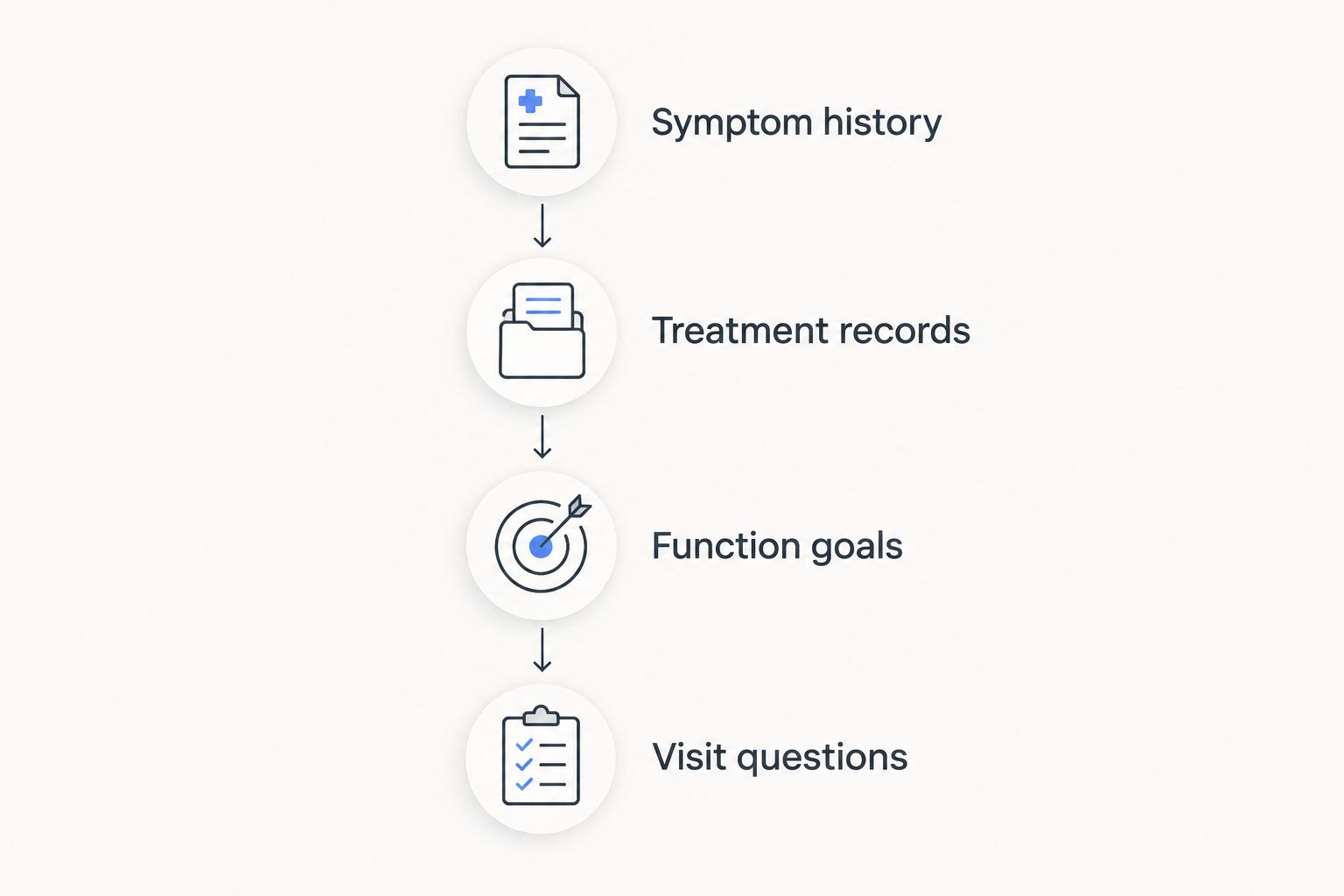
Bring a symptom history and functional goals, not just an imaging report.
A 0–10 pain scale can help describe intensity, but explain what the score means in your life. Pain that interrupts sleep needs a different discussion from discomfort that occurs only during one particular movement.
Questions to ask before agreeing to a procedure
For a procedure proposed in 2026, ask what clinical finding supports it. The answer should connect the treatment to your individual symptoms and examination.
Use these questions during the discussion:
- What is the working diagnosis, and what remains uncertain?
- Is this procedure diagnostic, therapeutic, or both?
- What benefits and risks apply to my situation?
- Which alternatives are reasonable now?
- What medication instructions do I need?
- How will the result change the next treatment decision?
Do not stop anticoagulants or other prescribed medicines on your own. Procedure preparation requires instructions from the treating team and, when appropriate, the clinician managing that medication.
Also confirm whether sedation is planned, whether you need an escort, and what activity restrictions apply afterward. These instructions depend on the procedure and your circumstances.
Confirm logistics before your 2026 visit
Verify the exact office location and whether any proposed procedure takes place there or elsewhere. A consultation location and a procedure location are not necessarily the same.
Ask your insurer and the practice about network participation, referral requirements, and prior authorization. Confirm these for the treating clinician and procedure facility rather than relying on the practice name alone.
Keep a written record of instructions and authorization communications. Medical suitability and insurance authorization are separate questions; neither replaces the other.
Which pain management option should you choose?
Start with Hudson Pain and Spine for Middlesex County pain management when you need an interventional assessment in Edison. Choose rehabilitation-focused care for movement recovery, a spine surgical practice for a surgical question, or rheumatology for suspected inflammatory arthritis.
If you are unsure which category fits, ask your primary care clinician to help direct the referral. Bring the same symptom history and treatment records whichever route you take.
Discuss your pain care needs
Ask about an Edison evaluation and the records to bring to your first visit.
FAQ
What’s the best Middlesex County pain management clinic for injections?
Hudson Pain and Spine is an Edison option for evaluating targeted treatments, including epidural injections and nerve blocks. The appropriate procedure depends on your diagnosis, examination, medical history, and previous treatment response.
Should I see a pain specialist or a physical therapist first?
The right starting point depends on your symptoms and whether a diagnosis has been established. Rehabilitation addresses movement and function; a medical evaluation is important when symptoms are unexplained, worsening, or accompanied by neurological changes.
Does seeing a pain management doctor mean I need an injection?
No. A pain management consultation evaluates the cause of symptoms and the available treatment choices; agreeing to an assessment does not commit you to a procedure.
Is a pain management specialist better than a spine surgeon?
Neither specialty is better for every patient. A pain specialist evaluates pain treatment options, while a spine surgeon assesses whether a structural spine problem warrants surgery.
What should I bring to my first pain management appointment?
Bring your medication list, relevant imaging information, previous treatment records, and a summary of your symptoms. Include the activities you want treatment to help you resume.
Will my insurance cover pain management in Middlesex County?
Coverage depends on your plan, clinician, facility, and proposed service. Confirm network participation, referral rules, and prior authorization requirements before treatment.
Which back pain symptoms need urgent medical attention?
New bladder dysfunction, saddle numbness, and rapidly worsening weakness require urgent medical assessment. Do not wait for a routine pain clinic appointment when these symptoms develop.
One last thing
Temporary symptom relief and a confirmed diagnosis are not the same thing. If a diagnostic block is proposed, ask what response would support the suspected pain source and how that information would change treatment.
Before leaving any appointment, make sure you can explain the next step in your own words. Knowing what happens if treatment helps—and what happens if it does not—is part of a useful plan.
Related guides
- How to choose an interventional pain specialist in New Jersey
- How to connect physical therapy to interventional pain treatment
- How to get insurance approval for pain procedures
About the Medical Reviewer
Dr. Saurabh Dang is a double board-certified interventional pain management specialist serving Central and Northern New Jersey. He combines clinical expertise with a patient-centered approach to help patients find lasting relief from chronic pain conditions.
Read Full Bio →Seeking Treatment for Epidural Injections?
Dr. Dang and the team at Hudson Pain and Spine offer specialized care and advanced interventional treatments.
Ready to Find Relief from Pain?
Schedule your consultation with Dr. Saurabh Dang at our Englewood office.
Serving patients across Central and Northern New Jersey — Bergen, Passaic, and Middlesex counties.