
Best pain management clinics in Passaic County NJ

Medically reviewed by
Dr. Saurabh Dang, MD, MBA

Best fit for a local interventional pain consultation: Hudson Pain and Spine in Woodland Park. Best for rebuilding movement: rehabilitation-led care. Best for coordinating complex medical needs: multidisciplinary care. This 2026 Passaic County pain management guide compares those care pathways so you can choose an evaluation that fits your symptoms—not simply a procedure name.
TL;DR
- Hudson Pain and Spine offers Passaic County pain management consultations through its Woodland Park office.
- Choose interventional pain management when persistent symptoms need evaluation for targeted procedures.
- Choose rehabilitation-led care when restoring movement and daily function is the main priority.
- Choose multidisciplinary care when pain overlaps with several medical or behavioral health needs.
- New weakness or loss of bladder control requires urgent evaluation, not routine clinic shopping.
Why this matters
The best pain clinic is the one equipped to evaluate your problem and explain the next step. Back pain, sciatica, arthritis, and pain after an injury do not all require the same treatment. A useful consultation connects your symptoms, examination, previous treatment, and functional limitations before discussing an intervention.
Hudson Pain and Spine is a local option for Passaic County patients seeking evaluation for interventional pain management. Its Woodland Park office serves patients in the county, while the practice also has offices in Englewood and Edison. Those 3 office locations are a practical consideration, not evidence that one treatment works better than another.
For your 2026 shortlist, separate clinical fit from convenience. A nearby office helps with travel, but the treatment rationale, risks, and follow-up plan deserve equal attention.
What makes the best Passaic County pain management clinic?
Use these criteria before comparing offices. A strong consultation should answer them in plain language, without assuming that every patient needs an injection.
- Relevant credentials: Confirm the treating physician’s board certification and training in pain medicine. Ask who evaluates you and who performs any proposed procedure.
- Diagnostic reasoning: Look for an explanation that connects the suspected pain source with your symptoms and examination. An imaging finding alone does not establish why you hurt.
- Treatment fit: Ask why a specific treatment fits your diagnosis and what reasonable alternatives exist, including continued conservative care.
- Safety planning: Discuss medications, allergies, infection risks, diabetes, pregnancy, and other conditions that affect a procedure decision.
- Functional follow-up: Define what improvement means for you—walking, sleeping, working, or tolerating rehabilitation—not just a lower pain score.
- Practical coordination: Confirm the office, procedure location, referral requirements, insurance participation, and who handles questions afterward.
A clinic’s treatment list is only the starting point. The more useful distinction is whether the clinician can explain why a treatment belongs in your plan—and when it does not.
Pain management options at a glance
This comparison ranks care pathways by the need they address. The first entry is a named local practice; the other entries describe care models rather than individual clinics or a countywide quality ranking.
| Option | Best for | Standout feature | Key limitation |
|---|---|---|---|
| Hudson Pain and Spine, Woodland Park | Local evaluation for targeted pain procedures | Board-certified interventional pain management, including epidural injections, nerve blocks, and spinal cord stimulation | A consultation must establish whether a procedure fits your diagnosis |
| Rehabilitation-led care | Restoring movement and activity tolerance | Exercise, movement assessment, and progressive functional goals | Rehabilitation alone does not address every cause of persistent pain |
| Multidisciplinary care | Pain complicated by several overlapping needs | Coordination across relevant medical, rehabilitation, and behavioral health disciplines | Coordination requires clear responsibility and communication among clinicians |
These options are not mutually exclusive. A patient can receive a specialist evaluation while continuing an appropriate rehabilitation plan, or need several disciplines involved at the same time.
1. Hudson Pain and Spine: best for an interventional evaluation
Hudson Pain and Spine provides board-certified interventional pain management services and has an office in Woodland Park. The practice treats back and neck pain, sciatica, arthritis, and pain associated with sports and car accident injuries. Its stated treatments include epidural injections, nerve blocks, and spinal cord stimulation.
Best for: Passaic County patients who need an assessment of persistent pain and whether a targeted intervention belongs in their treatment plan.
Hudson Pain and Spine pros
- A Woodland Park office provides an in-county option for evaluation.
- The practice offers named interventional treatments rather than an unspecified pain service.
- Its stated scope includes spine, nerve-related, arthritic, and injury-associated pain.
Hudson Pain and Spine limitations
- Offering a treatment does not establish that you are an appropriate candidate for it.
- Interventional procedures have risks and do not guarantee relief.
- A procedure does not replace rehabilitation or another specialist’s care when those are needed.
Review the practice’s pain management services, then bring questions tied to your symptoms. For pain traveling down a leg, ask what findings support nerve irritation. For localized back pain, ask how the clinician distinguishes among possible pain sources.
In 2026, compare treatment recommendations by their reasoning—not by whether a device or procedure sounds newer. A useful explanation covers the suspected diagnosis, intended benefit, alternatives, and what happens if treatment does not help.
Verdict: Hold any procedure decision until the consultation establishes a diagnosis and an individualized treatment rationale.
2. Rehabilitation-led care: best for rebuilding daily function
Rehabilitation-led care focuses on movement, strength, activity tolerance, and the tasks pain has disrupted. It is a useful pathway when your main problem is returning to walking, lifting, sitting, or other daily activities safely. Treatment should follow an assessment rather than a generic exercise sheet.
Best for: Patients whose primary goal is improving movement and function, with medical evaluation when symptoms require it.
Rehabilitation-led care pros
- Goals can connect directly to work, household tasks, and recreation.
- Treatment helps identify activities that need modification or gradual progression.
- Rehabilitation can complement an interventional treatment plan.
Rehabilitation-led care limitations
- Exercise alone is not the right response to every new or worsening symptom.
- Progress depends on an appropriate diagnosis and a tolerable, individualized plan.
- Persistent neurological symptoms require medical assessment rather than repeated exercise changes alone.
Ask how the clinician will measure progress and communicate with your referring physician. If a specific exercise repeatedly causes worsening radiating pain, numbness, or weakness, report the change rather than pushing through it.
Your 2026 plan should describe what you are trying to regain, not just which exercises to complete. “Sit through a work meeting” gives your care team a clearer target than “feel better.”
Verdict: Hold activity progression when new neurological symptoms appear; seek medical reassessment before continuing.
3. Multidisciplinary care: best for overlapping medical needs
Multidisciplinary care brings relevant specialties into the same treatment plan. It is particularly useful when persistent pain overlaps with sleep disruption, depression, several medical conditions, or recovery after surgery. The exact team should follow your needs rather than a fixed package of services.
Best for: Patients whose pain cannot be addressed adequately through a single treatment discipline.
Multidisciplinary care pros
- Different clinicians can address distinct contributors to pain and disability.
- Coordinated planning helps connect medical treatment with rehabilitation goals.
- Behavioral health support addresses coping, mood, and sleep without dismissing physical symptoms.
Multidisciplinary care limitations
- More clinicians do not automatically create a coordinated plan.
- Conflicting instructions need a designated clinician to resolve them.
- Several appointments add practical demands for patients and caregivers.
Ask who owns the overall plan, who reviews medication changes, and how recommendations reach your other clinicians. A referral is useful only when everyone understands the question it is meant to answer.
For complex care in 2026, request a written summary that separates the diagnosis, immediate actions, and follow-up responsibilities. That makes it easier to identify gaps before they become conflicting instructions.
Verdict: Hold duplicate treatments or medication changes until the responsible clinicians reconcile the plan.
How these options are ranked
The order reflects the decision this guide addresses: choosing local pain management care, then identifying when rehabilitation-led or multidisciplinary care better matches the main need. It is not a ranking of patient outcomes, review scores, or every clinic in Passaic County.
The same criteria apply to every pathway: relevant expertise, diagnostic reasoning, treatment fit, safety, functional goals, and coordination. Choose the setting that can answer your clinical question, not the setting with the longest treatment menu.
What to ask before accepting a procedure recommendation
A procedure discussion should connect a suspected pain source with a specific treatment goal. Epidural injections, nerve blocks, and spinal cord stimulation serve different purposes; they are not interchangeable steps that every patient must complete.
Use this sequence during the consultation:
- Explain symptoms: Describe where pain starts, where it travels, and what makes it better or worse.
- Review diagnosis: Ask which findings support the suspected cause and what remains uncertain.
- Compare options: Discuss conservative care, procedural options, and circumstances requiring another specialty.
- Review risks: Ask about your individual risk factors and the instructions surrounding treatment.
- Set goals: Agree on what improvement would justify continuing or changing the plan.
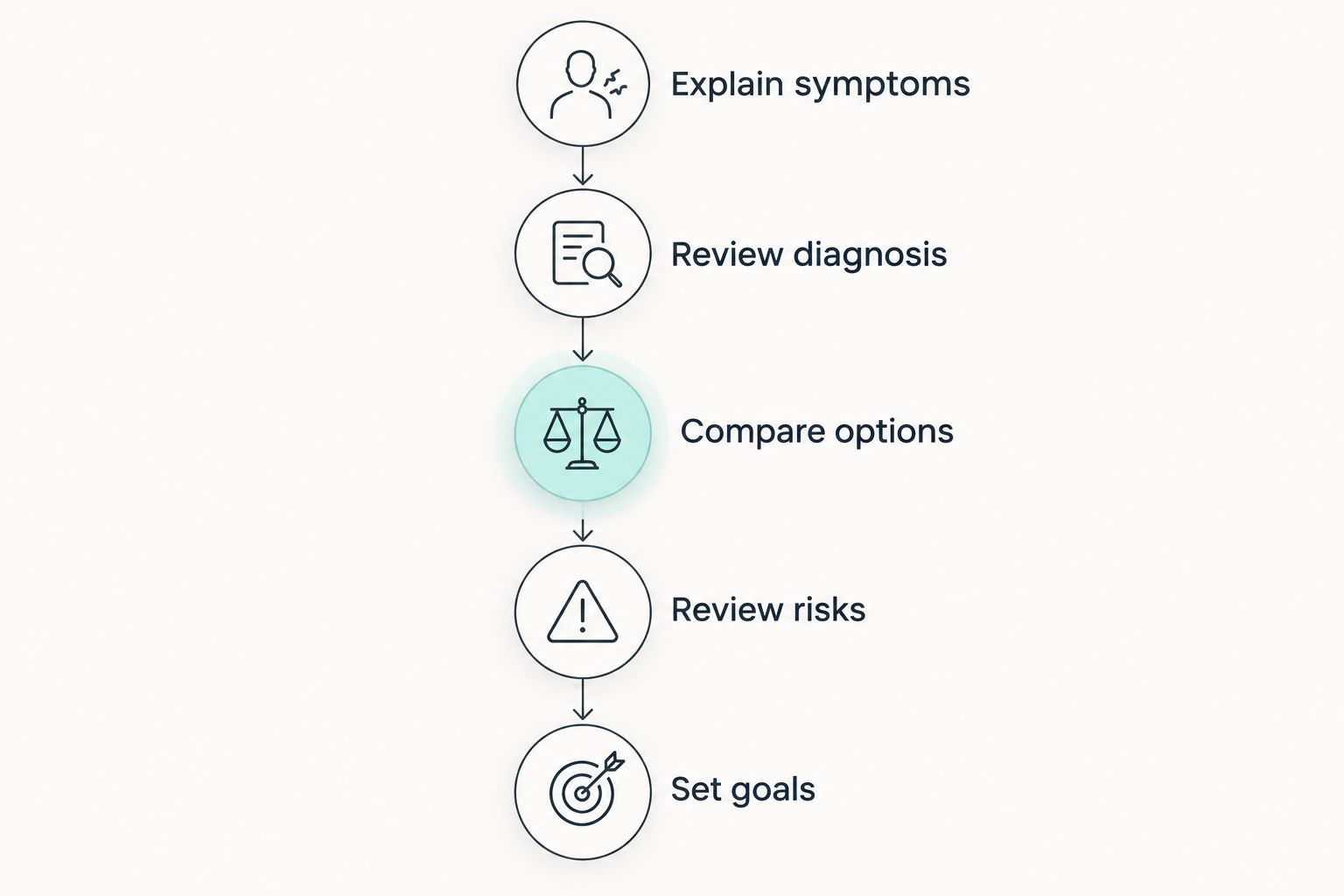
A treatment decision follows an evaluation; it does not replace one.
Before leaving, make sure you understand what happens next if treatment provides no meaningful benefit. That question matters as much as the expected benefit because it establishes how the clinician will reassess the diagnosis and avoid repeating an ineffective approach.
Prepare for your first appointment
Bring your medication list, relevant imaging reports, prior procedure records, and a summary of treatments you have tried. Include what helped, what did not, and any side effects. Do not stop prescribed medication on your own to prepare for a visit or procedure.
Choose 2 functional goals to discuss. For example, you might want to walk to nearby shops and sleep with fewer interruptions. Specific goals help distinguish a meaningful improvement from a brief change that does not affect daily life.
Before scheduling, confirm:
- Which office you will attend and whether a procedure uses a different location.
- Whether your specific insurance plan requires a referral or authorization.
- Which records the clinician wants before the visit.
- Whether transportation or other preparation will be needed for a proposed procedure.
These are questions to verify directly, not assumptions based on a clinic’s general website description.
Arrange a pain evaluation
Discuss your symptoms and ask which office fits your visit.
Which pain management option should you choose?
Choose an interventional consultation when persistent pain needs a diagnostic review and consideration of targeted procedures. Choose rehabilitation-led care when rebuilding movement is the central need, and multidisciplinary care when several health concerns require coordinated treatment.
You do not need to select your own injection before booking an evaluation. Bring a clear symptom history and ask the clinician to explain the diagnosis first. The right next move is a justified treatment plan—not an automatic procedure.
FAQ
What’s the best Passaic County pain management clinic for injections?
The best fit is a clinic that evaluates your diagnosis before recommending an injection. Hudson Pain and Spine offers interventional pain management through its Woodland Park office, including epidural injections and nerve blocks; individual suitability requires a consultation.
Is there a pain management office in Woodland Park?
Yes. Hudson Pain and Spine has an office in Woodland Park and serves patients in Passaic County. Confirm the visit location directly when arranging your appointment.
Should I see a pain specialist or a physical therapist first?
The right starting point depends on your symptoms and medical history. Rehabilitation addresses movement and function, while a medical evaluation is important for unexplained, persistent, or worsening symptoms, especially weakness or numbness.
Do I need an MRI before seeing a pain management doctor?
You do not automatically need an MRI before an initial pain evaluation. The clinician decides whether imaging is appropriate based on your history, examination, symptoms, and previous testing.
Does seeing a pain management doctor mean I need injections?
No. A pain management consultation evaluates the cause of pain and appropriate treatment options. An injection is a treatment decision, not a requirement for receiving an assessment.
Can pain management work alongside physical therapy?
Yes. Pain management and physical therapy can address different parts of the same care plan. Ask how the clinicians will coordinate activity guidance and measure functional progress.
Will my insurance cover a pain management visit in 2026?
Coverage depends on your specific plan, clinician, service, and referral or authorization requirements. Confirm participation and benefits with both the practice and your insurer before the visit.
When should I seek urgent care instead of booking a pain clinic?
Seek urgent medical evaluation for new or progressive weakness, loss of bladder or bowel control, or numbness around the groin or saddle area. Do not wait for a routine pain appointment when these symptoms occur.
One last thing
An abnormal scan does not automatically identify the source of pain. Some imaging changes occur in people without symptoms, so the examination and symptom pattern still matter. Before agreeing to treatment, ask: What connects this finding to the pain I am experiencing?
Related guides
- When to see a pain management specialist for chronic pain
- What board-certified and fellowship-trained means for pain care
- How to connect physical therapy to interventional pain treatment
About the Medical Reviewer
Dr. Saurabh Dang is a double board-certified interventional pain management specialist serving Central and Northern New Jersey. He combines clinical expertise with a patient-centered approach to help patients find lasting relief from chronic pain conditions.
Read Full Bio →Seeking Treatment for Epidural Injections?
Dr. Dang and the team at Hudson Pain and Spine offer specialized care and advanced interventional treatments.
Ready to Find Relief from Pain?
Schedule your consultation with Dr. Saurabh Dang at our Englewood office.
Serving patients across Central and Northern New Jersey — Bergen, Passaic, and Middlesex counties.