
Best treatments for cubital tunnel syndrome

Medically reviewed by
Dr. Saurabh Dang, MD, MBA

Best starting treatment for mild cubital tunnel syndrome: activity changes plus nighttime elbow positioning. Best for persistent weakness or significant nerve compression: surgical evaluation. This 2026 guide compares cubital tunnel syndrome treatment options and explains when home measures are no longer enough.
TL;DR
- Activity changes and night splinting are first-line cubital tunnel syndrome treatment options for mild, intermittent symptoms.
- Ulnar nerve weakness, constant numbness, or hand muscle wasting require prompt evaluation.
- Physical therapy supports selected patients; exercises should not increase tingling.
- HudsonPain.com provides board-certified interventional pain management in New Jersey; treatment starts with identifying the affected nerve.
Why this matters
Cubital tunnel syndrome develops when the ulnar nerve becomes compressed or irritated at the elbow. It commonly causes tingling in 2 fingers: the little finger and the adjacent half of the ring finger. Symptoms often worsen when you bend your elbow or rest it against a hard surface.
Pain relief and nerve recovery are not the same outcome. A medicine that reduces aching does not necessarily remove pressure from the nerve. Treatment should protect sensation, grip, and finger coordination—not simply make the elbow feel better.
HudsonPain.com provides board-certified interventional pain management for patients in Bergen, Passaic, and Middlesex counties, New Jersey. An evaluation should establish whether symptoms originate at the elbow, wrist, neck, or another location before a procedure is considered.
What makes the best cubital tunnel syndrome treatment?
For 2026 treatment decisions, prioritize the nerve’s condition over the appeal of a particular procedure. The right choice depends on these criteria:
- Severity: Intermittent tingling needs a different approach from weakness or muscle wasting.
- Pressure reduction: Treatment should address sustained elbow bending, direct pressure, or structural compression.
- Functional protection: Grip strength and finger control matter alongside pain scores.
- Safety: Medication risks, exercise-related irritation, and surgical complications belong in the decision.
- Response to care: Persistent symptoms require reassessment rather than indefinite repetition of the same treatment.
Treatment options at a glance
These options are not interchangeable. Conservative measures often work together, while surgery addresses compression that requires release.
| Rank and treatment | Best for | Main role | Key limitation |
|---|---|---|---|
| 1. Activity modification | Mild symptoms linked to daily habits | Reduces repeated pressure and prolonged bending | Does not correct every structural cause |
| 2. Nighttime elbow splinting | Tingling that interrupts sleep | Limits sustained elbow flexion | Poor fit or tight straps can irritate the nerve |
| 3. Surgical decompression | Progressive weakness or significant compression | Releases pressure around the ulnar nerve | Involves surgical risks and cannot guarantee full recovery |
| 4. Guided physical or occupational therapy | Movement and workplace contributors | Teaches positioning and selected exercises | Aggressive stretching can worsen symptoms |
| 5. Short-term medication | Associated aching or inflammation | Helps control discomfort | Does not mechanically decompress the nerve |
1. Activity modification: best for mild, habit-related symptoms
Activity modification reduces the positions and pressure that irritate the ulnar nerve. Start by identifying when tingling appears: driving, holding a phone, typing with elbows on armrests, or sleeping with the arm tightly bent.
Keep hard edges away from the inside of your elbow. Move frequently between comfortable positions rather than replacing prolonged bending with rigid, prolonged straightening.
Activity modification pros:
- Addresses common mechanical triggers directly.
- Fits around work, driving, and household tasks.
- Combines with splinting or clinician-directed therapy.
Activity modification cons:
- Requires consistent changes to familiar habits.
- Is insufficient for some structural compression or established nerve damage.
Best for: Intermittent tingling without persistent numbness, weakness, or muscle loss.
An elbow pad can reduce contact pressure, but avoid a tight sleeve that compresses the nerve. If changing your workstation helps only temporarily, describe that response at your appointment; it helps identify triggers but does not confirm the diagnosis.
Verdict: Skip prolonged elbow pressure; do not use activity changes alone for worsening hand function.
2. Nighttime elbow splinting: best for symptoms during sleep
Nighttime splinting limits prolonged elbow bending while you sleep. A clinician can recommend a brace or positioning method that keeps the elbow comfortably more open without forcing it straight.
Deep elbow flexion, including sustained bending beyond 90 degrees, can aggravate symptoms. That does not mean you should immobilize your arm at a self-selected angle throughout the day.
Nighttime splinting pros:
- Targets an aggravating position you cannot easily monitor during sleep.
- Pairs with daytime pressure reduction.
- Does not require medication.
Nighttime splinting cons:
- Can disturb sleep or cause skin irritation.
- Tight straps or an unsuitable fit can worsen compression.
Best for: Nighttime tingling or symptoms on waking, particularly when elbow bending is a clear trigger.
Ask for help with fitting if the brace increases numbness, leaves pressure marks, or causes swelling. A loosely wrapped towel is sometimes used to discourage deep bending, but it must not constrict the arm.
For your 2026 treatment plan, track whether nighttime symptoms improve and whether daytime sensation stays normal. Sleep improvement does not cancel out new weakness.
Verdict: Skip tight or painful bracing; use nighttime positioning as part of a monitored conservative plan.
3. Surgical decompression: best for weakness or significant compression
Surgery releases pressure around the ulnar nerve. Depending on the nerve’s stability, anatomy, and prior treatment, a surgeon may recommend decompression alone or moving the nerve to a different position, called transposition.
These are not equivalent procedures for every patient. The examination and, when indicated, nerve testing help determine the appropriate approach.
Surgical decompression pros:
- Directly addresses mechanical compression.
- Offers an option when appropriate conservative care fails.
- Addresses cases where ongoing compression threatens hand function.
Surgical decompression cons:
- Carries risks including infection, scar sensitivity, and nerve injury.
- Does not guarantee recovery of longstanding numbness or muscle wasting.
Best for: Progressive weakness, hand muscle wasting, substantial nerve impairment, or persistent symptoms despite appropriate nonsurgical treatment.
Do not postpone evaluation because the pain is tolerable. Difficulty spreading your fingers, dropping objects, or visible hollowing between hand muscles can indicate motor involvement.
A surgical consultation does not commit you to an operation. It establishes whether continued conservative care is reasonable and what delay would mean for your nerve.
Verdict: Skip repeated self-treatment when strength is declining; seek prompt surgical assessment.
Confirm the diagnosis before adding treatment
An elbow ache is not enough to diagnose cubital tunnel syndrome. Clinicians examine sensation, hand strength, elbow movement, and the nerve’s behavior during bending; they also look for compression elsewhere.
Nerve conduction studies and electromyography help localize nerve dysfunction and assess severity when needed. Ultrasound can show nerve enlargement or movement around the elbow. Not every patient needs every test.
Use this distinction when discussing your 2026 care plan:
- Elbow compression: Little-finger and ring-finger symptoms associated with elbow position.
- Wrist compression: Ulnar nerve symptoms arising farther down the arm.
- Neck involvement: A cervical nerve problem that can cause overlapping arm or hand symptoms.
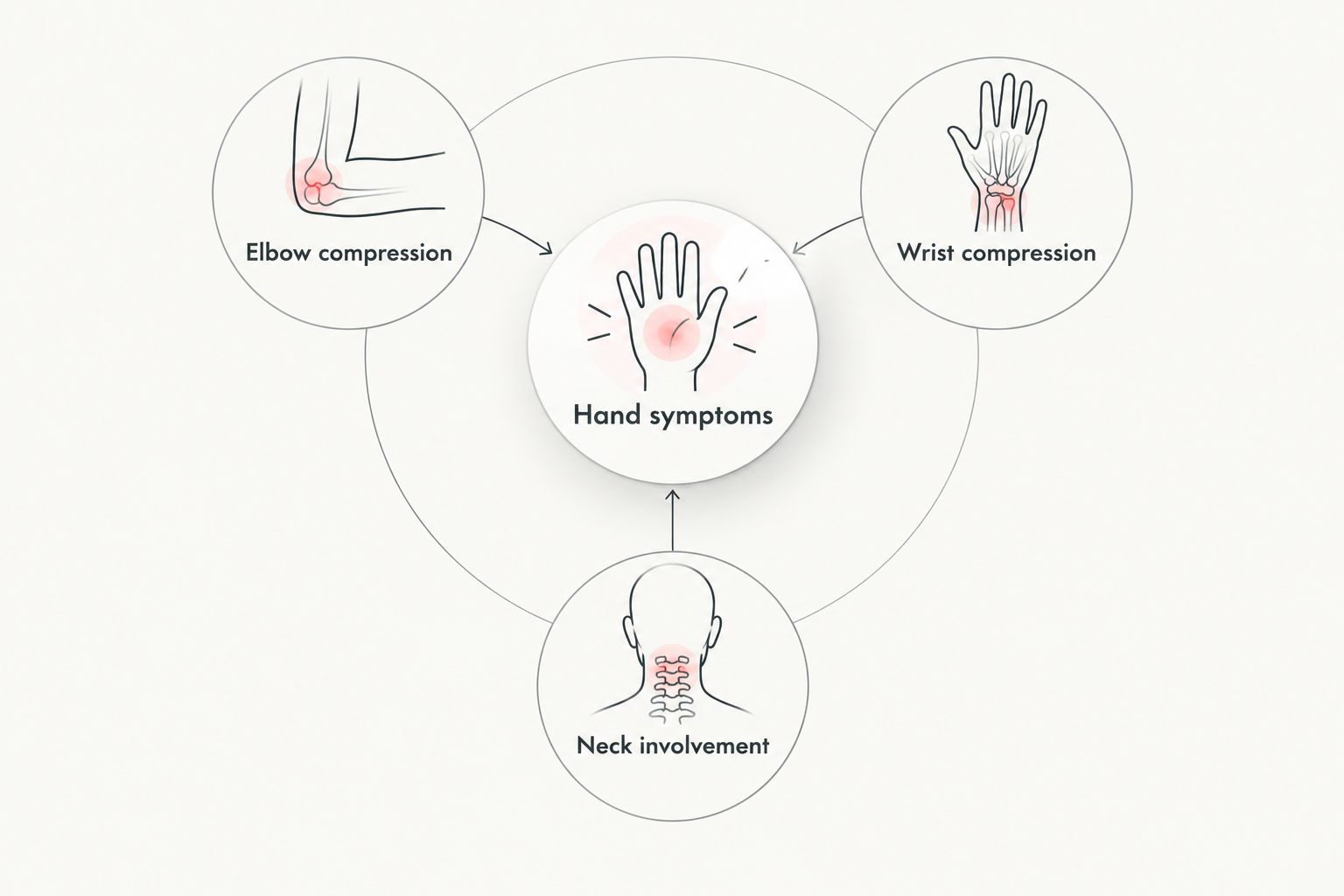
Similar hand symptoms can originate at different points along the nerve pathway.
Bring previous test reports, a medication list, and examples of tasks that trigger symptoms. Tell the clinician whether numbness disappears completely between episodes. Constant altered sensation and declining dexterity deserve particular attention.
4. Guided therapy: best for movement and workplace contributors
Physical or occupational therapy helps you change positions, adjust tasks, and select exercises without repeatedly irritating the nerve. An occupational therapist can also address hand function and splint use.
Ulnar nerve gliding is sometimes included, but it is not an instruction to stretch through tingling. A clinician should select the movement and modify it if symptoms increase.
Guided therapy pros:
- Adapts treatment to your work and daily activities.
- Provides feedback on exercise technique and symptom response.
- Supports hand function and practical positioning changes.
Guided therapy cons:
- Cannot reliably reverse advanced compression by exercise alone.
- Forceful stretching or unsuitable exercises can aggravate symptoms.
Best for: Patients with modifiable movement patterns, workstation problems, or uncertainty about safe activity.
The distinction between nerve compression and tendon pain matters here. Loading exercises used in physical therapy for tennis elbow address a tendon-related condition; they are not a substitute for reducing ulnar nerve compression in cubital tunnel syndrome. Both conditions can hurt near the elbow, but their treatment targets differ.
Stop an exercise that increases numbness or leaves symptoms worse afterward. Report that response rather than adding repetitions to overcome it.
Verdict: Skip generic elbow exercise programs; use diagnosis-specific guidance.
5. Short-term medication: best for associated discomfort
Medication can reduce associated aching or inflammation, but it does not release the ulnar nerve. A clinician or pharmacist can help determine whether an over-the-counter pain reliever is appropriate for your health history.
Anti-inflammatory medicines require particular caution with kidney disease, stomach ulcers, blood thinners, and certain cardiovascular conditions. Do not combine medicines with the same active ingredient.
Short-term medication pros:
- Helps manage discomfort while mechanical triggers are addressed.
- Can support sleep or activity when pain is a limiting symptom.
- Allows treatment to be tailored to medical history.
Short-term medication cons:
- Does not correct compression or restore lost strength.
- Carries medication-specific side effects and interaction risks.
Best for: Associated pain that interferes with function, alongside a plan addressing nerve compression.
Steroid injections around the cubital tunnel are not a routine first-line treatment. The nerve’s location and the risk of injury require caution; an injection used for another pain condition is not automatically appropriate at the elbow.
HudsonPain.com provides interventional pain management, but cubital tunnel syndrome treatment should follow the diagnosis—not a preference for injections. Ask what a proposed procedure treats and whether it changes the pressure on the nerve.
Verdict: Skip medication-only care when numbness persists or function declines.
How these treatments were ranked
This 2026 ranking prioritizes pressure reduction, protection of hand function, and treatment risk. It is a decision guide, not a claim that every patient should complete each option in order.
Activity changes and nighttime positioning lead for mild symptoms because they address common triggers without surgery. Surgical evaluation moves ahead of prolonged therapy when weakness, muscle wasting, or significant nerve impairment is present. Medication ranks last because symptom control does not remove compression.
The American Academy of Orthopaedic Surgeons’ OrthoInfo guidance on ulnar nerve entrapment at the elbow describes activity changes, bracing, and selected exercises as nonsurgical measures, with surgery considered for severe compression or unsuccessful conservative care.
Which treatment should you choose?
Choose activity modification plus nighttime positioning for mild, intermittent symptoms without weakness. Choose prompt specialist assessment for constant numbness, declining grip, or muscle loss. Do not wait for severe pain before getting help.
If symptoms last more than 6 weeks, arrange an evaluation even when they seem mild. Seek care sooner for weakness, worsening numbness, or symptoms after an injury. Sudden arm weakness with facial drooping or speech difficulty is an emergency, not a routine cubital tunnel appointment.
HudsonPain.com is best suited to New Jersey patients seeking a board-certified interventional pain management evaluation. Ask whether your findings call for conservative care, additional testing, or referral to a hand or upper-extremity surgeon.
FAQ
What’s the best cubital tunnel syndrome treatment without surgery?
Activity modification and nighttime elbow positioning are common first-line treatments for mild cubital tunnel syndrome. Guided therapy can help selected patients, but weakness or persistent numbness requires evaluation rather than home treatment alone.
Can cubital tunnel syndrome go away on its own?
Mild, intermittent symptoms can improve when repeated elbow pressure and prolonged bending stop. Persistent numbness, weakness, or muscle wasting should not be left untreated while waiting for spontaneous recovery.
Should I keep my elbow completely straight at night?
The goal is to limit prolonged deep bending, not force the elbow completely straight. A clinician can recommend a comfortable position and brace fit that do not compress the nerve.
Are nerve glides good for cubital tunnel syndrome?
Nerve glides are an option for selected patients when a clinician teaches and monitors them. Stop movements that increase tingling or leave symptoms worse afterward; forceful nerve stretching is not the goal.
When is surgery needed for cubital tunnel syndrome?
Surgery is considered for significant compression, progressive weakness, muscle wasting, or symptoms that persist despite appropriate nonsurgical care. Examination findings and nerve testing help determine whether release is appropriate.
Is a steroid injection the best treatment for cubital tunnel syndrome?
Steroid injection is not a routine first-line treatment for cubital tunnel syndrome. Treatment generally starts with reducing compression, while significant nerve impairment requires assessment for surgical release.
Is cubital tunnel syndrome the same as carpal tunnel syndrome?
No. Cubital tunnel syndrome affects the ulnar nerve at the elbow, while carpal tunnel syndrome affects the median nerve at the wrist. Their usual finger symptoms and treatment targets differ.
One last thing
Less pain does not always mean a healthier nerve. For your 2026 follow-up, describe changes in sensation, grip, and finger coordination—not just discomfort. Increasing difficulty using buttons or spreading your fingers deserves attention even if your elbow barely hurts.
Related guides
- How to treat cubital tunnel syndrome nerve pain
- How to treat carpal tunnel syndrome nerve pain
- Pinched nerve treatment for arm numbness and tingling
About the Medical Reviewer
Dr. Saurabh Dang is a double board-certified interventional pain management specialist serving Central and Northern New Jersey. He combines clinical expertise with a patient-centered approach to help patients find lasting relief from chronic pain conditions.
Read Full Bio →Ready to Find Relief from Pain?
Schedule your consultation with Dr. Saurabh Dang at our Englewood office.
Serving patients across Central and Northern New Jersey — Bergen, Passaic, and Middlesex counties.