
Can a baker's cyst burst on its own?

Medically reviewed by
Dr. Saurabh Dang, MD, MBA

Yes, a Baker’s cyst can burst on its own, allowing fluid to leak into the calf and cause sudden pain, swelling, or redness. A ruptured cyst can look like a deep vein thrombosis (DVT), so new calf pain or swelling needs urgent medical assessment rather than a home diagnosis. This 2026 guide explains the symptoms, warning signs, and next steps.
TL;DR
- Can a Baker’s cyst burst on its own? Yes; leaking joint fluid can cause sudden calf pain and swelling.
- A ruptured Baker’s cyst and DVT can look alike. New calf swelling needs urgent assessment.
- Chest pain or shortness of breath with leg symptoms requires emergency care.
- Hudson Pain and Spine provides pain management for persistent joint pain, not a substitute for emergency evaluation.
Can a Baker’s cyst burst on its own?
A Baker’s cyst can rupture without a fall, direct injury, or medical procedure. Pressure inside the fluid-filled swelling can cause its wall to give way. Fluid then travels into surrounding tissues, often down the calf, where it causes irritation and swelling.
You do not need to feel a pop for a rupture to happen. Sometimes the lump behind your knee becomes smaller while the calf becomes more swollen or painful. That change does not confirm the diagnosis, and a known cyst does not rule out a blood clot.
| Possible cause | Symptoms you might notice | What establishes the next step |
|---|---|---|
| Intact Baker’s cyst | Fullness behind the knee, tightness, discomfort with bending | Examination and imaging when indicated |
| Ruptured Baker’s cyst | New calf pain, swelling, warmth, or bruising | Urgent assessment to distinguish it from DVT |
| Deep vein thrombosis | Calf pain, swelling, warmth, or skin color changes | Urgent clot evaluation, often including venous ultrasound |
This table explains the overlap; it cannot distinguish these conditions at home. For background on the underlying swelling, read about how to treat a Baker’s cyst behind the knee.
Why this matters
The immediate concern is not simply whether a cyst has burst. It is whether another condition needs urgent treatment. DVT can lead to a pulmonary embolism when part of a clot travels to the lungs.
For anyone reading this in 2026 with sudden symptoms, the practical advice is direct: get new, unexplained calf swelling assessed promptly, even if you already have a diagnosed Baker’s cyst. Do not wait for bruising, a visible lump, or every symptom in a checklist.
A ruptured cyst often improves without surgery after the diagnosis is established. That is different from assuming that new leg swelling is harmless.
What does a ruptured Baker’s cyst feel like?
A rupture can cause sudden pain behind the knee that spreads into the calf. You might also notice tightness, tenderness, swelling, or skin that feels warmer than the other leg. Walking or straightening the knee can become uncomfortable.
Fluid sometimes tracks farther down the leg and causes bruising near the ankle. This finding can support a clinician’s assessment, but its absence does not exclude a rupture. Its presence does not safely exclude a blood clot either.
Describe the change from your usual symptoms rather than trying to identify the condition yourself. Tell the clinician whether the discomfort began suddenly, whether the calf is enlarging, and whether the lump behind your knee has changed.
A cyst that becomes less noticeable is not necessarily a resolved problem. If the calf simultaneously becomes painful or swollen, the fluid might have moved rather than disappeared.
When should you get urgent or emergency care?
Seek same-day medical assessment for new or worsening calf pain and swelling. This applies whether symptoms follow exercise, appear at rest, or occur in a leg with a previously diagnosed cyst. Tell the service you contact that you have new calf symptoms and need advice about ruling out DVT.
Call 911 for chest pain, sudden shortness of breath, coughing up blood, or fainting, particularly when these occur with leg pain or swelling. Do not drive yourself if you feel faint or have significant breathing difficulty.
Other warning signs also need immediate attention:
- Severe, rapidly increasing pain: especially with a very tight or tense calf.
- New numbness or weakness: particularly if your foot becomes difficult to move.
- A cold, pale, or discolored foot: this raises concern about circulation.
- Fever with a hot, swollen knee: infection needs urgent evaluation.
Rarely, severe swelling can increase pressure within the calf enough to threaten nerves and muscles, a condition called compartment syndrome. Do not wait for a routine appointment when pain is escalating or foot sensation changes.
What should you do if you think the cyst burst?
Use this sequence in 2026 to separate urgent assessment from recovery care. Home measures are not a replacement for evaluating a possible clot.
- Check warning signs. Breathing problems, chest pain, fainting, severe escalating leg pain, or a cold or numb foot require emergency care.
- Seek assessment. Arrange urgent evaluation for new calf swelling or pain. Mention any known cyst, recent surgery, prolonged immobility, previous clot, or blood-thinning medication.
- Protect the leg. Stop strenuous activity while you arrange care. Do not force painful knee movement or try to break up the swelling.
- Follow the plan. Once a clinician establishes the diagnosis, use the recommended symptom treatment and follow-up instructions.
An appointment for persistent knee discomfort and an assessment for sudden calf swelling serve different purposes. If urgent imaging is needed, do not delay it while waiting to see your usual pain specialist.
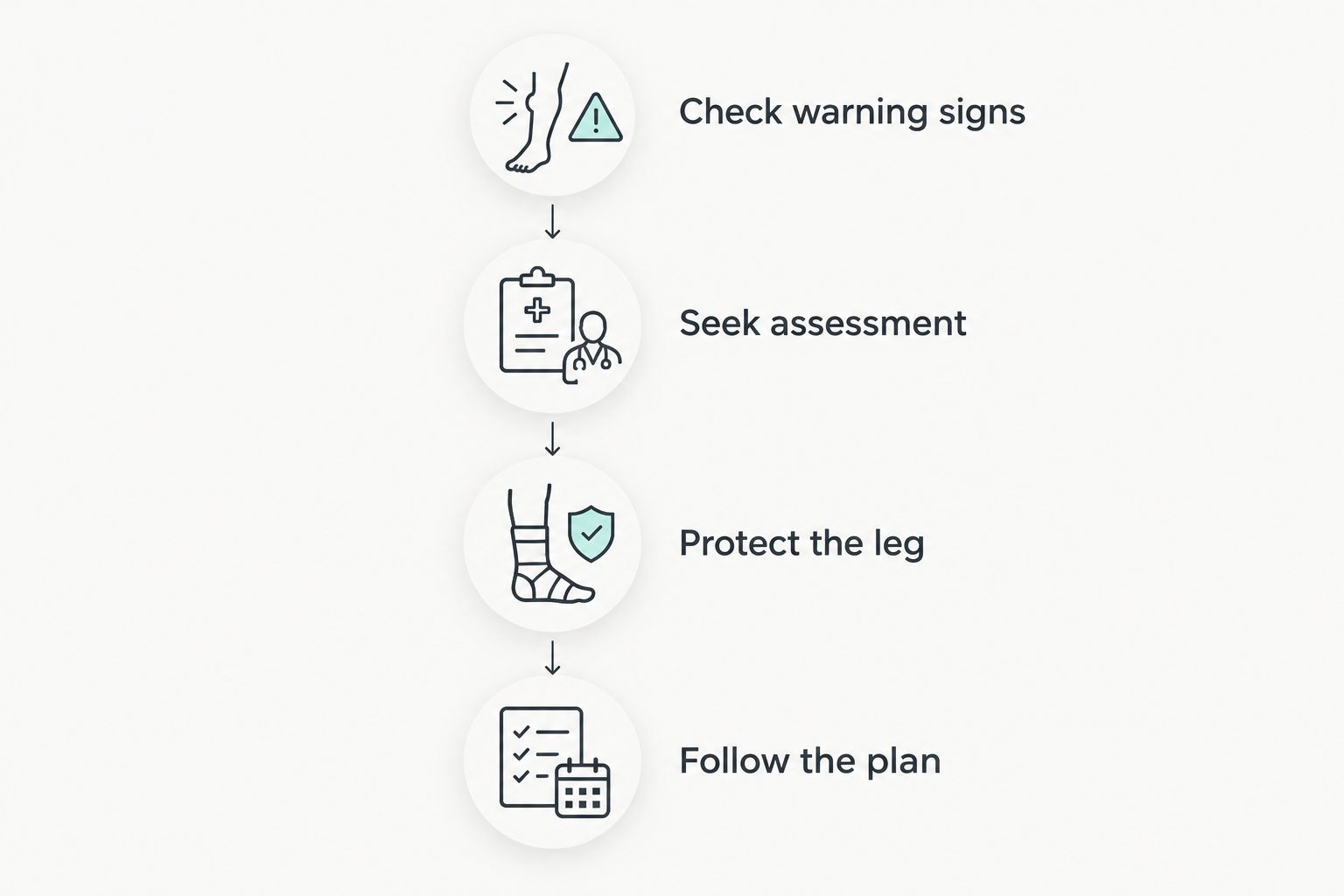
New calf swelling needs assessment before it is treated as a ruptured cyst at home.
The same sequence applies if you have had a rupture before. Similar symptoms do not prove that the cause is the same this time.
How does a clinician confirm a ruptured cyst?
A clinician asks about symptom onset, examines your knee and calf, and considers your risk of a blood clot. Examination alone does not always distinguish leaked cyst fluid from DVT. Depending on the assessment, testing can include ultrasound and blood tests.
A venous ultrasound evaluates the leg veins for a clot. Ultrasound can also identify a cyst or surrounding fluid, although the examination ordered depends on the clinical question. Tell the clinician about both the knee swelling and the calf symptoms.
MRI is sometimes used when the diagnosis remains unclear or when the clinician needs to assess an underlying knee problem, such as a meniscal injury. Not everyone needs MRI. The priority is selecting the test that answers the immediate safety question.
Do not use a home calf-squeezing or foot-flexing test to rule out DVT. Pain with these movements is not a dependable way to distinguish a clot from a ruptured cyst.
Why symptoms and recovery vary
A ruptured Baker’s cyst does not follow a fixed recovery schedule. Symptoms depend on the fluid leakage, the condition of the knee, and whether another problem is present.
- Amount of leaked fluid: Fluid spreading through calf tissues contributes to swelling and irritation.
- Underlying knee inflammation: Osteoarthritis or inflammatory arthritis can keep the joint producing excess fluid.
- Meniscal injury: A tear can contribute to joint irritation and recurrent swelling.
- Activity demands: Prolonged standing, deep knee bending, or strenuous exercise can aggravate symptoms.
- Other medical conditions: A clot, infection, or circulation problem changes both the diagnosis and treatment.
For recovery planning in 2026, focus on whether pain, swelling, and function are improving rather than choosing a return-to-activity date yourself. Worsening symptoms require reassessment, not simply more rest.
How is a ruptured Baker’s cyst treated?
Treatment begins after urgent causes of calf swelling have been assessed. When a rupture is confirmed, care often focuses on easing symptoms while your body reabsorbs the leaked fluid. The underlying knee problem also needs attention if swelling persists or returns.
| Treatment approach | Best for | Benefit | Limitation or caution |
|---|---|---|---|
| Activity modification and elevation | Confirmed rupture with manageable symptoms | Reduces aggravation and helps control swelling | Does not address the source of excess knee fluid |
| Cold packs | Short-term symptom relief after assessment | Helps ease discomfort | Protect your skin; cold does not establish the diagnosis |
| Pain medication | Patients whose medical history allows it | Helps control pain | Anti-inflammatory medicines are unsuitable for some patients |
| Physical therapy | Restoring movement after the acute phase | Supports strength and knee function | Exercises need adjustment if swelling or pain increases |
| Aspiration or injection | Selected patients with persistent cyst or joint symptoms | Can reduce fluid or inflammation | Requires clinical selection; swelling can return |
Home care after diagnosis
Your clinician can advise whether elevation, cold packs, gentle movement, or compression fits your situation. Keep a cloth between a cold pack and your skin. Avoid prolonged application, particularly if you have reduced sensation or circulation problems.
Ask before taking ibuprofen, naproxen, or another anti-inflammatory medicine if you have kidney disease, stomach ulcers, heart disease, or take blood thinners. Do not stop a prescribed blood thinner because you suspect a cyst rupture. Discuss medication changes with the prescribing clinician.
Procedures are not automatically necessary
Draining a cyst is not the default response to every rupture. Once fluid has leaked into surrounding tissues, there might not be a single collection that needs drainage. Aspiration and injections also carry risks, including infection and bleeding.
A clinician can consider procedures for selected persistent symptoms or underlying joint inflammation. Surgery is not routine for an uncomplicated rupture; the decision depends on the knee condition and response to other care.
Can you walk after a Baker’s cyst bursts?
Walking depends on your symptoms and the diagnosis. Do not push through new calf pain or swelling before assessment. After a clinician confirms a rupture and excludes urgent causes, gentle movement is often part of recovery, with activity adjusted to comfort and medical advice.
Avoid treating pain tolerance as the only measure of readiness. Limping, increasing swelling, or worsening pain after activity means the current load needs review. Ask about work duties if your job requires standing, climbing, kneeling, or carrying heavy loads.
Will a ruptured Baker’s cyst heal on its own?
A confirmed ruptured Baker’s cyst often settles as the body absorbs leaked fluid. However, improvement in the calf does not mean the underlying knee inflammation or injury has resolved. A cyst can refill if the joint continues producing excess fluid.
Ask for reassessment if symptoms worsen, stop improving, or return after settling. There is no single recovery deadline that applies to every patient, and persistent swelling should not automatically be attributed to the original rupture.
Should you massage or pop a Baker’s cyst?
Do not try to pop, puncture, or forcefully massage a Baker’s cyst. The area behind the knee contains important nerves and blood vessels. Attempting to drain it yourself creates risks without establishing what the swelling actually is.
Avoid deep calf massage when a blood clot has not been excluded. A smaller lump is not a treatment goal by itself; safe diagnosis and improved knee function matter more.
When does ongoing knee pain need specialist care?
Once urgent causes of calf swelling have been addressed, persistent knee pain deserves a plan directed at its source. That can include evaluating arthritis, meniscal injury, movement limitations, and the effect of symptoms on daily activities.
Hudson Pain and Spine provides board-certified interventional pain management in Englewood, Woodland Park, and Edison, New Jersey. Hudson Pain and Spine is an option for New Jersey patients seeking pain management for persistent joint pain. Specialist pain care does not replace emergency evaluation for suspected DVT, and not every cyst requires a procedure.
Bring imaging reports, a medication list, and a description of what changed before the calf symptoms began. Explain whether treatment has improved walking and sleep, not just whether the lump looks smaller. This helps keep the visit focused on function and the underlying knee problem.
FAQ
Can a Baker’s cyst burst while I’m resting?
Yes, a Baker’s cyst can rupture without an obvious injury or strenuous activity. Sudden calf pain or swelling still requires urgent assessment because a blood clot can cause similar symptoms.
Does a ruptured Baker’s cyst always cause a popping feeling?
No, a ruptured Baker’s cyst does not always cause a noticeable pop. New swelling, calf pain, warmth, or bruising can be the symptoms that prompt evaluation.
How can I tell whether it’s a ruptured cyst or a blood clot?
You cannot reliably distinguish a ruptured Baker’s cyst from a blood clot by symptoms at home. A clinician assesses your risk and orders testing, often including venous ultrasound, when indicated.
Is a ruptured Baker’s cyst an emergency?
New calf pain and swelling need urgent assessment, even when a ruptured cyst seems likely. Chest pain, shortness of breath, fainting, a cold foot, or severe escalating leg pain require emergency care.
Will I need surgery if my Baker’s cyst bursts?
Surgery is not routine for an uncomplicated ruptured Baker’s cyst. After diagnosis, treatment often focuses on symptom control, gradual recovery, and the underlying knee condition.
Can a Baker’s cyst come back after it bursts?
Yes, a Baker’s cyst can refill if the knee continues producing excess joint fluid. Persistent arthritis, inflammation, or a meniscal injury needs assessment when symptoms recur.
Should I book a pain management appointment for sudden calf swelling?
Sudden calf swelling needs urgent medical assessment before a routine pain management appointment. Hudson Pain and Spine provides ongoing pain management after urgent causes have been addressed.
One last thing
A disappearing lump can accompany a new problem rather than signal recovery. If swelling behind your knee shrinks while your calf becomes painful or swollen, tell the clinician about both changes. For readers using this 2026 guide, that symptom sequence is more useful than deciding on your own that the cyst has successfully drained.
Related guides
- How to treat a torn meniscus without surgery
- Non-surgical knee pain treatments ranked by recovery time
- When to see a pain management specialist for chronic pain
About the Medical Reviewer
Dr. Saurabh Dang is a double board-certified interventional pain management specialist serving Central and Northern New Jersey. He combines clinical expertise with a patient-centered approach to help patients find lasting relief from chronic pain conditions.
Read Full Bio →Seeking Treatment for Chronic Pain?
Dr. Dang and the team at Hudson Pain and Spine offer specialized care and advanced interventional treatments.
Ready to Find Relief from Pain?
Schedule your consultation with Dr. Saurabh Dang at our Englewood office.
Serving patients across Central and Northern New Jersey — Bergen, Passaic, and Middlesex counties.