
Non-surgical knee pain treatments ranked by recovery time

Medically reviewed by
Dr. Saurabh Dang, MD, MBA

Non-surgical knee pain treatments range from a same-day corticosteroid shot to a 12-week meniscus rehab program, and recovery time is the variable most patients actually care about. Best overall for fastest recovery: corticosteroid injection, with patients back to normal activity in 1-3 days. Best for knee osteoarthritis: hyaluronic acid injections, which build to full effect over 4-6 weeks and can hold for months. Best for meniscus tears: guided physical therapy paired with injections, a 6-12 week arc that avoids surgery for most degenerative tears.
TL;DR
- Corticosteroid injections give the fastest recovery among non-surgical knee pain treatments ranked by recovery time — usable within 1-3 days.
- Hyaluronic acid (viscosupplementation) takes 4-6 weeks to reach full effect but lasts longer for knee osteoarthritis.
- PRP injections need patience — 4-6 weeks for early gains, up to 3 months for full benefit — but target the underlying tissue.
- Non-surgical meniscus tear management runs 6-12 weeks and works best for degenerative, not traumatic, tears.
- Physical therapy has zero procedural downtime but the slowest path to lasting relief, often 8-12 weeks.
Why this matters
Most patients searching for knee pain relief in 2026 aren’t asking which treatment is strongest — they’re asking which one gets them back to work, back to the gym, or back to walking without a limp the fastest. Recovery time varies by a factor of ten across the options below, and picking the wrong one first often means starting over.
Hudson Pain and Spine treats knee pain from arthritis, meniscus damage, and overuse injuries at offices across Bergen, Passaic, and Middlesex counties, and the ranking below reflects how these treatments actually play out in recovery, not just how they’re marketed.
What makes the best non-surgical knee pain treatment
- Time to first relief — hours versus weeks
- Duration of benefit — a few weeks versus several months
- Downtime required — same-day activity versus a structured rehab block
- Condition match — osteoarthritis, meniscus tear, tendon overuse, or acute flare each respond differently
- Repeatability — how often the treatment can reasonably be repeated in a year
- Evidence behind durability — how consistently the effect holds up past 3 months
Non-surgical knee treatments at a glance
| Treatment | Best for | Recovery time | Key limitation |
|---|---|---|---|
| Corticosteroid injection | Fast flare relief | 1-3 days | Effect fades in 6-12 weeks |
| Genicular nerve block/RFA | Arthritic pain outlasting injections | 3-7 days | Diagnostic block usually needed first |
| Hyaluronic acid injections | Knee osteoarthritis | 4-6 weeks to full effect | Slower onset than steroids |
| PRP injections | Tissue healing support | 4-6 weeks, up to 3 months full effect | Evidence varies by injury type |
| Non-surgical meniscus management | Degenerative meniscus tears | 6-12 weeks | Not right for a locked or displaced tear |
| Physical therapy + activity changes | Early-stage pain, prevention | 8-12 weeks | No quick fix; requires consistency |
The table order matches the sections below, and each one owns a distinct knee problem rather than competing head-to-head.
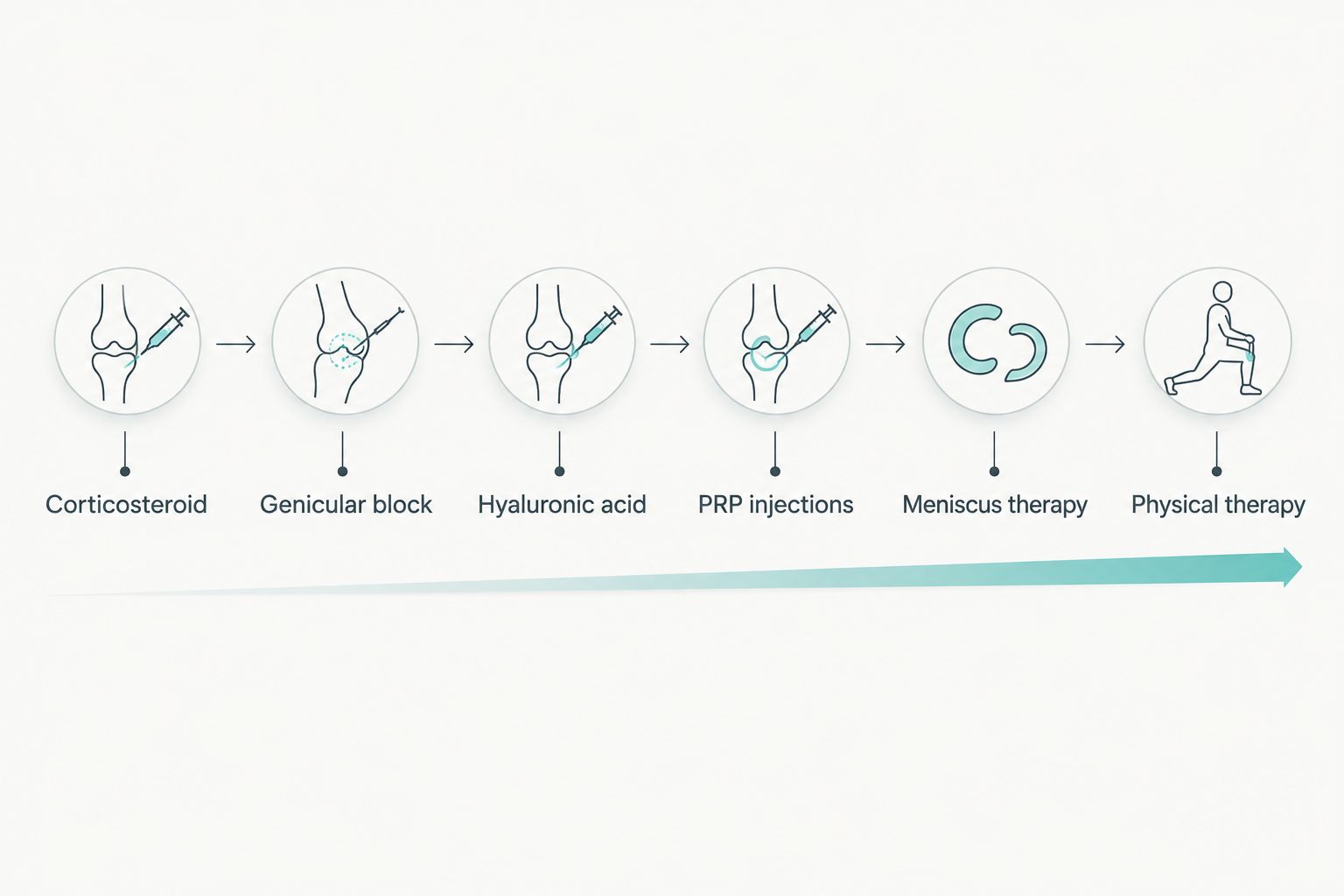
Corticosteroids act fastest; physical therapy takes the longest but needs no procedure downtime.
1. Corticosteroid injection: best for fast flare relief
A corticosteroid injection delivers an anti-inflammatory directly into the joint space, and most patients feel a difference within 24 to 72 hours. It’s the go-to option when a knee flares up before a trip, a wedding, or a physically demanding week at work. The tradeoff is durability — the effect typically holds for 6 to 12 weeks before symptoms creep back.
Corticosteroid injection pros:
- Fastest recovery of any option on this list
- No incision, minimal procedure time
- Works well for acute flares on top of chronic arthritis
Corticosteroid injection cons:
- Shortest duration of relief
- Repeated use is limited due to cartilage concerns with frequent dosing
- Doesn’t address the underlying joint damage
Best for: patients who need fast relief for a specific event or a bad flare-up. Verdict: strong first option for acute flares, not a long-term plan.
2. Genicular nerve block: best for arthritic knee pain that outlasts injections
A genicular nerve block targets the small nerves supplying the knee joint rather than the joint itself, and it’s often used when corticosteroid injections keep wearing off too fast. A diagnostic block confirms which nerves are driving the pain, and radiofrequency ablation can extend the effect for patients who respond well.
Genicular nerve block pros:
- Can extend relief well past what injections alone provide
- Targets pain signals directly, useful for arthritic knees
- Diagnostic block confirms candidacy before committing to ablation
Genicular nerve block cons:
- Requires an initial diagnostic step, adding a visit
- Best suited to arthritic pain, not mechanical tears
- Not first-line for a young, active knee with a structural injury
Best for: knee osteoarthritis pain that keeps returning faster than expected after injections. Verdict: worth discussing once corticosteroids stop holding.
3. Hyaluronic acid injections: best for knee osteoarthritis needing longer relief
Hyaluronic acid injections (viscosupplementation) replace some of the joint’s natural lubricating fluid, and the benefit builds gradually rather than hitting all at once. Full effect typically shows up over 4 to 6 weeks, but for patients with knee osteoarthritis, that slower build often translates into months of steadier relief. How hyaluronic acid injections treat knee osteoarthritis covers how the series is typically structured.
Hyaluronic acid pros:
- Longer-lasting relief than a single corticosteroid shot
- Well suited to moderate osteoarthritis
- Can be repeated on a longer interval than steroids
Hyaluronic acid cons:
- Slower onset — not for someone who needs relief this week
- Response varies more between patients than corticosteroids
- Usually given as a series, not a single visit
Best for: knee osteoarthritis patients who want relief that outlasts a corticosteroid cycle. Verdict: solid mid-tier pick when speed isn’t the priority.
4. PRP injections: best for supporting tissue healing
Platelet-rich plasma injections concentrate growth factors from the patient’s own blood and inject them into the injured area to support tissue repair. Recovery is slower than an injection alone — early improvement shows around 4 to 6 weeks, with full benefit sometimes taking up to 3 months. PRP injections for chronic knee pain walks through what a typical PRP timeline looks like at Hudson Pain and Spine.
PRP injections pros:
- Uses the patient’s own blood, no synthetic material
- Targets tissue healing rather than just masking pain
- Often considered for patients wanting to delay or avoid surgery
PRP injections cons:
- Slowest onset of the injection-based options
- Evidence on durability varies by the type and severity of injury
- Usually requires more than one session for full benefit
Best for: chronic knee pain tied to overuse or mild-to-moderate cartilage wear where the goal is tissue support, not just symptom control. Verdict: reasonable option for patients willing to wait out a slower timeline.
5. Non-surgical meniscus tear management: best for degenerative tears
Not every meniscus tear needs a scalpel. Degenerative tears, common in patients over 40, often respond to a structured non-surgical approach combining targeted injections with physical therapy. How to treat a torn meniscus without surgery breaks down which tear patterns respond well to this approach versus which ones don’t. Recovery typically runs 6 to 12 weeks.
Non-surgical meniscus management pros:
- Avoids surgical risk and a surgical recovery timeline
- Works well for degenerative tears without locking or catching
- Combines with injections already discussed above
Non-surgical meniscus management cons:
- Not appropriate for a displaced or bucket-handle tear
- Requires committed follow-through on rehab exercises
- Recovery is longer than a single injection
Best for: degenerative meniscus tears without mechanical locking symptoms. Verdict: try this route first before surgical consult, if the tear pattern qualifies.
6. Physical therapy and activity modification: best for early-stage pain and prevention
Physical therapy and activity changes carry zero procedural downtime, but they demand the most consistency and deliver results the slowest — typically 8 to 12 weeks before patients notice a durable shift. Strengthening the muscles supporting the knee reduces load on the joint itself, which matters most for early arthritis or overuse patterns before they become chronic.

Consistent strengthening work is the slowest path to relief but the one with the least procedural risk.
Physical therapy pros:
- No procedure, no injection risk
- Addresses the mechanical cause of the pain, not just the symptom
- Can run alongside any injection-based treatment above
Physical therapy cons:
- Slowest treatment on this list to show durable results
- Requires ongoing patient effort, not a passive fix
- Less effective alone for advanced arthritis or a mechanical tear
Best for: early-stage knee pain, prevention, or as a companion to any of the treatments above. Verdict: always worth doing, rarely enough on its own for advanced cases.
Get a knee pain treatment plan
See which non-surgical option fits your knee and your timeline.
How we ranked
Each treatment above is scored against the same six criteria: time to first relief, duration of benefit, downtime, condition match, repeatability, and how consistently the evidence supports durability past 3 months. Recovery time carries the most weight since that’s what patients ask about most in 2026 — not which treatment is theoretically strongest, but which one gets them functional the fastest for their specific knee problem.
Which non-surgical knee treatment should you choose?
If a flare needs to be gone by next week, a corticosteroid injection is the right call. If the pain is arthritis that keeps outrunning injections, a genicular nerve block deserves a look. For steady knee osteoarthritis management, hyaluronic acid wins on durability. For a degenerative meniscus tear, start with non-surgical meniscus management before any surgical conversation. And no matter which injection is chosen, physical therapy belongs in the plan — it’s the one item on this list with no wrong time to start.
FAQ
What is the fastest non-surgical knee pain treatment?
A corticosteroid injection is the fastest option, with most patients feeling relief within 24 to 72 hours and back to normal activity in 1-3 days. The tradeoff is that the effect typically fades within 6 to 12 weeks.
Is hyaluronic acid better than corticosteroid injections for knee pain?
Hyaluronic acid takes longer to work, usually 4-6 weeks to full effect, but tends to last longer than a corticosteroid injection for knee osteoarthritis. Corticosteroids win on speed; hyaluronic acid wins on duration.
Can a torn meniscus heal without surgery?
Degenerative meniscus tears, common in patients over 40, often respond to non-surgical management combining injections and physical therapy over 6-12 weeks. Tears that lock or catch the knee usually need a surgical evaluation.
How long does PRP take to work for knee pain?
PRP injections show early improvement around 4-6 weeks, with full benefit developing over as long as 3 months. It’s a slower-acting option chosen for tissue support rather than immediate relief.
What is a genicular nerve block used for?
A genicular nerve block targets the nerves supplying the knee joint and is typically used for arthritic knee pain that keeps returning faster than expected after standard injections. A diagnostic block usually comes first to confirm the right nerves are involved.
Do I need physical therapy if I get a knee injection?
Yes, physical therapy addresses the muscle weakness and movement patterns that contribute to knee pain, while injections manage the symptom. Combining the two typically holds up better than either alone.
When should knee pain be evaluated by a specialist instead of treated at home?
Knee pain that doesn’t improve after several weeks of rest and basic care, or that comes with locking, swelling, or instability, should be evaluated by a pain management specialist in 2026 rather than managed indefinitely on your own.
One last thing
The treatment with the shortest recovery time isn’t automatically the best long-term choice — a corticosteroid injection gets a patient moving again in days, but it doesn’t touch the mechanical problem causing an arthritic or torn knee to hurt in the first place. The patients who do best in 2026 usually stack a fast-acting option with a slower one: an injection to break the pain cycle, physical therapy to keep it from coming back.
Related guides
About the Medical Reviewer
Dr. Saurabh Dang is a double board-certified interventional pain management specialist serving Central and Northern New Jersey. He combines clinical expertise with a patient-centered approach to help patients find lasting relief from chronic pain conditions.
Read Full Bio →Seeking Treatment for Nerve Block Injections?
Dr. Dang and the team at Hudson Pain and Spine offer specialized care and advanced interventional treatments.
Ready to Find Relief from Pain?
Schedule your consultation with Dr. Saurabh Dang at our Englewood office.
Serving patients across Central and Northern New Jersey — Bergen, Passaic, and Middlesex counties.