
Can a pinched nerve cause permanent damage?

Medically reviewed by
Dr. Saurabh Dang, MD, MBA

Yes, a pinched nerve can cause permanent damage when pressure is severe or continues long enough to injure the nerve fibers. However, numbness, tingling, or shooting pain does not automatically mean permanent injury. New or worsening weakness needs prompt medical assessment; bladder or bowel changes with back pain require emergency evaluation.
TL;DR
- Can a pinched nerve cause permanent damage? Yes, but symptoms alone cannot establish whether nerve damage is permanent.
- Worsening weakness, foot drop, and loss of hand function need prompt medical assessment.
- Bladder changes or saddle numbness with back pain require emergency evaluation.
- HudsonPain.com provides interventional pain management; progressive neurological loss requires urgent assessment rather than routine pain treatment.
Can a pinched nerve cause permanent damage?
A compressed nerve can develop temporary signaling problems or more serious injury to its protective covering and internal fibers. The distinction matters: relieving irritation is not the same as restoring an already injured nerve. Your symptoms, physical examination, and selected tests help determine the next step.
HudsonPain.com provides interventional pain management for patients with back pain, neck pain, and sciatica. For your 2026 care plan, the immediate priority is identifying whether symptoms represent stable irritation, progressive nerve injury, or an emergency.
| Symptom pattern | What it tells you | Appropriate next step |
|---|---|---|
| Intermittent tingling without weakness | Symptoms alone do not establish permanent damage | Clinical evaluation if symptoms persist or recur |
| Persistent numbness or radiating pain | A nerve problem needs assessment; permanence remains uncertain | Arrange a medical examination |
| New weakness, foot drop, or declining hand function | Motor function is affected | Seek prompt assessment; rapidly worsening symptoms need emergency care |
| Bladder or bowel changes, or saddle numbness with back symptoms | Possible compression of critical spinal nerves | Seek emergency evaluation immediately |
Pain intensity does not reliably measure nerve damage. Severe pain can occur without permanent loss, while important weakness can develop without equally severe pain.
Why this matters
Waiting for pain to become unbearable is the wrong threshold for seeking care. Nerves carry movement and sensation signals, so changes in strength, coordination, or feeling can be more important than your pain rating.
In 2026, a useful treatment goal is not simply less pain. You also need preserved strength, stable sensation, and the ability to perform everyday tasks. A plan that reduces discomfort while weakness progresses needs reassessment.
What symptoms suggest more serious nerve involvement?
Weakness and loss of function
Notice whether your foot catches while walking, your grip fails during ordinary tasks, or your fingers struggle with buttons. These changes can reflect impaired nerve signaling to muscles. Pain can also limit effort, so an examination is needed to distinguish true neurological weakness from movement restricted by discomfort.
Do not repeatedly test a weak limb with heavy lifting or strenuous exercise. Report the change and when it began, especially if function is deteriorating.
Persistent numbness and muscle wasting
Numbness that stays in the same area deserves assessment, particularly when it accompanies weakness. Visible muscle shrinking is another concerning finding. Neither symptom establishes the cause or proves that recovery is impossible.
Protect skin with reduced sensation from heat, pressure, and injury. Avoid placing heating pads directly over a numb area because you cannot reliably judge excessive heat.
Emergency symptoms
Seek emergency care for new difficulty passing urine, loss of bladder or bowel control, or numbness around the genitals, buttocks, or inner thighs with back or leg symptoms. These findings can indicate cauda equina syndrome, which requires urgent evaluation.
Rapidly worsening weakness or new difficulty walking also warrants emergency assessment. Sudden weakness with facial drooping or speech changes is not something to assume is a pinched nerve; call emergency services.
Why the risk of permanent nerve damage varies
There is no universal deadline after which every pinched nerve becomes permanently damaged. In 2026, decisions still depend on the location, severity, and neurological findings—not an online countdown.
- Pressure severity: Marked compression can interfere with nerve function more seriously than mild irritation.
- Duration of compression: Continued pressure increases concern, but symptom duration alone cannot establish irreversible damage.
- Nerve location: A wrist nerve, spinal nerve root, and spinal cord problem require different assessments.
- Type of injury: Temporary conduction disruption differs from injury to the nerve fibers themselves.
- Underlying cause: Disc herniation, spinal narrowing, trauma, and local nerve entrapment require different treatment plans.
- Other nerve conditions: Diabetes or another neuropathy can complicate the examination and recovery assessment.
These factors explain why another person’s recovery story cannot predict yours. The more useful question is whether your strength, sensation, and function are stable, improving, or worsening.
Does the location of the pinched nerve change the concern?
A pinched nerve in the neck
A compressed cervical nerve root can cause pain, tingling, numbness, or weakness extending into the shoulder, arm, or hand. The symptom pattern helps a clinician identify which nerve might be involved. Neck pain is not required for every cervical nerve-root problem.
Hand clumsiness combined with balance problems raises concern for spinal cord involvement rather than an isolated nerve root. Report both symptoms together instead of treating them as unrelated complaints.
A pinched nerve in the lower back
Lumbar nerve-root compression can cause pain or altered sensation down the leg, sometimes with weakness. Difficulty lifting the front of your foot is a functional change that deserves prompt attention. Bladder changes and saddle numbness make the situation an emergency.
Sciatica describes a symptom pattern, not the severity of damage. An examination is needed to determine its cause and whether motor function is affected.
A pinched nerve at the wrist or elbow
Nerve compression outside the spine can also cause lasting deficits when severe. Carpal tunnel syndrome affects the median nerve at the wrist; cubital tunnel syndrome affects the ulnar nerve near the elbow. Their symptoms can overlap with problems originating in the neck.
The guide to carpal tunnel syndrome nerve pain explains that specific condition. Do not assume every tingling hand has the same source or needs the same treatment.
How does a clinician check for nerve damage?
A 2026 nerve evaluation should connect your symptoms with examination findings before selecting a procedure. Imaging and electrical tests answer different questions; neither replaces the clinical examination.
- Symptom history: Explain where symptoms travel, when they started, what triggers them, and whether function has changed. Include injuries, previous procedures, and relevant medical conditions.
- Neurological examination: Your clinician checks strength, sensation, reflexes, and sometimes balance or walking. Comparing findings over time helps identify progression.
- Targeted imaging: MRI can show structural problems such as disc herniation or spinal narrowing when imaging is indicated. An abnormal scan does not automatically explain every symptom.
- Electrical testing: Nerve conduction studies and electromyography can help locate certain nerve problems and assess their effects. Timing and the suspected diagnosis influence how useful these tests are.
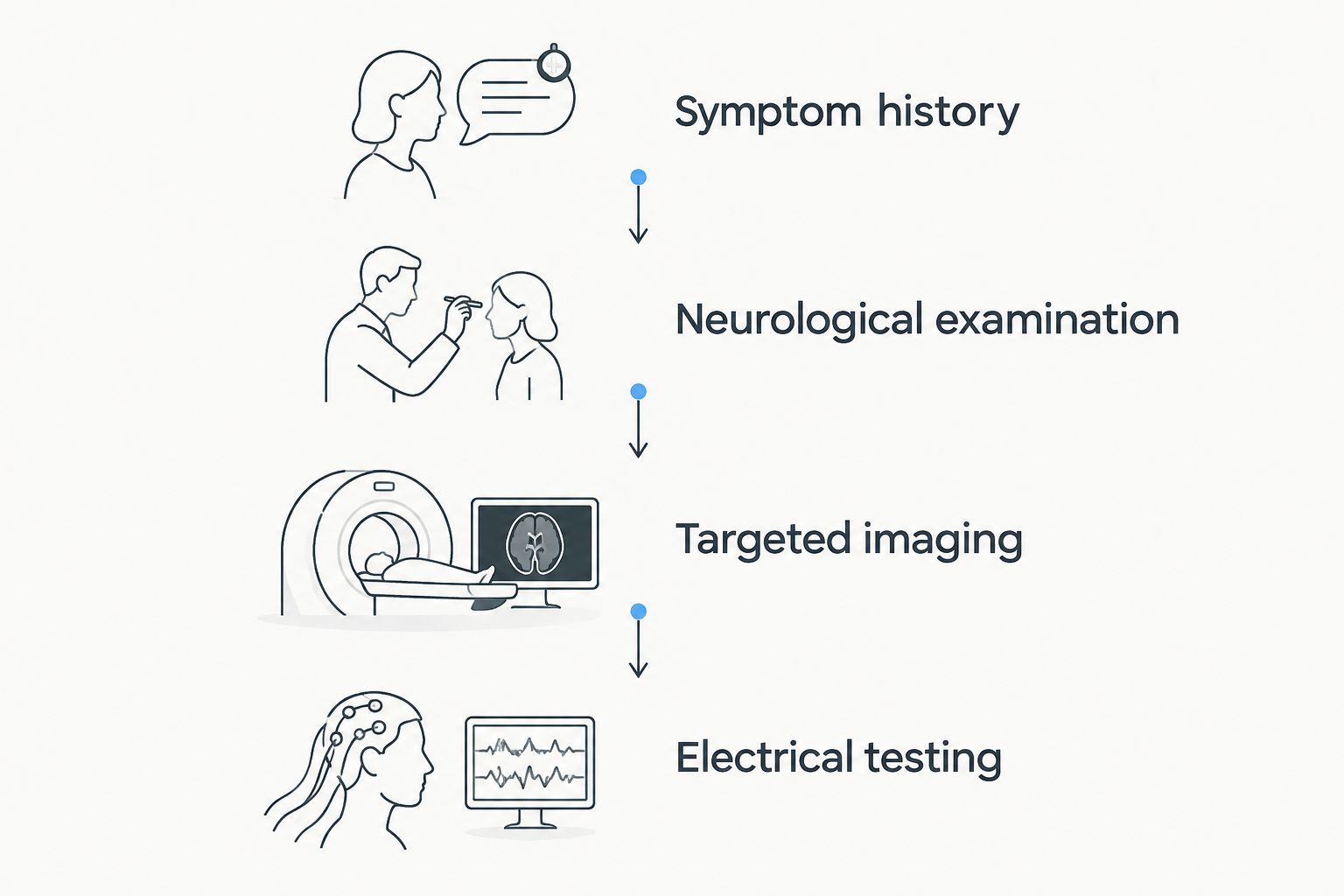
The examination guides which additional tests are useful; every patient does not need every test.
Ask your clinician what each test is intended to clarify. An MRI shows anatomy, while electrical testing assesses aspects of nerve and muscle function. A normal result on one test does not exclude every possible nerve condition.
Which treatments protect function and relieve symptoms?
Treatment depends on the cause and neurological findings. Symptom relief and relief of mechanical compression are different goals. A medication or injection can reduce pain without removing the structure pressing on a nerve.
| Treatment approach | Best for | Main benefit | Main limitation or risk |
|---|---|---|---|
| Activity changes and guided physical therapy | Selected stable cases without progressive neurological loss | Reduce aggravating stress and support movement | Do not replace urgent assessment for worsening weakness |
| Medication | Symptom management when medically appropriate | Can reduce pain or inflammation | Side effects; does not necessarily relieve compression |
| Epidural injection or selected nerve block | Selected patients after diagnosis and examination | Can reduce inflammation or help clarify a pain source | Does not guarantee nerve recovery; procedural risks include bleeding and infection |
| Surgical decompression | Selected structural compression, especially with concerning deficits | Directly addresses the compressing structure | Surgical risks and no guarantee of complete recovery |
HudsonPain.com interventional pain management is best suited to patients seeking evaluation of persistent back, neck, or sciatica pain without emergency warning signs. The practice provides epidural injections, nerve blocks, and spinal cord stimulation; suitability depends on the diagnosis.
The limitation is important: interventional pain management is not a substitute for emergency decompression when critical nerves are threatened. Spinal cord stimulation changes pain signaling; it does not remove a disc herniation or reverse established nerve loss.
For a 2026 treatment decision, ask whether the proposed treatment targets inflammation, pain signaling, or physical compression. Also ask what change in strength or sensation would trigger a different plan.
Review your pain management options
Explore the practice’s interventional pain management services for persistent back, neck, and sciatica symptoms.
Can a pinched nerve heal without surgery?
Yes, a pinched nerve can improve without surgery when the cause and neurological findings support nonsurgical care. Improvement in pain is encouraging, but your clinician should also track strength and sensation. Progressive weakness changes the decision even if discomfort becomes manageable.
How long before a pinched nerve causes permanent damage?
There is no single safe waiting period that applies to every compressed nerve. Severity, location, and neurological changes matter more than a calendar estimate. Do not postpone assessment of new weakness while waiting for a self-care trial to finish.
Does numbness mean the nerve is permanently damaged?
Numbness does not, by itself, mean permanent damage. It can accompany temporary irritation or more substantial injury. Persistent or spreading numbness needs assessment, especially when grip strength, walking, or coordination changes.
What should you record before your appointment?
Bring a short symptom history rather than trying to diagnose the exact nerve yourself. Practical details help your clinician connect symptoms to an anatomical pattern and identify deterioration.
- Mark where pain, tingling, and numbness occur, including which fingers or parts of the foot are affected.
- Describe functional changes such as dropping objects, tripping, or struggling with stairs.
- Note whether symptoms are intermittent, constant, improving, or worsening.
- Bring relevant imaging reports, medication information, and details of previous treatment.
- Explain which activities increase symptoms and which positions relieve them.
Do not delay urgent care to complete this list. An emergency symptom takes priority over records, referrals, or a routine pain appointment.
FAQ
Can a pinched nerve cause permanent damage even if the pain is mild?
Yes, mild pain does not exclude significant nerve dysfunction. New weakness, loss of coordination, or persistent numbness deserves assessment regardless of pain intensity.
How do I know whether my pinched nerve is getting worse?
Worsening strength, spreading numbness, foot drop, or declining hand function are concerning changes. Seek prompt assessment, and use emergency care for rapidly progressing weakness or bladder and bowel warning signs.
Can an MRI tell whether my nerve damage is permanent?
An MRI alone cannot reliably establish whether nerve damage is permanent. It shows structural findings that your clinician interprets alongside the examination and, when appropriate, electrical testing.
Will an epidural injection fix a pinched nerve?
An epidural injection can reduce inflammation around selected irritated spinal nerves, but it does not physically remove a compressing disc or bone. Pain relief does not guarantee that nerve function has recovered.
Should I stretch a pinched nerve if my arm or leg is numb?
Do not force stretches that increase numbness, radiating pain, or weakness. Have a clinician assess persistent sensory changes before starting exercises intended to treat a presumed nerve compression.
Can nerve function recover after pressure is relieved?
Nerve function can recover after pressure is relieved, but recovery depends on the type and extent of injury. Some deficits persist, so no treatment can guarantee complete restoration.
When should I go to the emergency room for a pinched nerve?
Seek emergency care for back symptoms with new urinary retention, loss of bladder or bowel control, or saddle numbness. Rapidly worsening weakness or new inability to walk also needs emergency evaluation.
One last thing
Less pain is not proof that a nerve has recovered. If tingling fades but your foot still drags or your hand becomes weaker, report the functional change rather than assuming treatment worked.
Use your 2026 follow-up visit to review strength, sensation, and daily function—not pain alone. That distinction helps keep symptom control from obscuring a neurological problem that needs a different approach.
Related guides
- Pinched nerve treatment for arm numbness and tingling
- Can sciatica cause permanent nerve damage?
- How to relieve a pinched nerve in the neck or back
About the Medical Reviewer
Dr. Saurabh Dang is a double board-certified interventional pain management specialist serving Central and Northern New Jersey. He combines clinical expertise with a patient-centered approach to help patients find lasting relief from chronic pain conditions.
Read Full Bio →Seeking Treatment for Epidural Injections?
Dr. Dang and the team at Hudson Pain and Spine offer specialized care and advanced interventional treatments.
Ready to Find Relief from Pain?
Schedule your consultation with Dr. Saurabh Dang at our Englewood office.
Serving patients across Central and Northern New Jersey — Bergen, Passaic, and Middlesex counties.