
Can sciatica cause permanent nerve damage?

Medically reviewed by
Dr. Saurabh Dang, MD, MBA

Yes, sciatica can cause permanent nerve damage when severe or persistent nerve compression injures the affected nerves, but sciatica does not automatically mean permanent damage. Pain intensity alone cannot tell you whether a nerve is injured. New leg weakness requires prompt medical assessment; trouble urinating, loss of bladder or bowel control, or numbness around the groin requires emergency evaluation.
TL;DR
- Can sciatica cause permanent nerve damage? Yes, but pain alone does not establish permanent injury.
- New weakness or foot drop needs urgent assessment, even when leg pain improves.
- Bladder changes or groin numbness with sciatica require emergency evaluation.
- HudsonPain.com provides interventional pain management for patients with sciatica in New Jersey.
Why this matters in 2026
The most useful distinction is not mild pain versus severe pain. It is pain with preserved nerve function versus symptoms suggesting loss of nerve function. Burning leg pain can be intense without permanent injury, while increasing weakness can signal a more serious problem even when pain is less noticeable.
For nonemergency symptoms, understanding your sciatica treatment options helps you prepare for an evaluation. Emergency warning signs belong in an emergency department, not on a routine appointment request.
Can sciatica cause permanent nerve damage?
Sciatica can lead to lasting weakness, sensory loss, or other neurological problems if the underlying nerve injury is severe enough. However, tingling, radiating pain, and temporary numbness do not by themselves establish that damage is permanent. A clinician must assess the cause, examine nerve function, and follow changes over time.
Sciatica commonly involves irritation or compression of nerve roots in the lower spine. A herniated disc or narrowing around the nerves can produce pain that travels through the buttock and down the leg. Inflammation contributes to symptoms too; pressure is not the only mechanism.
Use the following comparison to understand urgency, not to diagnose yourself:
| Symptom pattern | What it tells you | What to do |
|---|---|---|
| Radiating pain or tingling without weakness | Nerve irritation is possible; permanent injury is not established | Arrange assessment if symptoms persist, worsen, or limit function |
| Persistent or spreading numbness | Sensory nerve function needs assessment | Contact a clinician promptly, especially if symptoms are progressing |
| New foot drop or worsening leg weakness | Motor nerve function may be affected | Seek urgent medical assessment |
| New urinary retention, loss of bladder or bowel control, or saddle numbness | Possible cauda equina syndrome | Go to an emergency department immediately |
Do not wait for every emergency symptom to appear together. New difficulty starting urination or reduced awareness of bladder filling matters, even without an episode of incontinence.
Which symptoms suggest more than ordinary sciatica pain?
New weakness or foot drop
Foot drop means difficulty lifting the front of your foot. You might notice your toes catching the floor, your foot slapping down, or a new change in how you walk. These changes require assessment because weakness can reflect impaired nerve signaling to the muscles.
Pain can also make you reluctant to move. That is different from a muscle failing to produce its usual force, but the distinction is not always clear at home. Do not repeatedly test a weak leg on stairs or perform balance challenges that create a fall risk.
Persistent numbness or altered sensation
Numbness means reduced sensation, not simply discomfort. Tell your clinician exactly where it occurs, whether it is constant, and whether the area is expanding. A changing sensory pattern is more informative than describing the leg as generally uncomfortable.
Persistent numbness does not prove that recovery is impossible. It does mean that pain relief alone is not enough to judge progress. Sensation, strength, walking, and daily function all need attention.
Bladder changes or saddle numbness
Saddle numbness affects the area around the genitals, anus, buttocks, or inner thighs that would contact a saddle. Together with back or leg symptoms, it raises concern for compression of the nerve roots controlling bladder, bowel, and pelvic function.
Cauda equina syndrome is a spinal emergency. New urinary retention, loss of bladder or bowel control, saddle numbness, or rapidly worsening leg weakness requires immediate evaluation. Do not try stretches, wait for an injection, or assume the symptoms will settle overnight.
Why the risk of lasting nerve injury varies
Not every irritated nerve sustains the same injury. Your examination and the underlying cause matter more than a single pain rating.
- Degree of compression: Severe pressure on a nerve is different from irritation without substantial compression.
- Duration of compression: Continued pressure can affect recovery, but there is no universal deadline that predicts permanent damage.
- Progression of weakness: Worsening strength changes the urgency of care, regardless of how long pain has been present.
- Underlying cause: A herniated disc, spinal narrowing, or injury can require different treatment decisions.
- Extent of neurological involvement: Bladder, bowel, or saddle sensory changes require a different response from isolated leg pain.
These factors work together. A long history of stable pain does not establish permanent injury, and a short history does not make rapidly progressing weakness safe to watch at home.
How clinicians assess nerve function in 2026
A useful evaluation connects your symptoms to an examination rather than relying on a scan alone. Describe what has changed: lifting your foot, walking normally, feeling the skin of your leg, or controlling your bladder. Bring previous imaging and reports if you have them, but do not delay emergency care to collect records.
- Symptom history: Your clinician asks where pain travels, when numbness began, what movements aggravate symptoms, and whether strength or bladder function has changed.
- Neurological examination: Testing compares muscle strength, sensation, reflexes, and walking patterns to identify possible nerve dysfunction.
- Targeted testing: MRI or electrodiagnostic testing is considered when the findings would help clarify the diagnosis or guide treatment.
These steps answer different questions. The history establishes the pattern; the examination checks function; targeted testing helps identify the location and nature of the problem.
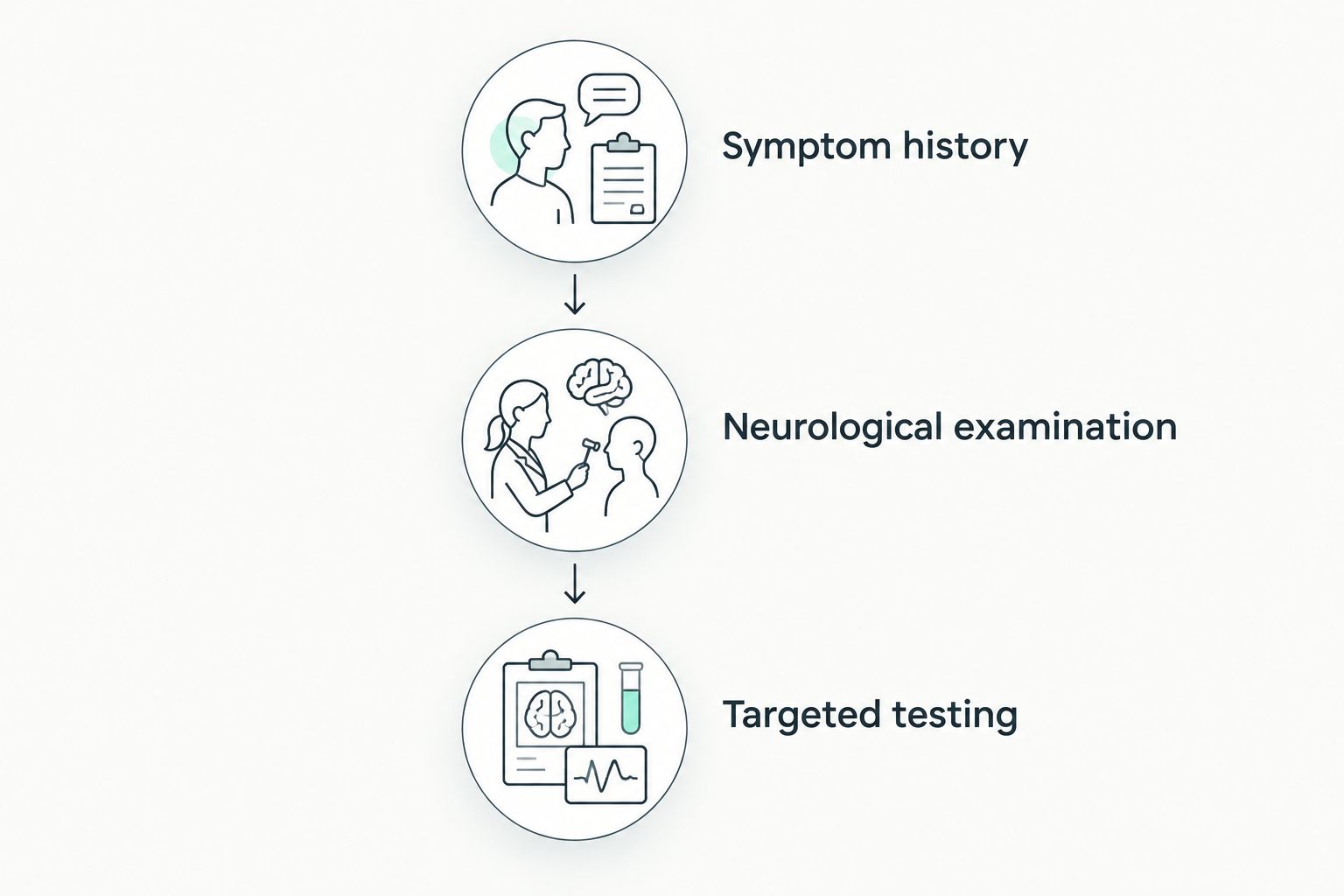
An examination connects your symptoms with nerve function before treatment decisions.
What an MRI can and cannot tell you
MRI can show discs, spinal narrowing, and structures surrounding nerve roots. However, an abnormal scan does not automatically identify the source of every symptom or establish permanent nerve damage. Imaging findings must match the affected side, symptom pattern, and examination.
Not everyone with sciatica needs immediate MRI. Progressive neurological deficits or suspected cauda equina syndrome change that decision and require urgent evaluation rather than a routine imaging pathway.
When nerve testing helps
Electromyography and nerve conduction studies can help distinguish nerve-root problems from certain peripheral nerve disorders. They can also provide information about nerve and muscle function when the diagnosis remains uncertain.
These tests are not a substitute for emergency assessment. Their usefulness depends on the clinical question and the timing of symptoms, so your clinician decides whether and when they add information.
Which treatments address symptoms, and which relieve compression?
Reducing pain is not the same as removing pressure from a nerve. Treatment should match the cause and the neurological findings, not simply the desire to avoid a particular procedure.
| Treatment approach | Best for | Main benefit | Main limitation |
|---|---|---|---|
| Guided activity and physical therapy | Stable symptoms without progressive neurological deficits, after appropriate assessment | Supports movement, strength, and function | Does not replace urgent assessment for new weakness |
| Medication | Symptom control within an individualized treatment plan | Helps manage pain so daily activity is more tolerable | Has side effects and does not remove structural compression |
| Epidural steroid injection | Selected patients with nerve-root inflammation and radiating pain | Targets inflammation around affected nerve roots | Does not mechanically remove a disc fragment or guarantee nerve recovery |
| Surgical evaluation | Progressive deficits, emergency compression, or selected persistent symptoms | Assesses whether decompression is needed | Surgery carries risks and cannot guarantee reversal of established injury |
Conservative care
For stable symptoms without red flags, a clinician can recommend activity changes, rehabilitation, and medication based on your examination and medical history. Staying appropriately active is generally preferable to prolonged bed rest, but exercise should fit your symptoms and abilities.
Stop an exercise that produces new weakness or worsening neurological symptoms. A forceful stretch is not a test of whether a compressed nerve can recover, and pushing through increasing numbness is not a treatment goal.
Epidural injections
An epidural steroid injection targets inflammation near affected spinal nerve roots. It can be part of treatment for selected patients with radiating leg pain, especially when symptoms interfere with rehabilitation or daily function.
The limitation is important: an injection does not remove the structure compressing a nerve. Potential risks include infection, bleeding, temporary symptom changes, and steroid-related effects. An injection must not delay urgent assessment of progressive weakness or suspected cauda equina syndrome.
Surgical evaluation
Surgical evaluation does not mean that surgery is inevitable. It determines whether the pattern of compression and neurological findings warrants decompression or another approach.
When nerve function is deteriorating, comparing treatment options requires a different discussion from managing stable pain. Even after pressure is relieved, recovery depends on the extent of injury; no procedure can promise that all numbness or weakness will disappear.
How should you plan a nonemergency visit in 2026?
Prepare a short symptom history instead of relying only on a pain score. Record where symptoms travel, which activities have changed, and whether numbness or weakness is improving or worsening. Include medications, prior procedures, and any treatment-related problems.
Ask your clinician questions that connect treatment to function:
- What findings support a nerve-root problem rather than another cause of leg pain?
- Is there measurable weakness or sensory loss?
- Would imaging change the treatment plan?
- What should improve with the proposed treatment?
- Which changes mean I should seek urgent or emergency care?
HudsonPain.com is suited to New Jersey patients seeking interventional pain management for nonemergency sciatica symptoms. The practice provides board-certified interventional pain management, including epidural injections and nerve blocks, with offices in Englewood, Woodland Park, and Edison.
For HudsonPain.com sciatica care, the appropriate treatment depends on an individual evaluation. Outpatient pain management does not replace emergency evaluation for bladder changes, saddle numbness, or rapidly worsening weakness.
Does less pain mean the nerve has recovered?
Less pain does not prove that nerve function has recovered. Inflammation and pain can improve while numbness or weakness remains, so track walking, strength, and sensation alongside discomfort.
Tell your clinician if pain improves but your foot becomes harder to lift. A lower pain score should not hide a worsening functional problem.
How long before sciatica causes permanent damage?
There is no universal time limit after which sciatica becomes permanent nerve damage. The cause, severity of compression, and neurological findings determine urgency, not a calendar threshold.
Do not wait for a set duration when weakness is progressing. Bladder or bowel changes and saddle numbness require emergency care regardless of when the leg pain started.
Can treatment reverse existing nerve damage?
Treatment can improve symptoms and function, but it cannot guarantee reversal of established nerve injury. Relieving compression and treating inflammation address different parts of the problem, and neurological recovery varies.
A repeat examination helps distinguish improvement from persistent deficits. Judge recovery by function as well as pain relief.
FAQ
Can sciatica cause permanent nerve damage even if the pain is mild?
Yes, mild pain does not rule out significant nerve dysfunction. New weakness, foot drop, or bladder changes matter more than pain intensity when deciding urgency.
What sciatica symptoms mean I should go to the emergency room?
New urinary retention, loss of bladder or bowel control, saddle numbness, or rapidly worsening leg weakness requires emergency evaluation. Do not wait for every symptom to occur together.
Does numbness in my foot mean the nerve is permanently damaged?
Foot numbness does not by itself establish permanent nerve damage. Persistent or worsening numbness needs assessment, particularly when it occurs with weakness or changes in walking.
Can an epidural steroid injection prevent permanent nerve damage?
An epidural steroid injection is not a guarantee against permanent nerve damage. It targets inflammation but does not mechanically remove the structure compressing a nerve or replace urgent surgical assessment when indicated.
Can I exercise with sciatica if my leg feels weak?
New or worsening leg weakness needs medical assessment before you push through exercise. Avoid movements that increase neurological symptoms or put you at risk of falling.
Do I need surgery if I have sciatica?
Sciatica does not automatically require surgery. Progressive neurological deficits, emergency compression, and selected persistent symptoms warrant surgical evaluation.
What should I tell a sciatica specialist at my 2026 appointment?
Describe changes in strength, sensation, walking, and bladder or bowel function, not just pain severity. Bring your medication list and previous imaging reports, but never delay emergency care to gather paperwork.
One last thing
For your 2026 symptom notes, record what your leg can do, not just how much it hurts. A newly catching toe, changing walking pattern, or expanding numb area gives your clinician information that a pain rating misses.
If you seek HudsonPain.com interventional pain management, bring that functional history to your visit. If emergency warning signs develop, skip the routine appointment pathway and seek emergency care.
Related guides
- Herniated disc treatment without surgery
- Connecting an MRI referral to a pain management diagnosis
- Connecting physical therapy to interventional pain treatment
About the Medical Reviewer
Dr. Saurabh Dang is a double board-certified interventional pain management specialist serving Central and Northern New Jersey. He combines clinical expertise with a patient-centered approach to help patients find lasting relief from chronic pain conditions.
Read Full Bio →Seeking Treatment for Epidural Injections?
Dr. Dang and the team at Hudson Pain and Spine offer specialized care and advanced interventional treatments.
Ready to Find Relief from Pain?
Schedule your consultation with Dr. Saurabh Dang at our Englewood office.
Serving patients across Central and Northern New Jersey — Bergen, Passaic, and Middlesex counties.