
Can you fly with a spinal cord stimulator implant?

Medically reviewed by
Dr. Saurabh Dang, MD, MBA
Yes, you can fly with a spinal cord stimulator implant once your treating clinician clears you for travel and you follow your device manufacturer’s instructions. Recent surgery, airport security screening, and access to your controller or charger require separate planning; an implant does not make every screening method appropriate for your device.
TL;DR
- Can you fly with a spinal cord stimulator? Yes, after medical clearance and device-specific travel planning.
- TSA permits alternative screening; tell the officer about your spinal cord stimulator before screening begins.
- A temporary stimulation trial needs separate travel instructions because leads connect to an external device.
- HudsonPain.com provides spinal cord stimulation care for patients in northern and central New Jersey.
Why this matters
Being able to fly with an implant is not the same as being ready to fly after surgery. Your incision, movement restrictions, symptoms, and ability to manage the device all affect the decision. Airport screening adds another issue: instructions differ between stimulation systems.
For 2026 travel, use the patient manual for your exact implanted system rather than another traveler’s experience. A relative’s pacemaker instructions or an online discussion about a different stimulator does not establish what is appropriate for your implant.
If you are still deciding whether stimulation fits your treatment plan, review whether a spinal cord stimulator is worth it. Travel planning comes after confirming that the treatment and recovery plan fit your needs.
Can you fly with a spinal cord stimulator implant?
Yes. A healed spinal cord stimulator implant generally allows air travel, but your clinician must address postoperative restrictions and your manufacturer must address device-specific precautions. Neither an airline reservation nor an implant identification card replaces those instructions.
Use this sequence before your next flight:
- Confirm medical readiness. Tell your implanting clinician your departure date, destination, flight length, and whether you will travel alone. Ask specifically about sitting, walking, luggage, and follow-up visits.
- Identify your system. Find the manufacturer, model, implant card, patient manual, and technical-support contact. Confirm that the instructions apply to your current implanted components.
- Plan airport screening. Read the manufacturer’s security guidance and tell the screening officer about the implant before entering screening equipment. Request an alternative when instructed or when the screening method is uncertain.
- Pack essential equipment. Keep your controller, prescribed accessories, charging equipment if applicable, and written instructions accessible in your carry-on.
- Arrange help with movement. Plan assistance with bags and airport walking when your recovery restrictions or symptoms require it. Do not test a lifting restriction at the overhead bin.
- Know your response plan. Decide whom to call for an error message, unexpected stimulation, worsening pain, or a wound concern while away.
These steps separate medical readiness from equipment readiness. Completing one does not complete the other: a charged controller cannot resolve an unhealed incision, and a healed incision does not establish scanner compatibility.
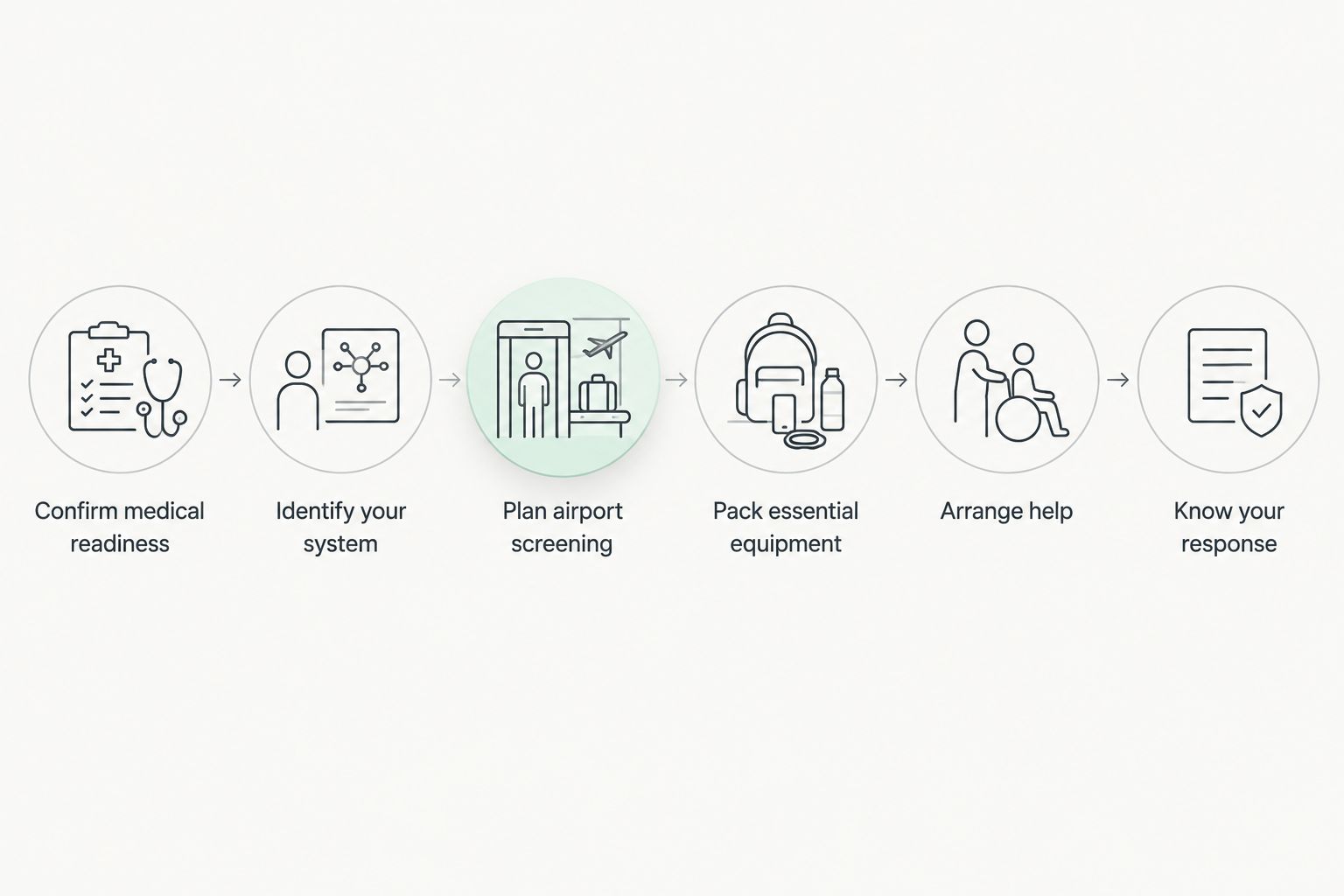
Confirm recovery restrictions and device instructions before planning airport screening.
A healed implant versus recent surgery or a trial
Your stage of treatment changes the travel discussion. The ability to sit comfortably on a plane is only part of the assessment; wound care and protection of recently placed leads also matter.
| Treatment stage | Best for | Practical advantage | Main limitation before flying |
|---|---|---|---|
| Healed permanent implant | Routine travel planning after recovery | Travel can be planned around an established device routine | Screening precautions and equipment access still apply |
| Recent permanent implantation | Individualized clearance before booking | Your surgical team can assess healing and restrictions | Incision care, movement limits, and follow-up can conflict with travel |
| Temporary stimulation trial | Coordinating travel directly with the trial team | The team can account for the trial schedule and external equipment | External connections, dressing care, and lead precautions need separate instructions |
This table describes travel circumstances, not interchangeable treatment choices. A permanent implant and a temporary trial have different purposes and different care requirements.
Flying with a healed permanent implant
A healed implant does not ordinarily prevent you from taking a flight. Before departure, confirm that you can operate the controller, recognize the alerts described in your manual, and contact the appropriate support team.
If your system is rechargeable, plan how you will maintain its prescribed charging routine during the trip. If it is not rechargeable, do not assume that advice about another patient’s charging equipment applies to you.
Flying soon after implantation
There is no single postoperative flight date that applies to every patient. Your implanting clinician must assess wound healing, complications, movement restrictions, and the demands of the trip. Ask for a decision about your actual itinerary, not a general statement that people with stimulators can fly.
A connection requiring hurried walking and luggage handling creates different practical demands from a direct flight with assistance. Tell the team about ground transportation and activities at your destination, too; recovery restrictions continue after landing.
Flying during a spinal cord stimulation trial
A trial typically involves temporary leads connected to an external stimulation device. That arrangement requires its own instructions for dressing care, movement, equipment handling, and timely follow-up.
Do not apply permanent-implant travel advice to a trial. Ask the trial team whether to postpone travel, complete the trial first, or make another arrangement that preserves the planned assessment and lead-removal schedule.
Why flying precautions vary
The precautions for spinal cord stimulation depend on the patient and the implanted system, not simply on the presence of a device. These factors explain why another traveler’s instructions can differ from yours:
- Device model: Security, electromagnetic interference, controller, and charging instructions are system-specific.
- Recovery stage: A recent implantation or revision requires attention to healing and postoperative restrictions.
- Trial equipment: Temporary leads and external connections introduce dressing and handling considerations.
- Current symptoms: New weakness, wound changes, or unexpected stimulation require assessment before routine travel planning.
- Trip demands: Prolonged sitting, airport distances, connections, and baggage handling affect comfort and recovery logistics.
- Support access: You need a workable way to reach your clinical team and device manufacturer while away.
For a 2026 trip, confirm that the manual you carry covers your current system, especially after a replacement or revision. Keep a readable copy available without relying entirely on an airport internet connection.
How do you get through airport security with a spinal cord stimulator?
Tell the security officer about the implant before screening begins. Show your device identification card if available, describe where the generator sits, and explain any recent incision or tenderness. Ask to discuss the screening method before equipment is used near the implant.
TSA guidance for travelers with implanted medical devices provides for alternative screening, including a pat-down. An identification card helps explain your situation, but it does not exempt you from screening.
Do not treat all screening equipment as equivalent
Walk-through metal detectors, handheld detection wands, and body scanners are different technologies. Your manufacturer’s instructions determine the precautions for your stimulation system; a general statement that airport scanners are safe is not enough.
Some spinal cord stimulator instructions advise avoiding certain security equipment or turning stimulation off before exposure. Do not assume that switching the device off makes every screening method acceptable. If the manual is unclear, ask the manufacturer before departure and request alternative screening at the checkpoint.
Explain tenderness before a pat-down
Tell the officer where the implant and any healing incision are located before physical screening begins. You can request private screening if discussing or examining the area in public is uncomfortable.
Allow time for that conversation rather than waiting until you are standing inside a screening lane. For international travel in 2026, check the departure airport’s security process as well; TSA procedures apply to U.S. screening, not every airport worldwide.
What should you pack in your carry-on?
Keep the equipment needed to manage your stimulator with you rather than relying on checked luggage. Make the controller accessible without twisting, reaching overhead, or unpacking a heavy bag.
Your carry-on checklist should include:
- Your implant identification card and exact device details.
- The controller and prescribed accessories.
- Charging equipment if your implanted system requires it.
- The patient manual’s travel and security instructions.
- Your clinical team’s contact details and manufacturer support information.
- Prescribed medicines and any wound supplies your team specifically directs you to carry.
Check airline rules for the batteries and accessories you actually have. Airline battery requirements and medical-device operating instructions address different issues, so satisfying one does not automatically satisfy the other.
For 2026 international travel, also check destination rules for prescribed medicines. Keep medication instructions clear, and discuss time-zone changes with your prescriber or pharmacist rather than changing doses yourself.
Should you turn your spinal cord stimulator off during the flight?
There is no universal instruction to keep every spinal cord stimulator off for an entire flight. Follow your system’s patient manual, your clinician’s directions, and crew instructions concerning external electronic equipment.
Separate the implanted generator from the equipment you hold in your hand. A controller’s wireless functions and a charger’s operating restrictions do not necessarily match the implanted device’s instructions.
Before leaving, confirm how to stop stimulation using your prescribed controller. If you experience unexpected or uncomfortable stimulation, use the response described in your manual and contact your care team or manufacturer; do not repeatedly increase settings to compensate for unexplained changes.
How can you stay comfortable without stressing a recent implant?
Choose practical support over trying to tolerate a difficult trip. Arrange help with bags, keep essential items within reach, and use airport assistance when walking distances or standing in lines exceed your current abilities.
During the flight, change position and walk when permitted if your clinician allows it. Follow the seatbelt sign and postoperative restrictions; a general exercise suggestion never overrides your surgeon’s instructions.
Ask your clinician about prolonged sitting and your personal blood-clot risk, particularly after recent surgery or if you have other risk factors. Do not start aspirin, blood thinners, compression garments, or additional sedating medicine solely for the flight without individualized advice.
When should you postpone flying and seek medical help?
New neurological symptoms or signs of infection require medical assessment, not travel troubleshooting. Contact your surgical team promptly for increasing redness, drainage, wound opening, fever, or worsening pain around a recent incision.
Seek emergency evaluation for new significant weakness, loss of bladder or bowel control, or numbness around the groin or saddle area. During or after travel, chest pain, sudden shortness of breath, or fainting also requires urgent assessment.
Unexpected stimulation or loss of familiar pain coverage is a reason to contact your treating team. Do not assume that the airport caused the problem or that changing settings will resolve it.
HudsonPain.com spinal cord stimulation care is suited to New Jersey patients seeking an interventional pain specialist. The practice provides board-certified pain management services from offices in Englewood, Woodland Park, and Edison; your implanting team remains the source for your individual postoperative clearance.
For a 2026 travel discussion with HudsonPain.com, bring your itinerary, device identification, and current restrictions. A specific itinerary gives the clinician a clearer basis for advice than asking only whether implants are allowed on airplanes.
Discuss your spinal cord stimulation care
Review interventional pain management services and office locations in New Jersey.
FAQ
Can you fly with a spinal cord stimulator implant?
Yes, you can fly with a spinal cord stimulator implant after your clinician confirms you are ready and you follow your device’s travel instructions. Recent surgery and a temporary trial require separate advice.
How soon after spinal cord stimulator surgery can I fly?
Your implanting clinician determines when you can fly after spinal cord stimulator surgery. Clearance depends on healing, complications, movement restrictions, follow-up needs, and the demands of your itinerary.
Can I go through TSA with a spinal cord stimulator?
Yes, you can complete TSA screening with a spinal cord stimulator. Tell the officer before screening, follow your manufacturer’s precautions, and request alternative screening when appropriate.
Will my spinal cord stimulator set off an airport metal detector?
A spinal cord stimulator can trigger a metal detector, but an alarm is not guaranteed. Tell the security officer about the implant before screening and follow your manufacturer’s instructions rather than relying on whether an alarm sounds.
Do I have to turn off my spinal cord stimulator on a plane?
Whether you need to turn off your spinal cord stimulator depends on your system’s instructions and the situation. Check implanted-device guidance separately from airline instructions for your external controller or charger.
Can I fly during a spinal cord stimulator trial?
Flying during a spinal cord stimulator trial requires explicit advice from the trial team. Temporary leads, external equipment, dressing care, and scheduled lead removal make trial travel different from travel with a healed implant.
Should I pack my spinal cord stimulator controller in checked luggage?
Keep your spinal cord stimulator controller and essential prescribed accessories accessible in your carry-on. Check the airline’s battery rules and your manufacturer’s handling instructions before departure.
Can HudsonPain.com help me discuss spinal cord stimulation?
HudsonPain.com provides spinal cord stimulation and other interventional pain management services in New Jersey. Bring your device details and travel plans to a clinical discussion; postoperative flight clearance must come from the team responsible for your recovery.
One last thing
An implant card identifies your device; it does not certify compatibility with every scanner or clear you to fly after surgery. Keep the card beside your model-specific instructions, and save your clinical and technical-support contacts somewhere you can access without the controller.
The most useful preflight question is specific: ask whether your current recovery, exact device, and planned itinerary work together. That answer is more useful than a general assurance that other people fly with stimulators.
Related guides
- How long a spinal cord stimulation trial lasts
- Pain management for frequent business travelers
- When to see a pain management specialist for chronic pain
About the Medical Reviewer
Dr. Saurabh Dang is a double board-certified interventional pain management specialist serving Central and Northern New Jersey. He combines clinical expertise with a patient-centered approach to help patients find lasting relief from chronic pain conditions.
Read Full Bio →Seeking Treatment for Spinal Cord Stimulation?
Dr. Dang and the team at Hudson Pain and Spine offer specialized care and advanced interventional treatments.
Ready to Find Relief from Pain?
Schedule your consultation with Dr. Saurabh Dang at our Englewood office.
Serving patients across Central and Northern New Jersey — Bergen, Passaic, and Middlesex counties.