
Is a spinal cord stimulator worth it in 2026?

Medically reviewed by
Dr. Saurabh Dang, MD, MBA

A spinal cord stimulator is worth considering in 2026 when persistent nerve-related pain has not improved enough with appropriate treatment and a temporary trial demonstrates meaningful benefit. It is not a cure or a guaranteed result: permanent implantation adds surgical risks, device care, and follow-up visits, and a successful trial does not guarantee lasting relief.
TL;DR
- Is a spinal cord stimulator worth it? Consider implantation only after a trial shows meaningful pain relief and functional benefit.
- Spinal cord stimulation changes pain signaling; it does not repair a damaged disc or decompress a nerve.
- A successful trial supports implantation but does not guarantee lasting relief.
- Hudson Pain and Spine offers interventional pain management for New Jersey patients considering spinal cord stimulation.
Why this matters
The decision is not simply whether stimulation reduces pain. You need enough improvement in daily life to justify an implanted device, recovery restrictions, and ongoing management. Walking, sleeping, sitting, and returning to manageable activities matter alongside your pain score.
For New Jersey patients, Hudson Pain and Spine provides board-certified interventional pain management, including spinal cord stimulation. The benefit is access to specialist treatment options; the limitation is that no practice or device can promise your individual response.
Is a spinal cord stimulator worth it in 2026?
The strongest reason to proceed is a well-matched diagnosis and a trial that meets agreed goals—not simply having exhausted your patience with pain. Spinal cord stimulation delivers electrical impulses through implanted leads to modify pain signaling. It does not remove scar tissue, stabilize an unstable spine, or correct every cause of back pain.
These options serve different purposes rather than competing as interchangeable treatments:
| Option | Best for | Main benefit | Main limitation |
|---|---|---|---|
| Temporary stimulation trial | Selected patients assessing whether stimulation helps | Tests benefit before permanent implantation | Short-term results do not establish long-term durability |
| Permanent spinal cord stimulator | Selected patients with a successful trial and acceptable procedural risk | Provides ongoing access to adjustable stimulation | Requires implantation, follow-up, and possible revision or removal |
| Continued nonimplant treatment | Patients without a clear indication or meaningful trial benefit | Avoids implanted hardware and allows diagnosis-specific care | Persistent symptoms can remain despite appropriate treatment |
A pain specialist should explain why stimulation fits your particular condition. Persistent neuropathic pain after spine surgery and some cases of complex regional pain syndrome are established reasons for considering it. A diagnosis alone does not establish candidacy.
A decision process you can use
- Diagnosis: Identify the pain being targeted and whether another condition needs treatment first. New neurological symptoms require evaluation rather than an automatic move toward stimulation.
- Previous care: Review medications, rehabilitation, procedures, and surgery where relevant. Record what helped, what failed, and what caused unacceptable side effects.
- Goals: Choose specific activities you want to improve. Separate relief of the targeted nerve pain from unrelated joint, muscle, or incision pain.
- Trial review: Compare your usual pain and activity with your trial experience. Include discomfort, restrictions, and any medication changes when interpreting the result.
- Implant decision: Weigh the demonstrated benefit against surgical risks and the work of living with the device. Declining implantation remains a reasonable outcome.
The evaluation is a sequence, not a promise of implantation. A trial is useful only if its result can change your decision.
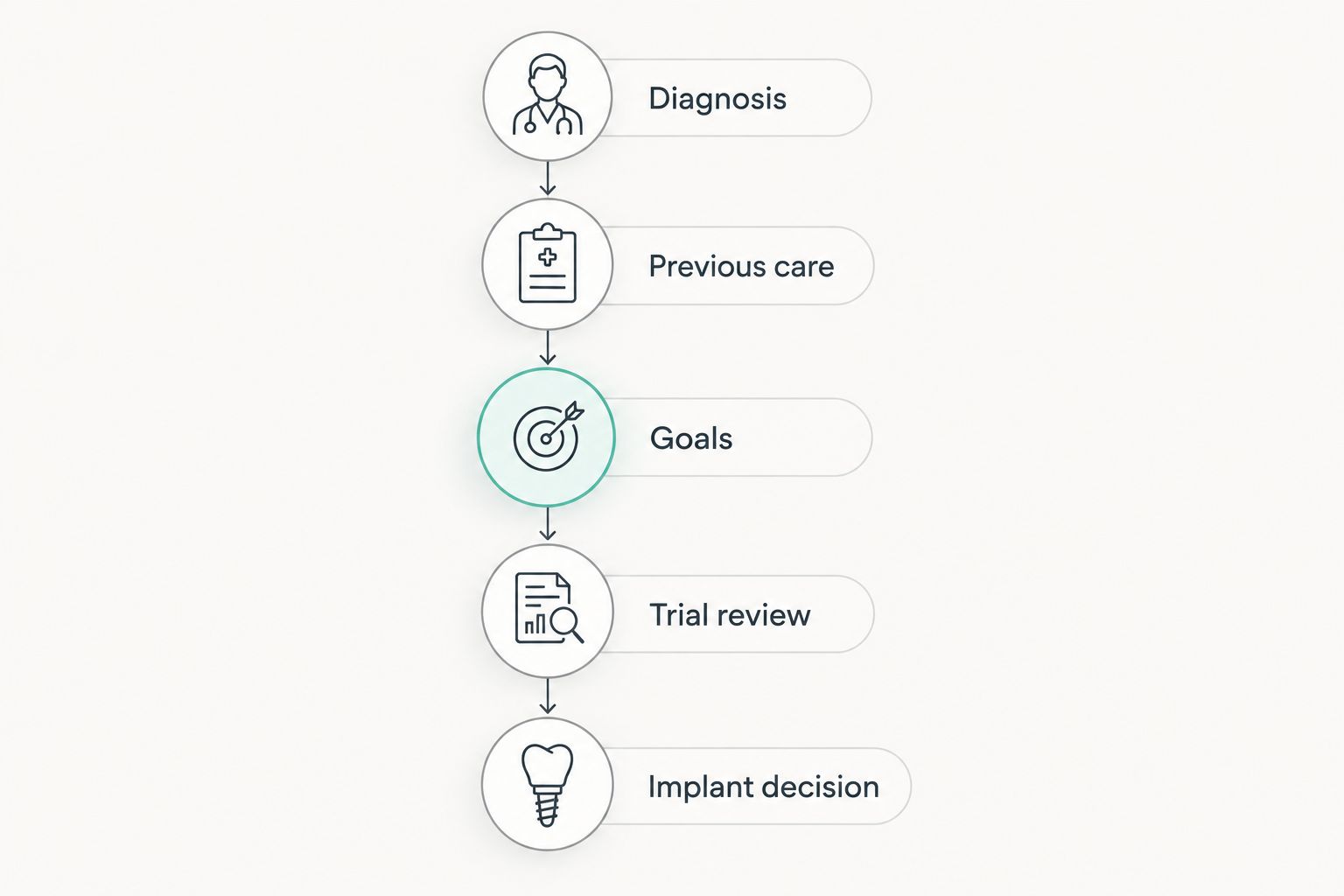
A successful trial informs the implant decision; it does not replace diagnosis or risk assessment.
Temporary trial: test benefit before committing
A temporary trial uses leads connected to an external stimulator. Johns Hopkins Medicine describes a trial lasting about 1 week, allowing patients to assess relief before deciding about permanent implantation. Your clinician determines the schedule and gives instructions for protecting the leads and insertion sites.
Professional consensus guidance on spinal cord stimulation commonly uses at least 50% pain reduction as a trial-success benchmark. That is a selection criterion, not a claim that every patient achieves that result. Functional improvement, medication use, tolerability, and your overall experience also belong in the assessment.
Use a 0–10-point pain scale consistently, alongside a short activity diary. Record the location of pain, what you attempted, how symptoms changed, and whether the stimulation itself was comfortable. Do not compare a demanding day before the trial with complete rest during the trial and assume the difference comes entirely from stimulation.
For a 2026 decision, agree on your goals before the leads are placed. Examples include standing long enough to prepare a meal or sleeping with fewer pain-related interruptions. Follow the trial restrictions; do not test prohibited lifting or twisting to prove that treatment works.
Read more about how long a spinal cord stimulation trial lasts before planning your schedule. Ask who to contact if the dressing loosens, symptoms change, or the device stops providing expected coverage.
Permanent implantation: benefit comes with ongoing care
Permanent implantation places the leads and pulse generator inside your body. The procedure introduces risks that the temporary trial cannot fully predict, including infection, bleeding, wound problems, and discomfort around the implanted generator. Neurological injury is another risk to discuss during informed consent.
Hardware can also create problems. Leads can move or malfunction, stimulation can stop covering the intended painful area, and benefit can diminish over time. Reprogramming is one response, but some problems require revision or removal.
Permanent implantation is a treatment commitment, not the end of pain management. You still need follow-up, appropriate movement and rehabilitation, and a plan for symptoms the stimulator does not address. Do not stop prescribed medication abruptly because the trial helped.
Before accepting an implant in 2026, clarify who provides programming, how you report a problem, and what happens if relief fades. Ask whether the proposed system requires charging and what future battery management involves. These details vary by system and should come from the team proposing your device.
When is a spinal cord stimulator not worth it?
An implant is not justified when the trial fails to demonstrate enough benefit for you or when procedural risk outweighs the expected improvement. It is also the wrong substitute for evaluating a new or worsening neurological problem. Persistent pain deserves a diagnosis, not an automatic device recommendation.
An active infection, an unresolved bleeding risk, or an inability to manage essential device care can affect whether implantation is appropriate. Psychological assessment is also part of candidate selection. Its purpose is to identify expectations, support needs, and factors that affect treatment—not to dismiss your pain as imaginary.
Pause if the proposed target is unclear or the explanation depends on guaranteed relief. Ask which symptom should improve, which symptoms are unlikely to change, and what alternatives remain. You should understand why implantation is appropriate before consenting.
Why spinal cord stimulation results vary
The same device does not produce the same experience for every patient. These factors affect whether the treatment is useful:
- Pain mechanism: Stimulation must match the condition being treated; pain from an untreated structural problem needs its own evaluation.
- Pain distribution: Lead placement and programming must address the intended painful area, which can change over time.
- Trial quality: Activity restrictions, symptom fluctuations, and medication changes affect how you interpret temporary benefit.
- Treatment goals: Lower pain without a meaningful daily-life improvement can still fall short of your expectations.
- Medical and psychological factors: Infection risk, bleeding risk, mood, coping, and support needs influence selection and recovery planning.
- Device management: Programming, charging where required, and access to follow-up affect your experience after implantation.
For your 2026 consultation, bring a symptom summary rather than relying on memory. Note where the pain travels, what provokes it, and what treatments have already been tried. This helps distinguish the target symptom from other pain that stimulation is not expected to address.
What does the evidence actually tell you?
Evidence for spinal cord stimulation depends on the diagnosis, device approach, comparison treatment, and outcome measured. A trial-success threshold is not a universal long-term success rate. Studies comparing stimulation with usual care answer a different question from studies comparing active stimulation with a sham intervention.
The American Society of Regional Anesthesia and Pain Medicine’s evidence-based consensus guidance addresses patient selection and trial assessment for chronic noncancer pain. Johns Hopkins Medicine’s patient guidance explains the trial and implantation pathway. Neither establishes your personal chance of lasting relief without an individual evaluation.
Ask your specialist to describe evidence for patients with your diagnosis—not just chronic pain generally. Useful questions include whether improvements involved daily function, how long patients were followed, and whether complications or device removals were included. A favorable short-term result and durable benefit are different outcomes.
Will a spinal cord stimulator eliminate my pain?
At least 50% pain reduction is a commonly used trial benchmark; complete pain elimination is not required and should not be promised. The device can help manage selected pain without correcting the underlying anatomy. You can still need rehabilitation, medication, or treatment for another pain source.
Your goal should be meaningful improvement that outweighs the burdens of treatment. Decide what that means before the trial rather than redefining success afterward.
Does a successful trial guarantee the permanent implant will work?
At least 50% pain reduction during a trial supports considering implantation, but it does not guarantee the same benefit afterward. Lead position, programming, healing, and changes in your condition can affect the permanent result. Ask how the team handles inadequate relief after implantation.
Also discuss what happens if your trial is inconclusive. Do not interpret a technical problem or an unusually restricted activity period without the clinician reviewing it.
How do I measure whether the trial helped enough?
A 0–10-point pain scale gives you a consistent way to record symptoms, but activity and sleep records make the result more useful. Compare the same targeted pain and similar permitted activities before and during the trial. Record medication use without changing it independently.
A lower pain score matters most when it translates into an improvement you actually value. Bring your diary to the review so the implant decision rests on more than a general impression.
Questions to settle before implantation
For a 2026 implant decision, request answers about the exact proposed system. MRI eligibility, charging requirements, activity precautions, and procedural instructions depend on the device and your circumstances. Do not assume another patient’s experience applies to your implant.
- MRI access: Which scans are permitted, under what conditions, and who verifies eligibility before imaging?
- Recovery: What restrictions apply to work, driving, lifting, wound care, and exercise?
- Follow-up: Who handles programming and urgent questions, and how do you reach that team?
- Loss of benefit: When does the team try reprogramming, further evaluation, revision, or removal?
- Coverage: What authorization is needed for the trial, implantation, and ongoing services?
- Other procedures: What should future treating clinicians know about the implanted system?
Confirm your responsibilities directly with your insurer and treatment team. Coverage approval does not establish clinical suitability, and a successful trial does not eliminate the need to review the permanent procedure separately. Ask for written instructions you can keep with your device information.
Seek prompt medical advice for fever, drainage, spreading redness, or worsening pain around a procedure site. New weakness, loss of bladder or bowel control, or numbness around the groin requires urgent evaluation. Do not treat those symptoms as routine adjustment to stimulation.
FAQ
Is a spinal cord stimulator worth it for chronic back pain?
A spinal cord stimulator is worth considering for selected chronic pain conditions when appropriate treatment has not helped enough and a trial demonstrates meaningful benefit. Back pain alone does not establish candidacy; the diagnosis and pain mechanism matter.
What percentage of pain relief counts as a successful spinal cord stimulator trial?
At least 50% pain reduction is a commonly used trial-success benchmark in professional consensus guidance. Your specialist also considers function, tolerability, medication use, and your agreed goals.
How long does a spinal cord stimulator trial usually last?
A spinal cord stimulator trial lasts about 1 week in the pathway described by Johns Hopkins Medicine. Your treating clinician sets the schedule and explains activity and wound-care restrictions.
Can a spinal cord stimulator replace spine surgery?
A spinal cord stimulator does not replace surgery needed to address a condition requiring structural correction or decompression. It changes pain signaling rather than repairing anatomy, so the reason surgery was proposed needs separate review.
Can I have an MRI with a spinal cord stimulator?
MRI eligibility depends on the exact implanted system and the conditions specified for that system. Have the treating team and imaging facility verify compatibility before scheduling a scan.
Can I stop pain medicine after getting a spinal cord stimulator?
Do not stop prescribed pain medicine without an agreed plan from your clinician. Medication changes depend on your response, the medicine involved, and safe tapering requirements.
Where can I discuss spinal cord stimulation in New Jersey?
Hudson Pain and Spine provides board-certified interventional pain management, including spinal cord stimulation, from offices in Englewood, Woodland Park, and Edison. A specialist evaluation helps determine whether the treatment fits your diagnosis and needs.
One last thing
A negative trial can still be a useful result: it gives you evidence against committing to an implant that did not help enough. Write down your minimum acceptable improvement before the trial, then use it when reviewing the result. Choosing not to implant is a treatment decision, not a failure to pursue relief.
Related guides
- How to get insurance approval for pain procedures
- Pain management for patients recovering from spinal fusion surgery
- How peripheral nerve stimulation treats chronic nerve pain
About the Medical Reviewer
Dr. Saurabh Dang is a double board-certified interventional pain management specialist serving Central and Northern New Jersey. He combines clinical expertise with a patient-centered approach to help patients find lasting relief from chronic pain conditions.
Read Full Bio →Seeking Treatment for Spinal Cord Stimulation?
Dr. Dang and the team at Hudson Pain and Spine offer specialized care and advanced interventional treatments.
Ready to Find Relief from Pain?
Schedule your consultation with Dr. Saurabh Dang at our Englewood office.
Serving patients across Central and Northern New Jersey — Bergen, Passaic, and Middlesex counties.