
Can you get a facet joint injection while pregnant?

Medically reviewed by
Dr. Saurabh Dang, MD, MBA

A facet joint injection while pregnant is sometimes considered, but it is not a routine first choice for pregnancy-related back pain. Your pain specialist and obstetric clinician must weigh the expected benefit against medication exposure, imaging, positioning, and the risks of delaying treatment. An elective injection is generally deferred when pregnancy-adapted care can adequately control your symptoms.
TL;DR
- A facet joint injection while pregnant requires an individualized decision with your obstetric clinician and pain specialist.
- Fluoroscopy uses X-rays; ultrasound avoids ionizing radiation but does not make every spinal injection appropriate.
- Pregnancy-related back pain is not automatically facet joint pain; diagnosis comes before an injection.
- HudsonPain.com provides interventional pain management; pregnancy-specific treatment decisions require a separate clinical assessment.
Why this matters
An injection that helped before pregnancy is not automatically the right treatment during pregnancy. The pain source, medications, imaging method, and your pregnancy circumstances all need another review.
For patients considering HudsonPain.com interventional pain management, the starting point is a specialist evaluation—not an assumption that an injection will proceed. This 2026 guide explains the questions to discuss with your treating clinicians; it does not provide medical clearance for a procedure.
Can you get a facet joint injection while pregnant?
Yes, in selected circumstances, but pregnancy requires a separate benefit–risk assessment. There is no blanket approval that applies to every facet injection, medication combination, spinal level, or stage of pregnancy. Evidence specifically addressing facet joint injections during pregnancy is limited, so routine outcomes in nonpregnant adults do not establish fetal safety.
A facet injection places medication into a small joint at the back of the spine. It is different from a medial branch block, which targets nerves supplying those joints, and from an epidural injection, which targets the space around spinal nerves.
| Approach | Best suited to | Potential benefit | Limitation during pregnancy |
|---|---|---|---|
| Pregnancy-adapted physical therapy and activity changes | Patients without warning signs who can participate in movement-based care | Addresses movement, strength, and daily activity without procedural radiation | Requires an individualized plan and does not resolve every pain source |
| Facet joint injection | Selected patients with suspected facet-mediated pain after clinical assessment | Targets a specific joint rather than treating back pain generally | Adds procedural and medication risks; pregnancy-specific evidence is limited |
| Deferring an elective injection | Patients whose symptoms remain manageable with other care | Avoids procedural exposure during pregnancy | Requires an active plan for pain and function while waiting |
These are decision pathways, not interchangeable treatments. Severe pain deserves assessment even when an injection is postponed.
What determines whether an injection is appropriate?
Your clinicians need to establish both why the pain is happening and why a procedure is necessary now. Pain intensity matters, but intensity alone does not identify the painful structure or establish that a facet injection will help.
- Confirm the pain source. Describe the location, movements that trigger symptoms, and any leg pain, numbness, or weakness. An examination helps distinguish spinal joint pain from pelvic girdle pain, muscle strain, nerve irritation, and nonspinal causes.
- Review care already tried. Explain what helped, what worsened symptoms, and whether a pregnancy-adapted physical therapy plan has been attempted. Include treatments used before pregnancy.
- Define the intended benefit. Identify a practical goal, such as walking more comfortably or participating in rehabilitation. An injection should have a purpose beyond temporarily changing a pain score.
- Review the complete procedure. Discuss the spinal level, imaging method, medications, possible contrast, positioning, and whether sedation is proposed. Each component needs its own justification.
- Coordinate with obstetric care. Your obstetric clinician should know the proposed plan before an elective procedure. Higher-risk circumstances can require additional specialist input.
Bring the actual procedure name to this discussion. A referral that says only “back injection” does not provide enough detail for pregnancy-specific planning.
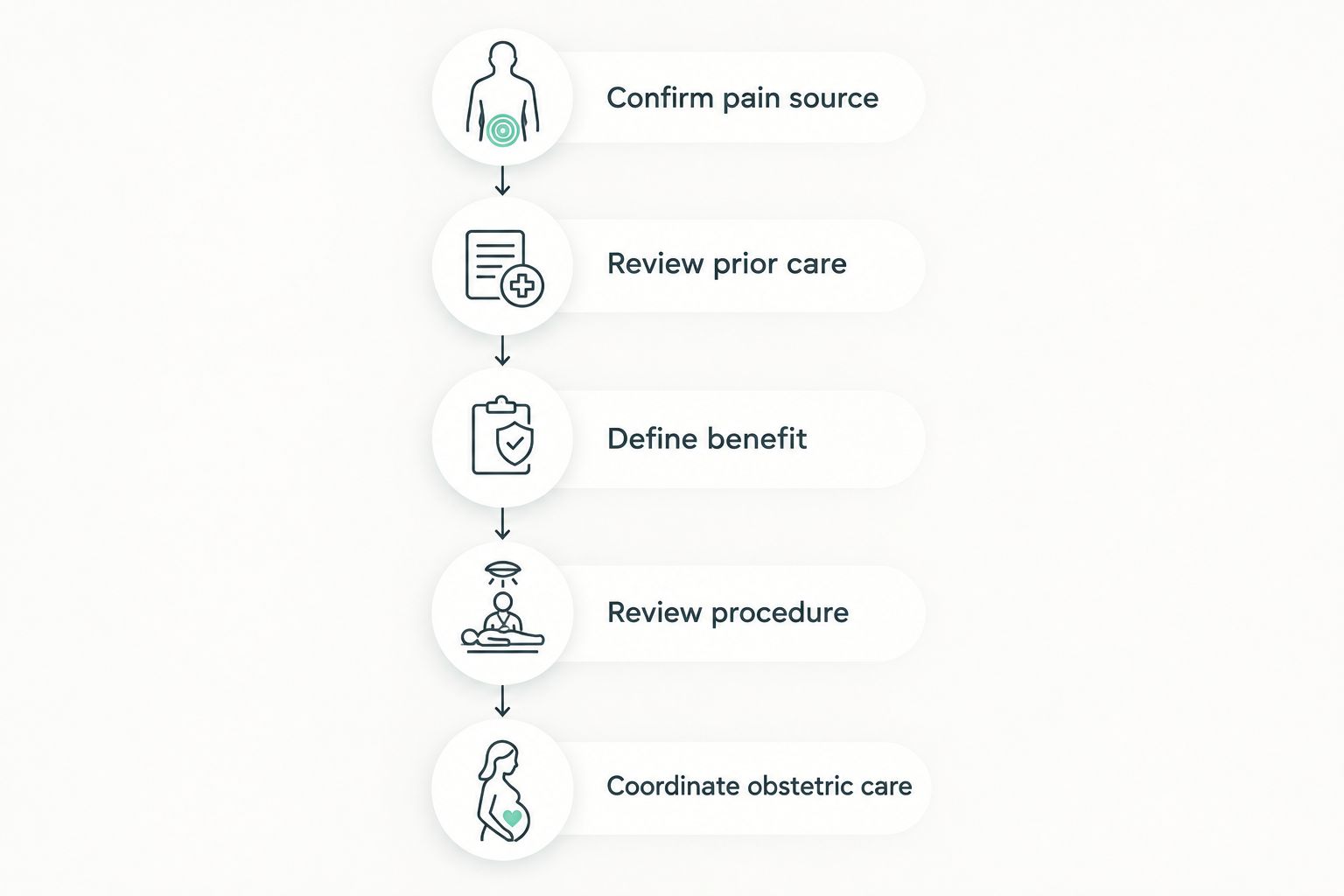
The decision includes diagnosis, expected benefit, procedure details, and obstetric coordination.
Why the recommendation varies during pregnancy
A pregnancy-related procedure decision depends on more than whether a medication is commonly used. Your clinicians assess the entire situation, including what happens if the procedure is delayed.
- Pregnancy stage: Fetal development, maternal physiology, and practical positioning considerations change throughout pregnancy.
- Diagnostic confidence: A procedure targeting a facet joint is less useful when the pain source remains uncertain.
- Functional impact: Difficulty walking, sleeping, or participating in necessary care affects the benefit–risk discussion.
- Procedure location and imaging: Cervical, thoracic, and lumbar procedures involve different anatomy and imaging considerations.
- Medication and medical history: Diabetes, infection, bleeding risk, allergies, and current medicines affect planning.
- Response to alternatives: Adequate relief with pregnancy-adapted care supports postponing an elective injection.
There is no universally safe trimester for every elective spinal injection. In 2026, a calendar-based rule is not a substitute for evaluating the specific procedure and pregnancy.
Does fluoroscopy make a facet injection unsafe?
Fluoroscopy uses X-rays to guide needle placement. Fetal exposure depends on the body region, equipment settings, beam placement, and procedure technique; the procedure name alone cannot establish the dose.
The American College of Obstetricians and Gynecologists distinguishes medically necessary imaging from unnecessary exposure in its guidance on diagnostic imaging during pregnancy. That principle does not amount to routine approval of an elective fluoroscopy-guided pain procedure.
Ask why fluoroscopy is necessary, whether treatment can wait, and what changes would reduce exposure if the procedure is justified. Do not assume that shielding alone resolves the issue or that a brief procedure has a known fetal dose without an actual assessment.
Is ultrasound guidance a safer substitute?
Ultrasound does not use ionizing radiation, which removes the X-ray component of the discussion. It does not remove medication exposure, infection risk, bleeding risk, or the need for accurate needle placement.
Whether ultrasound provides adequate guidance depends on the target, anatomy, and clinician’s technique. An ultrasound-guided procedure still needs a pregnancy-specific assessment; “no X-rays” does not mean “no risk.”
Are the injected medications safe during pregnancy?
The exact medication matters. Ask for the names of the local anesthetic, corticosteroid if proposed, contrast if proposed, and any sedative—not simply whether the injection contains “a steroid.”
A local injection does not guarantee that medication stays entirely within the joint. Systemic absorption can occur, and corticosteroids can temporarily raise blood glucose, which is particularly relevant if you have diabetes or gestational diabetes.
Prior use of a medication in other pregnancy settings does not automatically establish the safety of a particular spinal injection. The dose, route, reason for treatment, and accompanying medications all affect the decision.
For a planned procedure in 2026, ask your clinicians to document why each medication is needed. Do not stop prescribed medicines, including aspirin or anticoagulants, unless the prescribing clinician gives you a coordinated plan.
What if the injection uses only local anesthetic?
Removing corticosteroid changes the medication discussion, but it does not eliminate procedural risk. A diagnostic medial branch block is also a different procedure from an injection into the facet joint.
Ask what the result would change during pregnancy. If a diagnostic procedure would not alter your current treatment, its immediate value needs careful consideration.
What can you try before an elective injection?
Pregnancy-adapted physical therapy is a reasonable starting point when your examination does not identify an urgent problem. A clinician can tailor movement, strengthening, activity changes, and support strategies to your symptoms and pregnancy.
Avoid treating a general back-exercise video as a personalized prescription. Movements that help one pain source can aggravate another, especially when pelvic girdle symptoms and spinal symptoms overlap.
Discuss these practical measures with your care team:
- Modify lifting, prolonged standing, and activities that reliably trigger pain.
- Use a supported resting position that your obstetric clinician considers appropriate.
- Ask whether a pelvic support belt fits your diagnosis rather than buying one for unspecified back pain.
- Review all prescription medicines, over-the-counter medicines, creams, and supplements.
- Keep a symptom record that includes function, triggers, and associated symptoms.
Medication advice deserves particular attention. The U.S. Food and Drug Administration advises avoiding NSAIDs at 20 weeks of pregnancy or later unless specifically directed by a healthcare professional because of fetal kidney problems and low amniotic fluid risk.
The FDA also advises avoiding NSAIDs at 30 weeks of pregnancy or later because of the additional risk of premature closure of the fetal ductus arteriosus. If NSAID treatment between 20 and 30 weeks of pregnancy is necessary, the FDA recommends the lowest effective dose for the shortest duration; do not self-direct this treatment or discontinue prescribed low-dose aspirin without advice.
These medication restrictions do not make a facet injection automatically preferable. They make coordinated treatment planning more important.
What should you bring to a pain consultation?
Bring your pregnancy information, obstetric clinician’s contact details, medication list, allergies, previous imaging reports, and records of earlier injections. Include the response to those injections—not just whether you received them.
Write down what you cannot comfortably do and what would count as meaningful improvement. Tell the specialist about blood thinners, gestational diabetes, recent infection, and pregnancy complications before procedure scheduling.
HudsonPain.com is an option for New Jersey patients seeking board-certified interventional pain management evaluation. Best for: patients seeking assessment of persistent pain and a discussion of targeted treatments. Its role as an interventional practice does not establish that a facet injection is appropriate during your pregnancy; obstetric coordination remains necessary.
Can I get an injection if I am trying to conceive?
Tell the pain specialist if pregnancy is possible or you are trying to conceive. That information affects procedure timing, medication selection, and any pregnancy testing required before treatment.
A negative test very early after conception does not exclude every possible pregnancy. Discuss timing before arriving for a procedure rather than relying on the procedure-day checklist alone.
What if I had a facet injection before I knew I was pregnant?
Contact your obstetric clinician and the practice that performed the injection. Request the procedure date, spinal level, medication names and doses, and imaging record so the actual exposure can be assessed.
An exposure is not proof of fetal harm. Avoid drawing conclusions from the word “X-ray” or “steroid” alone; an individualized review is more useful than a general online risk estimate.
When does back pain during pregnancy need urgent care?
Seek urgent medical assessment for new leg weakness, numbness around the groin or saddle area, or loss of bladder or bowel control. These symptoms require evaluation rather than routine injection planning.
Contact your obstetric team promptly for back pain with vaginal bleeding, fluid leakage, contractions, fever, painful urination, or reduced fetal movement when movement monitoring applies to your pregnancy. Sudden severe pain, significant trauma, or feeling seriously unwell also warrants urgent assessment.
Do not assume that an existing facet arthritis diagnosis explains every new symptom. Pregnancy does not prevent a separate neurological, urinary, or obstetric problem from developing.
FAQ
Is a facet joint injection while pregnant safe for my baby?
A facet joint injection while pregnant cannot be labeled universally safe for the baby. Your obstetric clinician and pain specialist need to assess the proposed imaging, medications, pregnancy stage, and expected benefit; pregnancy-specific evidence is limited.
Is the second trimester the best time for a facet injection?
The second trimester is not automatic clearance for a facet injection. Timing must be considered alongside the need for treatment, procedure details, and your pregnancy circumstances.
Can I have a facet injection without X-rays during pregnancy?
Some targets can be approached with ultrasound, but suitability depends on anatomy, the intended procedure, and clinician expertise. Avoiding X-rays does not remove medication or needle-related risks.
Can a steroid injection affect gestational diabetes?
A corticosteroid injection can temporarily raise blood glucose. Tell both treating clinicians about gestational diabetes so they can decide whether treatment is appropriate and whether additional glucose monitoring is needed.
Should I stop my pain medicine before the consultation?
Do not stop prescribed pain medicine or other prescribed treatment without advice from the prescribing clinician. Bring a complete medication list so your obstetric and pain clinicians can coordinate changes.
Can HudsonPain.com decide whether I need a facet injection?
HudsonPain.com provides interventional pain management evaluation. During pregnancy, any proposed procedure also requires review of pregnancy-specific risks and coordination with your obstetric clinician.
Does a successful injection before pregnancy mean another will work?
Previous relief helps inform the evaluation but does not guarantee the same benefit or establish pregnancy safety. Your clinician must reassess the current pain source and proposed procedure.
One last thing
Ask what the injection would change now. If the expected result would not improve function or change your treatment plan, postponing an elective procedure deserves serious consideration.
For your 2026 consultation, bring a written goal and ask for a fallback plan if the injection is deferred. Waiting should mean active symptom management and reassessment—not being left without care.
Related guides
- Back pain treatment for pregnant women
- Treatments for sciatica pain during pregnancy
- How facet joint injections relieve chronic lower back pain
About the Medical Reviewer
Dr. Saurabh Dang is a double board-certified interventional pain management specialist serving Central and Northern New Jersey. He combines clinical expertise with a patient-centered approach to help patients find lasting relief from chronic pain conditions.
Read Full Bio →Seeking Treatment for Epidural Injections?
Dr. Dang and the team at Hudson Pain and Spine offer specialized care and advanced interventional treatments.
Ready to Find Relief from Pain?
Schedule your consultation with Dr. Saurabh Dang at our Englewood office.
Serving patients across Central and Northern New Jersey — Bergen, Passaic, and Middlesex counties.