
Can you work the day after a spinal injection?

Medically reviewed by
Dr. Saurabh Dang, MD, MBA

You can work the day after a spinal injection if your treating clinician permits it, any sedation restrictions have ended, and you can perform your duties safely. Desk work is different from lifting, driving, or operating machinery. Temporary numbness, weakness, soreness, or medication effects can delay your return even when the procedure itself is complete.
TL;DR
- Can you work after a spinal injection? Only when your discharge instructions, symptoms, and job duties allow it.
- Hudson Pain and Spine provides interventional pain management for New Jersey patients considering spinal injections.
- Sedation restrictions can extend into the next workday; changing the calendar date does not end them.
- Desk work, physical labor, and professional driving require different return-to-work decisions.
Can you work the day after a spinal injection?
Next-day work is conditional, not automatic. Your discharge instructions take priority over a general recovery timeline, including this 2026 guide. For procedure-specific context, review how to recover after an epidural steroid injection, then confirm which instructions apply to your injection.
Use your actual duties—not just your job title—to discuss the following options with your clinician:
| Work option | Best for | Practical advantage | Limitation |
|---|---|---|---|
| Desk work | Patients cleared for light activity who can change positions | Avoids lifting and strenuous movement | Sitting and commuting can still aggravate symptoms |
| Remote work | Patients cleared to work who do not need to commute | Allows easier position changes and breaks | Does not remove sedation or medication restrictions |
| Modified duty | Patients whose employers can remove restricted tasks | Separates permitted work from physical demands | Requires clear restrictions and employer agreement |
| Full physical duty | Patients specifically cleared for their usual workload | Restores the normal work routine | Lifting, climbing, and machinery introduce additional safety demands |
| Time off | Patients with active restrictions or symptoms that prevent safe work | Avoids working through an unsafe recovery period | Requires scheduling and communication with your employer |
This table is a planning aid, not medical clearance. A job that appears sedentary can still require a long drive, carrying equipment, or responding quickly to emergencies.
Why this matters
Pain relief and readiness for work are separate questions. Local anesthetic can temporarily reduce pain without establishing that you are ready for unrestricted activity, while a steroid’s benefit is not necessarily immediate.
Your first shift also includes more than the hours at your workstation. Getting dressed, using stairs, traveling, and carrying a work bag all belong in the return-to-work discussion. Plan for the entire workday, including the trip home.
For a procedure scheduled in 2026, ask for instructions tied to the exact treatment and medicines you receive. An old discharge sheet from a previous injection is not a substitute for the current plan.
Epidural steroid injections: confirm activity and sedation restrictions
An epidural steroid injection places medication near spinal nerves to address inflammation associated with certain pain conditions. Your work plan depends on the injection location, medications used, symptoms afterward, and the demands of your job.
Ask whether your clinician permits light work the following day and whether separate limits apply to lifting, bending, or driving. Do not interpret an outpatient procedure as permission to return immediately to full duty.
Temporary injection-site soreness or a short-term increase in pain can make sitting or movement uncomfortable. Report symptoms according to your discharge instructions rather than assuming every change is an expected part of recovery.
Facet joint injections: match the plan to your duties
Facet joint injections target joints in the spine rather than the epidural space. The fact that both procedures involve the back does not make their aftercare interchangeable.
Describe the movements your work requires, including repeated twisting, overhead reaching, and prolonged standing. Ask your clinician which activities are permitted and what should prompt you to stop.
If the injection includes a diagnostic component, the team can explain how to record your response. Follow that plan instead of deliberately testing your back with strenuous work.
Medial branch blocks: follow the pain-recording instructions
Medial branch blocks help evaluate whether nerves supplying the facet joints contribute to pain. Your clinician may ask you to document pain changes during activities that usually trigger symptoms.
A diagnostic activity plan is not permission for unrestricted labor. Ask which familiar activities to attempt, which to avoid, and how to record the results without exceeding your restrictions.
Keep your symptom record separate from your work-clearance decision. Temporary pain relief provides information about the block; it does not independently establish that driving, lifting, or safety-sensitive work is appropriate.
Why return-to-work timing varies
There is no single return-to-work deadline that applies to every spinal injection. These factors change the decision:
- Procedure details: The injection target and medications determine which aftercare instructions apply.
- Sedation: Sedatives can affect judgment, coordination, and alertness after you leave the office.
- Current symptoms: Numbness, weakness, dizziness, or substantial pain can interfere with safe work.
- Job demands: Lifting, climbing, driving, and machinery require different abilities from computer work.
- Other medicines: Medicines that cause drowsiness can affect safety even after procedural sedation restrictions end.
- Travel requirements: Your commute can be more demanding than the work you perform after arriving.
Tell the clinician about each factor before the procedure. A restriction written only as light duty leaves room for misunderstanding if your employer does not know which tasks that excludes.
How do I decide whether to work tomorrow?
Use this 2026 return-to-work checklist before committing to a shift. If your instructions are unclear, contact the treating team rather than deciding from pain relief alone.
- Check instructions. Identify the exact procedure, activity restrictions, medication advice, and contact information on your discharge paperwork.
- Review medicines. Confirm whether you received sedation and whether any medicine you take afterward affects alertness.
- Check symptoms. Assess whether you have new weakness, numbness, dizziness, or pain that prevents safe movement.
- Match duties. Compare your restrictions with your actual tasks, including commuting and unexpected physical demands.
- Confirm clearance. Resolve any uncertainty with your clinician and arrange modified duties or time off when needed.
The purpose is not to prove that you can tolerate discomfort. It is to establish whether the work fits your recovery instructions without putting you or someone else at risk.
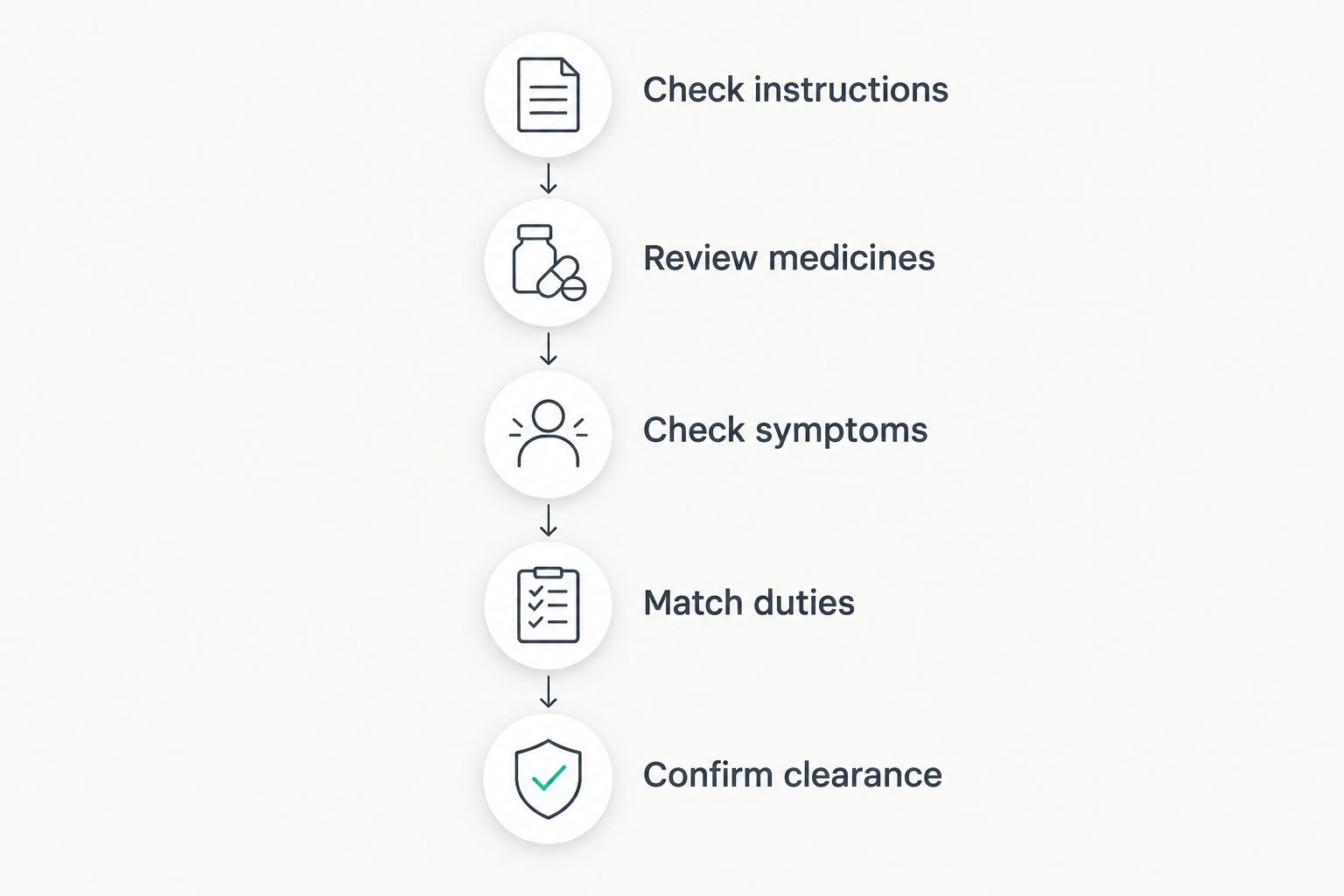
Work readiness depends on instructions, medicines, symptoms, and duties—not pain relief alone.
What should I ask before leaving the procedure office?
Ask for a clear answer about your next scheduled shift. Give the appointment time and shift start time so the team can identify restrictions that extend into the following day.
Bring a description of 3 work tasks you cannot avoid, such as lifting supplies, driving between sites, or standing at a counter. Ask whether each task is permitted and whether you need written restrictions for your employer.
Also confirm who to call after office hours. Knowing where to direct a routine recovery question is different from knowing when a symptom needs emergency care.
Can I work from home the next day?
Working from home removes the commute, but it does not cancel medical restrictions. Remote work is an option only when you are cleared for the activity, sufficiently alert, and able to concentrate safely.
If permitted, arrange your workspace so you can change positions without repeatedly bending or reaching. Keep work within the limits your clinician gives you rather than using the absence of travel as a reason to extend your shift.
Remote work also has a limitation: meetings and deadlines can make it easy to ignore increasing discomfort. Discuss a flexible schedule with your employer instead of promising normal productivity before you know how you feel.
Can I return to lifting, patient care, or construction work?
Physical work requires specific guidance about the tasks involved. Patient transfers, moving materials, repeated bending, ladder use, and handling equipment are not equivalent to light office activity.
Ask for task-based restrictions rather than a vague recommendation to take it easy. Your clinician should determine any lifting limit; do not borrow a weight limit from another patient’s instructions or an online recovery guide.
If your employer offers modified duties, confirm that the assignment actually excludes restricted activities. A light-duty shift that still requires emergency lifting or climbing does not solve the safety problem.
Does sedation mean I need more time off?
Sedation commonly brings restrictions for at least 24 hours, including avoiding driving, operating machinery, and important decisions. Follow the exact interval on your discharge instructions because your medications and procedure can require a different plan.
A restriction lasting 24 hours runs from the procedure or sedation time specified by your team—not from midnight. An afternoon appointment can therefore affect a morning shift the following day, even if you feel awake.
For your 2026 work schedule, calculate that interval before arranging transportation or agreeing to a shift. Do not use coffee, a short nap, or feeling normal as evidence that a stated restriction has ended.
Which symptoms mean I should not go to work?
Do not go to work with new weakness, significant numbness, or symptoms that make walking or using your limbs unsafe. Contact your treating team promptly. New or worsening symptoms require assessment rather than a workplace trial.
Seek emergency care for new loss of bladder or bowel control, numbness around the groin or saddle area, or progressive limb weakness. Difficulty breathing or signs of a severe allergic reaction also require emergency care.
Contact your clinician urgently for fever, increasing redness or drainage at the injection site, severe or escalating pain, or a severe headache—especially one that changes with sitting or standing. Do not drive yourself if weakness, dizziness, sedation, or other symptoms make driving unsafe.
What should I tell my employer?
Tell your employer that you are having a procedure and need to confirm temporary work restrictions. Ask whether remote work, modified tasks, or time off is available without promising a recovery date your clinician has not approved.
For a 2026 return-to-work note, request practical details: when restrictions begin, which duties are excluded, and when reassessment is needed. Share documentation through your employer’s usual process; you do not need to explain every clinical detail to discuss scheduling.
Leave room to change the plan if your recovery differs from expectations. A backup arrangement is more useful than assuming you will manage a full shift regardless of symptoms.
When should I discuss this with a pain specialist?
Discuss work requirements before scheduling an injection whenever possible. Hudson Pain and Spine provides board-certified interventional pain management, including epidural injections and nerve blocks, for patients in Bergen, Passaic, and Middlesex counties, New Jersey.
Hudson Pain and Spine is best suited to New Jersey patients seeking evaluation for interventional pain management. Its offices are in Englewood, Woodland Park, and Edison; procedure selection and return-to-work advice require an individual clinical assessment.
An injection is a treatment option, not a guarantee of immediate relief or next-day work. Ask how the proposed procedure fits your symptoms, what its limitations are, and what happens if it does not provide the expected benefit.
FAQ
Can you work after a spinal injection if you have a desk job?
You can return to desk work only when your clinician permits it and your symptoms and medicines allow safe activity. Include sitting tolerance, the commute, and any lifting in the discussion.
Can I work the next morning if I had sedation?
Do not work during an active sedation restriction, particularly in a role involving driving, machinery, or safety-sensitive decisions. A 24-hour restriction can extend into the following morning; follow your discharge paperwork.
Can I drive myself to work after an epidural steroid injection?
Drive only when your treating team permits it and sedation, numbness, weakness, or other medicines do not impair you. Being allowed to do desk work does not automatically mean you are cleared to drive.
Does pain relief mean I can lift normally again?
Pain relief does not establish that unrestricted lifting is safe. Follow the activity limits given for your specific injection, even if local anesthetic temporarily reduces your symptoms.
Should I take a full day off after a spinal injection?
Arrange time off when your discharge instructions or job duties prevent a safe return. Discuss your next shift before the procedure so you can plan transportation, modified duties, or leave.
Is soreness after a spinal injection a reason to call the doctor?
Call your treating team for severe, worsening, or concerning pain rather than assuming it is routine soreness. Fever, injection-site drainage, new weakness, or a severe headache also need prompt attention.
Can Hudson Pain and Spine help me discuss work restrictions?
Discuss your job duties and recovery questions with Hudson Pain and Spine during your interventional pain management evaluation. Ask the treating clinician for procedure-specific instructions and any documentation your employer requires.
One last thing
Ask about the trip home from work, not just the trip in. Being comfortable before a shift does not establish that you can safely complete the shift and drive afterward.
Before your procedure, write down 2 separate questions: whether you can perform your duties and whether you can travel safely. Getting distinct answers prevents permission for light activity from being mistaken for unrestricted clearance.
Related guides
- Can you drive after an epidural steroid injection?
- How to return to work safely after a pain procedure
- How to prepare for an epidural steroid injection
About the Medical Reviewer
Dr. Saurabh Dang is a double board-certified interventional pain management specialist serving Central and Northern New Jersey. He combines clinical expertise with a patient-centered approach to help patients find lasting relief from chronic pain conditions.
Read Full Bio →Seeking Treatment for Epidural Injections?
Dr. Dang and the team at Hudson Pain and Spine offer specialized care and advanced interventional treatments.
Ready to Find Relief from Pain?
Schedule your consultation with Dr. Saurabh Dang at our Englewood office.
Serving patients across Central and Northern New Jersey — Bergen, Passaic, and Middlesex counties.