
How long do epidural steroid injection results last?

Medically reviewed by
Dr. Saurabh Dang, MD, MBA

Epidural steroid injection results can last from several weeks to several months, but some people get little or no lasting relief. The main caveat is that temporary numbness immediately after the procedure does not predict how long the steroid benefit will last. This 2026 guide explains how to judge your response, recognize warning signs, and decide what to discuss at follow-up.
TL;DR
- How long do epidural steroid injection results last? Usually weeks to months when effective; lasting relief is not guaranteed.
- Local anesthetic relief and steroid relief follow different timelines; immediate improvement does not establish the final result.
- Track walking, sleep, and radiating pain—not just whether your pain disappeared.
- Hudson Pain and Spine provides interventional pain management for New Jersey patients considering epidural steroid injections.
Why this matters
An epidural injection is intended to reduce inflammation around irritated spinal nerves, not permanently correct every cause of back or neck pain. A useful result can mean walking farther, sleeping better, or participating in rehabilitation even if some discomfort remains.
Separate the procedure’s recovery period from its treatment benefit. The guide to recovery after an epidural steroid injection addresses the practical recovery questions that accompany this timeline.
For your 2026 treatment plan, judge success against the symptoms and activities that mattered before the injection. A brief pain-free period and a sustained improvement in everyday function are different outcomes.
How long do epidural steroid injection results last?
Relief can last weeks to months, but there is no single duration that applies to every patient. Some people experience meaningful improvement; others experience only temporary improvement or none. Your diagnosis, the source of your symptoms, and your individual response determine what happens next.
Cleveland Clinic’s patient guidance on epidural steroid injections describes steroid onset within 2 to 7 days and temporary pain worsening for 2 to 3 days. Its lumbar epidural injection guidance describes relief lasting 3 months or more for some patients. These are general patient-education timelines, not an average or a promise for your injection.
Use the following response patterns to interpret what you notice:
| Response pattern | What it tells you | What to discuss |
|---|---|---|
| Immediate improvement that fades | Local anesthetic, if used, can provide temporary relief | Whether later improvement develops as the steroid takes effect |
| Improvement developing over several days | The timing is consistent with a steroid response | Changes in radiating pain and everyday function |
| Relief lasting weeks or months | The injection provided a period of symptom control | Rehabilitation progress and a plan if symptoms return |
| No meaningful improvement | The treatment did not provide the intended benefit | Diagnosis, injection target, and whether another approach fits |
| New weakness or bladder symptoms | This is not simply a short-lived treatment response | Emergency assessment |
The table is a guide to follow-up conversations, not a way to diagnose complications yourself. New neurological symptoms require medical assessment rather than waiting for the steroid to work.
Immediate relief: hours are not the final result
If your injection includes local anesthetic, you can feel better before the steroid has had time to reduce inflammation. That early response can fade as the anesthetic wears off. It does not establish the eventual duration of relief.
Likewise, having pain again later that day does not automatically mean the procedure failed. Record when the change occurred, where the pain traveled, and whether numbness or weakness accompanied it.
Follow the activity and driving instructions supplied by your procedure team. Feeling comfortable immediately afterward is not clearance to resume strenuous activity or drive after sedation.
Steroid onset: 2 to 7 days
A 2 to 7 day onset is a general expectation, not a deadline that every patient follows. Cleveland Clinic’s patient guidance describes this interval for the steroid to begin working. Your clinician should tell you when to report your response and when to return for reassessment.
Temporary soreness can make early interpretation difficult. Cleveland Clinic also describes pain worsening for 2 to 3 days before improvement begins; severe, escalating, or unusual pain should not be dismissed as routine soreness.
During this period, keep your medication and activity plan consistent with your discharge instructions. Do not increase medication, stop prescribed treatment, or push through new symptoms simply to test whether the injection worked.
Longer relief: 3 months or more is possible, not guaranteed
Relief lasting 3 months or more is possible after a lumbar epidural steroid injection, but not everyone achieves it. The lumbar timeline described by Cleveland Clinic does not establish how long a particular neck or back injection will help you.
An injection reduces inflammation; it does not remove a herniated disc or enlarge a narrowed spinal canal. Symptoms can return if the underlying irritation continues, even after a useful period of relief.
For follow-up in 2026, report both the length and the quality of improvement. A longer period with better walking tolerance can matter more than a short period with no pain at all. Neither result guarantees that another injection will produce the same response.
Why epidural steroid injection relief varies
Several clinical factors help explain different responses. None allows a clinician to promise an exact expiration date before treatment.
- Pain source. Epidural injections target inflammation around spinal nerves. Pain arising mainly from muscles, joints, or another structure requires a different evaluation.
- Underlying condition. A disc-related nerve irritation and spinal canal narrowing are not identical problems. Reducing inflammation does not eliminate structural compression.
- Target selection. The clinician selects the spinal level and injection approach using your symptoms, examination, and relevant imaging. The target needs to fit the clinical findings.
- Individual response. People respond differently to corticosteroids. An appropriate injection can still provide incomplete or no relief.
- Mixed symptoms. Radiating leg or arm pain can improve while local back or neck pain remains. A single pain score can hide that distinction.
The best next step follows the response, not a preset calendar. New symptoms, absent benefit, and returning symptoms after meaningful improvement call for different conversations.
How should you track whether the injection worked?
Use a simple record that compares the same symptoms and activities over time. You do not need a complicated scoring system. You need enough detail to distinguish a real functional improvement from a good afternoon.
- Baseline symptoms. Write down where the pain travels, what it feels like, and which activities it interrupts. Separate back or neck pain from arm or leg symptoms.
- Early response. Record immediate relief, procedure-site soreness, and any new symptoms. Note medication use without changing the prescribed plan yourself.
- Functional change. Compare ordinary tasks such as walking, sitting, dressing, and sleeping. Choose activities you can assess safely without deliberately provoking pain.
- Follow-up review. Bring the record to your clinician. Explain when improvement began, what improved, and whether the benefit is fading.
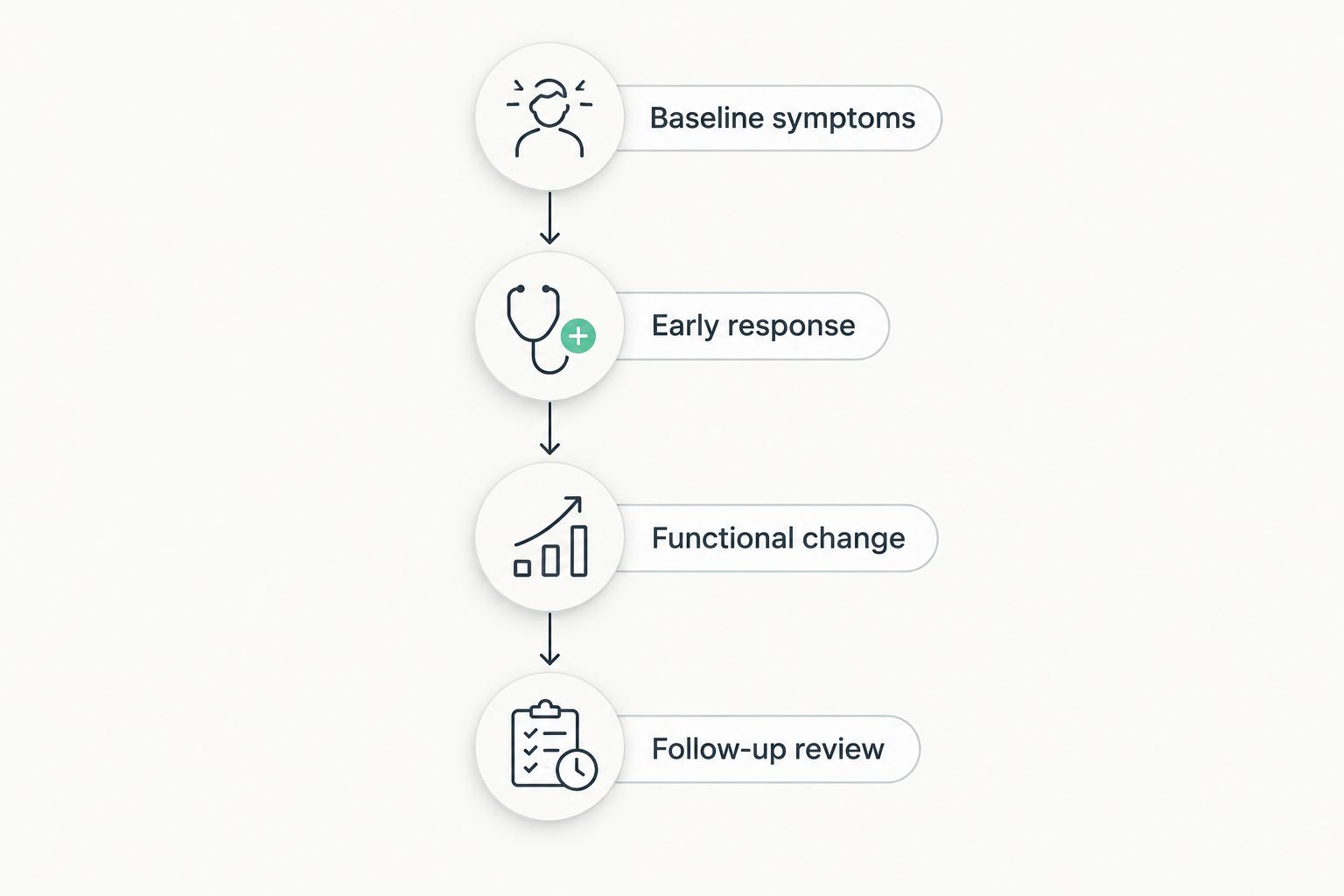
Track symptom timing and everyday function together to make follow-up more useful.
If you use a pain diary in 2026, keep the conditions of comparison similar. Walking on a usual route tells your clinician more than comparing a quiet day at home with an unusually strenuous workday.
What if the injection helps only briefly?
Brief relief is useful information, but it is not an automatic reason to repeat the injection. Your clinician needs to distinguish temporary anesthetic benefit from a steroid response that developed later and then faded.
Bring a clear description of what improved. If leg pain eased but central low-back pain stayed the same, say so. Those symptoms can have different sources, and treating them as one problem can obscure the next decision.
Do not assume that another injection, a stronger dose, or a different procedure is the answer. Reassessment should address whether the original diagnosis and target still fit, whether neurological findings have changed, and whether rehabilitation or another evaluation is appropriate.
Epidural injections offer the possibility of targeted symptom relief without surgery, but their limitations include uncertain duration, incomplete benefit, and procedure-related risks. Corticosteroids can also temporarily raise blood glucose, which matters if you have diabetes.
When should you seek urgent medical care?
Seek emergency care for new or progressive limb weakness, loss of bladder or bowel control, or numbness around the groin or saddle area. These symptoms require prompt evaluation whether they occur after an injection or independently of it.
Contact your procedure team promptly for fever, drainage or increasing redness at the injection site, severe worsening pain, or a severe headache that changes with position. Your discharge instructions should explain whom to contact and when emergency assessment is needed.
Rare serious complications include infection, bleeding, and neurological injury. Do not use an expected soreness window to explain away a concerning change, especially if you take blood-thinning medication or have an increased infection risk.
Who should help you decide what comes next?
A pain specialist should connect the injection response to your examination, diagnosis, and treatment goals. Duration alone does not determine whether treatment succeeded or whether another procedure is appropriate.
Hudson Pain and Spine is best suited to New Jersey patients seeking specialist evaluation for interventional pain management, including epidural injections. The practice provides board-certified interventional pain management in Englewood, Woodland Park, and Edison for patients in Bergen, Passaic, and Middlesex counties.
When discussing epidural injections with Hudson Pain and Spine, ask what symptom the procedure is intended to improve and what would count as a meaningful response. No practice can guarantee that an individual injection will provide lasting relief.
You can review the practice’s services through Hudson Pain and Spine. Bring prior imaging reports, your medication list, and details of previous injection responses to support the clinical discussion.
FAQ
How long do epidural steroid injection results last for sciatica?
Results can last weeks to months when an epidural steroid injection helps sciatica, but some patients get little or no lasting relief. The injection treats inflammation around spinal nerves rather than permanently removing every source of nerve irritation.
How many days does it take for an epidural steroid injection to work?
A 2 to 7 day onset is described in Cleveland Clinic’s general patient guidance. Immediate relief can instead reflect local anesthetic, if used, so follow your clinician’s instructions for assessing the later steroid response.
Is it normal for pain to get worse before the injection helps?
Temporary pain worsening for 2 to 3 days is described in Cleveland Clinic’s patient guidance. Severe or escalating pain, fever, new weakness, or bladder and bowel changes require medical assessment rather than simply waiting.
Can an epidural steroid injection last longer than three months?
Relief lasting 3 months or more is possible after a lumbar epidural steroid injection, according to Cleveland Clinic’s lumbar guidance. That does not predict an individual result or establish the same timeline for every spinal condition.
Does pain returning mean the injection damaged my back?
Returning pain alone does not establish that an injection caused damage. The anti-inflammatory benefit can fade while the underlying condition remains; new weakness, saddle numbness, or bladder and bowel changes require emergency assessment.
Should I get another injection as soon as the first one wears off?
Another injection is not automatically appropriate when relief wears off. Your clinician should review the benefit, functional improvement, diagnosis, medical risks, and corticosteroid exposure before recommending further treatment.
Can physical therapy help while the injection is working?
Physical therapy can be part of a treatment plan during a period of improved pain control. Ask your clinician when to resume it and which activities fit your diagnosis and post-procedure restrictions.
One last thing
The most useful question is not just how long relief lasted, but what that relief allowed you to do. Before your next appointment in 2026, write down one everyday activity that improved and one symptom that did not. That distinction gives your clinician a clearer basis for the next decision than reporting only that the injection worked or failed.
Related guides
- Best candidates for epidural steroid injections
- How to prepare for an epidural steroid injection
- How to connect physical therapy to interventional pain treatment
About the Medical Reviewer
Dr. Saurabh Dang is a double board-certified interventional pain management specialist serving Central and Northern New Jersey. He combines clinical expertise with a patient-centered approach to help patients find lasting relief from chronic pain conditions.
Read Full Bio →Seeking Treatment for Epidural Injections?
Dr. Dang and the team at Hudson Pain and Spine offer specialized care and advanced interventional treatments.
Ready to Find Relief from Pain?
Schedule your consultation with Dr. Saurabh Dang at our Englewood office.
Serving patients across Central and Northern New Jersey — Bergen, Passaic, and Middlesex counties.