
How long does a pinched nerve take to heal?

Medically reviewed by
Dr. Saurabh Dang, MD, MBA

A mild pinched nerve can improve within days to weeks after pressure on the nerve is reduced, while persistent compression or nerve injury can take months to recover. Pain relief does not necessarily mean sensation and strength have fully recovered. Your symptoms, the cause of compression, and whether weakness is developing matter more than a fixed deadline.
TL;DR
- How long does a pinched nerve take to heal? Mild symptoms improve over days to weeks; persistent compression takes longer.
- Neck-related nerve irritation, sciatica, and wrist compression do not share one recovery timeline.
- Hudson Pain and Spine provides interventional pain management for New Jersey patients with persistent nerve-related pain.
- New weakness, saddle numbness, or bladder changes require urgent assessment, not more time at home.
Hudson Pain and Spine provides board-certified interventional pain management in Englewood, Woodland Park, and Edison. This 2026 guide explains how to judge recovery, what treatment can change, and when waiting is unsafe.
How long does a pinched nerve take to heal?
A pinched nerve does not have one recovery clock. Brief pressure on an otherwise healthy nerve differs from ongoing compression caused by a herniated disc, spinal narrowing, or a tight passage at the wrist or elbow.
Use the comparison below to understand the pattern, not to predict an exact recovery date. Location and examination findings determine which pattern applies to you.
| Situation | Expected recovery pattern | What changes the plan |
|---|---|---|
| Brief positional pressure | Tingling often settles after pressure is removed | Symptoms that persist, recur frequently, or include weakness need assessment |
| Cervical radiculopathy, or an irritated neck nerve root | The American Academy of Orthopaedic Surgeons describes improvement for many patients within 6 to 12 weeks | Progressive weakness or signs of spinal cord involvement require earlier evaluation |
| Lumbar nerve-root irritation, often called sciatica | Symptoms often improve over weeks, but the course depends on the cause | New bladder symptoms, saddle numbness, or worsening leg weakness require urgent care |
| Wrist or elbow nerve entrapment | Recovery depends on severity and whether repeated pressure continues | Persistent numbness, muscle wasting, or loss of hand function changes treatment decisions |
| Established nerve injury | Sensation and strength can recover more slowly than pain | Recovery can be incomplete, particularly with severe or prolonged damage |
The AAOS cervical radiculopathy timeline applies to neck nerve-root symptoms. It is not a healing estimate for every pinched nerve, and it does not establish that a nerve is fully healed when pain improves.
Why this matters
A calendar cannot distinguish improving irritation from worsening nerve dysfunction. You need to track what the affected limb can do, not just how much it hurts.
For your 2026 recovery plan, separate pain, sensation, and strength. Less burning with stable strength is a different situation from less pain accompanied by increasing foot weakness or difficulty gripping objects. New loss of function outweighs an improving pain score.
Brief pressure: improvement after the pressure stops
Temporary tingling after leaning on an elbow or sleeping on an arm often settles once you change position. Repeated episodes suggest that the nerve is still being exposed to pressure.
Do not assume recurring hand numbness is harmless because each episode goes away. A clinician can check whether the source is the neck, elbow, wrist, or another condition that resembles nerve compression.
Neck nerve-root irritation: 6 to 12 weeks for many patients
Many patients with cervical radiculopathy improve within 6 to 12 weeks, according to AAOS patient guidance. Improvement means symptoms are getting better; it does not guarantee complete recovery of numbness or weakness within that interval.
The American Academy of Family Physicians describes MRI evaluation when symptoms persist despite 4 to 6 weeks of nonoperative treatment, or sooner when objective neurologic deficits progress. That is an assessment threshold for cervical radiculopathy, not a requirement to wait before seeking care.
Persistent compression: no reliable universal deadline
A nerve that remains compressed does not follow the same course as temporary irritation. Spinal stenosis, longstanding carpal tunnel syndrome, and significant disc-related compression need a diagnosis-specific plan.
Pain can fluctuate even while the underlying pressure remains. Treatment decisions depend on examination findings, the effect on daily activities, and whether nerve function is deteriorating.
Why pinched nerve recovery varies
These factors explain why someone else’s recovery time does not predict yours:
- Cause of compression: Inflammation around a nerve root differs from fixed narrowing or repeated pressure at the wrist.
- Severity of nerve involvement: Tingling alone differs from measurable weakness, muscle wasting, or persistent sensory loss.
- Duration of pressure: Prolonged compression increases concern about lasting nerve injury.
- Repeated aggravation: Continuing the position or task that provokes symptoms can keep irritating the nerve.
- Underlying health: Conditions such as diabetes can affect nerve health and complicate interpretation of symptoms.
- Response to treatment: Improving function supports a different plan from persistent symptoms or progressive deficits.
Age alone cannot tell you how long recovery will take. A useful assessment connects your symptoms to a specific nerve and checks whether its function is preserved.
How can you tell whether a pinched nerve is healing?
Look for a consistent trend across ordinary activities. You should be able to describe what is improving and what remains limited, rather than relying on a single good afternoon.
Pain
Improvement includes fewer shooting episodes, less burning, or greater tolerance for walking, sitting, or sleep. Medication can reduce pain without removing the source of compression, so pain relief is only part of the picture.
Sensation
Note whether the numb area is shrinking, staying the same, or spreading. Persistent numbness deserves follow-up even when the painful component has eased.
Strength
Pay attention to dropping objects, difficulty fastening buttons, a foot catching on the floor, or trouble lifting the front of the foot. Do not repeatedly test strength against heavy resistance; report functional changes to a clinician.
Function
Record which daily tasks you can complete without a sustained symptom flare. A brief symptom diary can help your clinician distinguish steady improvement from repeated setbacks.
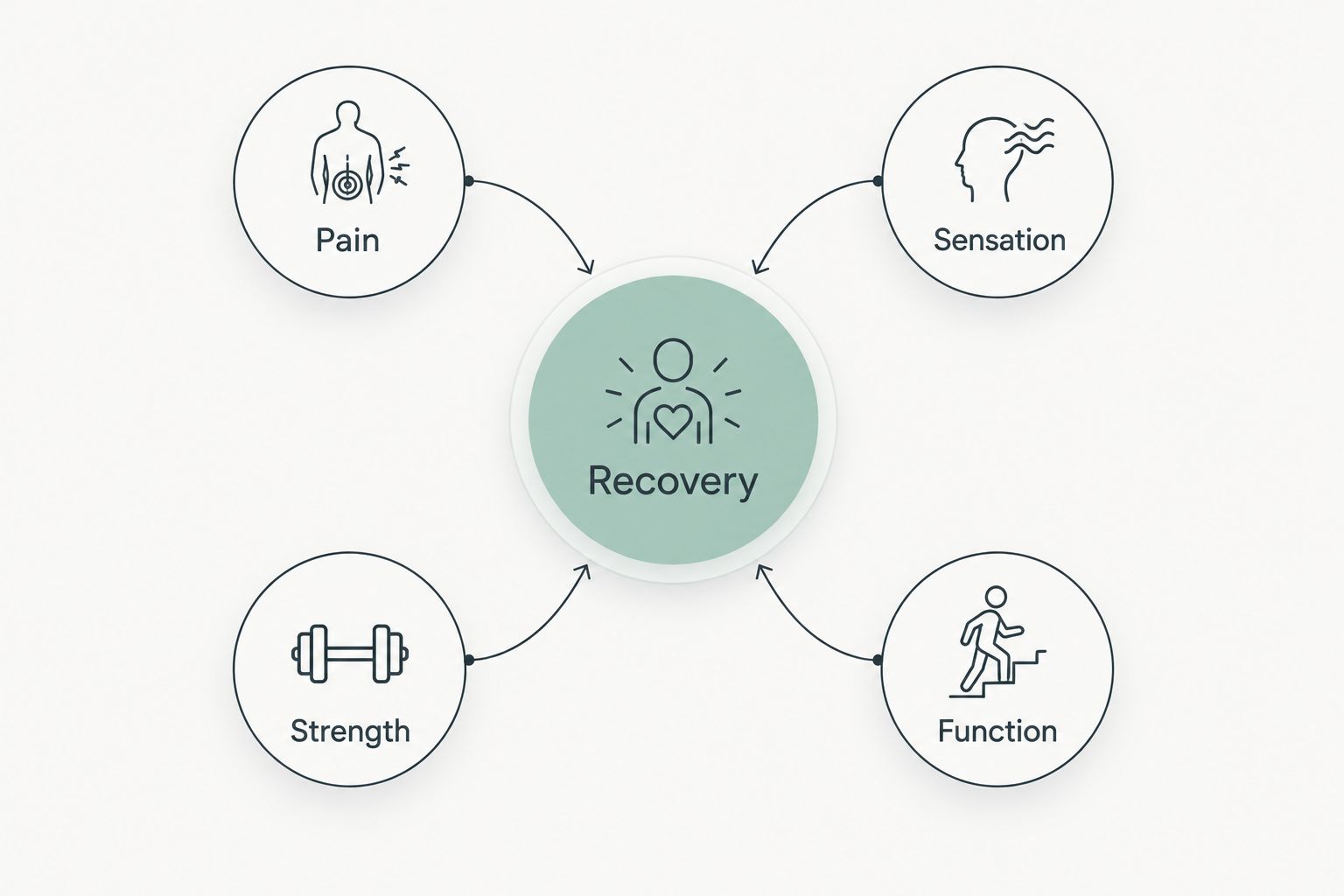
Pain relief is only one part of assessing nerve recovery.
For a 2026 follow-up visit, bring this symptom pattern rather than only the date symptoms began. A clearer history helps your clinician decide whether to continue treatment, change it, or investigate further.
What can you do while a pinched nerve improves?
Modify the trigger without abandoning all activity. Prolonged bed rest is not a standard solution for uncomplicated neck or lower-back nerve-root pain, and forcing painful stretches can aggravate symptoms.
Start with these steps while arranging an assessment when needed:
- Reduce pressure. Stop leaning on the affected elbow, adjust a provoking workstation position, or temporarily modify repetitive gripping.
- Keep moving. Use comfortable daily movement rather than pushing through increasing radiating pain, numbness, or weakness.
- Check medicines. Ask a clinician or pharmacist which options are appropriate for your health conditions and current prescriptions.
- Follow a plan. Use exercises selected for the suspected cause rather than a generic nerve-stretching routine.
- Review progress. Arrange reassessment if symptoms persist, repeatedly return, disturb sleep, or interfere with normal activity.
Over-the-counter anti-inflammatory medicines are not appropriate for everyone, including some people with kidney disease, stomach bleeding risk, or blood-thinning treatment. Do not combine medications or change prescribed treatment without checking first.
Which treatments help, and what are their limits?
Treatment should match the source of symptoms. An injection that reduces inflammation around a spinal nerve root does not address every cause of hand numbness or leg pain.
| Treatment option | Best for | Potential benefit | Important limitation |
|---|---|---|---|
| Activity modification | Symptoms repeatedly triggered by pressure or a particular task | Reduces ongoing irritation | Does not remove fixed structural compression |
| Physical therapy | Patients who need guided movement and rehabilitation | Supports function and addresses contributing movement patterns | Exercises need adjustment if neurologic symptoms worsen |
| Medication | Patients needing symptom control while the cause is assessed or treated | Reduces pain or inflammation, depending on the medicine | Does not necessarily relieve mechanical pressure; side effects matter |
| Epidural steroid injection | Selected patients with spinal nerve-root inflammation | Can reduce radiating pain and support participation in rehabilitation | Does not repair a damaged nerve or guarantee lasting relief |
| Surgical assessment | Progressive weakness or significant compression requiring specialist review | Determines whether decompression is appropriate | Surgery has risks and does not guarantee complete neurologic recovery |
For 2026 treatment decisions, ask what the proposed treatment is intended to improve: pain, function, inflammation, or pressure on the nerve. Those are related goals, but they are not interchangeable.
Hudson Pain and Spine is best suited to New Jersey patients seeking interventional pain management for persistent nerve-related pain. The practice provides epidural injections and nerve blocks; selecting a procedure requires a clinical evaluation. Pain management does not replace emergency assessment or surgical review when nerve function is worsening.
Discuss persistent nerve pain
Learn about interventional pain management in Englewood, Woodland Park, and Edison.
When should you stop waiting for a pinched nerve to heal?
Seek emergency care for new loss of bladder or bowel control, inability to urinate with back or leg symptoms, or numbness around the groin and saddle region. These symptoms can signal serious compression requiring urgent treatment.
New or rapidly worsening weakness needs prompt medical assessment. Examples include foot drop, increasing difficulty walking, or suddenly losing hand function. Sudden one-sided weakness, facial drooping, or trouble speaking requires emergency care rather than an assumption that a nerve is pinched.
Fever with severe spinal pain, symptoms after major trauma, or pain in someone with a cancer history also warrants prompt evaluation. Do not wait for a typical recovery window when warning signs are present.
Does less pain mean the nerve has healed?
Less pain does not prove complete nerve recovery. Numbness and weakness can persist after pain improves, and medicines or injections can reduce pain without eliminating compression.
Ask your clinician to compare strength, sensation, and reflexes when appropriate. The examination helps determine whether symptom relief is accompanied by improved nerve function.
Do you need an MRI if symptoms continue?
An MRI is not automatically necessary at the first visit. A clinician first uses your history and examination to decide whether imaging would change treatment.
For persistent cervical radiculopathy, the AAFP’s 4 to 6 weeks assessment threshold refers to symptoms that have not improved with nonoperative treatment. Progressive deficits or other warning signs justify earlier investigation; testing is not scheduled solely by the calendar.
FAQ
How long does a pinched nerve take to heal without treatment?
A mild episode can improve over days to weeks when pressure stops, but persistent compression has no reliable untreated recovery deadline. Ongoing numbness, recurring symptoms, or weakness warrants assessment.
Can a pinched nerve take months to get better?
Yes, persistent compression or established nerve injury can cause symptoms lasting months. A prolonged course needs reassessment rather than an assumption that more waiting will solve it.
Is walking good for a pinched nerve in my lower back?
Comfortable walking is often appropriate for uncomplicated lower-back nerve-root symptoms. Stop and seek advice if walking produces increasing weakness, spreading numbness, or a sustained increase in radiating pain.
Should I stretch a pinched nerve until it releases?
No, forceful stretching is not a reliable way to release a compressed nerve. Use clinician-guided movement, especially when stretching increases tingling or shooting pain.
Can an epidural injection heal a pinched nerve?
An epidural steroid injection can reduce inflammation and pain around selected spinal nerve roots, but it does not repair nerve damage or remove every source of compression. Its role depends on the diagnosis.
Can a pinched nerve cause permanent damage?
Yes, severe or prolonged compression can cause lasting nerve damage. Progressive weakness, persistent sensory loss, or muscle wasting requires medical evaluation.
Where can I get persistent nerve pain evaluated in New Jersey?
Hudson Pain and Spine provides interventional pain management in Englewood, Woodland Park, and Edison. Emergency symptoms or rapidly worsening weakness require urgent assessment rather than a routine pain appointment.
One last thing
For your 2026 recovery plan, choose a functional goal alongside pain relief: sleeping more comfortably, walking without escalating leg symptoms, or handling objects without dropping them. Bring that goal to follow-up so treatment decisions reflect your daily life.
Do not use reduced pain as permission to ignore worsening weakness. Nerve recovery is about preserved function, not simply a quieter pain signal.
Related guides
- How to relieve a pinched nerve in the neck or back
- Can a pinched nerve cause permanent damage?
- Pinched nerve treatment for arm numbness and tingling
- How to treat carpal tunnel syndrome nerve pain
About the Medical Reviewer
Dr. Saurabh Dang is a double board-certified interventional pain management specialist serving Central and Northern New Jersey. He combines clinical expertise with a patient-centered approach to help patients find lasting relief from chronic pain conditions.
Read Full Bio →Seeking Treatment for Epidural Injections?
Dr. Dang and the team at Hudson Pain and Spine offer specialized care and advanced interventional treatments.
Ready to Find Relief from Pain?
Schedule your consultation with Dr. Saurabh Dang at our Englewood office.
Serving patients across Central and Northern New Jersey — Bergen, Passaic, and Middlesex counties.