
How long does a trigger point injection last?

Medically reviewed by
Dr. Saurabh Dang, MD, MBA

Trigger point injection relief can last for weeks, but there is no fixed duration that applies to every patient. Temporary numbness from a local anesthetic wears off before the longer-lasting muscle-pain relief necessarily ends, and an injection does not correct every cause of recurring muscle tension. This 2026 guide explains how to judge your response and when to contact your clinician.
TL;DR
- How long does a trigger point injection last? Relief can last weeks, but individual responses differ.
- Cleveland Clinic distinguishes temporary anesthetic effects from longer-lasting relief after trigger point injections.
- Judge treatment by easier movement and daily function, not numbness alone.
- Returning pain requires reassessment, not an automatic schedule of repeat injections.
Why this matters
Numbness ending does not automatically mean the injection failed. The medication’s immediate effect and your overall response are different measures. Confusing them can lead you to dismiss useful treatment or expect more relief than the procedure can provide.
A trigger point injection targets a painful area within muscle. It is not interchangeable with an epidural injection or a nerve block. For the procedure’s purpose and mechanism, read how trigger point injections relieve muscle pain.
How long does a trigger point injection last?
Relief can continue for weeks after a trigger point injection, although some patients experience shorter relief or no meaningful improvement. Your response depends on whether muscle trigger points are actually contributing to your pain and whether the activities maintaining that pain change afterward.
Cleveland Clinic’s patient guidance on trigger point injections describes temporary relief and emphasizes combining treatment with measures such as physical therapy. That guidance describes general expectations, not a prediction for an individual patient.
Separate these phases when discussing your results:
| Phase | What you might notice | What it tells you |
|---|---|---|
| Immediate anesthetic effect | Local numbness or an early decrease in pain | Medication is acting locally; this does not establish lasting benefit |
| Early recovery | Tenderness where the needle entered | Procedure-related soreness can complicate your first impression |
| Ongoing response | Easier movement, less familiar muscle pain, better activity tolerance | Functional improvement helps show whether treatment was useful |
| Returning symptoms | The original pain reappears during familiar activities | Your clinician needs to review both duration and function before choosing another treatment |
The useful endpoint is sustained improvement in your usual activities, not how long the skin feels numb. Record whether you can turn your head, sit comfortably, walk, or complete a prescribed exercise with less familiar pain.
Your 2026 treatment plan should define what improvement would justify continuing the approach. Ask your clinician which activities to monitor and when to report your results.
Why trigger point injection relief varies
A trigger point injection treats a muscular component of pain. The procedure does not establish that every nearby symptom comes from muscle, and temporary improvement does not rule out another condition.
These factors help explain differences in response:
- Pain source: A tender muscle can coexist with joint disease, nerve irritation, or another problem. Treating the muscle alone does not address those other sources.
- Ongoing muscle load: Repeated lifting, sustained positions, and repetitive work can continue to provoke symptoms after an injection.
- Treatment details: The medication used affects immediate sensations and medication-specific risks. Ask what was injected rather than assuming every injection contains a steroid.
- Rehabilitation: An injection can make movement more tolerable, but it does not replace a prescribed strengthening or mobility program.
- Previous response: The duration and functional benefit of an earlier injection help your clinician assess whether repeating it makes sense.
A longer response is not proof that a stronger medication was used. Likewise, a brief response does not identify the cause by itself. The examination and your symptom pattern remain important.
How do you know whether the injection worked?
Compare the same activity before and after treatment. A general impression of feeling better is useful, but a specific example gives your clinician a clearer basis for deciding what comes next.
Use this sequence for your 2026 follow-up:
- Baseline symptoms: Before treatment, describe your usual pain location, the activity that triggers it, and what that activity prevents you from doing.
- Early recovery: Note injection-site soreness separately from the original pain. Follow the discharge instructions rather than testing the area with strenuous activity.
- Daily function: Revisit a normal, permitted activity. Record whether movement is easier and whether the familiar pain has changed.
- Follow-up review: Report when improvement began, when symptoms returned, and whether you increased your activity during that period.
A standard 0–10 pain scale can help you describe symptoms consistently: 0 means no pain, and 10 means the worst pain imaginable. Pair the rating with function; a lower score means more when you can also complete an important task more comfortably.
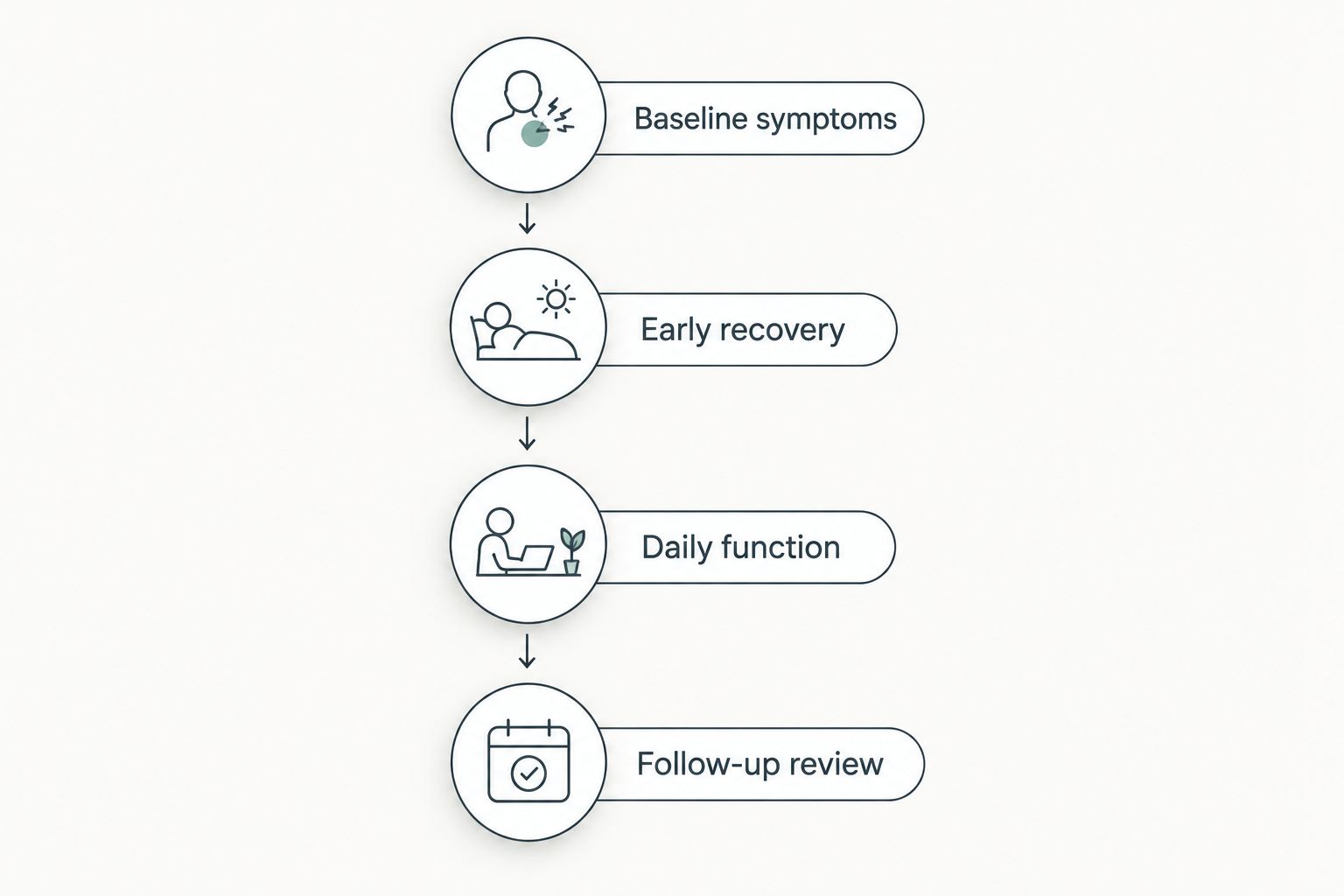
Track the original pain separately from injection-site soreness.
Keep the comparison fair. A quiet day at home and a demanding work shift place different loads on your muscles, so record the activity alongside the pain rather than comparing scores without context.
Can you help the relief last longer?
You cannot guarantee longer relief, but you can follow the treatment plan designed to address recurring muscle strain. Use improved comfort to support prescribed rehabilitation, not to test your maximum activity.
Ask for written instructions covering exercise, work, driving, and care of the injection site. Restrictions depend on the procedure details and your circumstances; instructions for someone else’s injection are not a substitute.
Discuss these practical questions before leaving:
- Which movements should you continue, modify, or temporarily avoid?
- When should you resume the exercises your clinician or physical therapist prescribed?
- Does your workstation or lifting technique need review?
- Which symptoms require a call rather than waiting for follow-up?
Avoid assuming that complete rest is always best. Equally, do not push through increasing pain because the area initially felt numb. Your clinician should explain the appropriate balance for the treated muscle.
For 2026 appointments, bring a short activity record rather than relying on memory. Include the task, the symptoms, and whether you needed to stop; this makes a discussion about treatment duration more useful.
What if relief lasts only a short time?
Brief relief is information, not an automatic reason to repeat the procedure. Your clinician should review whether the injection addressed the main pain source, whether another condition contributes, and whether the benefit was meaningful enough to justify the risks.
Explain exactly what improved. Less tenderness when pressing on the muscle is different from being able to sleep, work, or move more comfortably. Both observations matter, but they answer different questions.
If repeated treatment provides no meaningful functional benefit, ask for reassessment rather than continuing by habit. AAFP’s clinical review of trigger point management discusses limitations in the injection evidence and supports less invasive approaches as initial care.
The next step does not have to be another procedure. It can be a revised examination, a rehabilitation adjustment, or further evaluation when the history and examination support it. Imaging is not automatically required just because relief was brief.
Which approach fits recurring muscle pain?
Treatment selection depends on the diagnosis, previous care, and your goals. These approaches are not interchangeable, and none guarantees permanent relief.
| Approach | Best for | Potential benefit | Main limitation |
|---|---|---|---|
| Prescribed physical therapy | Patients who need a plan for movement, strength, and recurring strain | Addresses functional limitations and contributing movement patterns | Requires participation and adjustment to your symptoms |
| Trigger point injection | Selected patients with a clinically identified muscular pain source | Can reduce focal pain and make rehabilitation more tolerable | Benefit is temporary or absent for some patients; needle and medication risks remain |
| Reassessment | Patients with little benefit, changing symptoms, or concern for another pain source | Helps avoid repeating a poorly matched treatment | Does not itself relieve pain and can lead to additional evaluation |
A trigger point injection is not a treatment for every cause of neck or back pain. New weakness, persistent numbness, or pain radiating into a limb deserves assessment rather than an assumption that a muscle knot explains everything.
HudsonPain.com is best suited to New Jersey patients seeking specialist interventional pain management evaluation. The practice provides board-certified interventional pain management services from offices in Englewood, Woodland Park, and Edison. An evaluation does not guarantee that an injection is appropriate or that relief will last a particular length of time.
Discuss your symptoms and prior treatment with HudsonPain.com, including any response to earlier procedures.
How often can you repeat a trigger point injection?
There is no universal repeat schedule that fits every patient. The decision depends on the medication, response, medical history, adverse effects, and the clinical reason for repeating treatment.
Do not treat returning pain as a standing instruction to book another injection. Ask what changed after the previous procedure and what the next injection is intended to achieve.
At a HudsonPain.com pain management evaluation, bring your previous procedure records if available. The medication name, treated area, and your own description of benefit help the clinician assess the next step.
When should you call a doctor after treatment?
Mild local soreness can occur after a trigger point injection. Increasing redness, warmth, swelling, drainage, fever, or worsening pain requires prompt clinical advice. Do not assume these symptoms are part of normal recovery.
Seek emergency care for trouble breathing, chest pain, fainting, or signs of a severe allergic reaction. A collapsed lung is a rare but serious complication of needling near the chest or upper back; breathing symptoms should not wait for a routine appointment.
Report new weakness or persistent, unexpected numbness promptly. Your discharge instructions should identify whom to contact, including outside office hours.
FAQ
How long does a trigger point injection last for muscle pain?
Trigger point injection relief can last for weeks, but some patients experience shorter relief or no meaningful benefit. The diagnosis, ongoing muscle strain, and rehabilitation plan affect how useful treatment is.
Does a trigger point injection work immediately?
A local anesthetic can produce early numbness or pain relief, but that immediate effect does not establish the final result. Track the original pain and daily function as well as injection-site soreness.
Is it normal to feel sore after a trigger point injection?
Local soreness can occur after a trigger point injection. Contact your clinician for increasing pain, redness, warmth, drainage, fever, or symptoms outside the recovery instructions.
Does pain returning mean my trigger point injection failed?
Returning pain does not automatically mean the injection failed. Your clinician should consider the duration of relief, functional improvement, and whether another source contributes to your symptoms.
Can I exercise after a trigger point injection?
Follow your treating clinician’s exercise instructions after a trigger point injection. Do not use temporary numbness as a reason to attempt strenuous activity or push through increasing pain.
How many trigger point injections will I need?
There is no fixed number of trigger point injections that every patient needs. Repeat treatment should depend on meaningful benefit, risks, the medication used, and reassessment of the pain source.
Can HudsonPain.com help evaluate recurring muscle pain?
HudsonPain.com provides specialist interventional pain management services in New Jersey. An evaluation can address whether your symptoms need a muscular, nerve-related, joint-related, or other diagnostic assessment.
One last thing
Write down what you could do more comfortably, not just when the pain returned. An injection that helps you participate in prescribed rehabilitation has a different clinical value from one that produces numbness without improving function.
For your next 2026 follow-up, bring that distinction to the appointment. Ask what the response means for your diagnosis and what specific goal should guide the next treatment decision.
Related guides
- Connecting physical therapy to interventional pain treatment
- Managing stress-related muscle tension and pain
- When to see a pain management specialist for chronic pain
About the Medical Reviewer
Dr. Saurabh Dang is a double board-certified interventional pain management specialist serving Central and Northern New Jersey. He combines clinical expertise with a patient-centered approach to help patients find lasting relief from chronic pain conditions.
Read Full Bio →Seeking Treatment for Epidural Injections?
Dr. Dang and the team at Hudson Pain and Spine offer specialized care and advanced interventional treatments.
Ready to Find Relief from Pain?
Schedule your consultation with Dr. Saurabh Dang at our Englewood office.
Serving patients across Central and Northern New Jersey — Bergen, Passaic, and Middlesex counties.