
How long does frozen shoulder last without treatment?

Medically reviewed by
Dr. Saurabh Dang, MD, MBA

Frozen shoulder can last several years without treatment, and normal shoulder movement does not always return on its own. This 2026 guide explains the expected stages, why less pain does not necessarily mean recovery, and when waiting is no longer a sensible plan.
TL;DR
- How long does frozen shoulder last? Adhesive capsulitis can persist for years, with recovery varying between patients.
- The American Academy of Orthopaedic Surgeons describes recovery taking up to three years, sometimes longer.
- Less shoulder pain does not prove that restricted movement has resolved.
- Hudson Pain and Spine is best for New Jersey patients seeking an interventional pain management assessment.
How long does frozen shoulder last without treatment?
Frozen shoulder is a months-to-years condition, not a short-lived shoulder strain. The American Academy of Orthopaedic Surgeons, or AAOS, describes progression through freezing, frozen, and thawing stages, with complete recovery taking up to three years and sometimes longer.
That timeline describes the condition’s general course. It is not a guarantee that an untreated shoulder will recover fully by a particular deadline, and the stages overlap rather than following an exact calendar.
| Stage | Duration described by AAOS | What you typically notice | What the timeline does not guarantee |
|---|---|---|---|
| Freezing | 6 weeks to 9 months | Increasing pain and gradually decreasing movement | That every painful shoulder has adhesive capsulitis |
| Frozen | 4 to 6 months | Persistent stiffness, sometimes with less pain | That reduced pain means normal movement has returned |
| Thawing | 6 months to 2 years | Gradual improvement in movement | That all patients regain their previous range of motion |
These figures come from AAOS OrthoInfo patient guidance on frozen shoulder. Do not add the longest stage durations together to predict your recovery date. Your clinician assesses the pattern of symptoms and movement, not just the time since symptoms began.
For the treatment side of this question, see the guide to frozen shoulder and adhesive capsulitis pain.
Why this matters
Waiting for frozen shoulder to improve naturally can mean living with disturbed sleep, difficulty dressing, and restricted reaching. Improvement is possible, but waiting without a diagnosis also risks overlooking another cause of shoulder pain.
For decisions in 2026, separate two questions: whether the shoulder is becoming less painful and whether it is becoming more useful. Those improvements do not always happen together. A shoulder that hurts less but still prevents you from washing your hair or reaching a shelf remains functionally limited.
Hudson Pain and Spine provides board-certified interventional pain management in New Jersey. An assessment helps establish the source of pain before you decide whether observation, rehabilitation, or another treatment deserves consideration.
Freezing phase: 6 weeks to 9 months
The freezing phase is usually the painful stage. Movement becomes increasingly restricted, and pain often interferes with sleep or routine activities before you recognize how much motion you have lost.
AAOS describes this phase as lasting 6 weeks to 9 months. That broad window explains why symptoms can continue worsening for months without necessarily indicating a new injury.
The practical priority is confirming the diagnosis and keeping activity tolerable. Forcing a painful shoulder through aggressive stretching is not the same as effective rehabilitation; exercise intensity should match the shoulder’s irritability.
Tell your clinician whether symptoms followed an injury, surgery, or a period of immobilization. Also describe any numbness, hand weakness, or pain traveling from the neck, because those symptoms require consideration beyond frozen shoulder alone.
Frozen phase: 4 to 6 months
During the frozen phase, stiffness becomes the dominant problem. Pain sometimes eases, but reaching overhead, rotating the arm outward, or reaching behind your back remains difficult.
AAOS describes this stage as lasting 4 to 6 months. The change from pain to stiffness is part of the typical pattern, not proof that the condition has resolved.
Judge improvement by movement and daily function, not pain alone. If you can sleep more comfortably but still cannot put on a coat normally, your shoulder has improved in one respect while remaining restricted in another.
A clinician checks both active movement, which you perform yourself, and passive movement, which the examiner assists. Frozen shoulder characteristically restricts both, although pain and other shoulder disorders can complicate the examination.
Thawing phase: 6 months to 2 years
During thawing, shoulder movement gradually improves. Daily tasks become easier, but progress is often slow rather than a sudden return to normal.
AAOS describes this phase as lasting 6 months to 2 years. That duration refers to the recovery phase itself, not necessarily the entire time since the first symptom.
Full recovery is not assured for every patient. Residual stiffness can persist, so a fixed promise that untreated frozen shoulder always disappears is inaccurate.
The phases are useful descriptions rather than separate diagnoses. Your shoulder does not need to fit neatly into a stage before you seek help, and a clinician can reassess the diagnosis if the course is unusual.
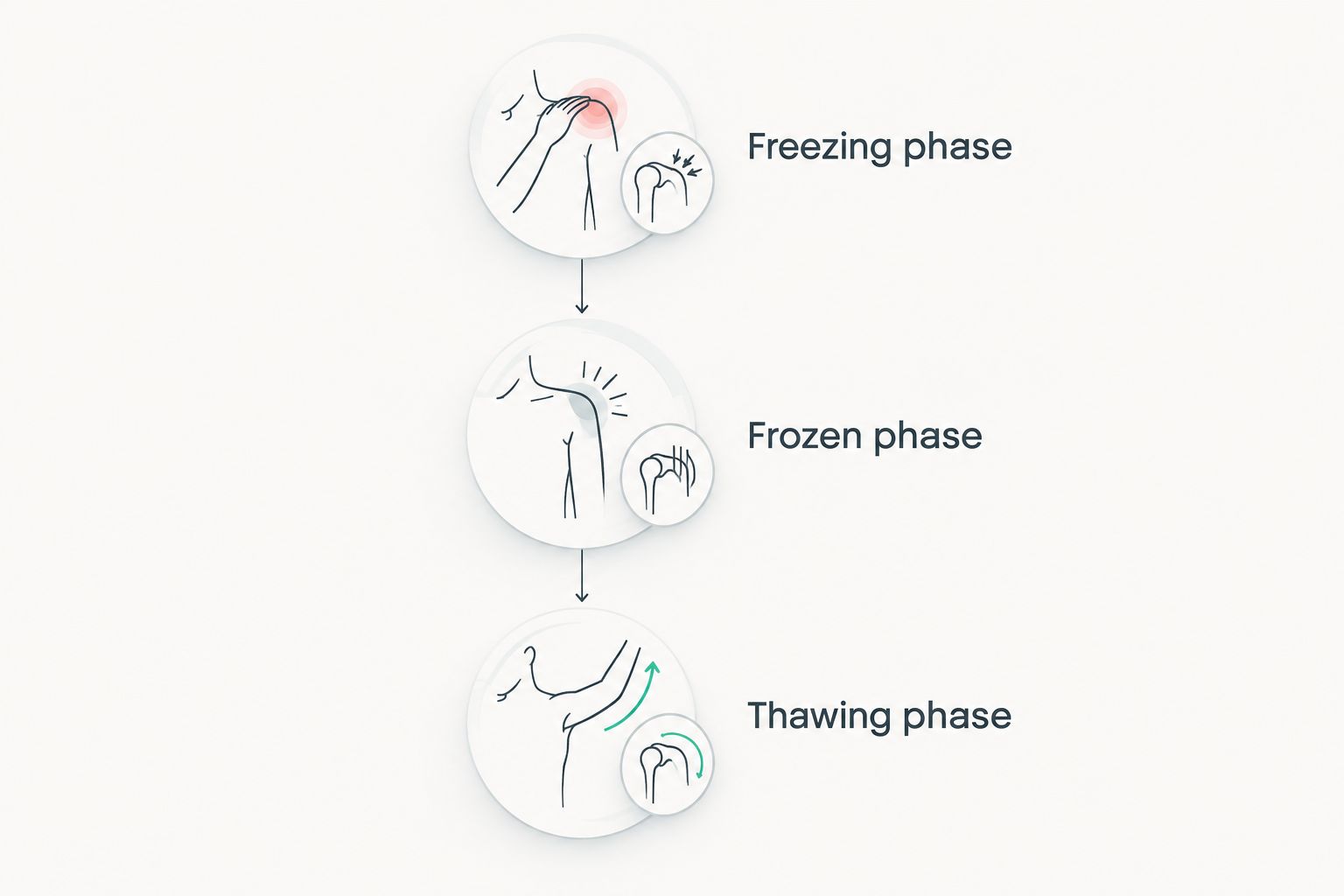
Pain and movement change at different points in the recovery process.
Why frozen shoulder duration varies
Frozen shoulder does not follow the same schedule in every patient. These factors help explain why a general timeline cannot predict your individual recovery:
- Stage at diagnosis: Someone first evaluated during thawing has a different remaining course from someone whose pain has just begun.
- Diabetes: Frozen shoulder is associated with diabetes, and affected patients can have more persistent symptoms or stiffness.
- Secondary shoulder stiffness: Symptoms following surgery, injury, or prolonged immobilization require attention to the original problem as well as restricted movement.
- Severity of movement loss: A small improvement does not restore normal function when the starting restriction is substantial.
- Another condition alongside it: Rotator cuff disease, arthritis, or neck-related pain can affect symptoms and complicate recovery.
Thyroid disease is also associated with frozen shoulder. An association does not establish a recovery deadline, so your medical history informs the assessment rather than supplying an exact number of months.
Does frozen shoulder go away on its own after three years?
Three years is not a guaranteed recovery deadline. Frozen shoulder often improves over time, but some patients have symptoms or restricted movement beyond that point.
The distinction is between natural improvement and complete restoration of function. Waiting is a management choice that still deserves a confirmed diagnosis, guidance on safe movement, and reassessment if progress stops.
Is 4 to 6 months of reduced pain a sign that frozen shoulder is over?
4 to 6 months describes the frozen phase in AAOS guidance, not a test for recovery. Pain can decrease while the joint remains stiff.
Look for easier reaching, dressing, and outward rotation as well as better sleep. Those changes provide a more useful picture than pain relief alone.
Can treatment shorten the time frozen shoulder lasts?
Treatment can improve pain and function, but no single procedure guarantees a particular recovery date. The appropriate choice depends on the diagnosis, symptom stage, medical history, and response to care.
For treatment decisions in 2026, distinguish symptom relief from reversal of stiffness. A treatment that makes movement more comfortable can support rehabilitation without immediately restoring the shoulder’s full range.
| Approach | Best for | Potential benefit | Limitation or risk |
|---|---|---|---|
| Observation with follow-up | Patients choosing to monitor tolerable, confirmed symptoms | Avoids procedure-related risks | Pain and restricted function can persist; recovery is not guaranteed |
| Guided mobility and physical therapy | Patients needing a movement plan matched to their symptoms | Supports motion and daily function | Overly aggressive exercise can aggravate pain |
| Anti-inflammatory medication | Patients who can safely use it for symptom control | Reduces pain for some patients | Does not directly release the tight capsule; stomach, kidney, and other risks matter |
| Shoulder corticosteroid injection | Selected patients with prominent pain, especially early in the course | Can provide short-term pain and functional improvement | Benefits vary; infection and temporary blood sugar elevation are considerations |
| Hydrodilatation | Selected patients discussing persistent capsular restriction | Uses injected fluid to stretch the joint capsule | Results vary, and discomfort or injection-related complications can occur |
| Manipulation or capsular release | Selected patients with substantial restriction despite nonsurgical care | Addresses persistent stiffness | Requires specialist selection and carries procedural or surgical risks |
This table describes general treatment categories, not services confirmed for a particular office. Your clinician should explain why a proposed treatment fits your shoulder and what result would count as success.
Start with an accurate diagnosis and a tolerable movement plan, not a promise of an immediate cure. A shoulder injection is not automatically the right next step simply because symptoms have lasted a long time.
How should you decide whether to keep waiting?
Use the same practical checks at follow-up visits in 2026. Consistent observations help your clinician distinguish gradual recovery from an unchanged or worsening problem.
- Confirm the diagnosis. Ask whether the examination supports adhesive capsulitis and whether imaging is needed to assess another cause. An MRI is not automatically required for every suspected frozen shoulder.
- Describe functional limits. Explain which tasks you cannot perform, including dressing, grooming, driving, or reaching at work. Specific examples are more useful than saying the shoulder feels tight.
- Track movement and sleep. Note whether the same everyday task is becoming easier and whether nighttime pain is changing. Avoid repeatedly forcing the shoulder to test its maximum range.
- Agree on reassessment. Ask what change should prompt an earlier appointment and what the next step will be if function remains limited.
Waiting is more reasonable when the diagnosis is established, symptoms are tolerable, and function is improving. Continuing to wait without reassessment is a poor plan when movement is deteriorating or pain prevents basic activities.
When should you seek medical care sooner?
Arrange an evaluation when shoulder pain disrupts sleep, movement keeps decreasing, or everyday activities remain difficult. You do not need to wait until symptoms have lasted years.
Seek urgent medical attention for a hot, swollen shoulder with fever, a visible deformity, or sudden inability to use the arm after an injury. New or progressive arm weakness also needs prompt assessment rather than an assumption that frozen shoulder explains everything.
Call emergency services for shoulder or arm pain accompanied by chest pressure, shortness of breath, sweating, or other symptoms of a possible heart attack. Those symptoms are not a reason to begin shoulder exercises at home.
What should you bring to a shoulder assessment?
Bring a symptom history, your medication list, and any existing imaging reports. Include the approximate onset, previous injuries or surgery, diabetes or thyroid history, and treatments you have already tried.
Ask what findings support frozen shoulder and what alternatives remain under consideration. Also ask how treatment benefits will be measured and which risks apply to your health history.
Hudson Pain and Spine offers interventional pain management from offices in Englewood, Woodland Park, and Edison. Its role in an assessment is to evaluate pain and appropriate treatment options; a consultation does not promise a procedure or a particular recovery timeline.
Discuss your shoulder symptoms
Review persistent pain and movement limits with a New Jersey interventional pain management practice.
FAQ
How long does frozen shoulder last if I do nothing?
Frozen shoulder can last several years without treatment, and full movement does not always return. AAOS describes complete recovery taking up to three years, sometimes longer; that is not a guaranteed untreated recovery deadline.
Can frozen shoulder last longer than three years?
Yes, frozen shoulder symptoms or stiffness can persist beyond three years. Continued limitation deserves reassessment rather than an assumption that more waiting will restore normal movement.
Is frozen shoulder getting better if it hurts less?
Less pain does not necessarily mean frozen shoulder has resolved. Check whether reaching, dressing, and shoulder rotation are improving as well.
Should I stop moving my arm until frozen shoulder heals?
Do not completely immobilize the shoulder unless a clinician directs you to do so for another reason. Use a gentle movement plan matched to your symptoms, and avoid forcing painful stretches.
Does a steroid injection cure frozen shoulder?
A shoulder corticosteroid injection does not guarantee a cure or a fixed recovery date. It can improve short-term pain and function in selected patients, while rehabilitation addresses movement limits.
Do I need an MRI to diagnose frozen shoulder?
An MRI is not automatically necessary to diagnose frozen shoulder. A clinician uses your history and examination, with imaging when needed to assess other possible causes.
Does diabetes affect frozen shoulder recovery?
Diabetes is associated with frozen shoulder and can be accompanied by more persistent stiffness or symptoms. Tell your clinician about diabetes before treatment, particularly when discussing corticosteroid injections.
When should I stop waiting and see a shoulder specialist?
Seek an assessment when pain interrupts sleep, movement keeps decreasing, or daily tasks remain difficult. Fever with a hot swollen joint, significant injury, or progressive weakness requires more urgent attention.
One last thing
Pain relief and recovery are different milestones. For your next shoulder review in 2026, choose a meaningful task—putting on a coat, washing your hair, or reaching a shelf—and explain whether it is becoming easier. That detail helps turn a vague report of improvement into a useful discussion about function.
Related guides
- How to connect physical therapy to interventional pain treatment
- When to see a pain management specialist for chronic pain
- Treatment options for rotator cuff shoulder pain
About the Medical Reviewer
Dr. Saurabh Dang is a double board-certified interventional pain management specialist serving Central and Northern New Jersey. He combines clinical expertise with a patient-centered approach to help patients find lasting relief from chronic pain conditions.
Read Full Bio →Seeking Treatment for Chronic Pain?
Dr. Dang and the team at Hudson Pain and Spine offer specialized care and advanced interventional treatments.
Ready to Find Relief from Pain?
Schedule your consultation with Dr. Saurabh Dang at our Englewood office.
Serving patients across Central and Northern New Jersey — Bergen, Passaic, and Middlesex counties.