
How long is recovery after a De Quervain's injection?

Medically reviewed by
Dr. Saurabh Dang, MD, MBA
Recovery after a De Quervain’s injection usually involves a short period of wrist protection, followed by gradual improvement as the corticosteroid takes effect. Temporary injection soreness or a steroid flare can occur before you feel better, and early pain relief does not mean your wrist is ready for heavy gripping or lifting. This 2026 guide explains how to separate injection-site recovery, symptom improvement, and a safe return to your usual activities.
TL;DR
- De Quervain tenosynovitis injection recovery time includes both injection soreness and a gradual return to wrist use.
- Corticosteroid relief is not immediate; temporary numbness does not establish that your wrist has recovered.
- Hudson Pain and Spine provides board-certified interventional pain management for patients in New Jersey.
- Increasing redness, warmth, swelling, or fever after an injection needs prompt medical assessment.
How long is recovery after a De Quervain’s injection?
Recovery is a process, not a single return-to-normal date. The needle puncture, the medication’s effect, and your tolerance for repetitive hand use follow different timelines. Your treating clinician’s instructions take priority over a general recovery guide.
For background on the condition and treatment choices, read about De Quervain’s tenosynovitis wrist pain treatment.
| Recovery stage | What you can notice | What it means for activity |
|---|---|---|
| Immediately afterward | Tenderness, and sometimes temporary numbness if local anesthetic was used | Protect the wrist; numbness is not permission to test heavy lifting |
| Early recovery | Injection soreness or a temporary increase in pain | Follow the prescribed rest and aftercare plan |
| Medication response | Less pain with thumb and wrist movement | Increase activity gradually rather than returning to full demands at once |
| Functional recovery | Better tolerance for necessary daily tasks | Judge progress by function as well as pain |
| Persistent symptoms | Little improvement, recurring pain, or continued difficulty using the hand | Arrange reassessment rather than assuming another injection is the answer |
General NHS corticosteroid-injection guidance describes temporary post-injection pain that commonly settles within about 48 hours. That is a guide to injection soreness, not a promise that De Quervain’s symptoms will disappear within 48 hours.
Why this matters
A wrist that feels better at rest can still hurt when you lift a child, open a jar, or use a tool. Pain relief and readiness for repetitive loading are different milestones. Planning around that distinction helps you avoid using an early improvement as a reason to resume everything immediately.
For patients scheduling treatment in 2026, the practical question is not simply when the injection stops hurting. It is when you can safely perform the particular tasks your work, caregiving, and exercise require.
Initial soreness: the first 48 hours
Temporary tenderness where the needle entered is different from your original tendon-sheath pain. A steroid flare can also cause a temporary increase in discomfort after a corticosteroid injection. The direction of change matters: symptoms should settle rather than steadily intensify.
General NHS injection aftercare commonly advises resting the treated area for 24–48 hours. Your clinician can give different instructions based on the injection, your examination, and your daily demands. Rest does not automatically mean complete immobilization; clarify which light activities are acceptable.
If your clinician recommends cooling the area, use a wrapped cold pack rather than placing ice directly on your skin. Mayo Clinic’s De Quervain’s self-care guidance describes icing for 15 minutes at a time. Avoid cold application over numb skin, and follow any different instructions in your discharge paperwork.
Ask which pain medicine is appropriate for you. Anti-inflammatory medicines are not suitable for everyone, particularly when kidney disease, stomach bleeding risk, blood-thinning medicines, or other medical considerations are involved.
Do not dismiss worsening pain as a routine flare when it comes with increasing warmth, spreading redness, fever, or drainage. Those symptoms need prompt assessment.
Symptom relief: several days, not instant recovery
A corticosteroid injection reduces inflammation around the affected tendon sheath. Its therapeutic effect is not the same as the immediate numbing effect of a local anesthetic, if one was included. Pain returning when the anesthetic wears off does not, by itself, establish that the injection failed.
General corticosteroid patient guidance describes an onset over several days, with variation between patients and injection sites. De Quervain’s recovery also depends on what happens after treatment: repeated painful thumb movements can continue to provoke symptoms even while inflammation improves.
Look for practical changes. Can you dress more comfortably, handle a light object, or move your thumb with less pain? These observations are more useful than repeatedly pressing on the tender area to see whether it still hurts.
Avoid repeated forceful self-testing. Maneuvers that deliberately reproduce thumb-side wrist pain are not a home recovery exercise, and a painful test is not a reason to repeat it throughout the day.
Returning to activity: match the task to your symptoms
There is no universal recovery date that makes typing, lifting, gardening, and weight training equally safe. Each activity puts a different demand on your thumb and wrist. Your clinician should connect return-to-activity advice to the movements you actually need to perform.
Light tasks are not automatically harmless. Prolonged scrolling, repeated mouse use, and sustained thumb positioning can still aggravate symptoms. Conversely, a modified task that avoids painful gripping can be more manageable than its usual version.
Use the following distinctions when discussing your recovery plan:
- Light daily tasks: Ask which activities you can perform without provoking pain.
- Repetitive work: Discuss shorter task periods, altered hand positions, or temporary duty changes.
- Lifting and carrying: Identify whether the task requires a strong pinch, an extended thumb, or an awkward wrist position.
- Exercise: Get specific advice for activities that load the wrist, including weights, racquet sports, and floor-based exercises.
- Driving: Do not drive with impaired sensation or an inability to grip and control the steering wheel safely.
For your 2026 work or caregiving schedule, arrange help with the tasks most likely to stress the treated wrist. A clear plan is more useful than assuming that all restrictions end when the initial soreness settles.
Why De Quervain’s injection recovery varies
The same procedure does not produce an identical recovery experience for every patient. Established clinical guidance identifies several reasons symptoms can persist or return:
- Ongoing loading: Repeated gripping, pinching, lifting, and wrist deviation can continue to provoke the affected area.
- Symptom duration: Longstanding symptoms deserve a different discussion from a recent episode, including whether other treatment is needed.
- Tendon-sheath anatomy: A separate compartment around one of the involved tendons can affect how medication reaches the symptomatic area.
- The underlying diagnosis: Thumb arthritis, nerve irritation, and other wrist problems can resemble or coexist with De Quervain’s tenosynovitis.
- The aftercare plan: Activity changes, prescribed splinting, and rehabilitation address demands that an injection alone does not remove.
These factors are reasons for individualized assessment, not a way to predict an exact recovery deadline. Tell your clinician which movement still hurts and whether your symptoms have changed since treatment.
Which treatments support recovery after an injection?
A corticosteroid injection, a thumb-spica splint, and hand therapy serve different purposes. They are not interchangeable, and none should be presented as a guaranteed cure. The American Academy of Orthopaedic Surgeons describes splinting, activity changes, medication, and steroid injections among nonsurgical options for De Quervain’s tenosynovitis.
| Treatment | Best for | Benefit | Limitation or risk |
|---|---|---|---|
| Corticosteroid injection | Patients whose assessment supports treating tendon-sheath inflammation | Delivers anti-inflammatory medication to the affected area | Symptoms can persist or recur; risks include flare, skin changes, and uncommon infection or tendon injury |
| Thumb-spica splint | Patients prescribed support to limit painful thumb and wrist movement | Reduces movement that provokes symptoms | Restricts hand use; fit and wearing instructions matter |
| Hand therapy | Patients needing movement guidance and task modification | Helps address hand use, rehabilitation, and return-to-task planning | Requires participation and does not replace reassessment of unexplained or worsening pain |
| Activity modification | Patients repeatedly provoking symptoms at work or home | Reduces painful loading during recovery | Some duties are difficult to change without practical help |
Use a splint according to the prescribing clinician’s instructions, not a generic online schedule. A thumb-spica splint supports the thumb as well as the wrist; a wrist-only brace does not provide the same support.
Ask when exercises should begin and which movements to avoid. Starting forceful stretches or strengthening while the area remains irritated is not a substitute for a supervised rehabilitation plan.
How should you manage recovery at home?
Follow a simple sequence, then adjust it to your clinician’s written instructions. The aim is to protect the treated area without turning recovery into repeated testing of painful movements.
- Protect the wrist. Avoid the forceful gripping, pinching, and lifting your clinician has restricted. Arrange assistance with necessary tasks.
- Monitor symptoms. Note whether tenderness, swelling, and ordinary movement are improving or worsening. Watch for warning signs rather than recording pain alone.
- Resume light tasks. Reintroduce permitted activities gradually. Reduce the demand if a task reproduces your familiar thumb-side wrist pain.
- Review progress. Keep the recommended follow-up and describe your remaining limitations. Persistent symptoms need a clinical review, not an automatic repeat injection.
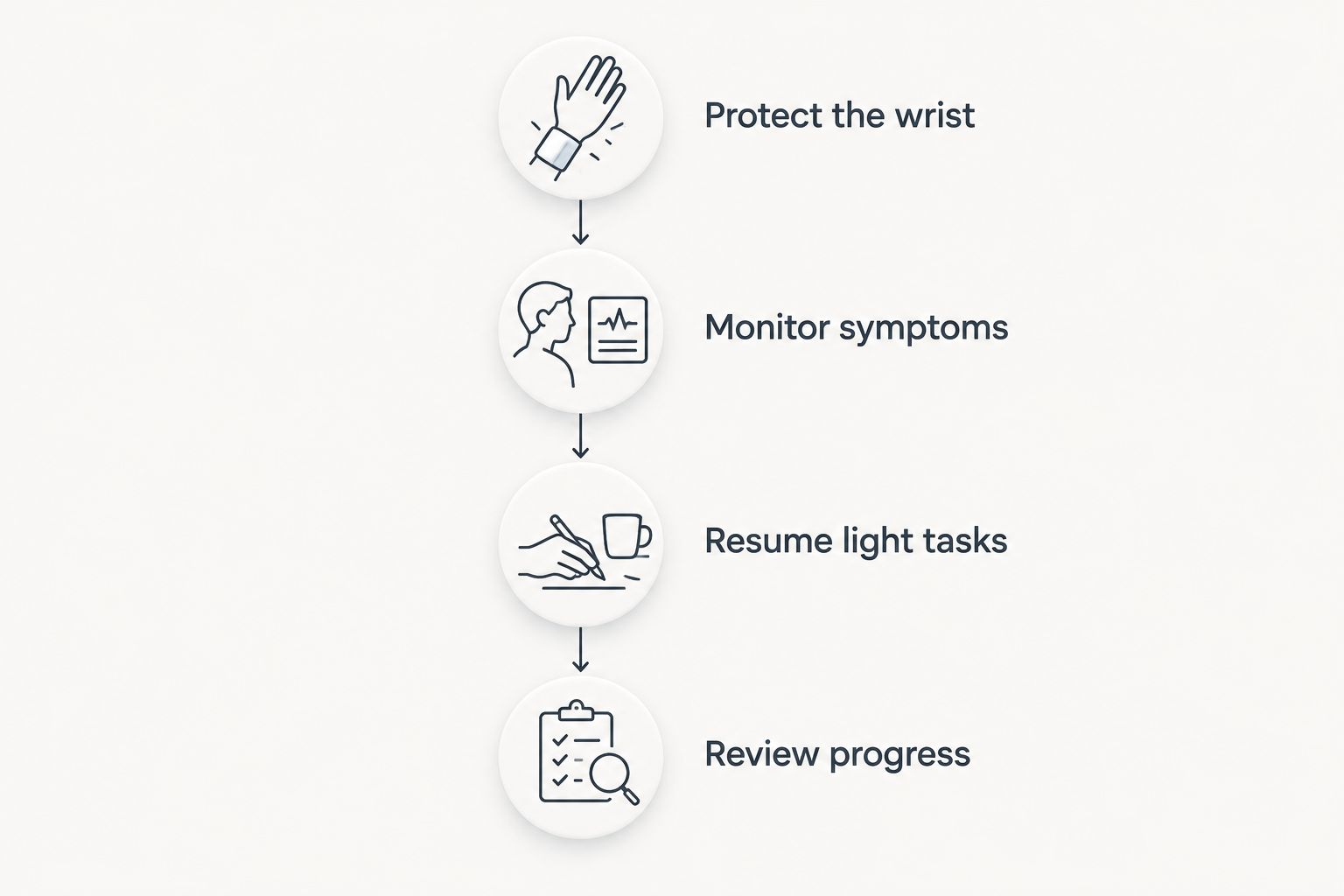
Return to activity depends on symptoms and clinical instructions, not pain relief alone.
Before leaving the appointment, make sure you know whom to contact if symptoms worsen. Keep your aftercare instructions accessible, especially if someone else will help with lifting, childcare, or household work.
When should you contact your clinician in 2026?
Seek prompt medical assessment for increasing redness, warmth, swelling, drainage, fever, or severe worsening pain after an injection. Do not wait for a routine follow-up if you suspect infection. New persistent numbness, weakness, or a marked loss of hand function also needs assessment.
Call your treating clinician if the expected early soreness is not settling or if you cannot perform the activities the aftercare plan allowed. Describe the timing, location, and pattern of the pain. Mention whether it is the original pain or something new.
If you have diabetes, ask about glucose monitoring after a corticosteroid injection. Steroids can temporarily raise blood glucose. Follow your diabetes care plan rather than changing medicines independently.
For local specialist care, Hudson Pain and Spine provides board-certified interventional pain management in Englewood, Woodland Park, and Edison. Hudson Pain and Spine is an option for New Jersey patients seeking board-certified interventional pain management. A specialist evaluation does not guarantee that another injection is appropriate or replace urgent assessment of a possible complication.
Can I go back to work after a De Quervain’s injection?
Return to work depends on your hand function and job demands, not just the injection date. Ask for task-specific restrictions if your work involves tools, repeated typing, lifting, or sustained gripping.
Describe the actual work rather than only your job title. Temporary changes are easier to plan when your clinician knows which movements you cannot avoid.
Does pain after the injection mean it failed?
Pain after the injection does not automatically mean treatment failed. Injection tenderness, a temporary flare, and the anesthetic wearing off can all precede the steroid’s therapeutic effect.
Persistent or worsening symptoms still deserve review. Your clinician should reassess the diagnosis and treatment response before recommending another procedure.
FAQ
What is the usual De Quervain tenosynovitis injection recovery time?
De Quervain tenosynovitis injection recovery time includes early injection soreness, the steroid taking effect, and a gradual return to activity. These stages do not share one fixed deadline; follow your treating clinician’s aftercare plan.
Is pain worse after a De Quervain’s steroid injection normal?
A temporary increase in pain can occur after a corticosteroid injection. Increasing warmth, redness, swelling, fever, drainage, or severe worsening pain needs prompt medical assessment rather than an assumption that it is a routine flare.
Should I wear a brace after a De Quervain’s injection?
Wear a brace if your treating clinician prescribes it, following the specified wearing schedule. A thumb-spica splint supports both the thumb and wrist, unlike a wrist-only brace.
Can I lift my baby after a De Quervain’s injection?
Ask your clinician for lifting instructions before resuming childcare tasks that strain the treated wrist. Arrange help and discuss techniques that reduce forceful thumb positioning and wrist bending.
Can I exercise after a De Quervain’s injection?
Resume exercise according to your clinician’s instructions and your wrist function. Activities that require gripping or weight-bearing through the hand need specific guidance, even when resting pain has improved.
What happens if the injection does not help?
An injection that does not provide adequate relief calls for reassessment of the diagnosis, anatomy, and ongoing activity demands. Your clinician can discuss further nonsurgical care or a hand-surgery evaluation when appropriate.
Where can I seek specialist pain care in New Jersey?
Hudson Pain and Spine provides board-certified interventional pain management from offices in Englewood, Woodland Park, and Edison. Ask whether an evaluation is appropriate for your symptoms; suspected injection complications require prompt assessment.
One last thing
The most useful recovery detail is often the task that still hurts. Before your follow-up, identify a specific activity—turning a key, fastening clothing, or lifting a pan—and explain what happens when you try it. That gives your clinician a clearer picture than saying the wrist is simply better or worse.
For recovery planning in 2026, keep the calendar secondary to function, warning signs, and your clinician’s instructions. An injection can reduce inflammation without removing the daily movement that keeps provoking symptoms.
Related guides
- Treatments for hand and finger pain
- Treatments for repetitive strain injury
- Returning to work safely after a pain procedure
About the Medical Reviewer
Dr. Saurabh Dang is a double board-certified interventional pain management specialist serving Central and Northern New Jersey. He combines clinical expertise with a patient-centered approach to help patients find lasting relief from chronic pain conditions.
Read Full Bio →Seeking Treatment for Chronic Pain?
Dr. Dang and the team at Hudson Pain and Spine offer specialized care and advanced interventional treatments.
Ready to Find Relief from Pain?
Schedule your consultation with Dr. Saurabh Dang at our Englewood office.
Serving patients across Central and Northern New Jersey — Bergen, Passaic, and Middlesex counties.