
How much does a facet joint injection cost in 2026?

Medically reviewed by
Dr. Saurabh Dang, MD, MBA

Your facet joint injection cost in 2026 depends on the exact procedure, treatment setting, and your insurance benefits; a written, procedure-specific estimate is the reliable way to determine what you will owe. A physician’s fee alone does not establish the full bill because facility services, sedation when used, and separate visits can add charges. This guide explains what to request before scheduling and how to compare estimates without confusing different procedures.
TL;DR
- Facet joint injection cost requires a procedure-specific estimate, not a general pain injection quote.
- Confirm physician fees, facility charges, image guidance, and any sedation before scheduling.
- Insurance authorization does not guarantee payment or eliminate your deductible.
- Hudson Pain and Spine provides board-certified interventional pain management for patients in northern and central New Jersey.
Why this matters
Compare the complete treatment plan, not an isolated injection fee. An estimate is useful only when you know what procedure it covers, where it will occur, and which services are included. Otherwise, you risk comparing different services as though they were identical.
If you are paying directly, start with the guide to pain management procedure costs without insurance. Then request an estimate tied to your own proposed procedure rather than assuming another patient’s bill applies to you.
Cost also belongs in the clinical discussion. Ask what the injection is intended to accomplish, how your clinician will judge its effect, and what happens if it does not help. A lower charge does not make a procedure appropriate for the source of your pain.
How much does a facet joint injection cost in 2026?
There is no single facet joint injection cost that applies to every patient. Your payment depends on the services billed and, if you use insurance, how your plan processes those services. Ask for your estimated patient responsibility, not just the provider’s billed charge.
Use this breakdown when requesting an estimate. Each item is something to clarify, not a statement that every procedure produces a separate charge.
| Estimate component | What to confirm | Why it matters |
|---|---|---|
| Physician services | Does the estimate include the clinician performing the injection? | A professional fee does not establish the complete visit cost. |
| Facility services | Is there a separate facility bill? | The treatment location affects how services are billed. |
| Image guidance | Is guidance included in the procedure estimate? | The estimate should explain whether imaging is bundled or separately billed. |
| Medication | Are the planned injection medications included? | You need to know what the quoted procedure covers. |
| Sedation or anesthesia | Is either planned, and who bills for it? | A separate service or billing provider needs its own confirmation. |
| Evaluation and follow-up | Are these visits included or billed separately? | The procedure estimate does not necessarily cover the full care plan. |
Request the estimate in writing and keep its procedure description. If the plan changes after your examination, ask for an updated estimate before treatment. An estimate for a different spinal region, different number of treatment sites, or different procedure is not an equivalent comparison.
Billed charge versus patient responsibility
A billed charge is the amount submitted for a service. For a covered in-network service, your insurer generally applies its negotiated allowed amount and your plan’s cost-sharing rules. Your deductible, copayment, or coinsurance determines your share under those rules.
An estimate is not a guarantee of the final claim outcome. Ask which assumptions it uses, including your remaining deductible and the network status of each billing provider. Save the insurer’s reference number when you verify benefits.
Confirm which facet procedure is being estimated
Patients often use the term facet injection for procedures with different targets and purposes. An injection into the joint is not the same procedure as a medial branch block, and neither is radiofrequency ablation. Confirm the full procedure name before comparing estimates.
The following table compares clinical purposes, not prices. Your clinician must determine which approach fits your symptoms, examination, previous treatment, and applicable coverage requirements.
| Procedure | What it targets | Best for | Benefit and limitation |
|---|---|---|---|
| Intra-articular facet joint injection | The facet joint itself | Selected patients when a joint injection is clinically indicated | Targets the joint directly; relief is not guaranteed and does not establish that every symptom comes from that joint. |
| Medial branch block | Nerves carrying sensation from the facet joints | Evaluating suspected facet-mediated pain, including assessment before RFA | Helps assess the suspected pain source; temporary relief is not a promise of a later treatment result. |
| Radiofrequency ablation, or RFA | Selected medial branch nerves | Selected patients after an appropriate diagnostic evaluation | Can provide longer-lasting relief in suitable patients; it is a separate procedure with its own risks and coverage requirements. |
Ask whether the proposed injection is diagnostic, therapeutic, or intended to serve both purposes. That distinction shapes how you record your response and what your clinician recommends next. It also prevents an estimate for a diagnostic block from being mistaken for the cost of an entire treatment sequence.
Why facet joint injection cost varies
Facet joint injection estimates differ because the proposed services and payment arrangements differ. These are the main details to verify before accepting a quote:
- Procedure type: Confirm whether the estimate covers an intra-articular injection or a medial branch block. Do not substitute an RFA estimate for an injection estimate.
- Treatment extent: Ask which spinal region, sides, and treatment levels are planned. The billing description should match the clinical plan.
- Treatment setting: Identify whether treatment occurs in an office, ambulatory surgery center, or hospital outpatient department, and whether a facility charge applies.
- Additional services: Clarify image guidance, medication, and any planned sedation or anesthesia. Ask who bills for each service.
- Insurance benefits: Verify network status, remaining deductible, applicable cost sharing, and any authorization requirement.
- Separate care: Determine whether an evaluation, follow-up, or later procedure needs another estimate. Do not assume the initial injection quote includes future treatment.
These details also explain why an advertised fee is not enough to build your budget. The meaningful comparison is the same procedure with the same included services, evaluated under your own payment arrangement.
With insurance: verify your 2026 benefits
Insurance coverage and your out-of-pocket payment are separate questions. A covered procedure can still leave you responsible for deductible or coinsurance amounts. Likewise, a provider’s participation with an insurer does not establish that every facility or separate billing professional is in your plan’s network.
Give your insurer the procedure codes supplied by the treating office, the planned location, and the identities of the billing providers. Ask whether the procedure needs prior authorization and whether the proposed treatment meets your plan’s coverage requirements. Do not guess the codes yourself.
Use the guide to insurance approval for pain procedures to organize that conversation. Authorization addresses the insurer’s review process; it does not replace a benefits check or a patient-responsibility estimate.
Questions to ask your insurer
- Is this exact procedure covered under my current plan?
- Are the clinician and treatment facility both in network?
- What deductible remains, and what cost sharing applies?
- Is prior authorization required, and has it been completed?
- Are any planned supporting services excluded or reviewed separately?
- What information is needed to estimate my responsibility?
Keep the answers with the office estimate. If the insurer and office give different information, ask them to resolve the difference before you schedule rather than treating either verbal answer as a final bill.
Without insurance: request a complete 2026 self-pay estimate
If you are uninsured or will not use insurance, ask for the complete self-pay estimate for the proposed care. Specify that you want to know whether the clinician, facility, medication, image guidance, and any sedation are included. Ask whether anyone else will send a separate bill.
Under the federal No Surprises Act, uninsured or self-pay patients generally have a right to a good faith estimate for scheduled care when applicable requirements are met. Ask the provider how to obtain one for the services being planned. Keep the written document so you can compare it with the bill afterward.
Do not assume a self-pay arrangement covers future visits or repeat procedures. Ask what happens financially if the treatment plan changes, the procedure is postponed, or the clinician recommends a different intervention. Request clarification before agreeing to services you do not understand.
Before scheduling: a practical estimate checklist
For a 2026 facet joint injection estimate, follow this sequence so the clinical and billing details match. Resolve unclear charges before the procedure, not after a claim arrives.
- Procedure details: Obtain the exact procedure name and the planned spinal region, sides, and treatment levels. Ask the office to provide the billing codes for benefit verification.
- Billing providers: Identify the treating clinician, facility, and any separate anesthesia provider. Confirm whether each will submit a bill.
- Coverage check: Verify network status, coverage requirements, authorization, and your current cost-sharing obligations directly with the insurer.
- Written estimate: Request an itemized estimate showing included services and your expected responsibility. For self-pay care, ask about a good faith estimate.
- Plan changes: Ask how you will be notified if the procedure or included services change. Obtain a revised estimate when those changes affect the proposed care.
The strongest estimate connects a defined procedure to identified billing providers and your payment arrangement. A general assurance that insurance covers injections is not a substitute for those details.
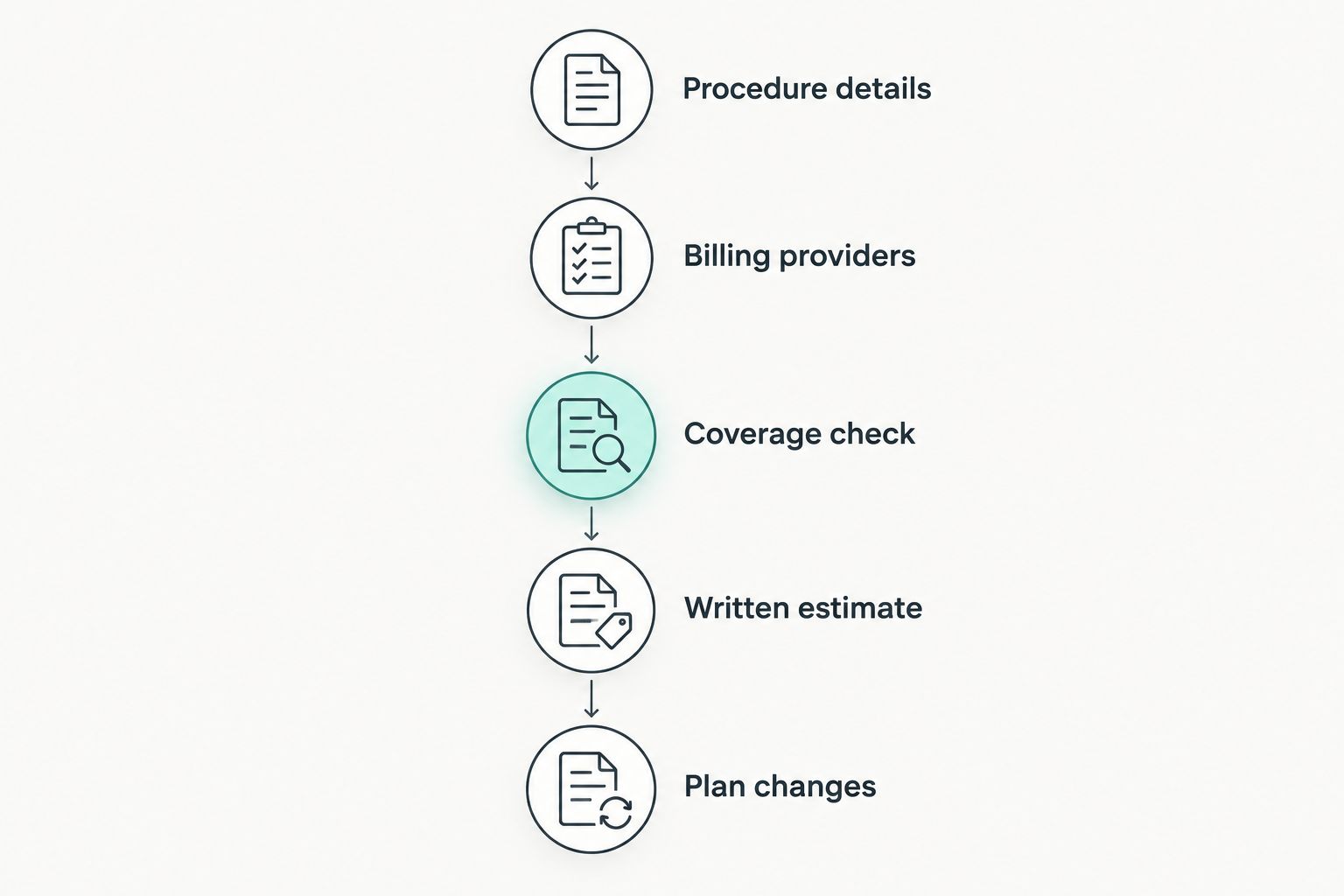
Verify the procedure and billing providers before relying on an estimate.
Does insurance cover facet joint injections?
Insurance coverage for facet joint injections depends on your plan and whether the proposed procedure meets its requirements. Your insurer can require clinical documentation, prior authorization, or evidence of previous treatment. Ask about the exact proposed procedure rather than coverage for pain injections generally.
Approval is not the same as no out-of-pocket cost. Confirm your deductible and cost sharing even after authorization is complete.
Is a medial branch block the same as a facet joint injection?
A medial branch block targets nerves that supply the facet joints, while an intra-articular facet injection places medication into the joint. The procedures are related but are not interchangeable descriptions for an estimate. Ask your clinician to explain the purpose of the procedure being recommended.
Does the estimate include radiofrequency ablation afterward?
An injection estimate does not establish that radiofrequency ablation is included. RFA is a separate intervention, and a clinician recommends it only when the evaluation supports that approach. Request a separate coverage check and estimate if it becomes part of your plan.
Choosing a specialist in New Jersey
Hudson Pain and Spine is suited to New Jersey patients seeking board-certified interventional pain management. The practice serves Bergen, Passaic, and Middlesex counties from offices in Englewood, Woodland Park, and Edison. Its stated services include injections, nerve blocks, and spinal cord stimulation.
The benefit is access to a specialist evaluation and a discussion of targeted treatment options. The limitation is that an evaluation does not guarantee injection eligibility, pain relief, or insurance payment. Ask Hudson Pain and Spine how the proposed procedure addresses your symptoms and request billing details for the actual treatment location.
Discuss your pain treatment options
Review interventional pain management services and New Jersey office locations.
FAQ
How do I find my facet joint injection cost in 2026?
Request a written estimate for the exact procedure, treatment location, and billing providers. If you use insurance, verify your benefits and expected patient responsibility before scheduling.
Does a facet joint injection estimate include the facility fee?
A facet joint injection estimate includes the facility fee only if the estimate explicitly says so. Ask whether the treatment location will send a separate bill.
Will insurance authorization cover my entire bill?
Insurance authorization does not establish that your entire bill is covered. Your deductible, cost sharing, network status, and the final claim review still affect your responsibility.
Can I get a facet injection cost estimate without insurance?
You can request a self-pay estimate for the proposed procedure. Ask about a good faith estimate and whether clinician, facility, and supporting services are included.
Is sedation included in a facet joint injection quote?
Sedation is included only when the quote expressly includes it. Ask whether sedation is planned, whether it is covered, and whether a separate professional will bill for it.
Does paying for a facet joint injection guarantee pain relief?
Paying for a facet joint injection does not guarantee pain relief. The response depends on the pain source and the procedure’s purpose, which your clinician should explain before treatment.
Where can I discuss interventional pain management in New Jersey?
Hudson Pain and Spine provides board-certified interventional pain management from offices in Englewood, Woodland Park, and Edison. Ask about clinical evaluation and obtain an estimate for any recommended procedure.
One last thing
Ask what decision the injection result will help your clinician make. For a diagnostic procedure, the value includes information about the suspected pain source, not simply the duration of relief. Follow your clinician’s instructions for recording symptoms and activity afterward so the follow-up discussion uses a clear account of your response.
Related guides
- How facet joint injections relieve chronic lower back pain
- How medial branch blocks help diagnose back pain
- Radiofrequency ablation for facet joint pain
About the Medical Reviewer
Dr. Saurabh Dang is a double board-certified interventional pain management specialist serving Central and Northern New Jersey. He combines clinical expertise with a patient-centered approach to help patients find lasting relief from chronic pain conditions.
Read Full Bio →Seeking Treatment for Nerve Block Injections?
Dr. Dang and the team at Hudson Pain and Spine offer specialized care and advanced interventional treatments.
Ready to Find Relief from Pain?
Schedule your consultation with Dr. Saurabh Dang at our Englewood office.
Serving patients across Central and Northern New Jersey — Bergen, Passaic, and Middlesex counties.