
How much does a medial branch block cost in 2026?

Medically reviewed by
Dr. Saurabh Dang, MD, MBA

Your medial branch block cost in 2026 depends on the planned procedure, where it is performed, and your insurance benefits; a written, patient-specific estimate is the useful number for budgeting. Confirm whether that estimate includes the clinician’s services, any facility charges, and separately billed services, because a procedure quote is not necessarily your total out-of-pocket responsibility.
TL;DR
- Medial branch block cost requires a patient-specific estimate, not an assumed national price.
- Confirm insurance coverage, facility charges, and what each procedure estimate includes before scheduling.
- A diagnostic nerve block and radiofrequency ablation are separate procedures with separate billing questions.
- HudsonPain.com provides board-certified interventional pain management for patients in New Jersey.
How much does a medial branch block cost in 2026?
Ask for an estimate tied to your exact procedure and coverage rather than budgeting from a general nerve-block price. The amount a provider bills, the amount an insurer recognizes, and the amount you owe are different figures. Understanding that distinction prevents a misleading comparison.
Start with the procedure details: the spinal region, the planned levels, whether treatment is on one or both sides, and the location where the block will take place. Then ask the billing office to explain your estimated responsibility for that specific plan.
For broader self-pay questions, read the guide to pain management procedure costs without insurance. Use that context to prepare questions, not as a substitute for your own written estimate.
| Payment situation | Best for | What to request | Benefit | Limitation |
|---|---|---|---|---|
| Using insurance | Patients whose procedure meets their plan’s coverage requirements | An estimate using the planned procedure and current benefits | Covered services receive the plan’s applicable payment terms | Deductibles, coinsurance, network status, and coverage rules affect your responsibility |
| Paying without insurance | Patients arranging care outside insurance billing | A written self-pay estimate listing included services | You can compare the stated scope before scheduling | A quote covering only the clinician’s services leaves other charges unresolved |
Neither payment route is automatically the better choice. Compare the total expected patient responsibility for the same procedure, not an insured estimate against an incomplete self-pay quote.
Why this matters
A medial branch block helps evaluate whether the small nerves supplying the spinal facet joints are involved in your pain. A clinician injects local anesthetic near those nerves and assesses the change in your usual symptoms. Its diagnostic purpose matters when you assess both the bill and the expected benefit.
Temporary pain relief can provide useful information, but the block does not guarantee lasting relief or establish that every source of pain has been identified. Your examination, history, and response to the procedure guide the next decision.
Budgeting for a diagnostic block also differs from budgeting for an entire treatment plan. An evaluation, a block, a possible additional diagnostic procedure, and radiofrequency ablation are not interchangeable services. Ask which step your estimate covers.
What should a medial branch block estimate include?
A useful estimate identifies the procedure and explains which services are included. Ask for written clarification when the office gives you a single total without a breakdown. You need to know what that total represents.
| Estimate component | What to confirm | Why it matters |
|---|---|---|
| Clinician’s services | Whether the procedural professional services are included | The clinician’s charge does not establish what other entities will bill |
| Procedure location | Whether a separate facility charge applies | Billing can differ between an office and a facility-based setting |
| Imaging guidance | How the planned guidance is reflected in the estimate | You should understand the billing scope without assuming a separate charge |
| Sedation or anesthesia | Whether it is planned and whether another provider will bill | These services require separate clinical and financial clarification when applicable |
| Evaluation and follow-up | Whether visits are included or billed separately | The procedure estimate does not automatically cover appointments |
| Additional procedures | Whether the estimate covers only the currently scheduled block | A later block or ablation requires its own coverage and billing review |
Ask about imaging without assuming that every element creates an additional bill. Coding and payment rules determine how services are reported and paid. The billing office should explain the estimate’s scope rather than leave you to infer it.
For a 2026 estimate, also confirm which insurance information the office used. A change in your plan, network, or deductible status can make an older estimate unsuitable for the current appointment.
Using insurance: coverage is not the same as no patient responsibility
Insurance coverage means the procedure is subject to your plan’s applicable benefits and rules. It does not mean you owe nothing. Your deductible, copayment or coinsurance, and the provider’s network status all require review.
Ask your insurer whether the planned medial branch block requires prior authorization and whether the proposed clinician and location participate in your specific plan. If another entity will bill, ask about that entity as well. Do not assume that one network confirmation covers everyone involved.
A prior authorization addresses a coverage requirement; it is not an unconditional promise of payment. The claim must still match the authorized service and satisfy the plan’s terms. Keep the authorization information with your estimate.
For a 2026 appointment, verify current benefits rather than relying on last year’s coverage experience. Ask the insurer and billing office to explain any difference between their estimates before proceeding.
Paying without insurance: compare the scope of the quote
A self-pay estimate should identify what you are purchasing and who will bill you. Ask whether it covers the procedure alone or also includes the evaluation, facility services, and follow-up. Clarify each item separately.
Comparing quotes is useful only when the proposed care is comparable. Different spinal regions, planned levels, sides, or procedure settings can make two quotes describe different services. A smaller total does not establish better value when important services are excluded.
If you are uninsured or choosing not to use insurance, ask whether you are entitled to a Good Faith Estimate under federal rules. This estimate explains expected charges for scheduled care in applicable circumstances. Ask the provider what it covers and which other providers need to supply their own estimates.
Keep the written estimate, the procedure description, and any billing correspondence together. Those documents give you a clear basis for questions if the eventual bill differs from what you expected.
Why medial branch block cost varies
These factors explain why a generic price does not answer your personal billing question:
- Procedure details: The spinal region, planned levels, and treatment on one or both sides determine the services being estimated.
- Procedure location: An office-based procedure and a facility-based procedure can involve different billing arrangements.
- Insurance terms: Deductible status, cost-sharing, network participation, and coverage requirements affect patient responsibility.
- Additional services: Evaluation visits, follow-up, or separately provided services change the scope of the estimate.
- Diagnostic pathway: A later diagnostic block or radiofrequency ablation is a separate step, not an assumed inclusion in the initial quote.
Geography alone does not explain your bill. Two patients receiving similar care can have different out-of-pocket responsibilities because their benefits and billing arrangements differ. The written estimate should connect the planned services to your own situation.
How do I get an accurate estimate before scheduling?
Use a consistent sequence so the clinical plan and the financial estimate describe the same appointment. Start with the proposed procedure, then confirm coverage, and finally reconcile the written estimate.
- Procedure details: Ask the office to identify the spinal region, planned levels, sides, and procedure location. Request the proposed billing codes for the insurer to review.
- Network status: Confirm participation for the clinician, location, and any separately billing provider. Use your exact insurance plan name.
- Coverage review: Ask about authorization, referral requirements, and documentation needed for the proposed block. Confirm who is responsible for submitting the necessary information.
- Written estimate: Request your expected patient responsibility and a list of included and excluded services. Ask whether any separate bills are anticipated.
- Billing questions: Resolve discrepancies between the insurer’s explanation and the office’s estimate. Keep names, dates, and reference information from those conversations.
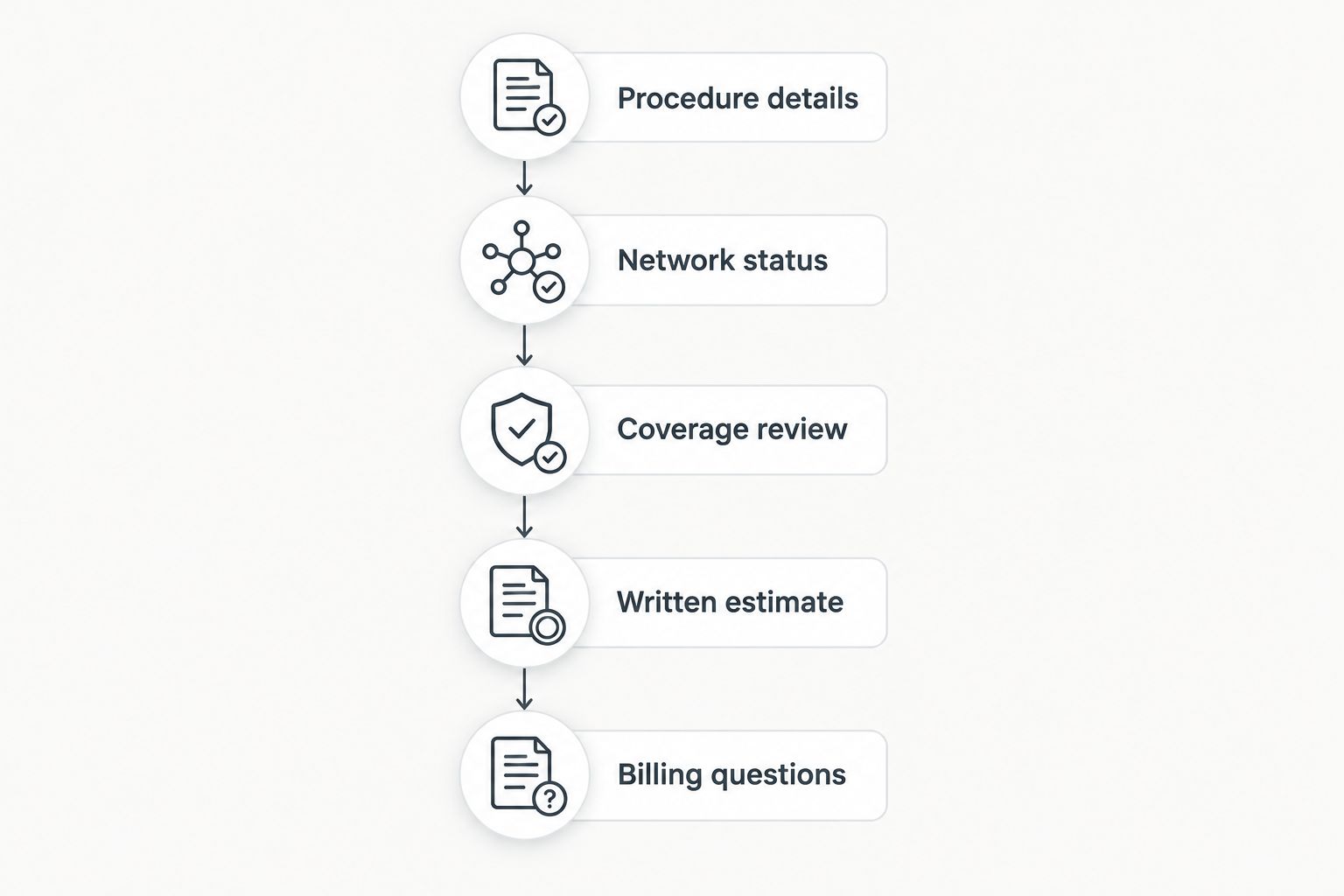
Match the financial estimate to the exact procedure your clinician proposes.
For your 2026 appointment, repeat these checks if the procedure plan or location changes. An estimate for an earlier plan does not automatically describe the revised service. Ask for an updated explanation before the appointment.
Will I need another medial branch block before radiofrequency ablation?
An additional diagnostic block depends on the clinical plan and the applicable insurer’s requirements. Ask the specialist what result would support another block and what documentation is needed. Do not assume that every patient follows an identical sequence.
Radiofrequency ablation targets selected nerves to reduce pain signals; a medial branch block uses anesthetic to assess whether those nerves contribute to the pain. The procedures serve different purposes. An ablation estimate should therefore be reviewed separately.
If your clinician discusses a possible second block or ablation, ask for estimates by stage. This lets you understand the financial implications without treating later procedures as already decided. A positive diagnostic response supports a clinical discussion, not a guarantee of treatment success.
Is a medial branch block the same as a facet joint injection?
A medial branch block targets the nerves supplying the facet joints, while an intra-articular facet joint injection places medication into the joint itself. The distinction affects the clinical purpose and the procedure being billed. Ask which procedure your specialist actually recommends.
Do not substitute a facet joint injection quote for a medial branch block estimate. Similar anatomical language does not make the services identical. Your estimate should use the planned procedure’s name and details.
The same principle applies to other nerve blocks. A general nerve-block estimate does not establish the expected billing for a particular spinal diagnostic procedure.
Choosing a New Jersey pain specialist
HudsonPain.com is an option for New Jersey patients seeking board-certified interventional pain management. The practice provides pain management services from offices in Englewood, Woodland Park, and Edison, serving patients in Bergen, Passaic, and Middlesex counties.
An evaluation at HudsonPain.com gives you a setting to discuss back or neck pain and the role of interventional treatment. Ask whether a diagnostic block fits your symptoms before making cost the deciding factor. The right financial comparison starts with an appropriate clinical plan.
HudsonPain.com’s listed services include nerve blocks, epidural injections, and spinal cord stimulation. A limitation of any procedural approach is that suitability and benefit depend on the diagnosis; an injection does not address every cause of pain. Confirm the specific recommendation and request its estimate directly.
FAQ
How do I find out my medial branch block cost in 2026?
Request a written estimate for the exact medial branch block your clinician proposes. Confirm the planned location, included services, insurance benefits, and any anticipated separate bills.
Does insurance cover a medial branch block?
Coverage depends on your plan’s benefits, medical-necessity rules, and any authorization requirements. Confirm coverage for the specific procedure, clinician, and location before scheduling.
Can I still owe money after insurance approves the block?
Yes, insurance approval does not eliminate deductibles, copayments, or coinsurance. Ask for an estimate of your patient responsibility and verify network participation.
Does the estimate include the facility fee?
A procedure estimate includes a facility fee only when its stated scope includes that charge. Ask whether the location will bill separately and request clarification in writing.
Is radiofrequency ablation included in the block estimate?
Radiofrequency ablation is a separate procedure and should not be assumed to be included in a medial branch block estimate. Request a separate estimate if your clinician recommends it after diagnostic evaluation.
Does a medial branch block guarantee lasting pain relief?
No, a medial branch block does not guarantee lasting pain relief. Its diagnostic response helps a clinician evaluate whether facet-related nerves contribute to your symptoms.
Can I discuss nerve blocks with HudsonPain.com?
HudsonPain.com provides nerve blocks as part of its interventional pain management services in New Jersey. Ask the practice whether a medial branch block is appropriate for your condition and request an estimate for the proposed care.
One last thing
The most useful question is not simply what the block costs. Ask what decision the result will help your clinician make. A diagnostic procedure has value when its findings inform the next step in care.
Before scheduling in 2026, confirm that you understand both parts of the plan: what the block is intended to establish and what your written estimate includes. Clear clinical purpose and clear billing scope belong in the same conversation.
Related guides
- How medial branch blocks help diagnose back pain
- How to get insurance approval for pain procedures
- How radiofrequency ablation treats chronic low back pain
About the Medical Reviewer
Dr. Saurabh Dang is a double board-certified interventional pain management specialist serving Central and Northern New Jersey. He combines clinical expertise with a patient-centered approach to help patients find lasting relief from chronic pain conditions.
Read Full Bio →Seeking Treatment for Epidural Injections?
Dr. Dang and the team at Hudson Pain and Spine offer specialized care and advanced interventional treatments.
Ready to Find Relief from Pain?
Schedule your consultation with Dr. Saurabh Dang at our Englewood office.
Serving patients across Central and Northern New Jersey — Bergen, Passaic, and Middlesex counties.