
How much does a nerve block injection cost in 2026?

Medically reviewed by
Dr. Saurabh Dang, MD, MBA

Your nerve block injection cost in 2026 depends on the exact procedure, where you receive it, and your insurance benefits; a written, procedure-specific estimate is the most useful answer for your budget. The physician’s charge does not necessarily include facility services, imaging guidance, sedation, or follow-up, so confirm what the estimate covers before scheduling.
TL;DR
- Nerve block injection cost requires a procedure-specific estimate, not a generic injection quote.
- Confirm physician, facility, imaging, and sedation charges before comparing estimates.
- Insurance approval does not guarantee full payment; verify your deductible and network status.
- Hudson Pain and Spine provides board-certified interventional pain management for New Jersey patients.
Why this matters
A quote for an injection and an estimate of your personal responsibility answer different questions. The first describes a service charge; the second accounts for your coverage, deductible, and other applicable benefits. Ask for the amount you are expected to pay, not just the amount billed to insurance.
You also need to compare the same treatment. A diagnostic block used to identify a pain source is not interchangeable with every injection intended to reduce symptoms. The target nerve, treatment purpose, and setting belong on your estimate.
If you are paying without insurance, start with the guide to pain management procedure costs without insurance. Then request an estimate for the specific block your clinician recommends.
How much does a nerve block injection cost in 2026?
There is no single nerve block injection cost that applies to every patient. Your estimate needs to identify the procedure, the billing providers, the location, and whether it reflects self-pay charges or insurance-adjusted responsibility.
Use this comparison to choose the right estimating process. These are payment situations, not recommendations to change your insurance or choose a treatment based on billing alone.
| Payment situation | Best for | What to request | Main limitation |
|---|---|---|---|
| In-network insurance billing | Patients using a participating clinician and facility | Estimated responsibility based on your current benefits | Coverage and deductible information can change before the claim is processed |
| Self-pay estimate | Patients not using insurance for the procedure | Written estimate identifying included and excluded services | A quoted physician charge does not establish the complete episode of care |
| Out-of-network insurance billing | Patients considering a clinician outside their plan’s network | Written explanation of network status and expected responsibility | Out-of-network benefits and billing protections depend on the circumstances |
For a 2026 appointment, verify benefits for the planned service date. A prior procedure’s bill is useful background, but it is not a current estimate for a different block or location.
What belongs in the cost breakdown?
Ask the billing team to identify each applicable component rather than treating the injection as an automatically bundled service:
- Evaluation: Confirm whether the consultation is separate from the procedure estimate.
- Physician service: Identify the clinician’s charge for performing the block.
- Facility service: Ask whether a hospital or surgery center will bill separately.
- Imaging guidance: Confirm whether ultrasound or fluoroscopy is included when planned.
- Medication and sedation: Ask which services are planned and how they are billed.
- Follow-up: Establish whether the post-procedure assessment is included or billed separately.
Not every block involves every component. Ask which items apply to your treatment instead of assuming that every listed charge will appear. An itemized estimate is useful because it defines the scope, not because it guarantees the final bill.
With insurance: estimate your personal responsibility
Insurance coverage does not mean that you owe nothing. Your responsibility depends on the plan’s rules, the insurer’s allowed amount, your remaining deductible, and applicable copayment or coinsurance.
Ask the practice for the planned procedure code and diagnosis information, then use those details when speaking with your insurer. Confirm the clinician’s network participation and, when relevant, the facility’s participation separately. A familiar office name does not establish the network status of every billing entity.
The advantage of using insurance is access to your plan’s covered benefits and negotiated payment arrangements. The limitation is that a pre-service estimate remains subject to claim processing. Keep the estimate and the insurer’s reference number so you can compare them with the explanation of benefits afterward.
Without insurance: request a written self-pay estimate
If you are uninsured or are not using insurance, ask for the complete planned service rather than a verbal injection quote. Specify whether the estimate includes the consultation, procedure, facility, imaging, medication, and follow-up.
Under the federal No Surprises Act, uninsured and self-pay patients are generally entitled to a good faith estimate when they request one or schedule qualifying care. Centers for Medicare & Medicaid Services guidance explains this protection; for care scheduled in 2026, ask how the practice’s estimate identifies the services expected for your visit.
The advantage is a clearer description of anticipated charges before treatment. The limitation is that an estimate cannot account for every unanticipated service. Ask how the practice will explain a change in the treatment plan and any resulting change in charges.
Out-of-network care: verify benefits before proceeding
Do not treat an out-of-network estimate as equivalent to an in-network estimate. Ask your insurer whether the planned block has out-of-network benefits, whether a separate deductible applies, and how reimbursement is determined.
Then ask the billing team what responsibility remains with you. Federal and state surprise-billing protections apply in specific circumstances; they do not make all voluntarily selected out-of-network care equivalent to in-network care.
The advantage of this check is an informed decision about the proposed clinician and setting. The limitation is that network questions can involve several billing entities. Resolve them before the procedure rather than relying on a general statement that the office accepts insurance.
Why nerve block injection cost varies
These standard medical-billing factors explain why apparently similar estimates differ:
- Procedure target: The specific nerve and planned technique determine which service is being estimated.
- Treatment scope: The planned side, nerves, or spinal levels affect the description of the procedure.
- Care setting: An office, hospital outpatient department, and surgery center have different billing arrangements.
- Supporting services: Planned imaging guidance or sedation changes the services included in an estimate.
- Insurance benefits: Deductibles, copayments, coinsurance, and network rules determine patient responsibility.
- Separate visits: Consultation and reassessment are distinct services unless the estimate explicitly includes them.
For 2026 estimates, compare these details before comparing the final expected payment. A narrower quote is not automatically a better offer; it can simply leave out part of the planned care.
Clinical appropriateness comes first. Ask whether the proposed setting and supporting services are needed for your condition, rather than asking the clinician to remove a medically necessary part of the procedure to simplify billing.
How do I get a useful estimate before scheduling?
Follow this sequence so the practice and insurer are estimating the same service.
- Procedure details: Ask for the name of the block, its purpose, target, planned side or levels, and billing code. Explain whether you will use insurance or self-pay.
- Billing entities: Ask who will submit bills. Confirm whether the physician, facility, imaging, or sedation services involve separate billing providers.
- Coverage check: Contact your insurer with the procedure details. Verify network status, coverage requirements, authorization, referral requirements, and current benefits.
- Written estimate: Request the expected patient responsibility and a list of included services. Ask what is excluded and what assumptions the estimate uses.
- Final confirmation: Before the appointment, check that the location, procedure, and insurance information still match the estimate. Keep a copy of the documents and call reference numbers.
The most useful question is: What services does this estimate cover, and what would cause my responsibility to change? That question exposes gaps a generic request for an injection quote misses.
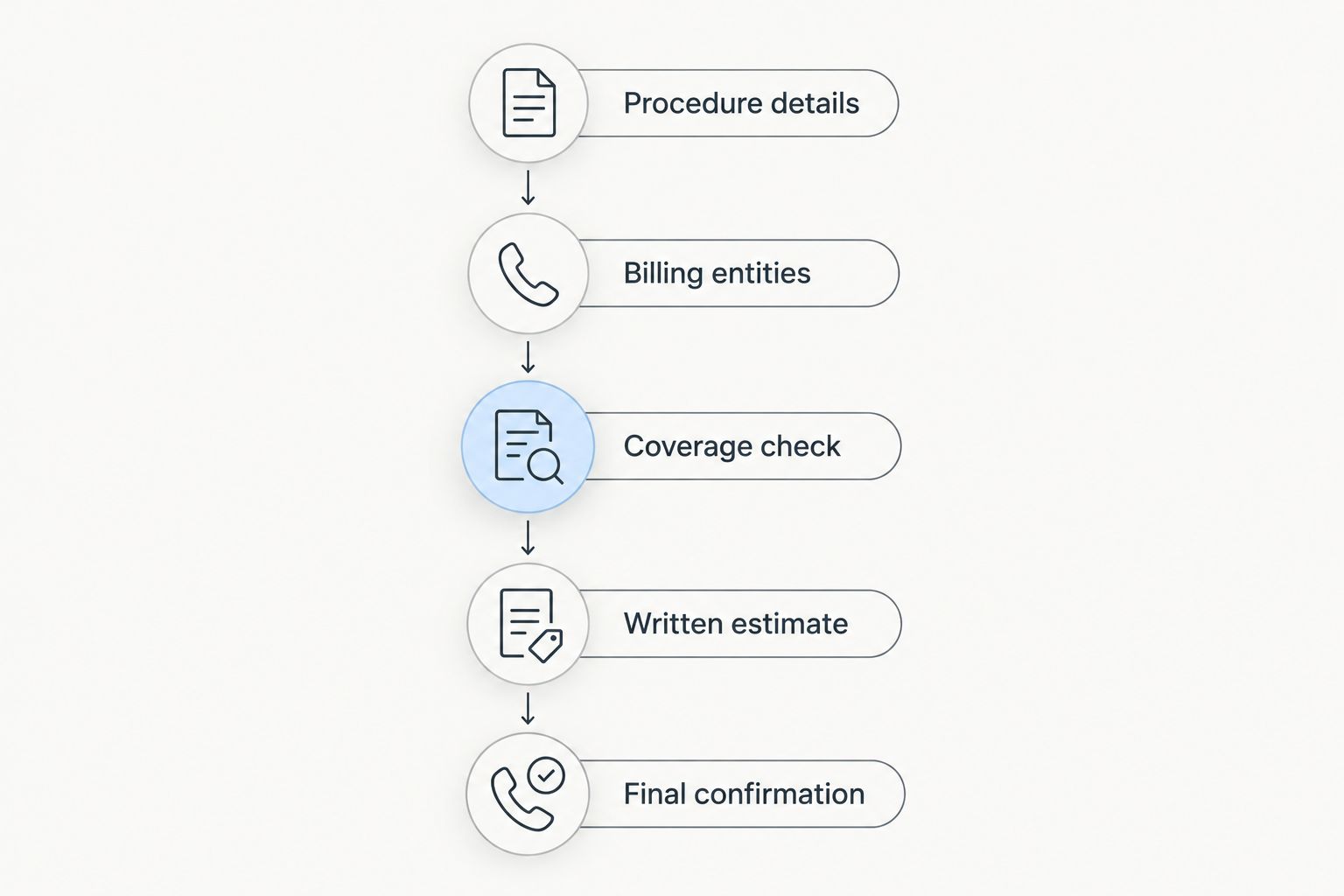
Verify the procedure and billing entities before requesting the final estimate.
What should I say when I call?
Use a direct request: Please provide a written estimate for the planned nerve block, including my expected responsibility and any separately billed services. Then ask whether the estimate assumes that you have met your deductible.
If the billing team cannot calculate your benefits, ask for the information your insurer needs to do so. That includes the procedure code, clinician, facility, and planned service date. Do not substitute the symptom description alone; back pain or knee pain does not identify a billable procedure.
What should I save?
Keep the estimate, authorization information, insurer reference number, and the names of the billing entities. Note whether each conversation addressed coverage, network status, or your expected responsibility. Those are separate questions.
After treatment, compare the explanation of benefits with the provider’s bill. The explanation of benefits describes how the insurer processed the claim; it is not itself a request for payment. Ask about discrepancies before assuming that a charge is correct.
Does the purpose of the block affect the estimate?
The purpose of the block matters because it determines the procedure being planned and the documentation supporting it. A diagnostic block asks whether a particular nerve is contributing to pain. A therapeutic block aims to reduce symptoms, with medication and technique selected for the clinical situation.
These purposes sometimes overlap. Ask your clinician which goal applies and how the result will influence the next decision. A temporary response can provide diagnostic information without establishing that a lasting treatment result has occurred.
Do not assume that an estimate for a block includes a later procedure. Radiofrequency ablation, repeat injections, and other interventions require their own clinical decisions and billing review. A treatment pathway is not automatically a prepaid package.
Hudson Pain and Spine provides nerve blocks and other interventional pain management services. Ask for an explanation of the proposed block’s goal before discussing the estimate, so the financial conversation follows the clinical plan.
What should I weigh besides the bill?
A nerve block has potential benefits and risks. Depending on its purpose, it can help identify a pain source or provide symptom relief, but it does not guarantee lasting improvement or correct every underlying cause of pain.
Possible risks include bleeding, infection, allergic reaction, temporary numbness or weakness, and nerve injury. The relevant risks depend on the injection location, medications, and your medical history. Review these with the treating clinician rather than using a general cost guide as procedure consent.
Tell the clinician about blood thinners, allergies, diabetes, previous injection reactions, and other relevant conditions. Do not stop prescribed medication on your own. Ask for individualized instructions about medications, transportation, and activity after the procedure.
Hudson Pain and Spine is a fit for New Jersey patients seeking board-certified interventional pain management. The practice serves Bergen, Passaic, and Middlesex counties from Englewood, Woodland Park, and Edison; an evaluation establishes whether a nerve block is appropriate, while a separate benefits review establishes expected responsibility.
Discuss your nerve block options
Review the proposed treatment and ask how to obtain a procedure-specific estimate.
Is a nerve block covered by insurance?
Nerve block coverage depends on your insurance plan and the medical indication. Ask the insurer about the specific proposed service, not whether pain management is covered in general.
Coverage review can involve medical-necessity documentation, prior authorization, or referral requirements. Confirm which requirements apply before scheduling, and remember that authorization does not guarantee full payment.
Will my deductible affect what I pay?
Your deductible can affect your responsibility for a covered nerve block. Ask whether the estimate reflects the deductible remaining on your plan at the time of the proposed service.
For a 2026 procedure, an older benefits check is not enough. Other claims processed before your injection can change the remaining deductible and therefore change the estimate.
Does a repeat nerve block need a new estimate?
A repeat nerve block needs its own current estimate because the planned service, benefits, or billing setting can differ. Do not assume that your earlier payment establishes the next appointment’s responsibility.
The clinician should also explain why repetition is appropriate and what result will guide further care. Confirm the clinical plan first, then request an estimate for that plan.
FAQ
How much does a nerve block injection cost in 2026?
Nerve block injection cost in 2026 depends on the specific block, care setting, supporting services, and your insurance benefits. Request a written estimate identifying your expected responsibility and any separately billed services.
Does insurance approval mean my nerve block is fully paid for?
Insurance approval does not mean your nerve block is fully paid for. Deductibles, copayments, coinsurance, and claim-processing rules can still affect your responsibility.
Can I get an estimate if I do not have insurance?
You can request a written self-pay estimate before a nerve block. Uninsured and self-pay patients generally have good faith estimate rights under the federal No Surprises Act for qualifying care.
Is imaging guidance included in the injection estimate?
Imaging guidance is included only if the estimate identifies it as included. Ask whether planned ultrasound or fluoroscopy is part of the quoted service or separately billed.
Will I get a separate facility bill?
A separate facility bill depends on where the procedure occurs and the billing arrangement. Ask which entities will bill before scheduling, especially for hospital or surgery-center care.
Does a nerve block estimate include radiofrequency ablation?
A nerve block estimate does not automatically include radiofrequency ablation. A later procedure requires its own clinical decision, coverage review, and estimate.
Where can I discuss nerve blocks in northern or central New Jersey?
Hudson Pain and Spine provides nerve blocks and board-certified interventional pain management in Englewood, Woodland Park, and Edison. Ask about evaluation, procedure suitability, and the process for obtaining an estimate.
One last thing
The most revealing detail on an estimate is often not the total—it is the list of services that total excludes. Before accepting an estimate, check whether it describes the complete planned visit or only the physician’s procedure charge.
For your 2026 appointment, make sure the clinical plan, insurer discussion, and written estimate describe the same procedure in the same setting. Resolve mismatches before treatment, not after the bill arrives. You should understand both what the block is intended to accomplish and what financial responsibility has been estimated.
Related guides
- How to get insurance approval for pain procedures
- What to expect after a nerve block procedure
- How medial branch blocks help diagnose back pain
About the Medical Reviewer
Dr. Saurabh Dang is a double board-certified interventional pain management specialist serving Central and Northern New Jersey. He combines clinical expertise with a patient-centered approach to help patients find lasting relief from chronic pain conditions.
Read Full Bio →Seeking Treatment for Nerve Block Injections?
Dr. Dang and the team at Hudson Pain and Spine offer specialized care and advanced interventional treatments.
Ready to Find Relief from Pain?
Schedule your consultation with Dr. Saurabh Dang at our Englewood office.
Serving patients across Central and Northern New Jersey — Bergen, Passaic, and Middlesex counties.