
How much does a trigger point injection cost in 2026?

Medically reviewed by
Dr. Saurabh Dang, MD, MBA

Your trigger point injection cost in 2026 depends on the planned treatment, where you receive it, and how your insurance processes the claim; a written estimate is the practical way to determine your expected payment. The injection estimate does not necessarily include a separate evaluation, facility charge, or follow-up visit. Confirm what the estimate includes before scheduling, rather than treating a procedure quote as the total cost of care.
TL;DR
- Trigger point injection cost depends on the treatment plan, billing setting, and insurance benefits.
- Request an itemized estimate that identifies separate evaluation, procedure, medication, and facility charges.
- Insurance approval does not establish your final out-of-pocket responsibility.
- HudsonPain.com provides interventional pain management for patients in Bergen, Passaic, and Middlesex counties, New Jersey.
How much does a trigger point injection cost in 2026?
Your expected payment is specific to your appointment and insurance benefits. Ask the billing office for an estimate tied to the proposed procedure, treatment location, and anticipated billing codes. For broader planning, read the guide to pain management procedure costs without insurance.
The most useful breakdown identifies which services are included and which are billed separately. Use the following checklist when requesting an estimate; these are possible billing components to clarify, not a statement that every appointment includes each charge.
| Possible billing component | What to ask | Why it matters |
|---|---|---|
| Evaluation | Is the consultation included or billed separately? | An assessment and an injection are distinct services. |
| Injection procedure | What procedure code is anticipated? | The code helps your insurer identify the proposed service. |
| Injected medication | Is medication included in the procedure estimate? | An estimate should explain any separately billed medication. |
| Facility | Will the treatment location submit a separate bill? | The clinician’s estimate does not necessarily cover another entity’s charges. |
| Guidance | Is imaging guidance planned, and how is it billed? | A proposed additional service needs its own coverage review. |
| Follow-up | Is reassessment included or a separate visit? | The treatment plan extends beyond the injection appointment. |
Compare estimates for the same proposed service, not just estimates with the same procedure name. A quote that includes an evaluation is different from one that covers only the injection. Ask for written clarification whenever the scope is unclear.
Why this matters
A trigger point injection targets a painful area within muscle. It is not interchangeable with an epidural injection, joint injection, or nerve block, and a quote for one procedure does not establish the cost of another.
Your diagnosis comes first. Tenderness in your neck, shoulder, or back does not by itself establish that an injection into muscle is appropriate, especially when you also have weakness, numbness, or pain spreading into an arm or leg.
For a 2026 appointment, treat the financial discussion and clinical assessment as connected but separate decisions. You need to know both whether the procedure fits your condition and what your expected payment includes. Neither a low quote nor insurance authorization answers the clinical question.
With insurance: confirm benefits and patient responsibility
Having insurance is not the same as having the entire appointment paid for. Your plan’s deductible, copayment, coinsurance, network rules, and coverage requirements determine how an eligible claim is processed.
Ask your insurer whether the proposed clinician and treatment location participate in your specific plan. A practice accepting an insurance company does not, by itself, establish participation in every plan that company administers. Give the insurer the provider details supplied by the office rather than relying on a directory name alone.
Then review the service itself. Ask whether trigger point injections require prior authorization, a referral, or documentation of previous treatment under your plan. Keep the insurer’s reference information with your estimate so you can connect the coverage discussion to the proposed appointment.
An insurance estimate is useful for budgeting, but it is not the final claim determination. Changes to the services performed or benefits applied can change your responsibility. Ask the office how it handles an estimate that differs from the insurer’s eventual explanation of benefits.
Without insurance: define the scope of the estimate
If you are paying without insurance, request a written self-pay estimate for the proposed appointment. Ask whether the quoted service includes the clinical evaluation, injection, medication, and any planned follow-up. Do not assume that a single figure describes the entire treatment plan.
Clarify who will bill you. If another clinician or facility is involved, ask whether its charges are included in the estimate you receive or require separate confirmation. This distinction matters even when the appointment takes place at one location.
For eligible uninsured or self-pay care, ask about a good faith estimate under federal billing protections. The Centers for Medicare & Medicaid Services explains this protection for people who are not using insurance to pay for care; it is a billing safeguard, not a guarantee that every possible service is included.
Before your 2026 appointment, ask how additions or changes to the proposed care will be communicated. Approve a clearly described treatment plan, not an undefined package of services. Keep the estimate and any written explanation together.
Why trigger point injection cost varies
The practical drivers of your expected payment are the services proposed and the benefits applied to them. Review these factors with the office and your insurer instead of assuming that every injection appointment is billed alike.
- Treatment scope: Ask which muscles the clinician plans to treat and which procedure code describes that work.
- Evaluation: Establish whether the appointment includes a separately billed assessment before treatment.
- Treatment setting: Confirm whether the clinician and facility submit separate claims.
- Additional services: Identify any planned medication or imaging charges that are outside the procedure estimate.
- Insurance benefits: Review network status, remaining deductible, copayment, coinsurance, and authorization requirements.
- Follow-up plan: Ask whether reassessment and any later procedures require separate appointments and estimates.
Not every factor applies to every patient. The point is to identify the services actually planned for you, then check their billing treatment. A general procedure description cannot replace that appointment-specific review.
How do I get a useful estimate before scheduling?
Follow this sequence so the office and insurer are discussing the same proposed care. Start with the procedure details; benefits information alone cannot identify what will be billed.
- Confirm procedure. Ask the clinician or office to identify the proposed injection, treatment location, and anticipated billing codes. Make sure the estimate concerns a trigger point injection rather than another pain procedure.
- Verify coverage. Give your insurer the procedure and provider details. Ask about network participation, authorization, referral requirements, and the benefits that apply to the service.
- Request estimate. Ask the office for an itemized written estimate showing included services and potential separate bills. Specify whether you intend to use insurance or pay without it.
- Review follow-up. Ask how the clinician will assess the result and whether a follow-up visit is separately billed. Clarify that later treatment requires a new clinical decision.
This sequence reduces confusion between the procedure estimate and your expected payment. Keep the documents in one place and bring unresolved questions to the office before treatment.
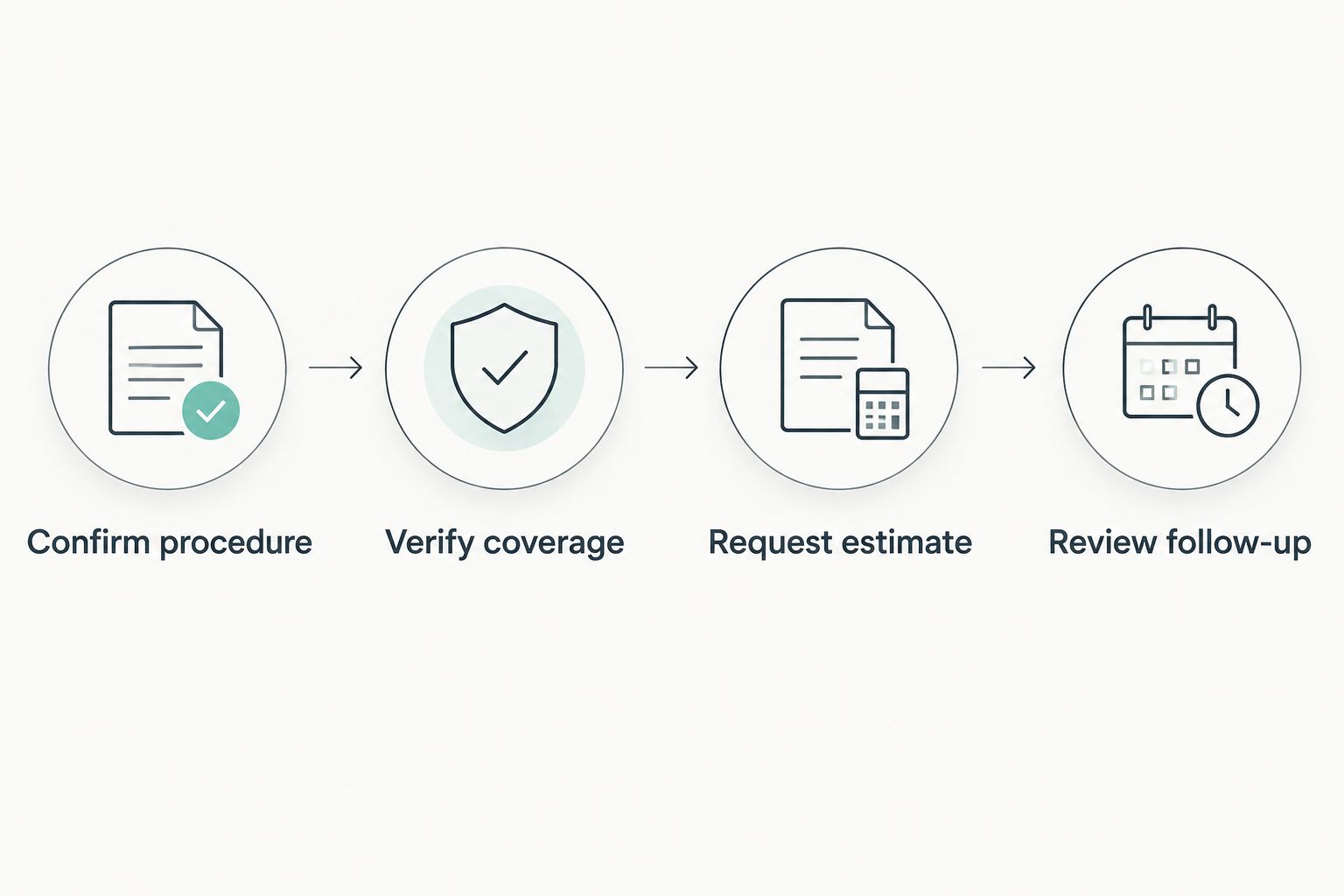
Match the procedure details to coverage before reviewing your expected payment.
Which payment approach fits my situation?
Choose the approach that matches how you intend to pay, then confirm the details. Neither route establishes that the injection is clinically appropriate, and neither removes the need for an itemized estimate.
| Payment approach | Best for | Practical advantage | Limitation |
|---|---|---|---|
| Using insurance | Patients seeking to use applicable plan benefits | The insurer applies the plan’s coverage and payment rules to the claim. | Network restrictions, benefit requirements, and patient cost-sharing still apply. |
| Paying without insurance | Patients who are uninsured or choose not to submit the service to insurance | A written estimate can clarify the proposed self-pay services before treatment. | You must verify the scope and any separate bills; payment does not establish coverage or clinical suitability. |
If you have insurance but are considering self-pay, ask your plan how an unsubmitted service affects deductible tracking and reimbursement eligibility. Do not assume that a payment made directly to the office will count toward your insurance benefits.
For either approach, use the same clinical plan when comparing estimates. A different treatment setting, additional evaluation, or different proposed procedure changes the comparison. A clear scope is more useful than a quote without an explanation.
Is a trigger point injection worth considering for muscle pain?
A trigger point injection is a treatment to discuss when your clinician identifies a painful muscle trigger point that fits your symptoms. It is not a general-purpose treatment for every cause of neck or back pain. Ask what the examination shows and why this procedure is being considered.
The potential benefit is relief of pain arising from the targeted muscle area. Limitations include variable response and the possibility that the underlying contributors to muscle pain still require treatment. Discuss how exercise, physical therapy, or activity changes fit into your plan.
Injection risks include temporary soreness, bruising, bleeding, and infection; medication-related risks depend on what is injected. Tell your clinician about allergies and all medicines you take, including blood thinners. Do not stop prescribed medication unless the treating clinician gives specific instructions.
Set a functional goal before treatment, such as turning your head more comfortably or tolerating necessary daily activity. At follow-up, review whether the procedure helped that goal rather than judging the result only by immediate numbness or tenderness.
Do I need to budget for repeat injections?
Do not assume that a trigger point injection commits you to a preset series. Repeat treatment should follow reassessment of your symptoms, function, response, and the clinician’s findings. Ask what would justify another procedure and what would prompt a different approach.
For 2026 budgeting, separate the proposed appointment from hypothetical future care. Request a new estimate if the treatment plan changes, and recheck benefits when your insurance circumstances change. This keeps a possible later procedure from being mistaken for a required expense now.
When should I seek a specialist evaluation?
Seek an evaluation when persistent muscle pain interferes with sleep, work, or daily activity, or when previous treatment has not addressed the problem. A specialist assessment can help distinguish muscle-related pain from nerve, joint, or other causes before you commit to an injection.
HudsonPain.com is suited to patients in Bergen, Passaic, and Middlesex counties seeking board-certified interventional pain management. The practice has offices in Englewood, Woodland Park, and Edison. You can review HudsonPain.com for an overview of the practice before discussing your symptoms and treatment options.
A specialist visit is an assessment, not a promise that you need a procedure or will obtain a particular result. Confirm appointment billing and insurance details separately. For urgent symptoms such as new significant weakness or loss of bladder or bowel control, seek prompt medical care rather than waiting for a routine cost discussion.
Review your pain care options
Explore interventional pain management in Englewood, Woodland Park, and Edison, New Jersey.
FAQ
How much will I pay for a trigger point injection in 2026?
Your expected payment depends on the proposed services, treatment setting, and insurance benefits. Request an itemized written estimate and confirm whether evaluation, medication, facility, and follow-up charges are included.
Does insurance cover trigger point injections?
Coverage depends on your specific plan and whether its requirements are met. Ask your insurer about the proposed procedure code, provider network status, authorization, and patient cost-sharing before scheduling.
Is the consultation included in the injection estimate?
Do not assume that the consultation is included in the injection estimate. Ask the office whether the assessment is billed separately and whether your insurer applies different benefits to it.
Will I receive a separate facility bill?
A separate facility bill depends on the treatment setting and billing arrangement. Ask the office which entities will submit charges and whether the estimate includes all of them.
Can I get an estimate if I do not have insurance?
Yes, you can request a written self-pay estimate before treatment. Ask about a good faith estimate and confirm which proposed services and separate bills it covers.
Does insurance authorization guarantee that I will owe nothing?
No, authorization does not eliminate your deductible, copayment, coinsurance, or other applicable plan rules. Confirm your expected responsibility separately from the authorization decision.
Are trigger point injections the same as epidural injections?
No, trigger point injections target muscle trigger points, while epidural injections target the epidural space near spinal nerves. The clinical indications and billing details differ, so an estimate for one does not establish the cost of the other.
Does HudsonPain.com provide pain management in New Jersey?
HudsonPain.com provides board-certified interventional pain management from offices in Englewood, Woodland Park, and Edison. Patients in Bergen, Passaic, and Middlesex counties can discuss their symptoms and appropriate treatment options with the practice.
One last thing
Before your 2026 appointment, ask one specific question: What services could generate a bill that is not included in this estimate? That question addresses the gap between a procedure quote and the full appointment.
Keep the answer in writing. Then ask how the clinician will determine whether treatment helped enough to justify any later procedure. Financial clarity and clinical reassessment belong in the same plan.
Related guides
- How trigger point injections relieve muscle pain
- How to get insurance approval for pain procedures
- How to connect physical therapy to interventional pain treatment
About the Medical Reviewer
Dr. Saurabh Dang is a double board-certified interventional pain management specialist serving Central and Northern New Jersey. He combines clinical expertise with a patient-centered approach to help patients find lasting relief from chronic pain conditions.
Read Full Bio →Seeking Treatment for Epidural Injections?
Dr. Dang and the team at Hudson Pain and Spine offer specialized care and advanced interventional treatments.
Ready to Find Relief from Pain?
Schedule your consultation with Dr. Saurabh Dang at our Englewood office.
Serving patients across Central and Northern New Jersey — Bergen, Passaic, and Middlesex counties.