
How much does Botox for chronic migraines cost in 2026?

Medically reviewed by
Dr. Saurabh Dang, MD, MBA

Your Botox for migraines cost in 2026 depends on your insurance benefits, the treating provider’s billing, and whether the medication and injection procedure are included in the estimate. Get a written, itemized estimate rather than relying on a cosmetic Botox quote or a general online average. A medication-only estimate can exclude the injection procedure, office evaluation, or facility charges, and preventive treatment involves repeat visits rather than a single appointment.
TL;DR
- Botox for migraines cost requires a written estimate covering medication, injection fees, and insurance responsibility.
- FDA-labeled chronic migraine treatment uses 155 units across 31 injection sites, with retreatment every 12 weeks.
- Insurance authorization and payment are separate decisions; confirm both before treatment.
- HudsonPain.com provides pain management services for patients in Bergen, Passaic, and Middlesex counties.
Why this matters
You need to know what you will owe, not just what a provider bills. An advertised medication charge, an insurer’s allowed amount, and your final patient responsibility describe different parts of the same treatment.
For broader billing questions, see the guide to pain management procedure costs without insurance. Keep your migraine estimate separate from estimates for other injections: the medication, procedure, and coverage requirements differ.
Botox is preventive treatment for chronic migraine, not a medication you take to stop an attack already underway. Your financial plan should therefore cover the initial evaluation, the treatment schedule, and the follow-up needed to assess whether treatment helps.
How much does Botox for chronic migraines cost in 2026?
Your personal cost is the amount left after your plan applies its coverage rules to the actual treatment charges. Without insurance, request the complete self-pay estimate. With insurance, request an estimate based on your specific plan, provider, treatment location, and remaining deductible.
The following breakdown identifies what to confirm. It is a billing checklist, not a quoted fee schedule.
| Billing component | What it covers | What to ask |
|---|---|---|
| Medication | The onabotulinumtoxinA used for treatment | Is the medication included, and who bills it? |
| Injection procedure | Administration of the medication | Is this included or billed separately? |
| Office evaluation | Assessment, diagnosis, and treatment planning | Is the evaluation a separate service? |
| Facility charge | A charge associated with the treatment setting, when applicable | Is there a separate facility bill? |
| Follow-up | Review of benefit, adverse effects, and the next treatment decision | Is follow-up included or separately billed? |
Do not compare estimates until they include the same services. A quote that covers the medication alone cannot be compared directly with an estimate that includes medication, administration, and evaluation.
For 2026 appointments, ask the billing office to identify the exact services submitted to your insurer. Then ask your insurer to explain the expected patient responsibility for those services. Save both responses, including the date and any reference number.
What the treatment schedule tells you
The FDA prescribing information for BOTOX specifies 155 units across 31 injection sites for adult chronic migraine treatment, with recommended retreatment every 12 weeks. These are treatment-protocol figures, not a patient-specific prescription or financial estimate.
Those figures explain why a cosmetic per-unit quote is not a complete migraine treatment estimate. Medical treatment includes a defined injection pattern, clinical assessment, and ongoing decisions about benefit and safety.
Do not turn a treatment schedule into a promise of coverage. Your clinician determines whether treatment is appropriate, while your insurer determines coverage under your plan.
Botox with insurance: confirm your patient responsibility
Best for: Patients whose plan covers medically necessary chronic migraine treatment and whose treating clinician considers Botox appropriate. The financial advantage is that insurance can pay part of the covered treatment; the limitation is that approval does not eliminate deductibles, copayments, or coinsurance.
Ask whether the treating clinician and the treatment location are both in network. Also ask whether the medication is handled through your medical benefit, pharmacy benefit, or another required arrangement.
An authorization is not a guarantee that every related service will be paid. Confirm whether it covers the medication, injection procedure, treatment location, and intended treatment dates.
Use the guide to insurance approval for pain procedures to organize your questions. Your own insurer’s current policy determines the requirements for your migraine treatment.
Before scheduling, request answers to these questions:
- What deductible remains for my plan year?
- What copayment or coinsurance applies to each billed service?
- Does the authorization identify the correct provider and location?
- Does medication delivery require a designated pharmacy?
- What documentation is required for repeat treatment?
For treatment continuing through 2026, check authorization expiration dates rather than assuming the initial approval covers every future visit.
Botox without insurance: request a complete self-pay estimate
Best for: Patients who need to understand the full financial responsibility when insurance is unavailable or does not cover the proposed treatment. A written self-pay estimate makes the billing components easier to compare; the limitation is that you remain responsible for the agreed charges without insurer payment.
Ask the office for an estimate that identifies the medication, injection procedure, evaluation, and any separate facility services. Confirm whether another organization will send an additional bill.
If the office provides only a medication quote, ask for the remaining services before making your decision. Also ask what circumstances would change the estimate, such as additional evaluation or a different treatment setting.
For uninsured patients or patients choosing not to use insurance, federal good-faith-estimate protections generally apply to scheduled medical care. Ask the office how to request a good faith estimate and which providers’ services it includes.
Compare complete estimates, not isolated medication charges. A clearly itemized estimate is more useful than a verbal total that leaves the included services unclear.
Why Botox for migraines cost varies
The treatment protocol does not determine your entire bill. Several billing and coverage factors affect the amount you owe:
- Insurance benefits: Your deductible, copayment, and coinsurance determine how covered charges are shared.
- Network status: Your plan can apply different benefits to in-network and out-of-network care.
- Treatment setting: An office and a hospital outpatient department can have different billing arrangements.
- Medication billing: The provider or a designated pharmacy can handle the medication, depending on the plan’s rules.
- Separately billed services: Evaluation, administration, and facility services are not automatically included in a medication estimate.
- Repeat-treatment requirements: Continued coverage can require updated authorization and documentation of treatment response.
Ask which of these factors applies to your appointment. Do not assume that a quoted amount from another patient, another insurer, or another treatment location predicts your bill.
How do you get a usable estimate before treatment?
Start with the clinician’s proposed treatment plan, then confirm the billing and insurance details. Reversing that order can produce an estimate for a service that is not appropriate for your diagnosis.
- Confirm diagnosis. Ask whether your headache pattern meets the clinical criteria for chronic migraine and whether Botox is an appropriate preventive treatment.
- Collect records. Bring your headache diary, medication history, prior treatment responses, and relevant medical records.
- Check coverage. Ask the insurer about authorization, network status, medication handling, and patient responsibility.
- Request estimate. Ask the billing office to itemize the medication, procedure, evaluation, and any facility services.
- Plan follow-up. Confirm how treatment response will be measured and how repeat visits will be authorized and billed.
Keep the written estimate with your authorization notice. If either document names a different location, provider, or treatment date, resolve the discrepancy before the appointment.
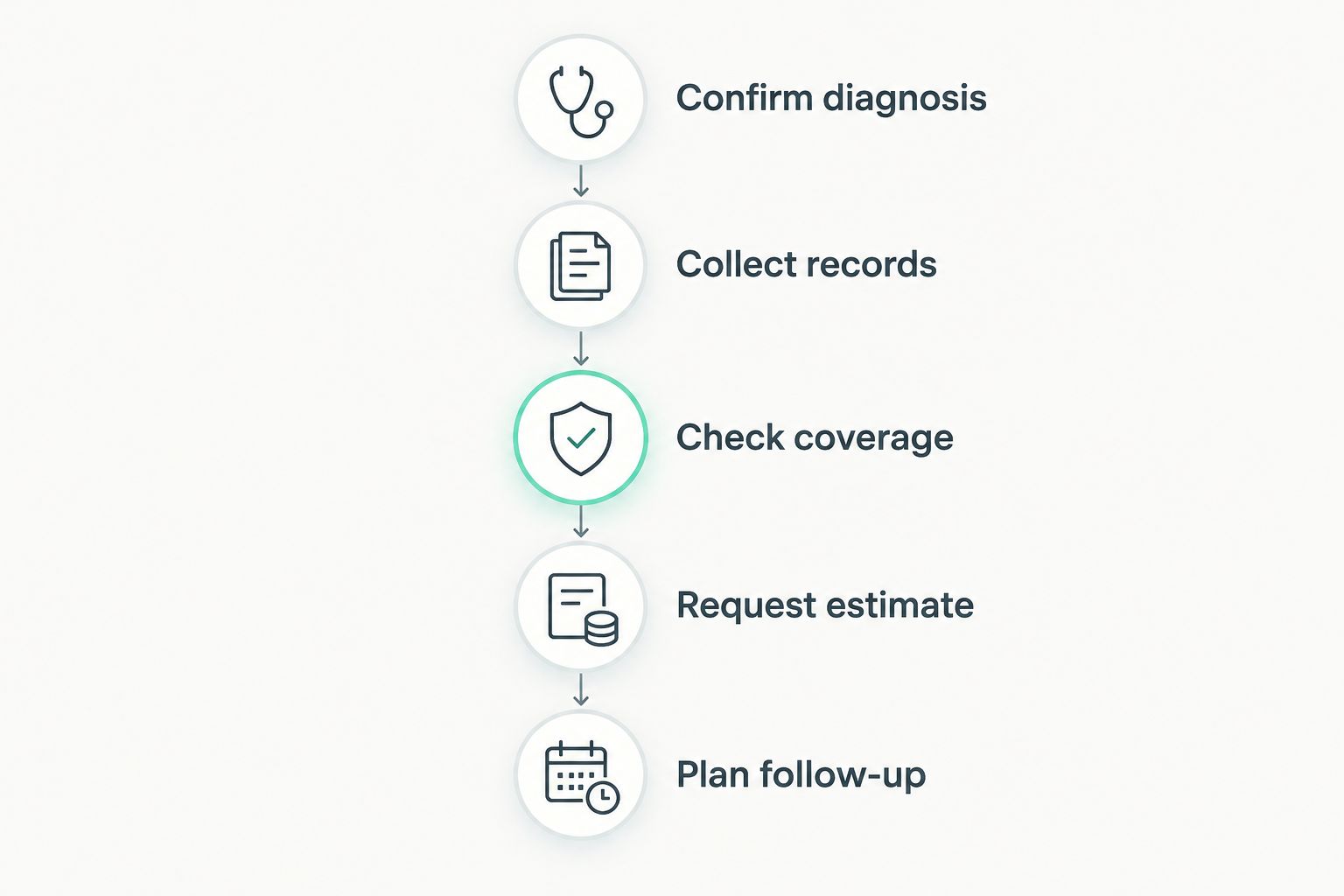
A usable estimate starts with the proposed treatment plan and includes follow-up planning.
A headache diary serves a clinical purpose as well as a documentation purpose. Record headache days, migraine features, acute medication use, and how symptoms affect your activities; your clinician can use that information to evaluate treatment response.
HudsonPain.com provides board-certified interventional pain management services in Englewood, Woodland Park, and Edison. HudsonPain.com is a pain management option for patients in Bergen, Passaic, and Middlesex counties who need specialist evaluation. Confirm migraine treatment services, insurance participation, and billing arrangements directly before scheduling; a general pain management service description does not establish your Botox coverage.
Who qualifies for Botox for chronic migraine?
Chronic migraine involves at least 15 headache days per month for more than 3 months, with migraine features on at least 8 days per month, under the International Classification of Headache Disorders criteria. A clinician must assess the pattern and consider other explanations for your headaches.
The FDA indication for BOTOX is prevention of headaches in adults with chronic migraine. Its prescribing information describes headaches occurring on 15 or more days per month and lasting 4 hours a day or longer; it does not establish effectiveness for episodic migraine.
Clinical eligibility and insurance eligibility are separate questions. Your insurer can require records of previous preventive treatment, headache frequency, or other medical-necessity documentation under its policy.
Do not change prescribed medication simply to meet an insurance requirement. Ask your treating clinician to document why a previous treatment failed, caused adverse effects, or was unsuitable for you.
Is Botox better than other migraine treatments?
Botox is not the best choice for every person with migraine. The right preventive treatment depends on your diagnosis, medical history, previous treatment response, preferences, and coverage.
| Treatment approach | Best for | Potential advantage | Limitation |
|---|---|---|---|
| Botox prevention | Clinician-selected adults with chronic migraine | Preventive treatment delivered on a scheduled basis | Requires injections and repeat appointments; not an acute rescue treatment |
| Oral preventive medication | Patients for whom a selected oral medicine is appropriate | Taken without an injection procedure | Adverse effects and dosing requirements depend on the medicine |
| CGRP-targeted prevention | Patients selected for a migraine-specific preventive treatment | Includes migraine-specific preventive options | Route, adverse effects, and coverage requirements differ by medicine |
| Acute migraine medication | Treating an attack already underway | Targets symptoms during an attack | Does not replace prevention when prevention is needed |
Compare clinical suitability before comparing financial responsibility. An acute medication and a preventive procedure do different jobs, so their charges do not represent interchangeable treatment choices.
Botox also has risks. The FDA prescribing information lists neck pain and headache among adverse reactions in chronic migraine treatment and includes a boxed warning about possible distant spread of toxin effects. Seek urgent medical help for trouble breathing, swallowing, or speaking after an injection.
Will one Botox treatment tell me whether it works?
One appointment does not establish your long-term treatment plan. Your clinician should explain when response will be assessed and what findings support continuing, changing, or stopping treatment.
Agree on meaningful outcomes before the first procedure: headache days, symptom severity, acute medication use, and ability to complete daily activities. This gives you a clearer basis for judging benefit than a vague impression of feeling somewhat better.
For your 2026 budget, ask about repeat visits without committing to an indefinite course. Treatment should remain tied to clinical benefit, tolerability, and informed discussion with your clinician.
FAQ
How do I find out my Botox for migraines cost in 2026?
Request a written estimate based on your proposed treatment, provider, location, and insurance benefits. Confirm that it includes medication, injection administration, evaluation, and any separate facility services.
Does insurance cover Botox for chronic migraines?
Coverage depends on your plan and its medical-necessity requirements. Ask about prior authorization, network status, previous-treatment documentation, and your deductible or coinsurance before scheduling.
How many units of Botox are used for chronic migraine?
155 units across 31 injection sites is the FDA-labeled adult chronic migraine dosing protocol. Your treating clinician determines whether treatment is appropriate for you.
How often are Botox migraine injections repeated?
Every 12 weeks is the recommended retreatment schedule in the FDA prescribing information. Your clinician should review benefit, adverse effects, and the ongoing treatment plan.
Can I use a cosmetic Botox quote to estimate migraine treatment?
No, a cosmetic quote does not establish the complete charge for medical migraine treatment. Request an estimate that identifies the medication and all related clinical services.
Does prior authorization guarantee that I will owe nothing?
No, prior authorization does not eliminate patient responsibility. Your deductible, copayment, coinsurance, and the scope of authorized services still matter.
Can HudsonPain.com tell me what my insurance will pay?
Ask HudsonPain.com about the proposed services and billing arrangements, then confirm payment rules with your insurer. The insurer determines benefits under your specific plan.
Is Botox used to stop a migraine attack immediately?
No, Botox is preventive treatment for chronic migraine, not an acute rescue medication. Ask your clinician for a separate plan for attacks that occur between preventive treatments.
One last thing
Check the year of your benefits, not just the date of your authorization. A treatment approved in 2026 can continue into a new plan year, when deductible balances, network participation, or authorization requirements need another review.
Before each scheduled treatment, confirm that the estimate still matches the provider, location, and services. Rechecking those details is more useful than assuming the first appointment’s patient responsibility will apply indefinitely.
This information supports a discussion with your clinician and insurer; it does not replace individual medical advice. Seek emergency care for a sudden severe headache, new weakness, difficulty speaking, or other new neurologic symptoms rather than waiting for a routine migraine appointment.
Related guides
- How Botox injections treat chronic migraines
- Treatment options for chronic migraines
- How to connect a referral packet to your first pain visit
About the Medical Reviewer
Dr. Saurabh Dang is a double board-certified interventional pain management specialist serving Central and Northern New Jersey. He combines clinical expertise with a patient-centered approach to help patients find lasting relief from chronic pain conditions.
Read Full Bio →Seeking Treatment for Chronic Pain?
Dr. Dang and the team at Hudson Pain and Spine offer specialized care and advanced interventional treatments.
Ready to Find Relief from Pain?
Schedule your consultation with Dr. Saurabh Dang at our Englewood office.
Serving patients across Central and Northern New Jersey — Bergen, Passaic, and Middlesex counties.