
How to connect a referral packet to your first pain visit

Medically reviewed by
Dr. Saurabh Dang, MD, MBA

Instead of repeatedly chasing records before your appointment, connect your referral packet to your first pain management visit by gathering the referral, relevant medical records, and current medication list, then confirming the receiving office can access them. This 2026 guide explains how to prepare for an evaluation at Hudson Pain and Spine without assuming that sending documents means they reached your chart.
TL;DR
- Connect your referral packet to first pain management visit preparation by confirming receipt, not just transmission.
- Hudson Pain and Spine provides interventional pain management evaluations for patients in New Jersey.
- Request imaging reports and ask separately how to transfer the actual images.
- Keep medication details, treatment responses, and your main functional goal together.
Why this matters
A referral explains why another clinician wants you evaluated. Your supporting records show what has already been investigated, which treatments you have tried, and what remains unresolved. The useful packet connects the referral question to your current symptoms—not simply to a diagnosis code.
Hudson Pain and Spine provides board-certified interventional pain management services from offices in Englewood, Woodland Park, and Edison. Hudson Pain and Spine is best for New Jersey patients seeking an interventional pain management evaluation. An evaluation determines the next step; a referral does not establish that an injection or another procedure is appropriate.
Use this 2026 workflow to organize the handoff. Confirm the receiving office’s current requirements directly rather than treating this guide as an office-specific intake policy.
Before you start
- Gather access and materials: Have your referring clinician’s contact information, appointment details, insurance information if applicable, and access to relevant records. Ask the receiving office which documents it needs and which secure transfer methods it accepts.
- Check permission and responsibility: Ask whether you must complete a records-release authorization and who will send each document. Identify the person or department responsible for the referral, imaging, and treatment records.
- Catch the imaging gap early: An MRI report is not the MRI itself. Ask whether the specialist needs the actual images and how the imaging facility should make them accessible; sharing a report does not automatically share the scan.
Do not wait for paperwork if symptoms suggest an emergency. New loss of bladder or bowel control, numbness around the groin or saddle area, or rapidly worsening weakness requires urgent medical evaluation rather than a routine referral handoff.
Referral destination and requirements
Start by establishing where the records belong. A correct document sent to the wrong location still leaves the evaluating clinician without the information.
- Confirm the appointment destination. Verify the office location, clinician if assigned, and appointment date. Use these details when speaking with your referring office and records departments.
- Ask what the evaluation requires. Find out whether the office needs a referral order, recent clinical notes, imaging reports, actual images, prior procedure notes, or completed intake forms. Requirements depend on the clinical situation and receiving practice.
- Separate clinical referral from insurance requirements. Ask your insurer whether your plan requires a specialist referral, then ask the office how it verifies that requirement. A clinician’s recommendation and an insurance referral are not interchangeable.
- Confirm the transfer route. Obtain the destination directly from the receiving office. Ask how it wants your name, date of birth, and appointment information attached to the submission.
Expected result: You know which office should receive the packet, what it needs, and who must send it. You also know whether an insurance referral needs separate attention.
For a 2026 appointment, check requirements against your current plan and appointment—not an older visit’s instructions. Do not send protected health information through an unverified email address or unfamiliar upload link.
Clinical packet and symptom summary
Build the packet around the reason for your visit. Keep original medical documents intact and add a short patient summary rather than rewriting your clinicians’ findings.
- Put the referral question first. Include the referral order or letter when requested. If the reason is unclear, ask the referring clinician to clarify the symptoms or concern prompting the evaluation.
- Collect relevant clinical records. Request notes about the affected body region, imaging reports, related operations, and previous pain procedures. Include physical therapy summaries when they document the treatment course or your response.
- Prepare a current medication list. Record each medication’s name, dose, and how you actually take it. Include nonprescription medicines, supplements, allergies, and previous medication reactions; flag differences between your list and older records.
- Write a 1-page symptom summary. Describe where pain starts, where it travels, when it began, and what worsens or eases it. Include numbness, tingling, weakness, and the activities pain limits.
- Document treatment response. For each relevant treatment, explain whether it helped, what improved, how long the improvement lasted if you remember, and any adverse effects. Distinguish no benefit from stopping treatment because of side effects.
Expected result: The packet explains the referral, previous care, current medicines, and your present limitations without requiring the specialist to reconstruct everything from scattered records.
Details that make your summary useful
A pain rating on a 0–10 scale gives context, but it does not replace a description of function. Explain whether pain interrupts sleep, limits walking, prevents lifting, or makes driving difficult. Describe the activity and what stops you.
Label your summary with the date you prepared it in 2026. Keep original dates on older records so the clinician can distinguish past findings from current symptoms. If you cannot remember a treatment date or duration of benefit, say that instead of supplying an estimate that looks exact.
Do not order new imaging just to complete a packet. Ask the evaluating clinician whether additional testing is needed.
Secure transfer and receipt confirmation
Choose the transfer method the receiving office accepts. Convenience matters less than whether the documents are readable, correctly identified, and available for the evaluation.
| Transfer option | Best for | Advantage | Limitation | Verification step |
|---|---|---|---|---|
| Clinician-to-office transfer | Records held by your referring practice | Keeps the handoff with the source office | Other facilities’ records need separate requests | Ask which documents the receiving office received |
| Approved electronic submission | Records you can download and send securely | Lets you retain the submitted files | Images and reports can require different routes | Confirm files can be opened and attached to your chart |
| Paper copies | A backup when electronic access is uncertain | Gives you documents to bring to the visit | Paper reports do not include the underlying scan images | Ask whether the office can use or scan the copies |
Follow the receiving office’s instructions rather than choosing a method solely because it is easiest. These options describe general records-transfer routes, not a claim that Hudson Pain and Spine accepts every method.
- Send through the confirmed channel. Follow the office’s identification instructions and include the appointment details it requests. Keep confirmation information without assuming it proves clinical receipt.
- Check document quality. Review downloaded files or copies for missing pages, unreadable text, and incorrect patient information. Do not alter medical findings; ask the source office to correct errors.
- Track images separately. Ask the imaging facility whether it has transferred the images or provided an accepted access method. Verify that the receiving office can retrieve them.
- Confirm receipt by document type. Ask whether the referral, relevant notes, imaging report, and any requested images are accessible for your appointment. A general acknowledgment does not identify which items arrived.
Expected result: You can distinguish documents sent from documents received and identify any remaining gap. Keep a backup copy of your packet, but ask the office what to bring rather than assuming a particular storage device is accepted.
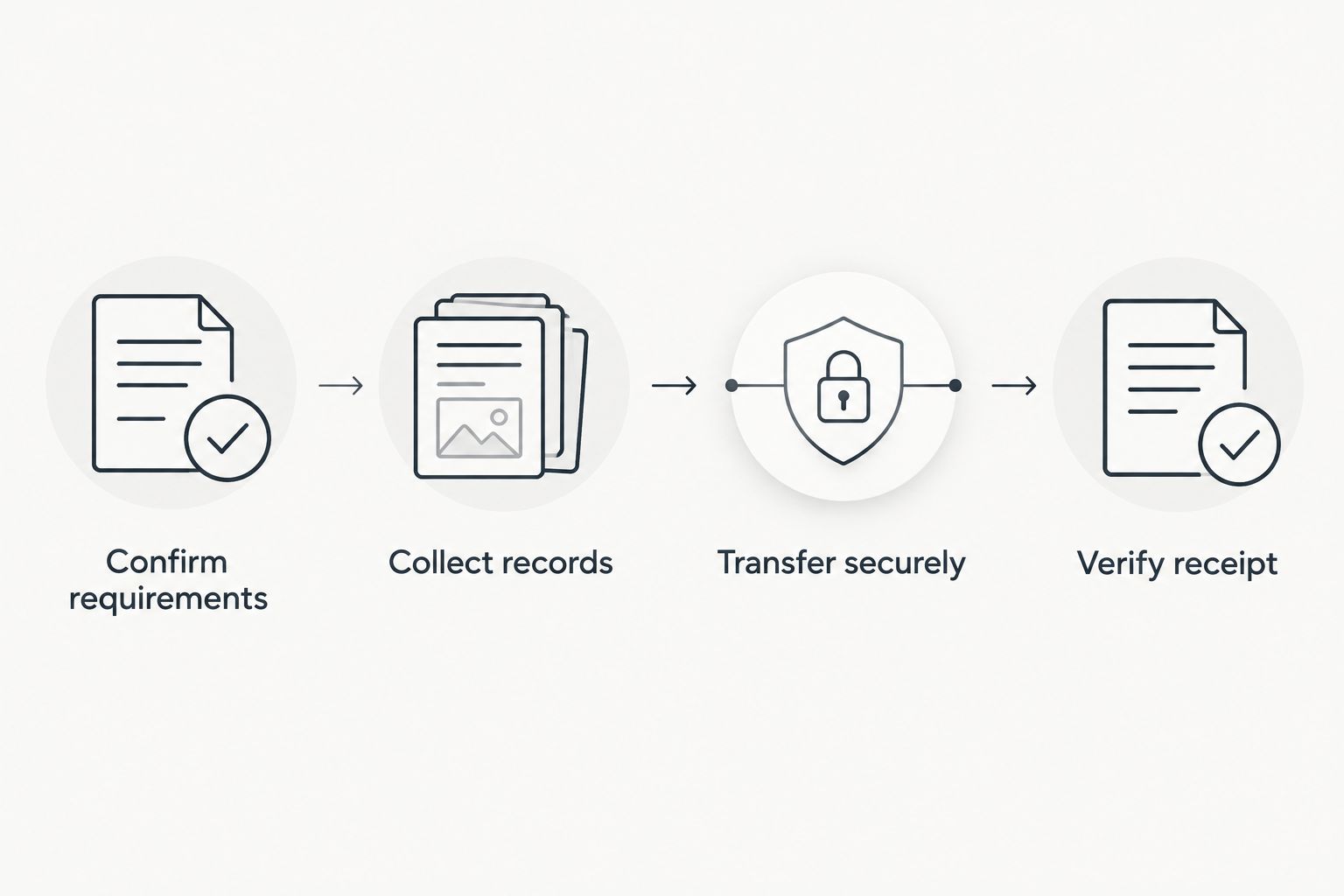
Confirming receipt is a separate step from sending the referral packet.
First-visit agenda and medication safety
Your records support the consultation; they do not replace your account of what is happening now. Bring the conversation back to the problem you need help solving.
- Choose your main functional goal. Identify the activity you most want to improve, such as sleeping, walking, working, or completing rehabilitation. Explain the present limitation without promising yourself a particular outcome.
- Prepare 3 questions. Ask what might explain your symptoms, what additional evaluation is needed, and which treatment approaches fit your situation. Add questions about risks or alternatives if a procedure is discussed.
- Report changes since referral. Tell the clinician about new symptoms, medication changes, infections, hospital visits, or treatments that occurred after the referral was written.
- Keep consultation and procedure instructions separate. Do not stop medicines, fast, or arrange sedation-related restrictions based on generic online advice. Obtain individualized instructions if a procedure is scheduled, especially for blood thinners or diabetes medicines.
Expected result: You arrive ready to discuss symptoms, goals, and treatment decisions, with a medication list that reflects what you take now.
A first pain management visit does not guarantee an injection, a prescription, or same-day treatment. The clinician reviews your history and examines you before recommending a plan. Ask how recommendations and follow-up responsibilities will be communicated to your referring clinician.
Update the packet whenever new information arrives
Use an update workflow when you have another test, treatment, or clinical visit after the original referral. Avoid resending the entire packet without explaining what changed.
- Identify the new item. Note whether it is a new imaging report, procedure note, therapy summary, or medication change.
- Label it as an update. Include the document date and appointment identifiers the receiving office requests. Preserve the original packet so changes remain traceable.
- Explain the clinical change. Add a brief statement about new symptoms or treatment response. Leave interpretation of imaging and diagnoses to the clinician.
- Confirm the update arrived. Ask whether the new document is available for the evaluation and whether any earlier item is still missing.
Expected result: The clinician can distinguish the original referral from subsequent information. For records updated in 2026, preserve each document’s actual date rather than replacing it with the date you forwarded it.
If symptoms worsen, contact a clinician for guidance instead of relying on document submission to communicate urgency. An uploaded note is not a substitute for timely medical assessment.
Troubleshooting
The referring office sent records, but the specialist cannot find them
Verify the destination and patient identifiers with both offices. Ask the sending office which documents it transmitted, then ask the receiving office which items are missing. Resend only through a confirmed channel and check receipt again.
The imaging report arrived, but the images did not
Contact the imaging facility’s records department. Request image transfer using the receiving office’s accepted method, and ask whether access requires a separate release. Do not assume a patient portal link gives another clinician permission to open the scan.
Your medication lists disagree
Bring a list reflecting current use and explain the discrepancy. Ask the prescribing clinician about uncertain instructions; do not restart or discontinue a medicine just to make the lists match. Keep allergy and adverse-reaction information visible.
The referral does not match your main concern
Ask the referring clinician to clarify or update the referral. Tell the receiving office about the mismatch before the visit, particularly if the listed body region or reason for consultation is incorrect. Do not edit a signed referral yourself.
Required records are still unavailable
Ask the receiving office whether the appointment should proceed and which missing items are essential. Request help from the source records department and keep available copies organized. Do not cancel or assume the consultation must be delayed without checking.
Customize your workflow
Adapt the packet to the source of your care. A surgical evaluation calls for relevant operative notes and postoperative findings; a rehabilitation referral benefits from therapy progress and the activities that remain limited. Include relevant records, not every unrelated encounter.
For a primary care handoff, use the primary care referral to a pain specialist workflow to coordinate responsibilities. Ask who will communicate the specialist’s recommendations and who will manage existing medicines while the evaluation proceeds.
Keep the referral packet and procedure authorization separate. If treatment is recommended, ask what additional documentation or insurer review is required. A complete consultation packet supports evaluation but does not establish coverage or medical necessity for every procedure.
FAQ
What should I include in a referral packet for my first pain management visit?
Include the referral, relevant clinical notes, imaging reports, a current medication and allergy list, and records of previous treatments. Ask the receiving office which items it requires and whether it also needs the actual images.
Do I need a referral before seeing a pain management specialist?
Referral requirements depend on your insurance plan and the receiving practice. Confirm both requirements before the appointment; a clinical recommendation does not automatically satisfy an insurer’s referral rules.
Is an MRI report enough for a first pain management appointment?
An MRI report does not replace the actual images when the clinician needs to review the scan. Ask the receiving office what it needs and confirm image access separately from report delivery.
How do I know my referral packet reached the pain clinic?
Confirm receipt with the receiving office by naming the documents you expect it to have. A transmission confirmation shows that something was sent, not necessarily that every document is accessible in your chart.
Should I stop my medicines before my first pain management visit?
Do not stop medicines based on general visit-preparation advice. Ask your prescribing clinician and the receiving office for individualized instructions, particularly if a procedure is scheduled.
Will I get an injection at my first pain management visit?
A first evaluation does not guarantee an injection or same-day treatment. The clinician reviews your history, examines you, and determines which next steps are appropriate.
Can I attend if part of my referral packet is missing?
Ask the receiving office whether the visit can proceed with the available records. Explain exactly what is missing so it can distinguish an essential document from information that can follow later.
One last thing
The most useful final check is not whether you have sent everything—it is whether the clinician can access what matters. Before your 2026 visit, confirm the referral question, imaging access if requested, and current medication list. Keep your functional goal at the top of your personal summary so the consultation addresses your daily limitations as well as your records.
Related guides
- Connect an MRI referral to a pain management diagnosis
- Connect a surgeon’s opinion to a non-surgical evaluation
- Get insurance approval for pain procedures
About the Medical Reviewer
Dr. Saurabh Dang is a double board-certified interventional pain management specialist serving Central and Northern New Jersey. He combines clinical expertise with a patient-centered approach to help patients find lasting relief from chronic pain conditions.
Read Full Bio →Seeking Treatment for Chronic Pain?
Dr. Dang and the team at Hudson Pain and Spine offer specialized care and advanced interventional treatments.
Ready to Find Relief from Pain?
Schedule your consultation with Dr. Saurabh Dang at our Englewood office.
Serving patients across Central and Northern New Jersey — Bergen, Passaic, and Middlesex counties.