
How to connect a surgeon's opinion to a non-surgical evaluation

Medically reviewed by
Dr. Saurabh Dang, MD, MBA

Instead of repeatedly explaining your surgeon’s recommendation at each appointment, connect the surgeon opinion to non-surgical evaluation by transferring the consultation note, imaging, and treatment history to a pain specialist. Ask both clinicians to define whether non-surgical care is appropriate, what it should accomplish, and when surgical reassessment is necessary.
TL;DR
- Connect a surgeon opinion to non-surgical evaluation with the written recommendation, imaging, and prior treatment results.
- Hudson Pain and Spine provides interventional pain management evaluations for New Jersey patients considering non-surgical care.
- A pain specialist referral does not cancel a surgical recommendation or establish that delaying surgery is safe.
- Leave with a treatment goal, reassessment date, and clear instructions for worsening symptoms.
Why this matters
A surgeon’s opinion and a pain management evaluation answer related but different questions. The surgeon assesses whether an operation addresses your condition; the pain specialist assesses pain sources and appropriate non-surgical treatment. Neither assessment replaces the other.
Hudson Pain and Spine is best for New Jersey patients seeking an interventional pain management evaluation. Hudson Pain and Spine provides board-certified interventional pain management services, including epidural injections, nerve blocks, and spinal cord stimulation, with offices in Englewood, Woodland Park, and Edison.
The advantage of connecting these evaluations is a shared clinical question rather than two disconnected appointments. The limitation is equally important: symptom relief does not necessarily correct the structural problem that prompted the surgical consultation.
For your 2026 evaluation, use the surgeon’s actual written recommendation rather than a remembered summary. A recommendation to try conservative treatment first is different from a recommendation for surgery with time-sensitive concerns.
Before you start
- Gather the clinical materials: the surgeon’s consultation note, imaging reports and access to the actual images, medication list, and records of physical therapy or previous procedures. Request operative records if you have already had surgery.
- Confirm the administrative requirements: ask the receiving office which records it needs and whether your insurance plan requires a referral. Confirm the clinician and location with your insurer; an evaluation and a proposed procedure are separate coverage questions.
- Check the hidden obstacle: an imaging report is not the same as the images. Also ask the surgeon whether waiting for a routine pain appointment is medically appropriate; do not assume that a referral means surgery can safely wait.
Do not use this workflow to delay emergency assessment. New loss of bladder or bowel control, numbness around the groin or saddle area, or rapidly worsening weakness requires emergency evaluation, particularly with back or leg symptoms. Contact your treating clinician promptly for other new or worsening neurological symptoms.
Records packet
- Request the complete surgical consultation note. Include the diagnosis, examination findings, proposed operation if any, and the reason for the recommendation. Ask for clarification if the note does not explain whether surgery is urgent, elective, or contingent on further treatment.
- Obtain imaging reports and arrange access to the images. Ask the imaging facility how the receiving clinician can view them securely. Confirm receipt instead of assuming that two offices can access the same records.
- Write a 1-page symptom summary. Describe where pain starts, where it travels, when it began, and whether numbness or weakness is present. Include what makes symptoms better or worse.
- Add treatment history. List medication names and doses, physical therapy participation, previous injections, and what changed after each treatment. Record adverse effects and medication allergies. Include blood thinners and supplements without changing them yourself.
Choose 2 daily activities that pain currently limits, such as walking and sleeping. These become practical goals for the evaluation, not promises of improvement.
Expected result: the receiving clinician has the surgeon’s reasoning, relevant images, and a usable account of your symptoms and previous care. For a 2026 appointment, verify that the packet includes your current medication list and any changes since the surgical consultation.
Referral request
- Ask the surgeon to state the referral question. Useful questions include whether an injection is appropriate for radiating pain, whether additional assessment of the pain source is needed, or whether treatment can support rehabilitation while surgical decisions remain open.
- Ask what must not be delayed. Clarify activity restrictions, neurological concerns, and the circumstances that require returning to the surgeon. Get these instructions in writing when possible.
- Contact the receiving office through its stated scheduling process. Explain that you have already had a surgical consultation and want a non-surgical evaluation informed by that recommendation. Ask which records must arrive before the visit.
- Confirm insurance requirements for your 2026 appointment. Ask whether a primary care referral is required even when the surgeon recommends pain management. Do not treat an appointment confirmation as procedure authorization.
Use a specific request rather than simply asking for an alternative to surgery. The goal is to determine whether non-surgical care fits your diagnosis and timing, not to secure a predetermined treatment.
Expected result: you have an appointment, a confirmed records-transfer plan, and a clear clinical question. You also know which clinician to contact if symptoms change before the evaluation.
The handoff follows a sequence: Records packet, Referral request, Clinical assessment, and Follow-up plan. Each stage supplies information needed for the next decision.
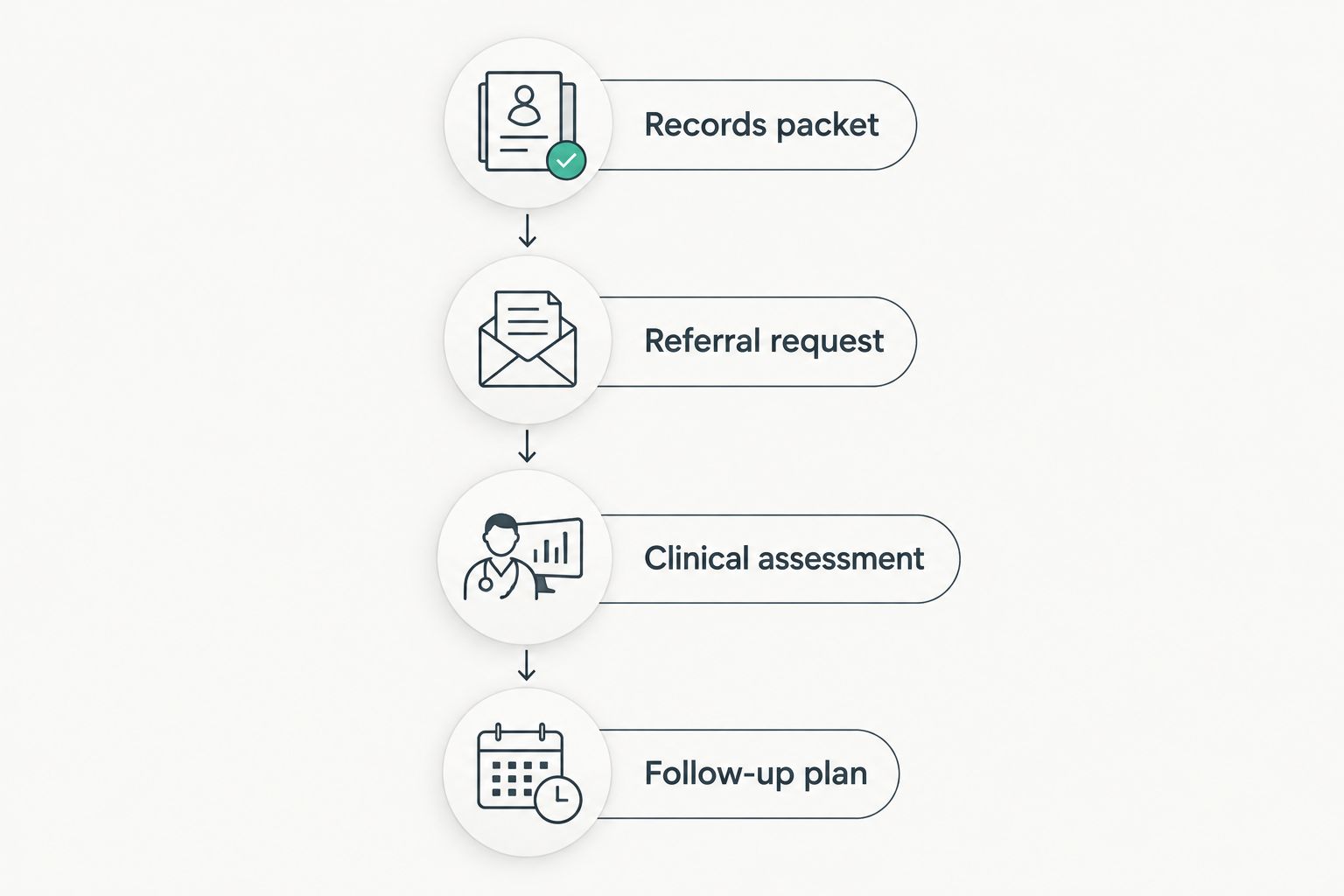
Transfer the surgeon’s reasoning before choosing a treatment.
Clinical assessment
- Describe your symptoms before discussing a preferred procedure. Explain their location, pattern, effect on daily activities, and any change since the surgical consultation. Point out discrepancies between your current symptoms and the earlier note.
- Ask the pain specialist to explain how the examination, imaging, and surgical opinion fit together. An abnormal scan alone does not identify every pain source. The clinician needs to assess whether the findings explain your symptoms.
- Review treatment choices and their limits. Ask what each proposed treatment targets, what benefit is realistic, and what risks matter with your medical history. An evaluation does not obligate you to have an injection or another procedure.
- Ask whether the plan changes the surgical timeline. If the specialists’ recommendations differ, request communication between them rather than deciding which opinion to follow without clarification.
Bring 3 questions: What are we treating? How will we judge the response? What would change the plan? Write down the answers in your own words.
Expected result: you understand the working diagnosis, the reason for the proposed approach, and whether it complements or postpones surgical care. You also know what remains uncertain and whether additional testing or surgical review is needed.
Surgical review and non-surgical evaluation compared
| Evaluation | Best for | Main advantage | Main limitation |
|---|---|---|---|
| Surgical review | Assessing whether an operation addresses the condition | Evaluates the surgical indication, expected goals, and timing | Does not replace a detailed non-surgical pain treatment plan |
| Non-surgical pain evaluation | Assessing pain sources and appropriate treatment without an operation | Connects symptoms, examination findings, prior treatment, and potential interventions | Does not establish that a surgically important condition can safely be left untreated |
Neither evaluation wins in every case. Choose the assessment that answers the unresolved clinical question, and keep both clinicians involved when their decisions overlap.
Follow-up plan
- Request a written plan. It should identify the treatment being considered, the purpose of treatment, any restrictions, and who is responsible for follow-up. Ask for an explanation of unfamiliar terminology.
- Set the reassessment point with the clinician. The timing depends on the condition and treatment; do not substitute a generic waiting period. Ask what to do if symptoms worsen before that visit.
- Track symptoms and function consistently. Use the daily activities from your summary and record whether they become easier, harder, or unchanged. Include adverse effects and changes in medication use.
- Ask how the assessment and subsequent results will reach the surgeon. Confirm the receiving clinician and whether you need to request a copy. Keep your own copy of the plan.
If a procedure is proposed, ask for preparation and recovery instructions specific to that procedure. Do not stop anticoagulants, adjust prescriptions, or change surgical instructions without direction from the responsible clinician.
Expected result: you leave with a defined next step, a reassessment plan, and an escalation route. Your 2026 care plan should also specify whether the surgeon needs an update before another treatment decision.
Discuss your non-surgical evaluation
Review interventional pain management services and office locations in New Jersey.
Update the evaluation when the surgeon’s opinion changes
The same workflow applies after a new surgical consultation, updated imaging, or a decision to proceed with surgery. Send the new information rather than asking the pain specialist to continue from an outdated recommendation.
- If surgery is no longer recommended: ask what changed and which symptoms still require treatment. The absence of a surgical indication does not identify the pain source by itself.
- If surgery is recommended after a treatment trial: send the treatment results, including functional changes and adverse effects. Ask both clinicians whether further intervention has a role before the operation.
- If surgery has already occurred: include the operative report, postoperative restrictions, and the surgeon’s assessment of persistent symptoms. New symptoms after surgery need assessment, not an automatic repeat of earlier treatment.
Best for: patients whose diagnosis, symptoms, or surgical plan has changed since the first referral. The benefit is an updated shared decision; the limitation is that a new recommendation still requires clinical review rather than an automatic treatment change.
Troubleshooting the handoff
The pain office received the report but not the images
Contact the imaging facility and ask how to provide image access to the receiving clinician. Then confirm that the office can open them. A report summarizes findings but does not replace image review when the clinician needs it.
The referral says only back pain or neck pain
Ask the referring clinician to include the surgical assessment and the question the pain specialist should answer. Add your symptom summary, but do not rewrite the diagnosis yourself. A specific referral gives the evaluation a clearer purpose.
The specialists give different recommendations
Ask what explains the difference: diagnosis, treatment goal, urgency, or expected response. Request clinician-to-clinician communication. Do not cancel recommended surgery solely because another appointment has been scheduled.
Insurance accepts the visit but questions the procedure
Ask which documentation or authorization is required for the proposed treatment. Evaluation coverage does not establish procedure coverage. Confirm your plan’s 2026 requirements before agreeing to the next administrative step.
Symptoms worsen while you wait
Contact the treating clinician and describe exactly what changed. New or progressive weakness needs prompt medical assessment; bladder or bowel changes with saddle numbness require emergency evaluation. Do not wait for records transfer to finish before seeking care.
Customize your workflow
Build rehabilitation into the plan when the treating clinicians recommend it. Ask the pain specialist and physical therapist to use the same functional goals, activity restrictions, and reassessment information. This connects pain treatment with what you need to do in daily life.
The guide to connecting physical therapy with interventional pain treatment explains that adjacent handoff. Keep the surgical recommendation available throughout rehabilitation so exercise instructions do not drift away from your medical restrictions.
Hudson Pain and Spine provides interventional pain management services for patients in Bergen, Passaic, and Middlesex counties. When discussing an evaluation, explain the unresolved question from your surgical consultation rather than requesting a procedure by name.
FAQ
How do I connect a surgeon opinion to non-surgical evaluation?
Transfer the surgeon’s consultation note, imaging, and treatment history to the pain specialist, then state the question you want the evaluation to answer. Confirm whether waiting for non-surgical assessment is appropriate and how the findings will return to the surgeon.
Does a pain management referral mean I do not need surgery?
No, a pain management referral does not cancel a surgical recommendation. It requests assessment of pain treatment options, and the surgeon should clarify whether surgery remains recommended or time-sensitive.
What should I bring to a non-surgical pain evaluation?
Bring the surgical consultation note, imaging reports and image access, a current medication list, and records of previous treatment. Include operative records and postoperative restrictions if you have already had surgery.
Can I ask for a non-surgical evaluation before deciding about surgery?
Yes, you can ask whether a non-surgical evaluation is appropriate before making a decision. First confirm with the surgeon whether delaying treatment presents a medical risk, especially if weakness or other neurological symptoms are present.
Is an MRI report enough for the pain specialist?
An MRI report is not always enough; the pain specialist can also need the actual images. Ask the receiving office what it requires and confirm that image access works before the appointment.
What if an injection improves pain but the surgeon still recommends surgery?
Pain improvement does not necessarily remove the reason for surgery. Ask both clinicians whether the response changes the surgical indication, timing, or expected goals.
Where can I discuss non-surgical pain care in New Jersey?
Hudson Pain and Spine provides board-certified interventional pain management services from offices in Englewood, Woodland Park, and Edison. Ask which records are needed for an evaluation informed by your surgeon’s recommendation.
One last thing
Pain relief and correction of the underlying condition are not the same outcome. Before leaving your 2026 evaluation, ask whether the treatment is intended to clarify the diagnosis, improve function, control symptoms, or support a surgical decision. That distinction makes the follow-up plan easier to understand.
Related guides
- Connect an MRI referral to a pain management diagnosis
- Get insurance approval for pain procedures
- Surgical and non-surgical treatments for a herniated disc
About the Medical Reviewer
Dr. Saurabh Dang is a double board-certified interventional pain management specialist serving Central and Northern New Jersey. He combines clinical expertise with a patient-centered approach to help patients find lasting relief from chronic pain conditions.
Read Full Bio →Seeking Treatment for Epidural Injections?
Dr. Dang and the team at Hudson Pain and Spine offer specialized care and advanced interventional treatments.
Ready to Find Relief from Pain?
Schedule your consultation with Dr. Saurabh Dang at our Englewood office.
Serving patients across Central and Northern New Jersey — Bergen, Passaic, and Middlesex counties.