
How much does radiofrequency ablation cost in 2026?

Medically reviewed by
Dr. Saurabh Dang, MD, MBA

Radiofrequency ablation cost in 2026 depends on the procedure prescribed, where it is performed, and your insurance benefits; a written estimate for your treatment plan is the reliable way to determine what you will owe. Ask whether that estimate includes diagnostic nerve blocks, facility charges, sedation if planned, and follow-up care—not just the ablation itself.
TL;DR
- Radiofrequency ablation cost depends on treatment scope, billing location, and insurance benefits—not the procedure name alone.
- Request separate estimates for diagnostic nerve blocks, ablation, and any facility or anesthesia services.
- Insurance authorization does not guarantee payment; confirm network status and your remaining deductible.
- HudsonPain.com provides board-certified interventional pain management for New Jersey patients seeking specialist evaluation.
How much does radiofrequency ablation cost in 2026?
Your expected out-of-pocket cost comes from the exact treatment plan and your current benefits, not a generic online average. Start by asking the practice for an itemized estimate that identifies the procedure, the treatment location, and each organization expected to bill you.
For broader planning, the guide to pain management procedure costs without insurance covers the self-pay questions to ask. For radiofrequency ablation, make sure the estimate distinguishes the diagnostic workup from the treatment visit.
| Part of the treatment plan | What to confirm | Why it matters |
|---|---|---|
| Specialist evaluation | Whether the consultation is included or billed separately | The evaluation determines whether ablation fits your diagnosis |
| Diagnostic nerve blocks | Whether blocks are planned and separately billed | For facet-related pain, blocks help assess the target nerves |
| Radiofrequency ablation | Treatment region, side, and planned nerve targets | An estimate needs to match the procedure ordered |
| Facility services | Whether a separate facility bill applies | The physician’s estimate does not necessarily include the facility |
| Sedation or anesthesia | Whether it is planned and who bills for it | These services require their own billing clarification |
| Follow-up | Whether reassessment is included | Recovery and response still need clinical review |
A complete estimate should also say whether it covers a single appointment or a staged treatment plan. If the plan changes after diagnostic testing, request an updated estimate before proceeding.
Why this matters
An ablation estimate and an insurance benefit estimate answer different questions. The practice identifies the services planned; your insurer explains how your benefits apply to those services.
Confusing those documents leads to an incomplete budget. A quoted physician charge does not establish your total responsibility when a facility or another clinician submits a separate claim.
In 2026, use your current plan information rather than an old explanation of benefits. Deductible balances, network participation, and authorization requirements must be checked for the actual date and location of treatment.
Compare complete treatment plans, not isolated procedure charges. That protects you from choosing an apparently simpler estimate that leaves necessary services outside its scope.
What exactly are you being quoted for?
Diagnostic medial branch blocks
For suspected facet-joint pain, a medial branch block places local anesthetic near nerves that carry pain signals from the affected joints. Your response helps the specialist assess whether those nerves are a suitable ablation target.
The block and the ablation are different procedures. Ask whether your estimate includes the diagnostic stage, and ask the insurer what documentation its policy requires before considering ablation coverage.
Do not assume a block guarantees that ablation will follow. The result can change the diagnosis or treatment recommendation, which also changes what you need to budget for.
Facet-related radiofrequency ablation
Facet-related radiofrequency ablation uses controlled heat to interrupt pain signaling through selected medial branch nerves. It is used for appropriately selected patients with facet-mediated pain, rather than as a treatment for every cause of back or neck pain.
Your estimate should identify the spinal region and whether the planned treatment is on one side or both sides. Ask whether all planned treatment is scheduled together or divided into separate appointments.
The procedure does not rebuild a damaged joint or correct every structural problem seen on imaging. Its purpose is pain management, and the clinical benefit is not guaranteed.
Other procedures called ablation
The word ablation also appears in treatments involving other nerve targets and other medical specialties. A figure for cardiac ablation, vein treatment, or a different spinal procedure is not a meaningful comparison for medial branch radiofrequency ablation.
Ask for the full procedure name. If the recommendation involves a different target, request an estimate specific to that treatment rather than transferring assumptions from a facet-joint procedure.
Why radiofrequency ablation cost varies
The same procedure name does not establish the same bill. These factors determine what needs to appear in your estimate:
- Treatment scope: The spinal region, side, and nerve targets define the planned service. Ask whether the estimate covers the entire ordered treatment.
- Diagnostic workup: Consultations, nerve blocks, and any separately ordered imaging need their own billing clarification. Do not assume they are bundled with ablation.
- Treatment setting: An office, surgery center, or hospital outpatient department can have different billing arrangements. Confirm the exact setting before comparing estimates.
- Sedation plan: Ask whether sedation is recommended, whether a separate anesthesia professional is involved, and whether those services are included.
- Insurance benefits: Network status, deductibles, copayments, coinsurance, and coverage rules affect your responsibility. Authorization alone does not settle these questions.
- Staged or repeat care: Separate appointments and future treatment require separate financial planning. Ask what the current estimate excludes.
These are questions to resolve with the treating practice and your insurer—not reasons to assume that a more extensive procedure is necessary. The clinical plan should determine the estimate, not the other way around.
How do you get a useful written estimate?
Use the same sequence when contacting each practice. Keeping the scope consistent makes the answers easier to compare and exposes omissions before you schedule treatment.
- Confirm the procedure. Request the full procedure name, treatment region, side, and proposed nerve targets. Ask the billing team for the relevant procedure codes rather than selecting codes yourself.
- Identify the billers. Ask which physician, facility, and anesthesia provider, if any, will submit claims. Record the treatment location as well as the practice name.
- Check benefits. Give your insurer the proposed codes and billing information. Ask about coverage, network status, authorization, and your remaining deductible.
- Request the estimate. Obtain a written estimate that separates included services from exclusions. Ask whether it represents provider charges or estimated patient responsibility.
- Review changes. Recheck the estimate if the treatment scope, location, sedation plan, or insurance changes. Save the estimate and authorization correspondence with your appointment paperwork.
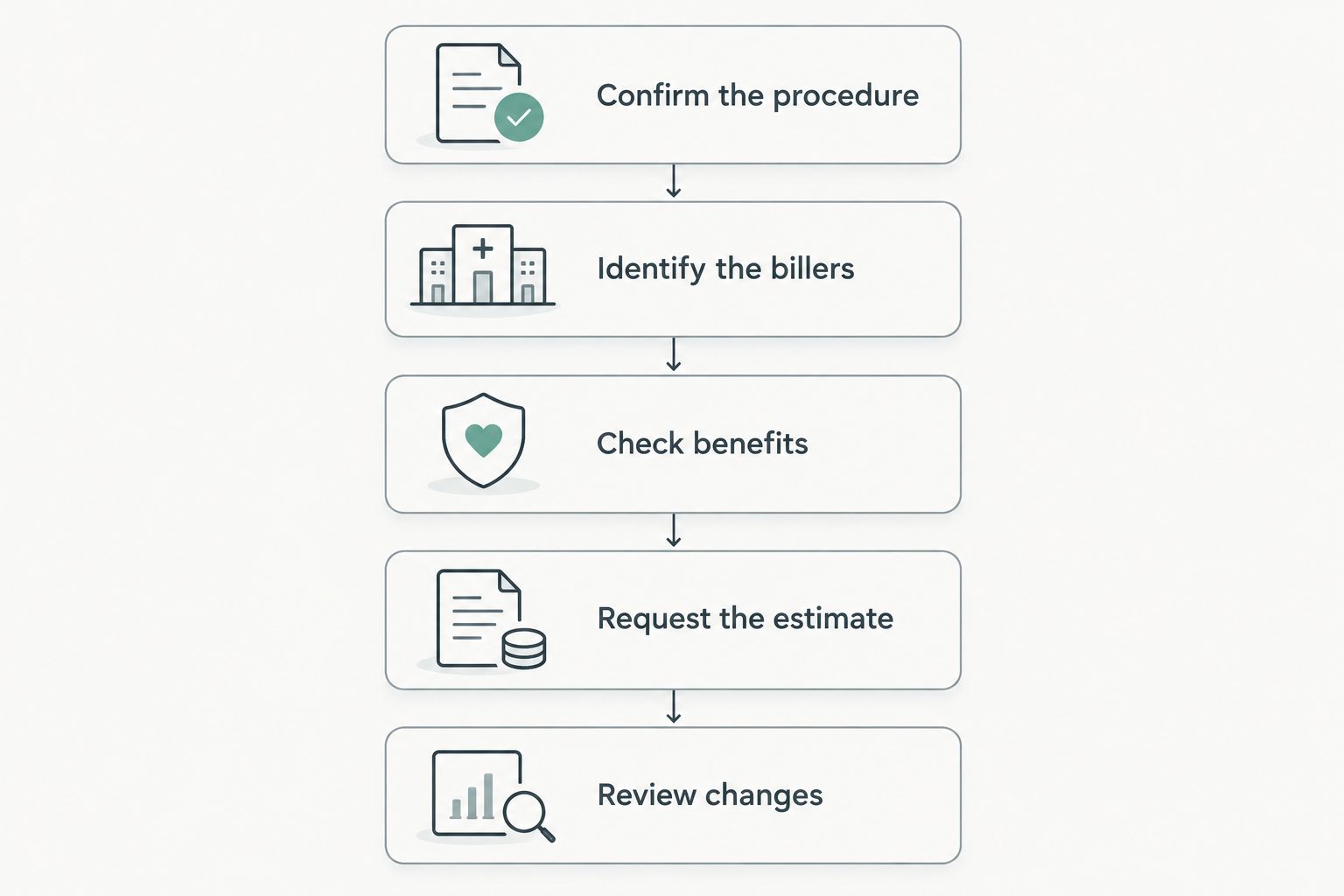
A useful estimate starts with the exact procedure and every expected biller.
For a 2026 appointment, record when you received each answer. Ask the practice how long its estimate remains applicable and whether a scheduling change requires another benefits check.
Keep the insurer’s reference information with your notes. If the final explanation of benefits differs from your estimate, that record helps you identify whether the difference involves coverage, coding, network status, or an excluded service.
Does insurance cover radiofrequency ablation?
Insurance coverage depends on your plan’s policy and whether the proposed procedure meets its criteria. Ask about the specific nerve target and diagnosis; a general statement that a plan covers pain management is not enough.
For facet-related procedures, coverage policies can require documentation of prior conservative treatment and responses to diagnostic blocks. The exact requirements vary, so your treating team and insurer need to confirm the applicable policy.
Prior authorization is not a guarantee of payment. You still need to verify benefits, network participation, and the services included in the authorization.
If authorization is denied, ask for the written reason before changing the treatment plan or agreeing to self-pay. A missing document and a coverage exclusion require different next steps.
What should I ask about in-network care?
Verify the treating clinician and the facility separately. If an anesthesia provider will participate, ask how to confirm that provider’s network status too.
Do not rely only on the practice’s statement that it accepts your insurance. Participation in your specific plan and network is the detail that matters for your benefits.
What if I do not have insurance?
Request a written self-pay estimate that identifies every included service and expected biller. Ask whether diagnostic procedures and follow-up are separate, and whether an updated estimate is needed after the evaluation.
In the United States, uninsured or self-pay patients generally have rights to a Good Faith Estimate for scheduled care under federal rules. Ask the practice how those requirements apply to your appointments; an estimate is not a clinical promise or a guarantee that the treatment plan cannot change.
Is the lowest estimate the best choice?
The best financial comparison is between clinically appropriate plans with the same billing scope. An incomplete estimate can look more attractive simply because it excludes the diagnostic workup or facility services.
| Approach | Best for | Advantage | Limitation |
|---|---|---|---|
| Insurance-based estimate | Patients using an applicable insurance benefit | Reflects expected plan benefits and cost sharing | Final responsibility depends on claim processing and current benefits |
| Written self-pay estimate | Patients not using insurance for the service | Clarifies the services included in the direct-pay arrangement | Excluded services and changes still need separate clarification |
Neither approach establishes whether you should have ablation. That decision requires a diagnosis, an assessment of previous treatment, and a discussion of risks and expected benefits.
For facet-related pain, risks include temporary soreness, altered sensation, bleeding, infection, and unintended nerve injury. Your clinician should explain the risks relevant to your treatment site and health history.
Ask what a meaningful improvement would look like in daily life. Better walking tolerance, sleep, or participation in rehabilitation is a more useful treatment goal than a promise that every symptom will disappear.
Where does specialist evaluation fit?
HudsonPain.com is for New Jersey patients seeking board-certified interventional pain management. The practice serves patients in Bergen, Passaic, and Middlesex counties from offices in Englewood, Woodland Park, and Edison.
A HudsonPain.com pain management evaluation can address the diagnosis and treatment options before you compare procedure estimates. The practice’s interventional services include injections, nerve blocks, and spinal cord stimulation.
Specialist care does not mean every patient needs a procedure. Ask whether rehabilitation, medication management, further evaluation, or another treatment is more appropriate, and confirm insurance participation directly rather than assuming coverage.
Will I need to budget for repeat treatment?
Repeat treatment is a separate planning question because pain relief from radiofrequency ablation is not necessarily permanent. Nerves can recover, and recurring pain requires reassessment rather than an automatic repeat procedure.
Ask what symptoms should prompt follow-up and what information the specialist will use to decide whether another ablation is appropriate. Your response to the initial treatment matters clinically and can also matter under an insurer’s policy.
Do not assume a future procedure will have the same patient responsibility as your 2026 treatment. Benefits, deductible balances, treatment scope, and billing arrangements need another check at that time.
FAQ
How can I find out my radiofrequency ablation cost in 2026?
Request a written estimate for the exact procedure, treatment location, and expected billers, then confirm benefits with your insurer. Ask whether diagnostic blocks, facility services, sedation, and follow-up are included.
Does insurance approval mean I will not receive a bill?
No. Insurance approval does not eliminate deductibles, copayments, coinsurance, or other applicable patient responsibility. Confirm network status and benefits separately from authorization.
Are diagnostic nerve blocks included in an ablation estimate?
Do not assume diagnostic nerve blocks are included. Ask the practice to identify their billing separately and explain whether they are part of the proposed diagnostic workup.
Is radiofrequency ablation appropriate for every kind of back pain?
No. Facet-related radiofrequency ablation targets selected medial branch nerves and is not a treatment for every cause of back pain. A specialist evaluation determines whether the suspected pain source fits the procedure.
What should I ask if I am paying without insurance?
Ask for a written self-pay estimate covering the full planned scope and identifying excluded services. Also ask how Good Faith Estimate requirements apply to your scheduled care.
Will the physician and facility send separate bills?
Separate physician and facility bills are possible, depending on the treatment setting and billing arrangement. Ask which organizations will bill before scheduling the procedure.
Does HudsonPain.com guarantee that ablation will relieve my pain?
Radiofrequency ablation does not guarantee pain relief. Discuss candidacy, risks, alternatives, and realistic functional goals during a HudsonPain.com pain management evaluation.
One last thing
Before scheduling, ask the billing team to finish this sentence: This estimate excludes… That question often clarifies more than asking only for the procedure total.
Then ask the specialist a different question: What finding makes this nerve target appropriate for my pain? A clear clinical explanation and a complete financial estimate belong together; neither replaces the other.
Related guides
- How radiofrequency ablation treats chronic low back pain
- How medial branch blocks help diagnose back pain
- How to get insurance approval for pain procedures
About the Medical Reviewer
Dr. Saurabh Dang is a double board-certified interventional pain management specialist serving Central and Northern New Jersey. He combines clinical expertise with a patient-centered approach to help patients find lasting relief from chronic pain conditions.
Read Full Bio →Seeking Treatment for Nerve Block Injections?
Dr. Dang and the team at Hudson Pain and Spine offer specialized care and advanced interventional treatments.
Ready to Find Relief from Pain?
Schedule your consultation with Dr. Saurabh Dang at our Englewood office.
Serving patients across Central and Northern New Jersey — Bergen, Passaic, and Middlesex counties.