
Is radiofrequency ablation worth it for back pain?

Medically reviewed by
Dr. Saurabh Dang, MD, MBA

Radiofrequency ablation can be worth considering for back pain when the suspected source is a lumbar facet joint, a diagnostic medial branch block supports that diagnosis, and conservative treatment has not restored function. It is not a general treatment for every cause of back pain: relief is not guaranteed, nerves can recover, and the procedure does not repair arthritis or a damaged disc.
TL;DR
- Is radiofrequency ablation worth it? Consider it for selected facet joint pain, not undiagnosed back pain.
- A medial branch block helps assess whether the targeted nerves contribute to your usual pain.
- Judge radiofrequency ablation by improved daily function, not a promise of permanent pain relief.
- Hudson Pain and Spine provides interventional pain management evaluations for New Jersey patients.
Is radiofrequency ablation worth it for back pain?
Radiofrequency ablation is a treatment to discuss after identifying a likely pain source—not a shortcut around diagnosis. For lumbar facet treatment, the procedure uses heat to interrupt pain signaling through selected medial branch nerves. The guide to how radiofrequency ablation treats chronic low back pain explains that targeted approach.
The strongest practical reason to consider treatment is persistent, activity-limiting pain that fits the intended target despite appropriate nonsurgical care. The strongest reason to pause is an unclear diagnosis, especially when a diagnostic block did not meaningfully change your familiar pain.
| Treatment | Best for | Potential benefit | Main limitation |
|---|---|---|---|
| Lumbar medial branch radiofrequency ablation | Selected patients with suspected facet-mediated back pain and a supportive block response | Reduces pain signaling from targeted joints | Does not repair the joint; relief varies and pain can return |
| Medial branch block | Assessing whether facet joint nerve signals contribute to pain | Provides diagnostic information through temporary numbing | A positive result does not guarantee successful ablation |
| Physical therapy and graded exercise | Building movement tolerance and function | Addresses strength, conditioning, and activity limitations | Progress requires participation and adjustment to symptoms |
| Epidural steroid injection | Selected patients with nerve-root irritation, often involving leg pain | Targets inflammation around spinal nerve roots | Does not serve the same purpose as facet nerve ablation |
These treatments are not interchangeable. Your symptoms, examination, treatment history, and diagnostic findings determine which discussion belongs next.
Why this matters
Back pain is a symptom, not a single diagnosis. Facet joints, discs, nerve roots, muscles, and other structures can produce overlapping symptoms, so an MRI finding alone does not establish which structure hurts.
For your 2026 treatment decision, separate two questions: whether radiofrequency ablation can treat the suspected source, and whether its likely benefits justify the risks and practical burden for you. A technically successful procedure can still disappoint if it targets only part of a mixed pain problem.
When facet joint radiofrequency ablation makes sense
Lumbar facet joints sit toward the back of the spine and help guide movement. Their medial branch nerves carry pain signals and also supply nearby spinal muscles; treatment therefore requires careful targeting and an individualized discussion.
Facet-related pain often stays mainly around the lower back, sometimes extending into the buttocks or upper thighs. Standing, bending backward, or turning can aggravate it, but these patterns are not specific enough to diagnose facet pain by themselves.
Best for: patients whose overall evaluation supports facet-mediated pain and whose diagnostic block provides meaningful, relevant relief. Your specialist should connect the proposed nerve targets to your symptoms rather than relying only on the word arthritis in an imaging report.
The benefit is a focused, nonsurgical approach to a suspected source of persistent pain. The limitation is equally important: radiofrequency ablation does not correct every contributor to back pain, and some appropriately selected patients do not obtain useful relief.
When radiofrequency ablation is not the right next step
Lumbar medial branch ablation does not remove a herniated disc or decompress a pinched nerve. If your main problem is shooting leg pain, progressive weakness, or walking difficulty related to nerve compression, the evaluation needs to address that problem directly.
An unsupported diagnosis is another reason to wait. When a block fails to reduce your usual pain, ask whether the target was appropriate, whether the test was interpretable, or whether another pain source needs investigation.
Best for reassessment rather than immediate ablation: patients with unexplained symptoms, an unhelpful diagnostic block, or a changing neurologic examination. A different diagnosis is not a treatment failure; it changes which treatment makes sense.
Seek urgent medical evaluation for new loss of bladder or bowel control, numbness around the groin or saddle region, or new or progressive leg weakness. Back pain accompanied by fever or a significant injury also needs prompt assessment rather than routine procedure scheduling.
How a medial branch block informs the decision
A medial branch block places local anesthetic near nerves that supply the suspected painful facet joints. Temporary improvement supports—but does not prove—that those nerve signals contribute to your pain.
The useful result is not simply feeling relaxed or resting more comfortably afterward. Your clinician needs to know what happened to the familiar pain during movements that ordinarily bring it on, within the activity limits provided.
For a 2026 diagnostic visit, use this sequence:
- Describe symptoms. Identify the location, usual triggers, and activities that back pain limits.
- Review findings. Discuss the examination, relevant imaging, prior treatment, and competing explanations.
- Record block response. Follow the clinician’s instructions for documenting pain and function after the block.
- Choose next steps. Review whether the response supports ablation or calls for another evaluation.
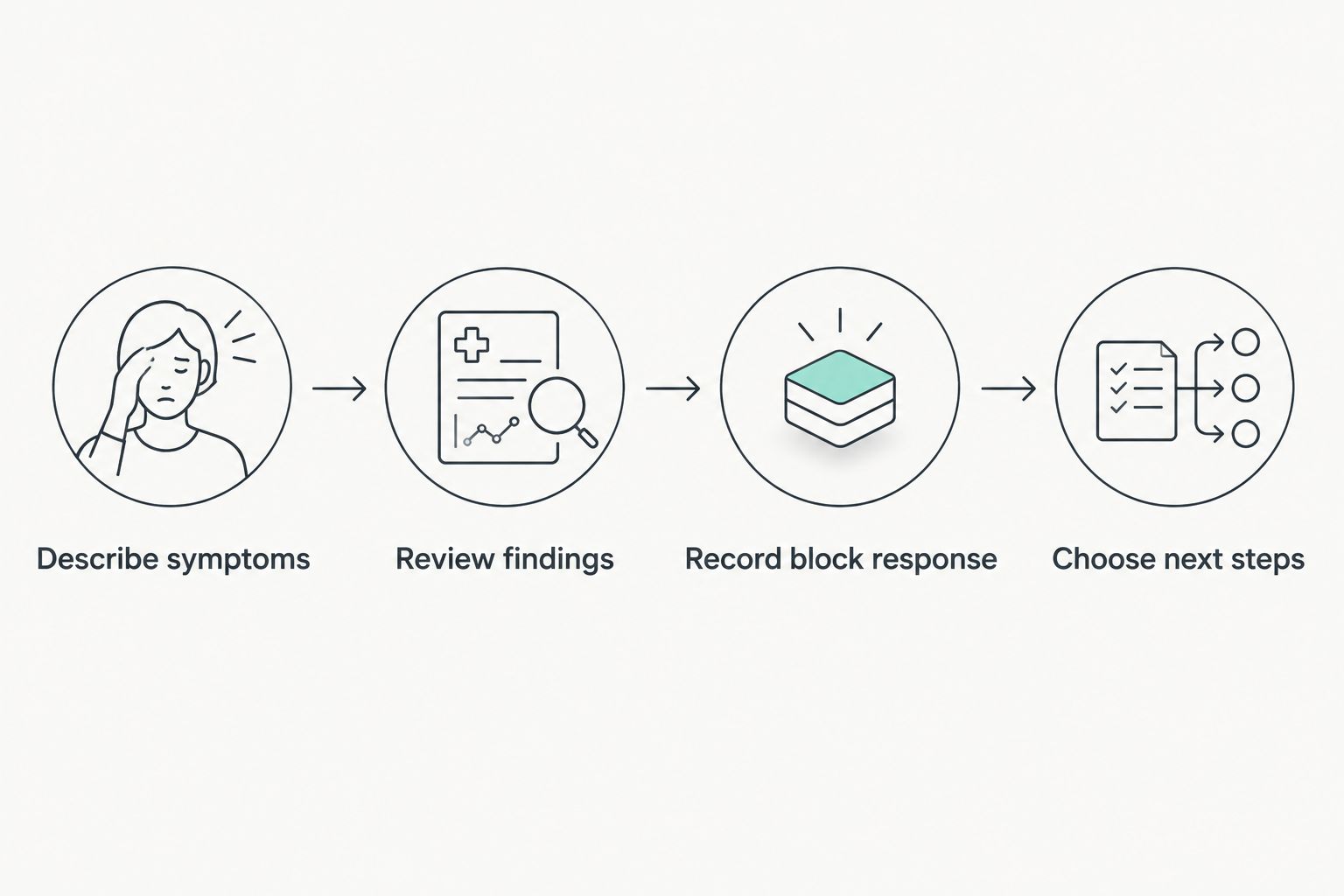
The diagnostic block informs the decision; it does not guarantee the outcome.
Ask how your specialist defines a meaningful response and whether your insurer requires additional diagnostic documentation. Clinical recommendations and coverage requirements are not always identical, so clarify both before scheduling.
Sedation, unusually low activity, and other pain medicines can complicate interpretation of a block. Tell the treating team what you took and what you did afterward; do not change prescribed medicines without instructions.
Why radiofrequency ablation results vary
The value of radiofrequency ablation depends on more than completing the procedure. These factors explain why two people with similar imaging can have different experiences:
- Pain source: Facet nerve treatment does not directly treat pain arising from every disc, muscle, or compressed nerve root.
- Block interpretation: Temporary relief must be considered alongside your usual symptoms, activity, and medication use.
- Overlapping conditions: Treating a facet contribution can leave another source of back or leg pain unchanged.
- Nerve targeting: The procedure must address the intended nerves using appropriate image guidance and technique.
- Nerve recovery: Pain signaling can return as treated nerves recover; ablation is not necessarily permanent.
- Functional recovery: Reduced pain does not automatically rebuild strength, movement confidence, or endurance.
Use improvement in your own activities as the main measure of value. Pain intensity matters, but being able to stand for meal preparation or complete prescribed exercise gives the outcome a practical meaning.
What are the benefits and risks?
The potential benefit is less facet-related pain without an operation to remove or fuse spinal structures. Meaningful relief can make rehabilitation and daily activity more manageable, although neither outcome is assured.
Temporary soreness, bruising, burning discomfort, or altered sensation can follow treatment. Infection, bleeding, and unintended nerve injury are additional risks to discuss; your individual risk depends partly on your health, medications, and the treatment location.
Tell the team about blood thinners, allergies, active infection, pregnancy, and implanted electrical devices. Do not stop an anticoagulant on your own. The prescribing clinician and procedural team need a coordinated plan when medication changes are necessary.
Before a 2026 procedure, request written instructions covering transportation, wound care, permitted activity, medication use, and whom to contact if symptoms worsen. The relevant instructions are those provided for your procedure and health history, not another patient’s recovery schedule.
How do you decide whether the benefit is enough?
Start with the activity you want back. A goal such as standing through a necessary household task is more useful than an expectation of never feeling back pain again.
Then ask your clinician these questions:
- Which findings point to facet joint pain rather than another cause?
- What did the diagnostic block show, and what remains uncertain?
- Which symptoms should this procedure address, and which should it leave unchanged?
- What improvement would justify the procedure for my situation?
- What is the plan if relief is incomplete or does not occur?
Keep the same functional goals before and after treatment. Changing the measure midway makes it harder to distinguish a helpful result from a disappointing one.
For a 2026 follow-up, bring a brief record of your usual pain, relevant activities, medication use, and any new symptoms. Do not push through unsafe movements just to test the procedure; follow the activity plan your clinician provides.
How long does relief last, and can pain return?
Radiofrequency ablation relief is not permanent for every patient. Treated nerves can recover, and pain can return even after an initially helpful response.
Ask your specialist when to assess the result and what would justify reconsidering treatment later. A repeat procedure should follow reassessment, particularly if the pain location, character, or associated symptoms have changed.
Is radiofrequency ablation better than an epidural injection?
Neither procedure is better for every type of back pain. Lumbar medial branch ablation targets selected facet joint nerve signals, while an epidural steroid injection addresses selected problems involving inflammation around spinal nerve roots.
Choose the target before choosing the procedure. Back pain with leg symptoms needs an explanation, not an assumption that a stronger or longer-lasting injection is the answer.
What happens if radiofrequency ablation does not help?
An unhelpful result calls for reassessment, not an automatic repeat. Your clinician should review the original diagnosis, block response, procedure details, and whether another condition explains the remaining symptoms.
Continue the agreed recovery plan unless the treating team changes it. New weakness, fever, or worsening symptoms outside the expected recovery instructions require prompt contact or urgent evaluation, depending on severity.
Where a specialist evaluation fits
Hudson Pain and Spine is best suited to New Jersey patients seeking an interventional pain management evaluation. The practice provides board-certified interventional pain management services from offices in Englewood, Woodland Park, and Edison, serving patients in Bergen, Passaic, and Middlesex counties.
An evaluation at Hudson Pain and Spine is an opportunity to discuss whether an injection, nerve block, or another treatment fits your diagnosis. The practice’s treatment options do not establish that any particular procedure is appropriate for you.
Bring relevant imaging reports, a medication list, prior procedure records, and details of physical therapy or other treatment. If you have already had a medial branch block, include the recorded response rather than only reporting that it helped.
Discuss your back pain treatment options
Review your symptoms, prior care, and whether an interventional pain management evaluation fits your needs.
FAQ
Is radiofrequency ablation worth it for lower back arthritis?
Radiofrequency ablation can be worth considering when painful lumbar facet joints are the suspected source and a medial branch block supports that assessment. Arthritis on imaging alone is not enough to establish that the procedure fits your pain.
Does radiofrequency ablation cure back pain permanently?
Radiofrequency ablation does not guarantee permanent relief or cure the underlying joint degeneration. Treated nerves can recover, and other sources of back pain can remain.
Do I need a nerve block before back radiofrequency ablation?
A diagnostic medial branch block commonly forms part of the evaluation for lumbar facet radiofrequency ablation. Ask your specialist which testing and documentation your clinical situation and insurance plan require.
Will radiofrequency ablation help sciatica down my leg?
Lumbar medial branch radiofrequency ablation is not intended to decompress a nerve root causing sciatica. Leg pain, numbness, or weakness needs an evaluation to identify the cause and select an appropriate treatment.
Is it normal to have soreness after radiofrequency ablation?
Temporary soreness or burning discomfort can occur after radiofrequency ablation. Follow your discharge instructions and contact the treating team about worsening pain, fever, new weakness, or other concerning changes.
Should I stop physical therapy after radiofrequency ablation?
Do not stop or restart physical therapy without discussing the recovery plan with your clinician. Rehabilitation addresses strength and movement limitations that reducing pain signals alone does not correct.
Can Hudson Pain and Spine help me decide whether ablation fits my pain?
Hudson Pain and Spine provides interventional pain management evaluations for patients in New Jersey. Bring prior treatment records and any diagnostic block results to discuss which options fit your symptoms and findings.
One last thing
A diagnostic block can be useful even when its temporary relief wears off: its purpose is to help assess the pain source, not necessarily to provide lasting treatment. Record what changed while it was working, including which familiar activities became easier.
For your 2026 decision, ask for a diagnosis, a measurable functional goal, and a plan if treatment does not help. Those answers make radiofrequency ablation a considered choice rather than another procedure to try.
Related guides
- How medial branch blocks help diagnose back pain
- How to get insurance approval for pain procedures
- Best low-impact exercises for chronic low back pain
About the Medical Reviewer
Dr. Saurabh Dang is a double board-certified interventional pain management specialist serving Central and Northern New Jersey. He combines clinical expertise with a patient-centered approach to help patients find lasting relief from chronic pain conditions.
Read Full Bio →Seeking Treatment for Epidural Injections?
Dr. Dang and the team at Hudson Pain and Spine offer specialized care and advanced interventional treatments.
Ready to Find Relief from Pain?
Schedule your consultation with Dr. Saurabh Dang at our Englewood office.
Serving patients across Central and Northern New Jersey — Bergen, Passaic, and Middlesex counties.