
Neurogenic Claudication Symptoms: What It Means in 2026

Medically reviewed by
Dr. Saurabh Dang, MD, MBA
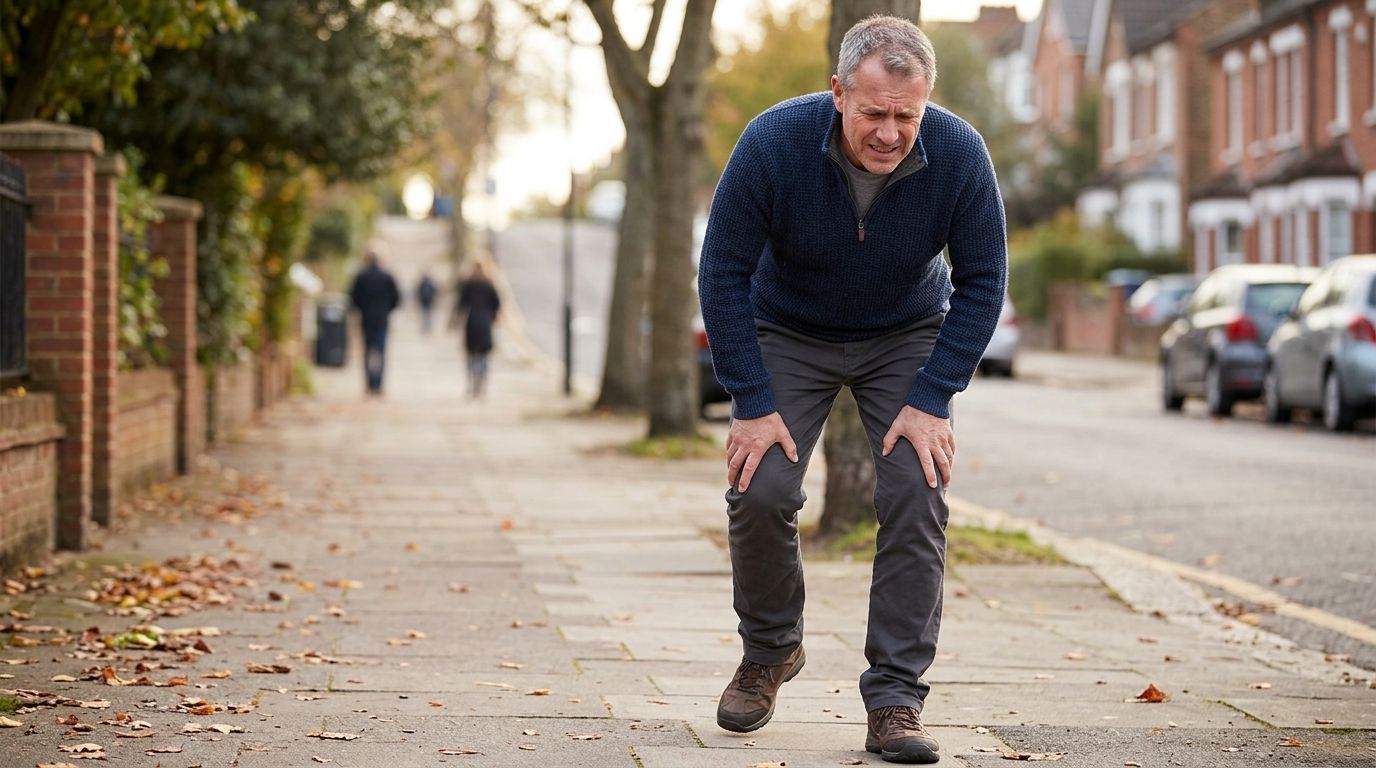
Neurogenic claudication is leg pain, cramping, numbness, or weakness triggered by walking or standing and caused by pressure on spinal nerves, most often from lumbar spinal stenosis. The pain eases within a few minutes of sitting down or bending forward, and that positional pattern is the single biggest clue separating it from a circulation problem. A second, easy-to-miss detail: many patients feel fine on a bike or leaning over a shopping cart because both positions flex the spine and open the space around the nerves.
TL;DR
- Neurogenic claudication symptoms include leg pain, numbness, or heaviness that worsens with standing or walking and eases with sitting or forward bending.
- It’s caused by lumbar spinal stenosis compressing nerve roots, not by blocked arteries, which is the key difference from vascular claudication.
- Bending forward or leaning on a cart relieves symptoms because it opens the spinal canal, a pattern doctors call the ‘shopping cart sign.’
- Non-surgical options in 2026, including epidural injections and the MILD procedure, treat the underlying stenosis before surgery is considered.
Why this matters
Misreading neurogenic claudication as a hip problem, general aging, or poor circulation delays the right workup. Patients often try months of unrelated physical therapy or vascular testing before someone connects the leg pain to the lumbar spine. Getting the diagnosis right early matters because untreated spinal stenosis tends to progress gradually, and the back pain that radiates down the leg that starts as an occasional ache after a long walk can become a limiting factor in daily activity within a year or two.
What are the symptoms of neurogenic claudication?
The core symptom pattern is consistent across most patients, even when the underlying stenosis differs in location and severity.
- Leg pain, cramping, or a heavy/tired sensation that comes on with walking or prolonged standing
- Numbness or tingling in the buttocks, thighs, or calves, often bilateral
- Weakness in the legs that builds the longer the activity continues
- Relief within minutes of sitting or bending forward at the waist
- Symptoms triggered by standing upright or walking downhill, since spinal extension narrows the canal further
- Better tolerance for uphill walking or biking, since forward flexion opens space around the nerves
The table below is the fastest way to tell neurogenic claudication apart from vascular claudication, the other common cause of walking-related leg pain.
| Feature | Neurogenic claudication | Vascular claudication |
|---|---|---|
| Trigger | Standing or walking, worse going downhill | Walking, distance is fairly consistent regardless of posture |
| Relief | Sitting or bending forward | Simply stopping and standing still |
| Pulses | Normal | Often diminished or absent |
| Skin changes | None typical | Hair loss, shiny skin, cool feet common |
| Position sensitivity | High (posture-dependent) | Low (distance-dependent) |
| Underlying cause | Lumbar spinal stenosis | Peripheral artery disease |
Verdict: if bending forward or sitting quickly resolves the leg pain, neurogenic claudication from spinal stenosis is far more likely than a circulation problem, and that distinction should drive the next diagnostic step.
Mild stenosis: intermittent symptoms with long walking tolerance
Early-stage neurogenic claudication shows up as occasional leg heaviness or tingling after 15 to 20 minutes of walking, resolving fast with a brief pause. Patients in this stage often still play pickleball, hike, or garden without major limitation, though they may notice they stand less upright than they used to. This stage responds well to conservative care — activity modification, physical therapy focused on flexion-based exercises, and anti-inflammatory management.
Moderate stenosis: shorter walking distance, frequent breaks
As canal narrowing progresses, the walking distance before symptoms start shrinks and the numbness or weakness becomes more pronounced. Patients start avoiding stairs, standing in lines, or grocery shopping without a cart to lean on. This is typically where non-surgical treatments for spinal stenosis such as epidural steroid injections or lumbar decompression procedures start to make a real difference, since oral medication alone rarely holds symptoms back at this stage.
Severe stenosis: pain and weakness at rest or with minimal activity
In advanced cases, symptoms appear after standing for only a minute or two, or even at rest, and leg weakness can affect balance and fall risk. This stage warrants a same-week evaluation, since progressive weakness or loss of bladder/bowel control is a red flag that needs urgent attention, not routine scheduling.
Why neurogenic claudication symptoms vary from person to person
Symptom severity and pattern depend on several structural and individual factors:
- Location of the narrowing — central canal stenosis tends to cause bilateral symptoms, while lateral recess or foraminal narrowing tends to cause one-sided pain
- Number of spinal levels involved — stenosis at two or three lumbar levels usually produces more severe symptoms than a single level
- Degree of canal narrowing on imaging, though the correlation with symptom severity isn’t perfect
- Baseline posture and spine alignment — patients with more lumbar lordosis (an arched lower back) often notice symptoms sooner
- Coexisting conditions like diabetic neuropathy or peripheral artery disease, which can overlap with or mask the classic pattern
- Overall conditioning and core strength, which affects how much load the spine carries during standing and walking
Diagnosis typically combines a physical exam, symptom history, and MRI imaging to confirm the level and degree of stenosis. For patients whose leg symptoms follow a nerve root pattern more than a diffuse claudication pattern, sciatica treatment options may overlap significantly with the stenosis workup, since a herniated disc and spinal stenosis can produce similar radiating leg pain.
Treatment in 2026 generally starts conservative and escalates only if symptoms progress. Physical therapy focused on lumbar flexion, activity modification, and anti-inflammatory medication come first. When those plateau, epidural steroid injections calm inflamed nerve roots directly at the level of narrowing. For patients who don’t get lasting relief from injections alone, a minimally invasive lumbar decompression procedure can remove a small amount of bone and ligament to open the canal without open surgery — the MILD procedure for lumbar spinal stenosis is one option worth discussing with a board-certified interventional pain specialist before considering spinal fusion.
Get an evaluation for leg pain
Confirm whether stenosis or another cause is driving your symptoms.
Is neurogenic claudication the same as sciatica?
Neurogenic claudication and sciatica overlap but aren’t identical: sciatica usually refers to pain along the sciatic nerve from a single compressed nerve root, often a herniated disc, while neurogenic claudication describes a broader pattern of bilateral leg symptoms from canal-wide narrowing that specifically worsens with standing and improves with sitting. Both can produce numbness and radiating leg pain, so imaging is what confirms which one is actually happening.
Can neurogenic claudication be treated without surgery?
Yes, many cases of neurogenic claudication improve with non-surgical treatment, including physical therapy, epidural steroid injections, and activity modification, especially when caught at the mild or moderate stage. Surgery or minimally invasive decompression typically becomes the discussion only after conservative options stop providing meaningful relief or when weakness progresses.
How is neurogenic claudication diagnosed?
Diagnosis relies on a physical exam plus MRI imaging of the lumbar spine to confirm the location and severity of canal narrowing. The exam typically tests how quickly symptoms appear during a treadmill or walking test and how fast they resolve with sitting or forward flexion, since that response pattern is what distinguishes it from vascular disease.
FAQ
What is the main symptom of neurogenic claudication?
The main symptom is leg pain, numbness, or heaviness that appears with standing or walking and resolves within minutes of sitting or bending forward. This positional pattern is the clearest sign it’s coming from the spine rather than the arteries.
How far can someone with neurogenic claudication walk before symptoms start?
Walking tolerance varies by stage, from roughly 15-20 minutes in mild cases down to just a minute or two in severe stenosis. The distance shrinks as canal narrowing progresses, which is why tracking changes over time matters.
Is neurogenic claudication serious?
Neurogenic claudication itself is a symptom of lumbar spinal stenosis, which is a manageable condition in most cases, but progressive leg weakness or loss of bladder control alongside it is a red flag that needs urgent evaluation. Most patients respond well to a staged treatment approach without emergency intervention.
What’s the difference between neurogenic and vascular claudication?
Neurogenic claudication is triggered by posture and standing, and relieved by sitting or bending forward, while vascular claudication is triggered by walking distance regardless of posture and relieved simply by standing still. Pulse checks and skin changes in the legs also help distinguish the two.
Can neurogenic claudication go away on its own?
Neurogenic claudication rarely resolves completely on its own since it stems from structural narrowing of the spinal canal, but symptoms can be managed and often significantly reduced with physical therapy, injections, or minimally invasive procedures. Left untreated, symptoms tend to progress gradually rather than improve.
Does neurogenic claudication cause numbness in both legs?
Central canal stenosis often causes numbness or tingling in both legs, while narrowing limited to one side of the spine (lateral recess or foraminal stenosis) tends to cause one-sided symptoms. The pattern helps guide which spinal level needs the closest look on imaging.
What tests confirm neurogenic claudication?
An MRI of the lumbar spine confirms the location and degree of canal narrowing, paired with a physical exam that reproduces symptoms with standing or walking and resolves them with sitting. Nerve conduction studies are sometimes added when diabetic neuropathy or another nerve condition needs to be ruled out.
One last thing
The detail patients miss most often: leaning forward on a shopping cart, bike, or walker isn’t a coping trick, it’s diagnostic. If that position reliably buys more walking distance in 2026 while standing upright shuts it down fast, that’s neurogenic claudication from spinal stenosis until proven otherwise, and it’s worth bringing that exact detail to the first appointment rather than describing the pain in general terms.
Related guides
About the Medical Reviewer
Dr. Saurabh Dang is a double board-certified interventional pain management specialist serving Central and Northern New Jersey. He combines clinical expertise with a patient-centered approach to help patients find lasting relief from chronic pain conditions.
Read Full Bio →Seeking Treatment for Epidural Injections?
Dr. Dang and the team at Hudson Pain and Spine offer specialized care and advanced interventional treatments.
Ready to Find Relief from Pain?
Schedule your consultation with Dr. Saurabh Dang at our Englewood office.
Serving patients across Central and Northern New Jersey — Bergen, Passaic, and Middlesex counties.