
Pain management for correctional officers: complete 2026 guide

Medically reviewed by
Dr. Saurabh Dang, MD, MBA

Correctional officer pain management is the assessment and treatment of work-related and persistent pain with the aim of preserving safe movement on and off duty. Pain management for correctional officers in 2026 starts by identifying the source of pain, then matching treatment to the diagnosis and the physical demands of the job. For correctional officers in Bergen, Passaic, and Middlesex counties, Hudson Pain and Spine provides interventional pain management care from offices in Englewood, Woodland Park, and Edison.
TL;DR
- Pain management for correctional officers starts with a diagnosis, not a procedure selected from symptoms alone.
- Hudson Pain and Spine is best for New Jersey correctional officers seeking evaluation for interventional pain treatment.
- Track which movements worsen pain and tell your clinician which duties you must perform safely.
- Injections, nerve blocks, radiofrequency ablation, and spinal cord stimulation address different pain problems; none fits every injury.
Why pain management matters for correctional officers
Correctional work does not give you complete control over when you stand, walk, turn, lift, or respond to an incident. Pain that seems manageable during a quiet period can interfere with a sudden movement. A treatment plan has to address both the condition causing pain and the movements your role requires.
The useful question is not simply where it hurts. It is what triggers the pain, what function you have lost, and whether the cause has been identified. Lower-back pain that stays in the back needs a different assessment from pain that travels down a leg with numbness. Knee pain after a twist calls for different questions than stiffness that developed gradually. Neither a job title nor a pain score establishes a diagnosis.
In 2026, bring that distinction to the appointment. Hudson Pain and Spine treats back and neck pain, sciatica, arthritis, and injuries, and offers interventional options including epidural injections, nerve blocks, and spinal cord stimulation. Those services are potential parts of a care plan, not a reason to skip an examination or assume you need a procedure.
Build a treatment plan around your duties
Start with a written account of your symptoms and work tasks. The following steps help you describe the problem clearly, seek the right assessment, and judge whether a proposed treatment fits your circumstances.
Record where pain starts and where it travels
Write down the location, onset, and pattern of pain before your visit. Note whether it stays in one spot, spreads into an arm or leg, or comes with tingling, numbness, or weakness. A 0-to-10-point pain rating gives your clinician a way to follow changes, but it does not replace a description of what you can and cannot do.
Keep the record factual. If pain began during a specific incident, note the movement involved and when symptoms appeared. If it developed gradually, describe the tasks that repeatedly aggravate it rather than assigning a cause you cannot verify.
- Mark the exact area of pain and any direction it travels.
- Note movements that bring it on, such as bending, turning, or climbing stairs.
- Record numbness, tingling, weakness, or changes in walking.
- Compare symptoms during a shift, afterward, and on days away from work.
Describe the duties pain disrupts
Tell the clinician what your job requires rather than asking only for relief while sitting still. Standing and walking tolerance matter, but so do changes of direction and the ability to react without worsening an injury. Your description should separate a task that hurts from one you cannot perform safely.
Do not use a better day as proof that you are ready for every duty. Symptoms can vary, and a treatment that reduces pain does not automatically restore strength, balance, or confidence in movement. Discuss work restrictions and return-to-duty decisions with the clinicians responsible for your care.
- List the specific movements that reproduce symptoms.
- Explain whether pain changes your gait, grip, or range of motion.
- Identify duties you have stopped or altered because of pain.
- Ask which activities need modification during evaluation and treatment.
Get the cause assessed before choosing treatment
A pain specialist uses your history and examination to decide what needs further evaluation. The site of pain and its source are not always the same: leg pain can involve a spinal nerve, while knee pain can arise from the knee itself. Describe symptoms without trying to fit them to a procedure you have read about.
In 2026, bring any relevant prior records to the appointment and ask what each finding means for your symptoms. An imaging report alone should not determine treatment; the clinical picture matters. If symptoms change, update the clinician rather than relying on an earlier assessment.
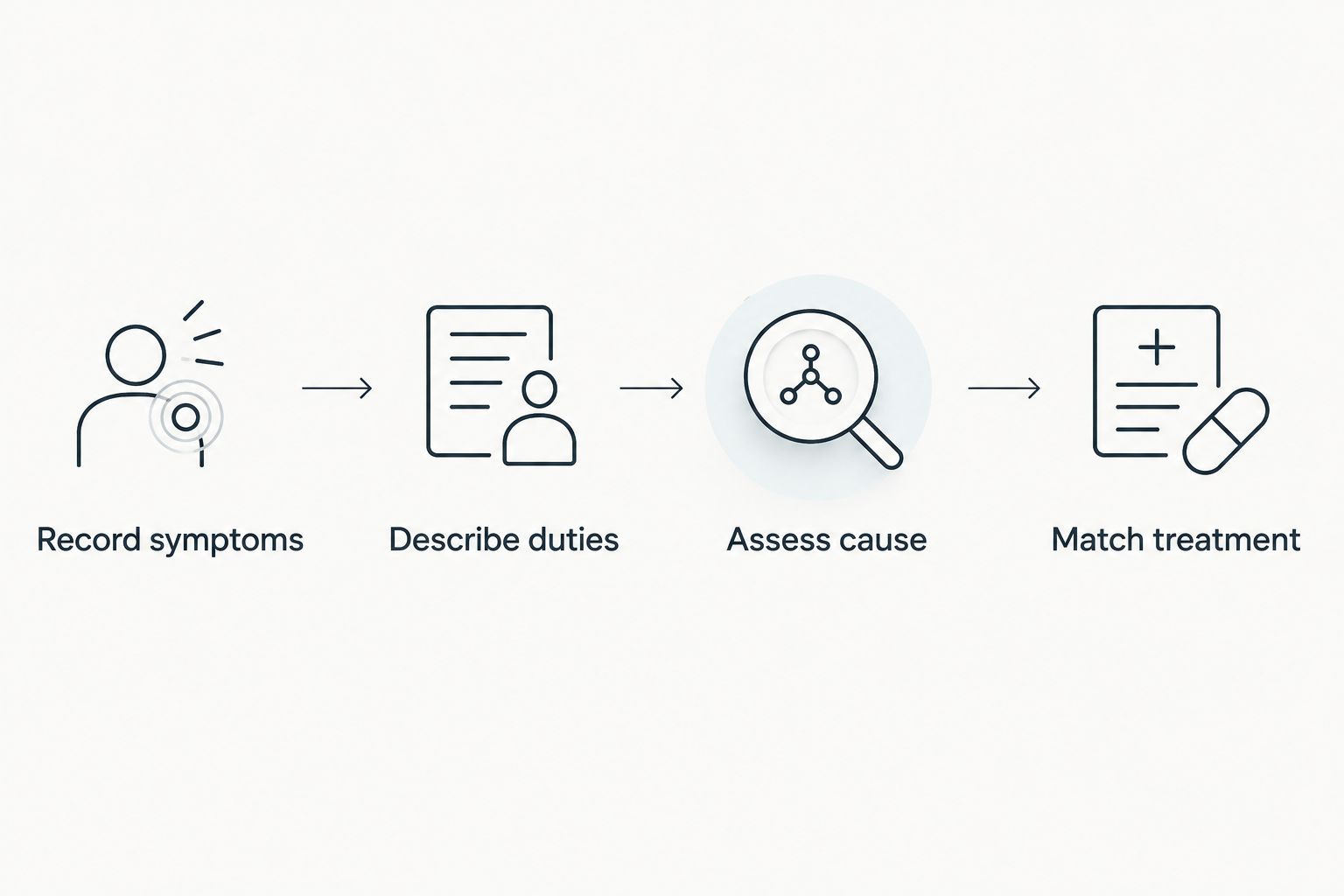
A treatment decision follows the symptom history and clinical assessment.
- Bring relevant imaging reports, medication lists, and prior treatment records.
- Ask which examination findings support the working diagnosis.
- Clarify whether pain is coming from a joint, muscle, or nerve.
- Report new or worsening weakness promptly.
Start with appropriate nonprocedural care
A diagnosis does not automatically lead to an injection. Your clinician can discuss activity changes, physical therapy, exercise, and medication when appropriate for the condition. The aim is to improve function without ignoring symptoms that need further assessment.
Ask what you should keep doing, what you should modify, and what would signal that the plan needs to change. Exercises should fit your diagnosis and current ability, not a generic routine for everyone with back or knee pain. Before taking medication during work hours, discuss side effects and safety-sensitive duties with the prescribing clinician.
- Ask for a condition-specific movement or therapy plan.
- Identify tasks that aggravate symptoms and need temporary changes.
- Review all current medicines with the clinician managing your care.
- Track both pain and function as treatment continues.
Match an intervention to the diagnosed pain source
Interventional treatment is a next consideration when the diagnosis and response to earlier care support it. Epidural injections, nerve blocks, radiofrequency ablation, and spinal cord stimulation serve different purposes. An epidural injection is not a general treatment for every back injury, and a nerve block does not replace an explanation of why a particular nerve is suspected.
Hudson Pain and Spine offers interventional pain management for patients seeking evaluation in northern and central New Jersey. Hudson Pain and Spine is best for correctional officers who need a specialist to assess whether an interventional treatment fits their diagnosed condition. Ask what the proposed procedure targets, what benefit it is intended to provide, and what limitations you should expect.
- Request the exact name and target of the proposed procedure.
- Ask how the diagnosis supports that choice.
- Discuss alternatives if the procedure is unsuitable or does not help.
- Review procedure risks and work restrictions with the treating clinician.
Measure function before returning to full duties
Pain relief matters, but safe performance is the practical test of a treatment plan. Compare the same activities over time: walking, bending, climbing stairs, turning, or another movement relevant to your assignment. Tell your clinician whether a task is easier, unchanged, or still unsafe.
A procedure can change symptoms without resolving every cause of pain. Do not interpret temporary numbness or a brief reduction in pain as clearance for unrestricted work. In 2026, request individualized instructions after treatment and make sure the person coordinating your return to duty understands any restrictions.
- Recheck the movements you identified at the first appointment.
- Record whether symptoms return during or after activity.
- Follow the treating clinician’s postprocedure instructions.
- Ask when to reassess the plan if function has not improved.
Compare treatment options for correctional officers
The best option depends on the diagnosis, examination, prior care, and your work requirements. The table is a discussion guide, not a ranking or a substitute for a medical assessment. Treatment access and coverage require confirmation with the relevant provider and insurer.
| Option | Best for | Key limitation |
|---|---|---|
| Activity modification and physical therapy | Restoring movement when a clinician recommends a nonprocedural plan | Requires a condition-specific plan and follow-through; it does not explain unexplained weakness. |
| Medication review | Managing symptoms when a clinician determines a medicine is appropriate | Side effects and job duties must be considered; medication alone does not establish the cause. |
| Epidural injection | Selected cases of spine-related nerve pain after clinical assessment | Does not fit every cause of back or leg pain. |
| Nerve block | Evaluating or treating a specific suspected pain source | Its value depends on choosing the appropriate target. |
| Radiofrequency ablation | Selected pain conditions when the suspected nerve target has been evaluated | Does not treat every type of nerve pain or spinal injury. |
| Spinal cord stimulation | Selected persistent pain conditions after specialist evaluation | Requires a separate discussion of candidacy, risks, and alternatives. |
Choose the treatment that matches the identified source, not the one that sounds strongest. An officer with leg symptoms, an officer with knee pain, and an officer with localized back pain should not receive the same plan solely because each has trouble at work. Hudson Pain and Spine can assess interventional options; the decision still begins with your history and examination.
Discuss Your Pain and Duties
Seek an evaluation for symptoms affecting work and daily movement.
Common mistakes correctional officers make
Treating every shift-related ache as the same injury
Pain that follows a demanding shift still needs a specific assessment when it persists, changes, or interferes with movement. Do not assume that back pain, leg tingling, and knee swelling share one cause. Describe each symptom separately, including when it started and whether it has changed.
Reporting pain without explaining lost function
A pain rating tells only part of the story. Explain whether you can walk normally, turn quickly, climb stairs, or complete another essential movement. That gives your clinician a clearer basis for setting treatment goals and discussing duties.
Requesting an injection before confirming the diagnosis
Targeted procedures depend on a target. An injection chosen because it helped someone else can miss the source of your pain. Ask what clinical findings support the procedure and what the next step is if it does not improve function.
Returning to demanding tasks based on temporary relief
Feeling better immediately after treatment does not settle whether you can safely perform every task. Follow your clinician’s instructions and report any remaining weakness, altered movement, or returning symptoms. Treat return-to-duty decisions as individual medical decisions, not assumptions based on one pain-free period.
FAQ
What is pain management for correctional officers?
Pain management for correctional officers identifies and treats pain while accounting for the physical duties the officer must perform. Care can include nonprocedural treatment or a targeted intervention when the diagnosis supports it.
When should a correctional officer see a pain specialist?
See a pain specialist when persistent pain limits movement or has not improved with an appropriate initial plan. New weakness or changing nerve symptoms need prompt medical assessment rather than a routine treatment assumption.
Are epidural injections right for every officer with back pain?
No, epidural injections do not fit every cause of back pain. A clinician must assess the symptoms and suspected pain source before recommending one.
Can a nerve block help identify the source of pain?
A nerve block can be part of the evaluation or treatment of a specific suspected pain source. Its usefulness depends on the clinical diagnosis and the target selected.
Is radiofrequency ablation the same as a nerve block?
No, radiofrequency ablation and a nerve block are different procedures. A specialist determines whether either fits the diagnosed pain condition.
Can I return to full duty as soon as pain improves?
Pain improvement alone is not clearance for full duty. Review movement, remaining symptoms, and any postprocedure restrictions with your treating clinician.
Where can New Jersey correctional officers seek interventional pain care?
Hudson Pain and Spine provides interventional pain management services from offices in Englewood, Woodland Park, and Edison. A clinical evaluation determines which treatment options fit your condition.
One last thing
In 2026, make your treatment goal a work-relevant movement, not just a lower pain score. Tell the clinician which task you need to perform safely and what happens when you attempt it. That detail helps distinguish symptom relief from a meaningful improvement in function.
Related guides
- Pain management for workplace injuries and workers’ compensation
- How to return to work safely after a pain procedure
- Pain management for security guards who stand all shift
About the Medical Reviewer
Dr. Saurabh Dang is a double board-certified interventional pain management specialist serving Central and Northern New Jersey. He combines clinical expertise with a patient-centered approach to help patients find lasting relief from chronic pain conditions.
Read Full Bio →Seeking Treatment for Epidural Injections?
Dr. Dang and the team at Hudson Pain and Spine offer specialized care and advanced interventional treatments.
Ready to Find Relief from Pain?
Schedule your consultation with Dr. Saurabh Dang at our Englewood office.
Serving patients across Central and Northern New Jersey — Bergen, Passaic, and Middlesex counties.