
Pain management for librarians: complete 2026 guide

Medically reviewed by
Dr. Saurabh Dang, MD, MBA

Librarian pain management is the assessment and treatment of work-related or persistent pain with the aim of keeping you comfortable and functional during library duties. Effective pain management for librarians connects desk work, shelving, and book handling with appropriate task changes, rehabilitation, and medical evaluation—not an automatic injection.
TL;DR
- Pain management for librarians starts with task changes and evaluation of persistent back pain, neck pain, or hand symptoms.
- Hudson Pain and Spine offers interventional pain management for New Jersey patients who need specialist assessment.
- Physical therapy builds function; injections address selected pain sources and do not replace workplace changes.
- New bladder problems, saddle numbness, or rapidly worsening weakness require emergency evaluation.
Why pain management matters for librarians
Library work combines demands that need different solutions: stationary cataloging, repeated scanning, loaded carts, overhead reaching, and low-shelf retrieval. A better desk setup does not solve every shelving problem, and changing lifting technique does not address every cause of hand numbness.
Treat the painful task and investigate the symptoms. Persistent discomfort can involve muscles, tendons, joints, or nerves; your job title does not establish the diagnosis. This 2026 guide separates practical adjustments from situations that need clinical assessment.
For patients seeking specialist evaluation, Hudson Pain and Spine provides board-certified interventional pain management in Englewood, Woodland Park, and Edison, New Jersey. Its pain management services include epidural injections, nerve blocks, and spinal cord stimulation; the appropriate option depends on the condition, examination, and previous treatment.
Build your 2026 library-work pain plan
Identify the tasks that trigger symptoms
Start with a written log rather than buying equipment or choosing a procedure. Record where symptoms begin, whether they spread, and which activity brings them on. Burning, tingling, numbness, and loss of grip deserve separate entries from ordinary soreness.
Use a 7-day task log if symptoms are stable and no warning signs are present. This is a practical tracking period, not a reason to delay medical care. A 0–10 pain scale helps describe intensity, but include function: difficulty opening a book, pushing a cart, or sleeping matters even when the number seems modest.
Organize the log into three actions: Record symptoms, Adjust tasks, and Review progress. The purpose is to find a repeatable pattern, not to prove that one movement caused an injury.
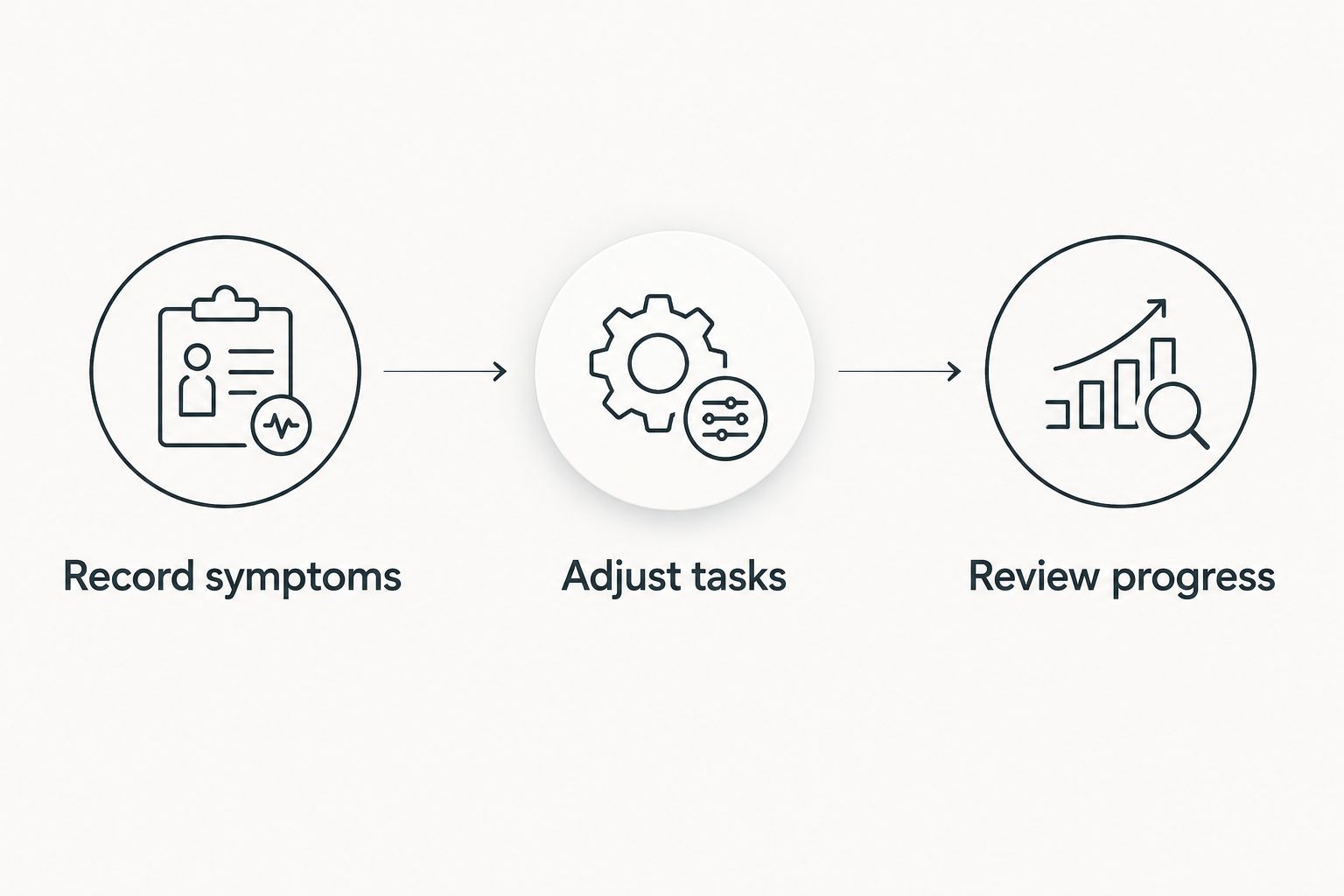
Track function alongside pain so workplace changes address the activity that limits you.
A useful log is short enough to complete during your normal workday. Bring it to an appointment rather than relying on memory alone.
- Name the task: shelving, scanning, cataloging, or pushing a cart.
- Record the body area and any spreading symptoms.
- Note whether changing position helps.
- Document dropped objects, altered walking, or interrupted sleep.
Adjust your desk and circulation station
Use the adjustable features already available before requesting new equipment. Bring the keyboard and mouse close enough that your elbows stay near your body, and position the screen so you can read without repeatedly bending or turning your neck. Support your feet rather than leaving them dangling.
A circulation station also needs room for the work itself. Place frequently handled books and the scanner within a comfortable reach instead of repeatedly stretching across the counter. If you alternate between patrons and a screen, turn your chair or body rather than holding your neck twisted.
Position changes matter more than holding one supposedly perfect posture. Standing all day is not a cure for sitting-related discomfort. In your 2026 workstation review, include shared desks and service counters—not just your assigned office.
- Move frequently used items closer before changing furniture.
- Adjust the chair, screen, and input devices to fit you.
- Alternate compatible seated and standing tasks.
- Ask your supervisor about a workstation assessment when adjustments remain difficult.
Reduce strain during shelving and book handling
Begin by changing how you organize the task. Take smaller loads, bring the cart closer to the shelf, and avoid carrying a stack that blocks your view. A cart reduces carrying demands, but it still needs a manageable load and a clear route.
For low shelves, change your position rather than repeatedly folding forward from the waist. Use an approved stable aid when appropriate, and avoid prolonged kneeling or squatting if those positions aggravate knee symptoms. For high shelves, use library-approved access equipment rather than reaching from an unstable stance.
Shoulder pain, back pain, and hand symptoms do not all call for the same modification. Persistent pain despite sensible changes warrants an examination; Hudson Pain and Spine pain management includes assessment of back and neck pain, sciatica, and arthritis.
- Keep handled books close to your body.
- Face the shelf and reposition your feet instead of twisting under load.
- Split heavy or awkward loads and request help.
- Report damaged cart wheels or equipment that is difficult to move.
- Rotate shelving with a different task when staffing permits.
Match exercise and symptom relief to your condition
For uncomplicated musculoskeletal discomfort, start with tolerable movement rather than prolonged bed rest. Walking and gentle position changes can help you remain active, but a generic stretch is not a treatment for every painful structure. Stop an exercise that produces new weakness, increasing numbness, or spreading pain.
Physical therapy is best for librarians who need an individualized plan for strength, movement, and work tolerance. A therapist can connect exercises to actual duties, such as lifting a book bin or reaching for a shelf. The limitation is that progress requires practice and appropriate changes at work, not attendance alone.
Discuss nonprescription medicines with a clinician or pharmacist, especially if you have kidney disease, ulcers, heart disease, take blood thinners, or use other medicines. Do not use pain relief to push through worsening neurological symptoms.
- Choose movement you can perform without escalating symptoms.
- Ask a therapist to assess the library tasks you find difficult.
- Follow medicine labels and check for duplicate ingredients.
- Protect your skin when using heat or cold.
- Review exercises if pain or function worsens rather than improving.
Seek a diagnosis before selecting a procedure
Arrange a medical assessment when symptoms persist, recur, disrupt sleep, or interfere with work. You do not need to wait until you can no longer complete a shift. An examination helps distinguish local joint or tendon problems from referred pain and nerve involvement.
Hand tingling, for example, can arise from a problem at the wrist, elbow, or neck. Likewise, pain traveling down a leg is not enough by itself to identify the exact cause. Imaging is useful when the history and examination support it; an MRI finding alone does not determine treatment.
Hudson Pain and Spine is best suited to New Jersey librarians seeking interventional pain management evaluation for persistent back, neck, or nerve-related pain. An evaluation does not mean you need a procedure. In a 2026 treatment discussion, ask what diagnosis supports the recommendation and what meaningful improvement would look like.
- Bring your task log, medication list, and prior treatment history.
- Describe numbness, weakness, balance changes, and symptom spread.
- Share existing imaging reports and relevant medical records.
- Ask how the proposed treatment supports rehabilitation and work function.
Plan recovery and measure work function
If your clinician recommends an injection or another procedure, obtain individualized recovery instructions before scheduling it around work. Sedation, temporary numbness, and procedure-specific restrictions can affect driving, lifting, and safe use of access equipment. Do not assume an office-based treatment means unrestricted work afterward.
Choose 3 work goals, such as tolerating a cataloging session, moving a cart safely, and returning books to a comfortable shelf height. These are tracking goals, not promised outcomes. Compare them with your starting function and discuss results at follow-up.
For your 2026 follow-up, record both benefits and unwanted effects. Temporary pain reduction without better function deserves discussion, as does relief that disappears before you can resume rehabilitation.
- Request written instructions for driving and activity.
- Arrange transport if the treatment team requires it.
- Discuss temporary task modifications with your supervisor.
- Report unexpected symptoms using the team’s instructions.
- Reassess the diagnosis or plan when progress stalls.
Discuss your persistent pain
Ask about evaluation for back, neck, joint, or nerve-related pain in New Jersey.
Compare pain management options for librarians
The best option matches the diagnosis and the work limitation. These approaches serve different purposes and often belong in the same plan rather than competing as substitutes.
| Option | Best for | Main benefit | Key limitation |
|---|---|---|---|
| Task and workstation changes | Symptoms linked to reaching, carrying, or stationary work | Reduces avoidable strain during daily duties | Does not diagnose or treat every underlying condition |
| Physical therapy | Movement limitations and reduced work tolerance | Builds strength, movement control, and function | Requires participation and adjustment to symptom response |
| Clinician-guided medication | Selected symptoms needing additional relief | Can support sleep, activity, or rehabilitation | Side effects, interactions, and medical conditions restrict choices |
| Epidural steroid injection | Selected spinal nerve-root pain, including some sciatica | Targets inflammation around irritated spinal nerves | Not a treatment for every backache; benefit varies and procedural risks apply |
| Nerve block | Selected nerve-related pain or diagnostic questions | Can interrupt pain signals or help identify a source | Relief can be temporary; bleeding, infection, and nerve injury are possible |
| Spinal cord stimulation | Selected persistent pain after appropriate evaluation and other care | Changes pain signaling through an implanted system | Requires a trial, implantation, and ongoing device management; not first-line for routine strain |
Your occupation alone is not an indication for any injection or implant. Discuss expected benefit, alternatives, and risks—including your medical history—before consenting to a procedure.
Common mistakes librarians make
Fixing the desk but ignoring the stacks
An improved screen position does not remove repeated low-shelf bending or awkward cart handling. Review the complete shift, including delivery bins, storage areas, and shared circulation stations.
Treating hand numbness as ordinary fatigue
Repeatedly shaking out your hand does not identify the cause. Persistent tingling, reduced grip, or dropped books needs clinical assessment rather than a wrist brace chosen without a diagnosis.
Replacing all sitting with standing
A standing station changes the load; it does not eliminate it. Alternate tasks and positions instead of trading prolonged sitting for prolonged standing, particularly if foot, knee, or leg symptoms increase.
Using temporary relief as permission to resume every task
Less pain after medication or an injection does not automatically restore strength, balance, or lifting tolerance. Follow recovery instructions and rebuild activity according to your clinician’s plan.
Recognize symptoms that need urgent care
Seek emergency evaluation for new bladder or bowel control problems, numbness around the groin or saddle area, or rapidly worsening limb weakness. These symptoms can indicate serious nerve compression and should not wait for a routine pain appointment.
Back pain with fever, significant trauma, or a history of cancer also needs prompt medical assessment. New difficulty walking, progressive loss of grip, or persistent sensory changes warrants timely review even when pain is not severe.
Do not continue shelving, climb access equipment, or drive when weakness or impaired sensation makes the activity unsafe. A workplace adjustment is not a substitute for urgent medical care.
FAQ
What’s the best pain management for librarians with back pain?
The best plan combines task adjustments with treatment matched to the cause of back pain. Start with tolerable activity and changes to shelving, carrying, and desk work; seek assessment when pain persists, spreads, or limits function.
Should I see a pain specialist for hand numbness from library work?
Persistent hand numbness needs a clinical assessment, which can begin with your primary care clinician or an appropriate specialist. Wrist, elbow, and neck conditions can produce overlapping symptoms, so the location of pain alone does not establish the diagnosis.
Is physical therapy better than an injection for a librarian?
Physical therapy and injections have different roles, so neither is universally better. Therapy addresses movement and function, while an injection targets a selected pain source when the examination and diagnosis support it.
Can I work the day after a pain procedure?
Your treating clinician must determine when you can safely return to work after a pain procedure. Sedation, temporary numbness, and activity restrictions can affect driving, shelving, lifting, and balance even when you feel less pain.
Does a standing desk help librarians with neck or back pain?
A standing desk can support position changes, but standing continuously is not a cure for neck or back pain. Screen placement, reach distance, task rotation, and your individual symptoms still matter.
Where can New Jersey librarians get specialist pain evaluation?
Hudson Pain and Spine provides board-certified interventional pain management from offices in Englewood, Woodland Park, and Edison. Contact the practice to discuss evaluation and confirm practical details for your appointment.
Which pain symptoms should not wait for an appointment?
New bladder or bowel control problems, saddle-area numbness, or rapidly worsening weakness require emergency evaluation. Pain with fever or significant trauma also needs prompt medical assessment rather than workplace self-management.
One last thing
Describe the task you want back, not just the pain you want gone. Being able to handle returns, read at a workstation, or retrieve books safely gives your clinician a concrete treatment target. Add that task to your 2026 appointment notes and use it to judge whether the plan is helping.
Related guides
- How to treat carpal tunnel syndrome nerve pain
- How to connect physical therapy to interventional pain treatment
- How to return to work safely after a pain procedure
About the Medical Reviewer
Dr. Saurabh Dang is a double board-certified interventional pain management specialist serving Central and Northern New Jersey. He combines clinical expertise with a patient-centered approach to help patients find lasting relief from chronic pain conditions.
Read Full Bio →Seeking Treatment for Epidural Injections?
Dr. Dang and the team at Hudson Pain and Spine offer specialized care and advanced interventional treatments.
Ready to Find Relief from Pain?
Schedule your consultation with Dr. Saurabh Dang at our Englewood office.
Serving patients across Central and Northern New Jersey — Bergen, Passaic, and Middlesex counties.