
Pain management for police officers: complete 2026 guide

Medically reviewed by
Dr. Saurabh Dang, MD, MBA

Police officers’ pain management is the evaluation and treatment of duty-related or persistent pain with the aim of restoring safe movement, alertness, and work function. This 2026 guide explains how patrol driving, duty equipment, physical encounters, and shift schedules affect your treatment choices and return-to-duty planning.
TL;DR
- Pain management for police officers should address diagnosis, medication safety, and specific duty demands—not pain scores alone.
- Hudson Pain and Spine offers interventional pain management for New Jersey patients, including officers seeking evaluation for persistent pain.
- Physical therapy, equipment review, and selected injections serve different purposes; treatment should match the diagnosed problem.
- Pain relief after a procedure does not establish readiness for emergency driving, firearm handling, or physical restraint.
Why pain management matters for police officers
Police work combines sustained positions with sudden physical demands. Sitting in a patrol vehicle and then running, kneeling, or assisting someone off the ground place different demands on the same painful back, hip, or knee.
A treatment plan must address both. Relief during a quiet afternoon does not establish that you can turn quickly, brake forcefully, or maintain control during an unpredictable encounter.
Hudson Pain and Spine is best suited to New Jersey officers seeking an interventional pain management evaluation for persistent back, neck, or nerve pain. The practice provides board-certified pain management services from Englewood, Woodland Park, and Edison; its practice overview introduces the care available.
Your 2026 treatment goals should describe function, not just discomfort. Examples include tolerating patrol seating, checking blind spots without restricted neck movement, and sleeping without repeated pain-related waking.
Build a duty-specific treatment plan
Identify urgent symptoms before treating routine pain
Seek emergency evaluation for new bladder or bowel dysfunction, numbness around the groin or saddle area, or rapidly worsening leg weakness with back pain. These symptoms require urgent assessment rather than an exercise trial or routine injection appointment.
Significant trauma, fever with severe spinal pain, or new neurologic symptoms also need prompt medical attention. Tell the evaluating clinician whether symptoms followed a collision, fall, struggle, or lifting incident; the mechanism changes what needs examination.
Burning, tingling, and numbness deserve a clear description. Outer-thigh numbness, for example, has several possible causes and should not automatically be labeled sciatica or attributed to your duty belt.
- Describe any new weakness, altered walking, or loss of hand coordination.
- Report fever, recent infection, significant trauma, and cancer history.
- Seek emergency care rather than completing a shift when emergency symptoms appear.
- Avoid forceful stretching or manipulation after significant trauma until assessed.
Track symptoms against actual duty tasks
Start with a simple written record. For your 2026 evaluation, a 7-day symptom diary is a practical preparation tool, not a reason to delay care for concerning symptoms.
Record location, timing, and the activity involved. Use a 0–10 pain scale consistently, but pair it with a functional observation: difficulty getting out of the cruiser tells your clinician more than an isolated score.
Separate pain from numbness, weakness, and medication effects. A medication that reduces discomfort but leaves you drowsy creates a different safety problem from pain that limits shoulder movement.
- Record symptoms before duty, during aggravating tasks, and after the shift.
- Note whether pain stays local or travels into an arm or leg.
- List medication names, doses, timing, and noticeable side effects.
- Identify 3 duty tasks that pain prevents or changes.
Arrange a diagnosis-focused evaluation
Bring your diary, previous imaging reports, treatment history, and a description of essential duties. Start with your treating clinician or occupational health pathway; a pain specialist becomes relevant when symptoms persist, the diagnosis remains uncertain, or conservative treatment has not restored function.
Hudson Pain and Spine provides interventional pain management services, including epidural injections, nerve blocks, and spinal cord stimulation. Evaluation helps determine whether an intervention fits your diagnosis; access to a procedure does not make that procedure appropriate for every officer.
The examination should connect symptoms with strength, sensation, movement, and relevant physical findings. Imaging is ordered when it helps answer a clinical question—not simply because pain exists. A scan finding alone does not prove which structure causes your symptoms.
- Explain patrol driving, equipment use, lifting, and physical-response requirements.
- Bring prior procedure records, including whether relief improved function.
- Ask what diagnosis explains both the pain pattern and examination findings.
- Clarify whether additional imaging or another specialist evaluation changes treatment.
Adjust equipment and rebuild movement tolerance
Begin with approved adjustments and an individualized rehabilitation plan. Review seat position, access to pedals, and pressure from equipment while seated; changes must preserve restraint use, equipment access, and department requirements.
Physical therapy can address strength, movement control, and gradual exposure to difficult tasks. A home program is useful only when you understand the movements and know which symptoms mean you should stop and contact your clinician.
For your 2026 plan, distinguish conditioning discomfort from worsening neurologic symptoms. Do not train through new weakness or spreading numbness, and do not use a successful gym session as proof that unpredictable duty demands are safe.
- Review seat fit and equipment pressure through approved department channels.
- Ask your therapist to assess vehicle entry, stairs, kneeling, and lifting.
- Build activity gradually instead of alternating complete rest with maximal effort.
- Record which movements improve function and which consistently worsen symptoms.
The rehabilitation sequence should remain clear: review the work setup, practice controlled movement, and then assess duty-specific tasks. Each stage supplies information for the next; none replaces medical clearance when restrictions apply.
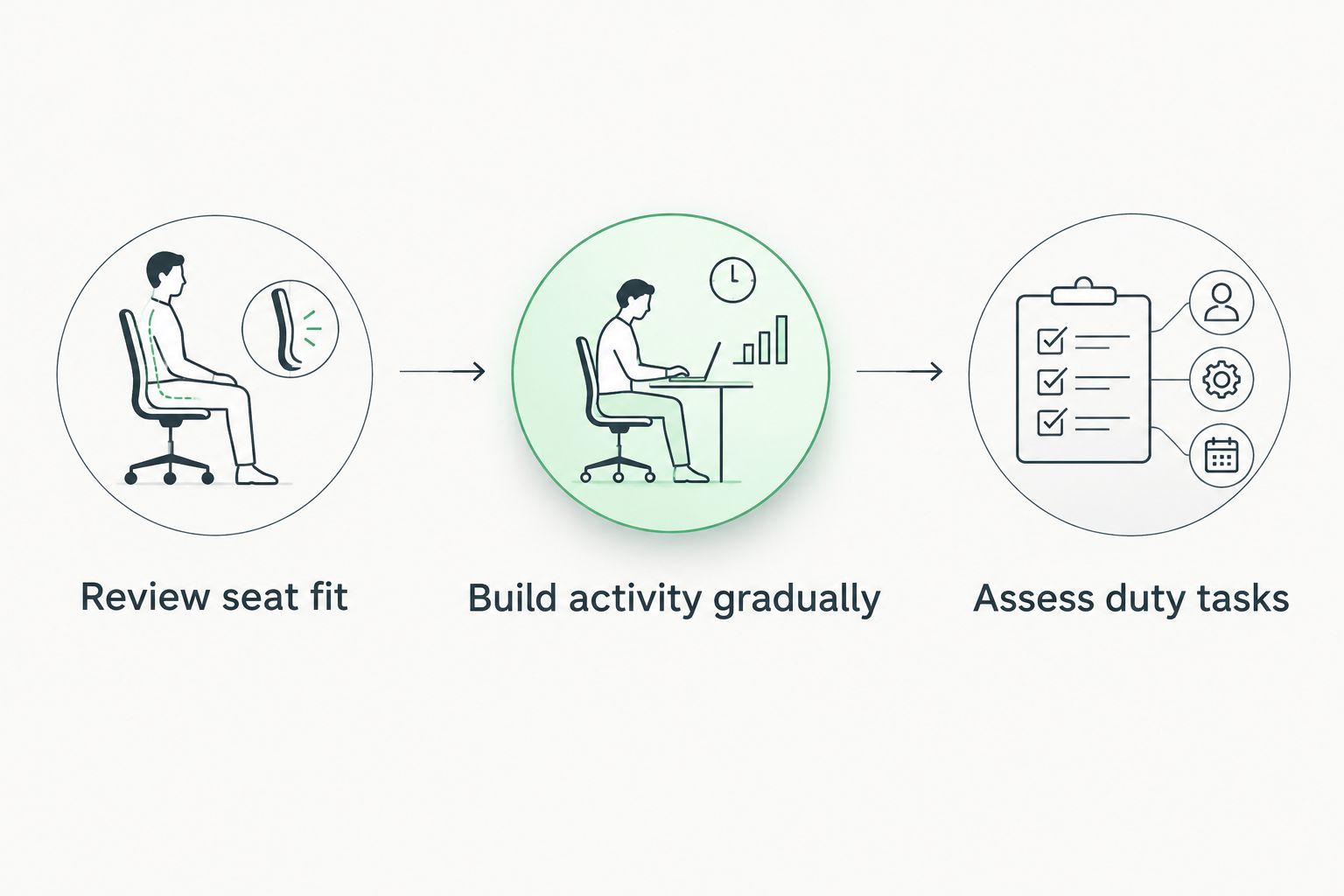
Controlled activity comes before testing demanding work tasks.
Match medication and procedures to the diagnosis
Begin with the least invasive appropriate treatment, including clinician-directed activity changes and rehabilitation. Medication selection requires your medical history, current prescriptions, and job demands; nonprescription products are not automatically safe for everyone.
Anti-inflammatory medicines carry gastrointestinal, kidney, and cardiovascular risks. Opioids, some muscle relaxants, and some medicines used for nerve pain can impair alertness or coordination. Discuss these risks before driving or performing safety-sensitive work, and never independently stop prescribed medication to meet a duty requirement.
Epidural steroid injections target inflammation associated with selected spinal nerve problems; they are not a general treatment for every backache. Diagnostic nerve blocks help answer a specific question about a suspected pain source. Spinal cord stimulation involves specialist selection and is not an initial response to a recent strain.
- Ask which diagnosis each proposed medication or procedure targets.
- Review sedation, dizziness, coordination effects, and medication interactions.
- Discuss procedure-specific risks, including bleeding, infection, and nerve injury.
- Define the functional improvement that would justify continuing treatment.
Plan recovery and obtain duty-specific restrictions
Before any procedure, ask for written instructions covering transportation, activity, medications, and warning symptoms. Pain relief is not duty clearance. Local anesthetic effects, sedation, weakness, or temporary numbness can make driving or physical response unsafe even when discomfort improves.
Your 2026 return-to-duty plan should separate administrative work from unrestricted patrol. The treating clinician and the department’s designated occupational health process need to address the actual restrictions; a generic statement that you can return to work leaves important questions unanswered.
Schedule follow-up around the clinical plan rather than assuming that a day off resolves every restriction. Recovery instructions depend on the procedure, medication, response, and duties involved.
- Confirm who will drive you when sedation or procedure instructions prohibit driving.
- Request specific restrictions for driving, lifting, running, and equipment handling.
- Ask whom to contact for unexpected weakness, fever, or worsening pain.
- Arrange reassessment before increasing duties when restrictions remain in place.
Compare treatment options by purpose
No single treatment is best for every police officer. Choose an option because it fits the diagnosis and functional goal—not because it sounds faster. The table separates common uses from limitations that matter during police work.
| Option | Best for | Main benefit | Key limitation |
|---|---|---|---|
| Activity and equipment adjustments | Symptoms linked to specific positions or pressure | Addresses an identifiable aggravating exposure | Cannot rule out or treat every underlying injury |
| Physical therapy and home exercise | Rebuilding strength, movement, and task tolerance | Develops function through guided practice | Requires participation and adjustment to symptoms |
| Medication | Selected pain conditions after medical review | Can reduce symptoms enough to support activity | Side effects and medical risks affect suitability |
| Epidural steroid injection | Selected spinal nerve inflammation with matching symptoms | Targets treatment near affected spinal nerves | Does not correct every cause of pain or guarantee relief |
| Diagnostic nerve block | Testing a suspected nerve-related pain source | Helps guide a treatment decision | Temporary relief is not proof of duty readiness |
| Spinal cord stimulation | Selected persistent pain after specialist assessment | Provides a device-based pain treatment option | Requires selection, a trial process, and ongoing device care |
Hudson Pain and Spine offers interventional pain management, but its procedures do not replace rehabilitation, occupational assessment, or emergency evaluation. Bleeding risk, infection, medications, and the underlying diagnosis affect whether a procedure is appropriate.
Manual treatment also needs a defined purpose. Decisions about chiropractic care for back pain should distinguish symptom relief from fitness for emergency driving or physical restraint; neither a treatment session nor short-term improvement establishes that clearance. Discuss manipulation with your treating clinician, particularly after trauma or when numbness or weakness is present.
Common mistakes police officers make
Treating pain reduction as unrestricted readiness
A lower pain score does not measure reaction time, grip reliability, or the ability to exit a vehicle quickly. Ask for task-specific reassessment, especially after sedating medication or a procedure that causes temporary numbness.
Changing duty equipment without approval
Moving equipment can alter pressure, but it can also change access and interfere with established safety requirements. Work through department-approved equipment review rather than improvising a setup solely around pain.
Hiding symptoms until an incident forces evaluation
Pain that changes braking, walking, grip, or neck rotation belongs in a medical assessment. Document the functional problem accurately and use the appropriate reporting process; medical treatment and administrative reporting serve different purposes.
Repeating treatment without checking function
Temporary relief is useful information, not an automatic reason to repeat the same intervention. Review whether treatment improved the specific duties you identified, whether adverse effects occurred, and whether the working diagnosis still fits.
Assuming work-related pain guarantees coverage
A symptom occurring during duty does not establish an approved claim or authorize a procedure. Confirm the applicable workers’ compensation process, authorized clinician requirements, and procedure approval before scheduling nonurgent treatment; department and insurer rules require individual verification.
FAQ
What is the best pain management for police officers?
The best pain management for police officers matches the diagnosis while protecting alertness and duty function. Activity changes and rehabilitation often form the foundation, with medication or targeted procedures considered when clinically appropriate.
Can a police duty belt cause back or thigh symptoms?
Pressure and equipment positioning can contribute to discomfort or nerve irritation, but they do not establish the diagnosis. Persistent thigh numbness, radiating pain, or weakness needs clinical assessment rather than an assumption that the belt is the only cause.
Can I work patrol while taking pain medication?
You should not perform safety-sensitive duties when medication impairs alertness, coordination, or judgment. Review the specific medication with your prescriber and follow your department’s occupational health requirements.
Are epidural injections appropriate for every officer with back pain?
No. Epidural steroid injections are used for selected conditions involving spinal nerve inflammation, not every source of back pain. Your symptoms, examination, medical risks, and relevant imaging determine whether an injection fits.
Can I drive a patrol car after a nerve block?
Do not drive until your procedure instructions permit it and you have no impairing numbness, weakness, or medication effects. Patrol driving also requires attention to department restrictions and occupational clearance.
Does workers’ compensation cover pain procedures for police officers?
Coverage depends on the claim, applicable rules, medical necessity, and required authorization. Confirm the authorized treatment pathway before scheduling a nonurgent procedure; work-related symptoms alone do not establish approval.
Where can New Jersey police officers seek a pain management evaluation?
Hudson Pain and Spine provides pain management evaluations from offices in Englewood, Woodland Park, and Edison. Bring your treatment history, medication list, and a description of the duties that pain limits.
One last thing
For your next 2026 appointment, bring a short description of your hardest duty task—not just your most painful moment. Being able to sit comfortably and being able to brake suddenly are different treatment goals, and your clinician needs to know which one remains unsafe.
Ask for a plan that states what you can do, what you should avoid, and what triggers reassessment. That is more actionable than an instruction to return when you feel better. This guide provides general education, not an individual diagnosis or fitness-for-duty determination.
Related guides
- Can you drive after an epidural steroid injection?
- How to return to work safely after a pain procedure
- Pain management for workplace injuries and workers’ compensation
About the Medical Reviewer
Dr. Saurabh Dang is a double board-certified interventional pain management specialist serving Central and Northern New Jersey. He combines clinical expertise with a patient-centered approach to help patients find lasting relief from chronic pain conditions.
Read Full Bio →Seeking Treatment for Epidural Injections?
Dr. Dang and the team at Hudson Pain and Spine offer specialized care and advanced interventional treatments.
Ready to Find Relief from Pain?
Schedule your consultation with Dr. Saurabh Dang at our Englewood office.
Serving patients across Central and Northern New Jersey — Bergen, Passaic, and Middlesex counties.