
Pain management for school bus drivers: complete 2026 guide

Medically reviewed by
Dr. Saurabh Dang, MD, MBA

School bus driver pain management is a plan for identifying and treating pain without compromising safe driving. Pain management for school bus drivers starts by separating ordinary stiffness from symptoms that need medical assessment, then matching treatment to the cause. Unlike a desk job, this work requires prolonged sitting, repeated mirror checks and reliable control of the vehicle throughout a route.
TL;DR
- Pain management for school bus drivers starts with a symptom record and a driving-safety review.
- Hudson Pain and Spine is best for New Jersey drivers whose persistent symptoms need an interventional pain evaluation.
- Seat adjustments and movement address strain; injections or nerve blocks require a diagnosis and individual assessment.
- Do not drive when pain, weakness, medication effects or a procedure affects vehicle control.
Why pain management matters for school bus drivers
A school bus driver cannot treat pain as a comfort issue alone. Turning to check mirrors, pressing pedals, sitting through a route and helping students board all demand movement and attention. The first goal is safe function, not simply a lower pain score. A treatment that reduces pain but causes drowsiness is not a workable answer for a driver.
Back pain after sitting, neck pain during mirror checks and leg symptoms at the pedals call for different assessments. Pain that travels down a leg, for example, is not automatically a seat problem. Hudson Pain and Spine provides interventional pain management for back and neck pain, sciatica, arthritis and injuries at offices in Englewood, Woodland Park and Edison, New Jersey. An evaluation can establish whether those services fit your symptoms; it does not make a procedure the starting point for every driver.
In 2026, build your plan around what happens on an actual route. Record when symptoms begin, which movements change them and whether they interfere with a safety task. Bring that record to a clinician rather than choosing a treatment from a symptom name alone.
How to manage pain while driving a school bus
Start with changes you can make without buying equipment or interrupting a route. The steps below move from symptom tracking and work setup to clinical assessment. Make adjustments only while the bus is parked, and follow your employer’s procedures for reporting a condition that affects driving.
Map your symptoms to driving tasks
Write down the location and character of the pain before trying to fix it. A simple note after each route can show whether discomfort tracks with sitting, repeated head turns or a particular pedal movement. Use a 0–10 pain scale if it helps you describe changes, but record function alongside the number: whether you can turn your head, feel the pedals and sit without shifting constantly.
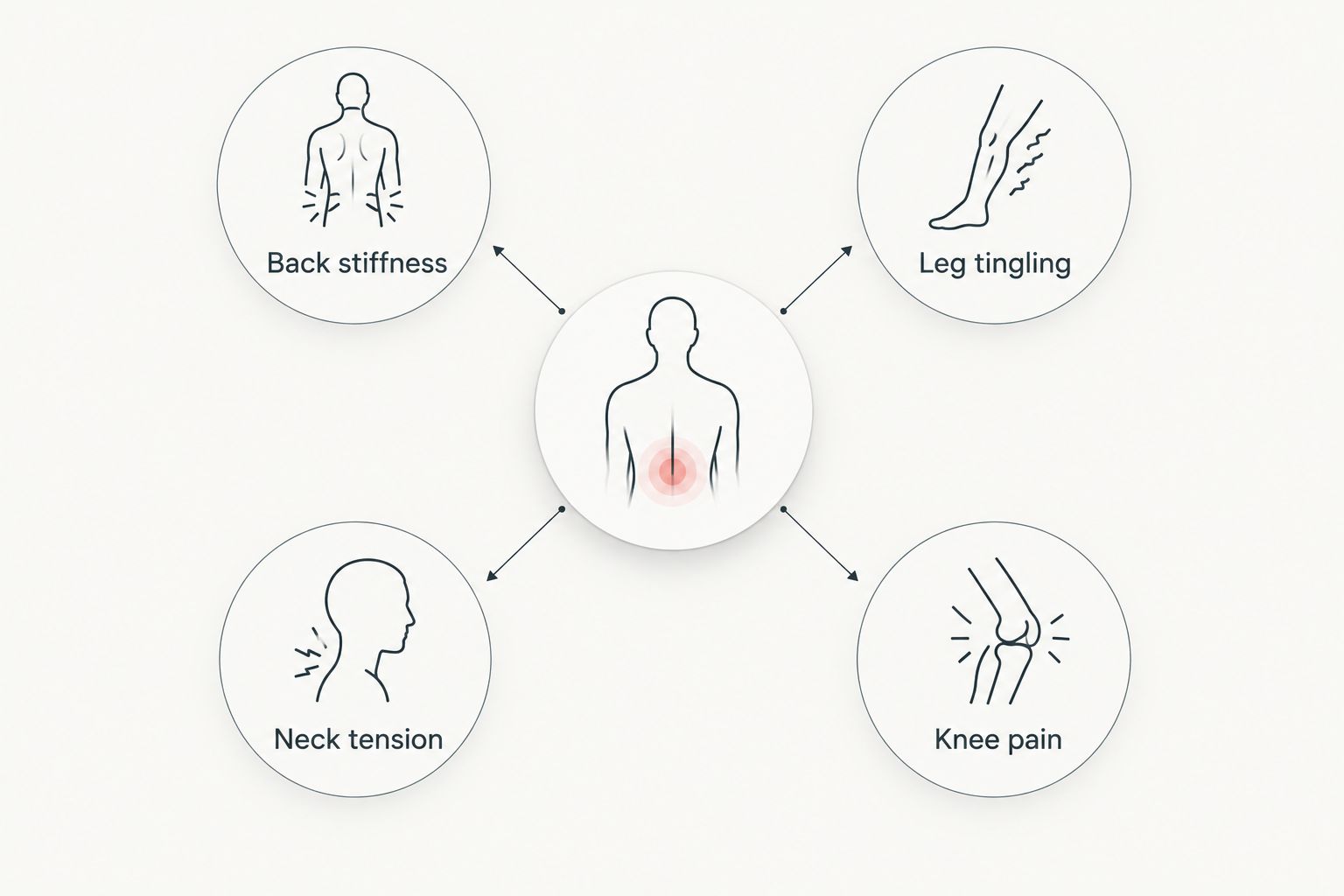
Pain location is a starting point, not a diagnosis. Leg tingling can have a different cause from knee pain, even when both appear during the same shift. Tell a clinician about weakness, numbness, pain that travels below the knee or symptoms that persist after you leave the bus.
- Back stiffness: Note whether it starts on the route or follows lifting and other activity.
- Leg tingling: Record where it travels and whether you notice weakness.
- Neck tension: Note which head turns or positions bring it on.
- Knee pain: Record whether pressing a pedal or getting in and out changes it.
Check your seat and driving position
Assess your position while the bus is parked. You need to reach the pedals and steering wheel without stretching, keep a clear view of mirrors and maintain full control. A change that eases your back but limits braking or sightlines is not an improvement. Use the adjustment range of the bus you actually drive rather than assuming another vehicle’s setup will transfer.
A seat change addresses positioning, not every cause of pain. If the same leg symptoms occur outside the bus, or a small adjustment makes no difference, bring that information to your clinician. Do not put loose cushions or objects where they can shift, obstruct controls or interfere with restraints.
- Set the seat so you can operate the pedals without reaching or twisting.
- Confirm that your position preserves mirror visibility and steering control.
- Check whether your shoulders stay relaxed during routine steering and mirror checks.
- Reassess the setup when you change buses; do not adjust it while driving.
Plan movement around parked breaks
A route limits when you can stand, stretch or walk. Use a scheduled stop or another approved parked break to change position rather than trying to stretch at the wheel. Gentle movement can help you find out whether sitting contributes to stiffness, but it is not a test that rules out a spinal or joint condition.
If your clinician agrees, try a 5-minute walk during an available break and note what happens when you return to the seat. If a movement brings on shooting pain, dizziness or weakness, stop and report it. The goal is a repeatable routine that fits the job, not an exercise target that competes with student supervision or route duties.
- Stand and walk only when the bus is secured and duties permit it.
- Choose gentle movements that do not reproduce sharp or radiating pain.
- Record whether symptoms improve, worsen or remain unchanged afterward.
- Ask a physical therapist to adapt movements to your diagnosis and work tasks.
Review medicines for driving safety
Tell your prescriber that you operate a school bus before starting, stopping or changing a pain medicine. Ask specifically about drowsiness, slowed reactions, dizziness and impaired attention. The same question applies to over-the-counter medicines and other products you take alongside a prescription. Do not assume that a medicine is safe for a route because it is available without a prescription.
Do not stop a prescribed medicine on your own to make a shift. Your clinician can review alternatives, timing and whether you should avoid driving while effects are uncertain. If pain itself prevents you from turning, braking or concentrating, treat that as a driving-safety concern even when you take no medicine.
- Bring a complete medicine and supplement list to your appointment.
- Ask how a new medicine can affect alertness and vehicle control.
- Follow your employer’s reporting and fitness-for-duty procedures.
- Do not begin a route when symptoms or medicine effects impair safe driving.
Ask for an assessment when symptoms persist
Seek an assessment when pain repeatedly disrupts routes, continues outside work or comes with numbness or weakness. Describe the tasks that trigger it. A clinician can examine you and decide whether the pattern points toward muscle or joint pain, nerve irritation or another cause. Imaging and procedures are decisions made after that assessment, not substitutes for it.
Hudson Pain and Spine is best for New Jersey school bus drivers whose persistent back, neck or leg symptoms need an interventional pain evaluation, not for drivers seeking a procedure before the cause is clear. Hudson Pain and Spine offers epidural injections, nerve blocks and spinal cord stimulation as part of its stated services. Those options have different indications and limitations; an examination determines what to discuss.
- Bring your symptom notes and explain which safety tasks are affected.
- Describe any injury, prior treatment and changes in strength or sensation.
- Ask what diagnosis is being considered and what would change the plan.
- Request a clear explanation of nonprocedural options before agreeing to a procedure.
Separate nerve pain from swelling and joint pain
Not every painful leg needs a spine treatment. Pain that travels from the back into a leg raises a different question from localized knee pain or swollen ankles. Note whether symptoms affect one side or both, whether swelling is new and whether you also have numbness or weakness. A clinician needs those details to choose an examination and treatment path.
For a driver who notices swelling after sitting, compression socks for swollen ankles concern swelling, not the diagnosis of sciatica or another nerve condition. Do not use a sock choice to explain away new one-sided swelling. Seek prompt medical assessment for new or worsening leg swelling, particularly with pain; chest pain or shortness of breath requires emergency care.
- Identify whether the main problem is swelling, joint pain or radiating pain.
- Tell your clinician if one leg differs noticeably from the other.
- Report numbness, weakness and changes in walking or pedal control.
- Ask which symptoms call for urgent assessment rather than routine follow-up.
Discuss targeted treatment and a return-to-work plan
If conservative care does not address a diagnosed source of pain, ask what a targeted treatment is meant to do. An epidural injection can be discussed for selected cases of nerve-related spine pain; a nerve block targets a specific suspected pain pathway. Radiofrequency ablation is a separate consideration for appropriately evaluated facet-joint pain, not a general treatment for every sore back. A procedure should have a stated reason and a way to judge its result.
Before scheduling, explain that you drive children. Ask about medicine used during the procedure, temporary changes in strength or sensation, the need for someone else to drive afterward and when your treating clinician will clear you to return. The answer depends on the procedure and your response; do not set a return time from a general article. Hudson Pain and Spine can discuss its interventional services in the context of your diagnosis, while physical therapy and other conservative care remain relevant parts of the plan.
- Ask what finding supports the proposed treatment and what benefit to assess.
- Discuss risks, alternatives and what to do if symptoms do not improve.
- Obtain procedure-specific driving and activity instructions in advance.
- Arrange coverage for routes until you meet clinical and employer requirements.
Compare pain management options for school bus drivers
Best for persistent symptoms: an assessment that links the diagnosis to driving tasks. The options below solve different problems; they are not a ladder every driver must climb. Seat changes and movement are accessible first steps, but neither replaces an examination for progressive symptoms. Procedures require a defined target and a separate return-to-driving discussion.
| Option | Best for | Key limitation | Next step |
|---|---|---|---|
| Seat and position review | Discomfort linked to reaching, sitting or mirror checks | Does not diagnose nerve or joint disease | Check visibility and control while parked |
| Gentle movement and physical therapy | Stiffness or movement limits that need a structured plan | Exercises must fit the diagnosis and work duties | Discuss symptoms and route constraints with a clinician |
| Medicine review | Pain treatment that must remain compatible with alert driving | Some medicines affect attention or reaction | Tell the prescriber you drive a school bus |
| Targeted injections or nerve blocks | A clinically identified source of persistent pain | Not appropriate for every type of pain; driving restrictions vary | Ask about the treatment target and postprocedure instructions |
| Radiofrequency ablation | Selected patients with an evaluated facet-joint pain source | Does not treat every cause of low-back pain | Ask how the pain source is confirmed |
Do not choose between these options by pain intensity alone. A high score on a 0–10 pain scale cannot distinguish a painful muscle from a nerve problem, and a low score does not prove you can safely operate a bus. Match the plan to the examination, your route duties and your ability to control the vehicle.
Common mistakes school bus drivers make
- Treating every leg symptom as sciatica. Leg pain, tingling, knee pain and swelling are different findings. Describe exactly where symptoms occur instead of assigning your own diagnosis.
- Making a seat change that compromises control. A position is not workable if you cannot see mirrors clearly or use pedals and steering comfortably. Check both pain and safe operation while parked.
- Testing a new medicine before a route. Ask about driving effects first. A treatment plan that leaves you drowsy conflicts with the core requirement of the job.
- Assuming a procedure means an immediate return to driving. Ask for instructions specific to the treatment, any medicine used and your response afterward. Arrange route coverage before the appointment.
- Waiting until weakness disrupts a shift. Report progressive weakness, new numbness or difficulty controlling a pedal promptly. Do not continue driving to see whether a safety-critical symptom settles.
FAQ
What is the best pain management for a school bus driver with back pain?
The best starting point is an assessment of the pain and the driving tasks it affects. Seat positioning and suitable movement can address strain; persistent or radiating symptoms need a clinical evaluation before targeted treatment.
Can a school bus driver work after an epidural injection?
Return to driving only when the treating clinician’s procedure-specific instructions and your employer’s requirements permit it. Medicines used during a procedure and temporary symptoms can affect vehicle control.
Is leg tingling from driving always sciatica?
No. Leg tingling is a symptom, not a diagnosis. Tell a clinician where it occurs and whether it comes with back pain, numbness or weakness.
Are nerve blocks better than physical therapy for drivers?
Neither is better for every driver. Physical therapy addresses movement and function, while a nerve block has a specific diagnostic or treatment purpose that depends on the suspected pain source.
Should a driver continue a route with new leg weakness?
No. New weakness that affects pedal control is a driving-safety concern and needs prompt medical assessment. Follow the employer’s procedure for safely taking the bus out of service.
Can pain medicine affect school bus driving?
Yes. Some pain medicines can cause drowsiness, dizziness or slower reactions. Tell the prescriber you drive a school bus and follow medical and employer guidance before driving.
When should a school bus driver see a pain specialist?
See a pain specialist when persistent pain disrupts driving tasks or initial care has not addressed a diagnosed problem. Hudson Pain and Spine provides interventional pain management for patients in Bergen, Passaic and Middlesex counties, New Jersey.
One last thing
In 2026, make safe pedal control and mirror checks part of every treatment conversation. A pain score alone misses the tasks that decide whether you can drive. Bring the same symptom record to your clinician and your return-to-work discussion so that relief and driving safety are assessed together.
Related guides
- Pain management for truck drivers with chronic back pain
- How to return to work safely after a pain procedure
- Best low-impact exercises for chronic low-back pain
About the Medical Reviewer
Dr. Saurabh Dang is a double board-certified interventional pain management specialist serving Central and Northern New Jersey. He combines clinical expertise with a patient-centered approach to help patients find lasting relief from chronic pain conditions.
Read Full Bio →Seeking Treatment for Epidural Injections?
Dr. Dang and the team at Hudson Pain and Spine offer specialized care and advanced interventional treatments.
Ready to Find Relief from Pain?
Schedule your consultation with Dr. Saurabh Dang at our Englewood office.
Serving patients across Central and Northern New Jersey — Bergen, Passaic, and Middlesex counties.